<?xml version="1.0" encoding="utf-8" ?><rdf:RDF
            xmlns="http://purl.org/rss/1.0/"
            xmlns:rdf="http://www.w3.org/1999/02/22-rdf-syntax-ns#"
            xmlns:dc="http://purl.org/dc/elements/1.1/"
            xmlns:content="http://purl.org/rss/1.0/modules/content/"
            xml:lang="en-us">
        
        <channel rdf:about="https://www.tetsufuku.com/">
            <title>TETSUFUKU</title>
            <link>https://www.tetsufuku.com/</link>
            <description>Premium Japanese blacksmith tools at Tetsufuku. Discover authentic Tobisho pruning shears, Izumimasa kitchen knives, and Kondo masonry tools.</description>
            <subject>326</subject>
            <items>
                <rdf:Seq>
        <rdf:li rdf:resource="https://www.tetsufuku.com/product/296" />
                <rdf:li rdf:resource="https://www.tetsufuku.com/product/200" />
                <rdf:li rdf:resource="https://www.tetsufuku.com/product/151" />
                <rdf:li rdf:resource="https://www.tetsufuku.com/product/224" />
                <rdf:li rdf:resource="https://www.tetsufuku.com/product/278" />
                <rdf:li rdf:resource="https://www.tetsufuku.com/product/277" />
                <rdf:li rdf:resource="https://www.tetsufuku.com/product/239" />
                <rdf:li rdf:resource="https://www.tetsufuku.com/product/304" />
                <rdf:li rdf:resource="https://www.tetsufuku.com/product/201" />
                <rdf:li rdf:resource="https://www.tetsufuku.com/product/121" />
                <rdf:li rdf:resource="https://www.tetsufuku.com/product/29" />
                <rdf:li rdf:resource="https://www.tetsufuku.com/product/28" />
                <rdf:li rdf:resource="https://www.tetsufuku.com/product/251" />
                <rdf:li rdf:resource="https://www.tetsufuku.com/product/269" />
                <rdf:li rdf:resource="https://www.tetsufuku.com/product/208" />
                <rdf:li rdf:resource="https://www.tetsufuku.com/product/266" />
                <rdf:li rdf:resource="https://www.tetsufuku.com/product/11" />
                <rdf:li rdf:resource="https://www.tetsufuku.com/product/242" />
                <rdf:li rdf:resource="https://www.tetsufuku.com/product/265" />
                <rdf:li rdf:resource="https://www.tetsufuku.com/product/303" />
                <rdf:li rdf:resource="https://www.tetsufuku.com/product/10" />
                <rdf:li rdf:resource="https://www.tetsufuku.com/product/282" />
                <rdf:li rdf:resource="https://www.tetsufuku.com/product/197" />
                <rdf:li rdf:resource="https://www.tetsufuku.com/product/17" />
                <rdf:li rdf:resource="https://www.tetsufuku.com/product/281" />
                <rdf:li rdf:resource="https://www.tetsufuku.com/product/16" />
                <rdf:li rdf:resource="https://www.tetsufuku.com/product/305" />
                <rdf:li rdf:resource="https://www.tetsufuku.com/product/243" />
                <rdf:li rdf:resource="https://www.tetsufuku.com/product/268" />
                <rdf:li rdf:resource="https://www.tetsufuku.com/product/289" />
                <rdf:li rdf:resource="https://www.tetsufuku.com/product/250" />
                <rdf:li rdf:resource="https://www.tetsufuku.com/product/276" />
                <rdf:li rdf:resource="https://www.tetsufuku.com/product/15" />
                <rdf:li rdf:resource="https://www.tetsufuku.com/product/226" />
                <rdf:li rdf:resource="https://www.tetsufuku.com/product/297" />
                <rdf:li rdf:resource="https://www.tetsufuku.com/product/111" />
                <rdf:li rdf:resource="https://www.tetsufuku.com/product/195" />
                <rdf:li rdf:resource="https://www.tetsufuku.com/product/14" />
                <rdf:li rdf:resource="https://www.tetsufuku.com/product/270" />
                <rdf:li rdf:resource="https://www.tetsufuku.com/product/279" />
                <rdf:li rdf:resource="https://www.tetsufuku.com/product/115" />
                <rdf:li rdf:resource="https://www.tetsufuku.com/product/271" />
                <rdf:li rdf:resource="https://www.tetsufuku.com/product/272" />
                <rdf:li rdf:resource="https://www.tetsufuku.com/product/236" />
                <rdf:li rdf:resource="https://www.tetsufuku.com/product/114" />
                <rdf:li rdf:resource="https://www.tetsufuku.com/product/320" />
                <rdf:li rdf:resource="https://www.tetsufuku.com/product/113" />
                <rdf:li rdf:resource="https://www.tetsufuku.com/product/338" />
                <rdf:li rdf:resource="https://www.tetsufuku.com/product/112" />
                <rdf:li rdf:resource="https://www.tetsufuku.com/product/273" />
                <rdf:li rdf:resource="https://www.tetsufuku.com/product/110" />
                <rdf:li rdf:resource="https://www.tetsufuku.com/product/308" />
                <rdf:li rdf:resource="https://www.tetsufuku.com/product/274" />
                <rdf:li rdf:resource="https://www.tetsufuku.com/product/205" />
                <rdf:li rdf:resource="https://www.tetsufuku.com/product/264" />
                <rdf:li rdf:resource="https://www.tetsufuku.com/product/13" />
                <rdf:li rdf:resource="https://www.tetsufuku.com/product/307" />
                <rdf:li rdf:resource="https://www.tetsufuku.com/product/263" />
                <rdf:li rdf:resource="https://www.tetsufuku.com/product/237" />
                <rdf:li rdf:resource="https://www.tetsufuku.com/product/275" />
                <rdf:li rdf:resource="https://www.tetsufuku.com/product/12" />
                <rdf:li rdf:resource="https://www.tetsufuku.com/product/106" />
                <rdf:li rdf:resource="https://www.tetsufuku.com/product/196" />
                <rdf:li rdf:resource="https://www.tetsufuku.com/product/1" />
                <rdf:li rdf:resource="https://www.tetsufuku.com/product/295" />
                <rdf:li rdf:resource="https://www.tetsufuku.com/product/323" />
                <rdf:li rdf:resource="https://www.tetsufuku.com/product/341" />
                <rdf:li rdf:resource="https://www.tetsufuku.com/product/246" />
                <rdf:li rdf:resource="https://www.tetsufuku.com/product/253" />
                <rdf:li rdf:resource="https://www.tetsufuku.com/product/118" />
                <rdf:li rdf:resource="https://www.tetsufuku.com/product/280" />
                <rdf:li rdf:resource="https://www.tetsufuku.com/product/267" />
                <rdf:li rdf:resource="https://www.tetsufuku.com/product/249" />
                <rdf:li rdf:resource="https://www.tetsufuku.com/product/291" />
                <rdf:li rdf:resource="https://www.tetsufuku.com/product/120" />
                <rdf:li rdf:resource="https://www.tetsufuku.com/product/244" />
                <rdf:li rdf:resource="https://www.tetsufuku.com/product/234" />
                <rdf:li rdf:resource="https://www.tetsufuku.com/product/235" />
                <rdf:li rdf:resource="https://www.tetsufuku.com/product/206" />
                <rdf:li rdf:resource="https://www.tetsufuku.com/product/255" />
                <rdf:li rdf:resource="https://www.tetsufuku.com/product/254" />
                <rdf:li rdf:resource="https://www.tetsufuku.com/product/257" />
                <rdf:li rdf:resource="https://www.tetsufuku.com/product/256" />
                <rdf:li rdf:resource="https://www.tetsufuku.com/product/317" />
                <rdf:li rdf:resource="https://www.tetsufuku.com/product/316" />
                <rdf:li rdf:resource="https://www.tetsufuku.com/product/315" />
                <rdf:li rdf:resource="https://www.tetsufuku.com/product/314" />
                <rdf:li rdf:resource="https://www.tetsufuku.com/product/339" />
                <rdf:li rdf:resource="https://www.tetsufuku.com/product/129" />
                <rdf:li rdf:resource="https://www.tetsufuku.com/product/128" />
                <rdf:li rdf:resource="https://www.tetsufuku.com/product/96" />
                <rdf:li rdf:resource="https://www.tetsufuku.com/product/95" />
                <rdf:li rdf:resource="https://www.tetsufuku.com/product/94" />
                <rdf:li rdf:resource="https://www.tetsufuku.com/product/93" />
                <rdf:li rdf:resource="https://www.tetsufuku.com/product/91" />
                <rdf:li rdf:resource="https://www.tetsufuku.com/product/233" />
                <rdf:li rdf:resource="https://www.tetsufuku.com/product/67" />
                <rdf:li rdf:resource="https://www.tetsufuku.com/product/68" />
                <rdf:li rdf:resource="https://www.tetsufuku.com/product/69" />
                <rdf:li rdf:resource="https://www.tetsufuku.com/product/24" />
                
                </rdf:Seq>
            </items>
        
                <image rdf:about="https://www.tetsufuku.com/data/tetsufuku/image/20120825_532a67.gif">
                    <url>https://www.tetsufuku.com/data/tetsufuku/image/20120825_532a67.gif</url>
                </image>
                
            <dc:language>en-us</dc:language>
            <dc:creator>TETSUFUKU</dc:creator>
            <dc:date>2026-08-01T20:26:55+09:00</dc:date>
        </channel>
        
                <item rdf:about="https://www.tetsufuku.com/product/296">
                    <title>[Tobisho] Hisui Pruning Shears 165mm (6.5&quot;)</title>
                    <link>https://www.tetsufuku.com/product/296</link>
                    <description>So light, it barely feels like cutting at all. — Premium Japanese Hand-Forged Pruning Shears

Abou…</description>
                    <content:encoded><![CDATA[<p><a href="https://www.tetsufuku.com/product/296" target="_blank"><img src="https://www.tetsufuku.com/data/tetsufuku/product/20231128_4e107a.jpg" width="250" border="0" alt="[Tobisho] Hisui Pruning Shears 165mm (6.5")" hspace="5" align="left"/></a><h2>So light, it barely feels like cutting at all. — Premium Japanese Hand-Forged Pruning Shears</h2>

<h3>About the Tobisho Hisui & Hirei Series</h3>

<p>The Hisui and Hirei began with a request from a peach orchard farmer: a smaller hand pruner, one that could cut thin, hard branches with a real sense of drawing through the cut rather than simply pinching it shut. Daiki Tobitsuka, Tobisho's fourth-generation master, took the request as a starting point and reworked the handle from the ground up. The motif behind the shape is the "pistol-type" pruning shear developed in the Akita region; Hisui and Hirei are both built on that silhouette, carrying forward Tobisho's own accumulated experience.</p>

<p>Hirei shares its body with Hisui, forged full-body in Yamagata, but its blades are finished to meet and slide against each other, cutting the way an ordinary pair of shears does, the same logic as the Asuka. Hisui's blades incorporate the innovations behind the Hiryu, Tobisho's most refined model: shaped so the two edges never touch at all, cutting with a drawing motion instead of a direct pinch.</p>

<p>Both are forged full-body in Yamagata, Japan, the same construction as the rest of the Tobisho pruning shear lineup.</p>

<h3>About Tobisho Hisui Pruning Shears 165mm (6.5")</h3>

<p>The Hisui 165mm (6.5") is right-handed only. Steel: Premium Blade Steel (undisclosed grade), full-body forged in Yamagata, Japan.</p>

<p>Because the whole shear is built smaller, its blade runs thinner too, and that thinness is directly tied to how easily it bites into a cut. Combined with a hamaguri-style convex edge and a mirror finish, and blades that never touch at all, the same non-contact engineering behind the Hiryu, the Hisui cuts with remarkably little resistance. One customer described it simply: it's like cutting butter.</p>

<p>It sits close to the hand, light enough to prune with something close to the feeling of pinching with your fingers. Despite its small size, it suits a wide range of hand sizes, and for work that doesn't call for a saw, it can often handle the job on its own. The difference this makes on a single cut is small, but over a long day of pruning, that difference compounds, which is why the Hisui is especially recommended for professionals concerned about tendonitis.</p>

<h3>How to Maintain Your Tobisho Pruning Shears</h3>

<p><strong>Why won't it cut rope or paper?</strong><br>
That's expected with the Hisui. It's built specifically for materials with the hardness and thickness of a branch. Because there's a gap between the blades, soft or thin materials won't cut, and that isn't a defect or a fault.</p>

<p><strong>How do I keep the blade in condition?</strong><br>
Wipe off resin after every use, ideally. Resin buildup gradually forces the blade trajectory outward, the two cutting edges stop meeting cleanly, and the pivot bolt begins to wear along that same outward path, compounding the problem. If wiping after every use isn't practical, clean the blades regularly. Carrying a small cloth and blade cleaner means you can do it on a break.</p>

<p><strong>How do I lubricate the pivot?</strong><br>
Ideally, remove the bolt periodically and pack grease inside, grease holds longer than oil. That said, this requires skill and confidence to do correctly. A practical alternative: one drop of oil on the pivot once a month. It's not the full solution, but it keeps things running smoothly.</p>

<p><strong>Can the shear get wet?</strong><br>
Avoid it where possible, and never leave the shear wet. After working in rain or morning dew, wipe it dry thoroughly. The pivot area retains moisture longest, use a blower or compressed air if you have one. Regular oiling helps here too: a well-oiled blade sheds water rather than holding it.</p>

<p><strong>What if I drop it?</strong><br>
It depends on how and where it lands. A handle-first drop can bend the handle, affecting feel and the locking mechanism. A blade-first drop risks chipping. As a general rule: the sharper the blade, the harder and more brittle the steel, and the thinner the edge. Handle forged Japanese blades accordingly.</p>

<p><strong>Can I sharpen it myself?</strong><br>
The Hisui's blade is ground to a shape unlike a standard pruning shear, so we don't recommend sharpening it yourself. Because the blades are built never to touch, even a small sharpening error can throw off the cutting performance and balance significantly. If you notice the cutting performance declining, we'd recommend sending it to the maker instead.</p>

<p><strong>What if I force it through a branch that's too thick?</strong><br>
Don't. Twisting or levering the shear to force a cut transfers lateral stress directly to the blade, chipping, blade separation, handle damage. Pruning shears, regardless of maker, are not designed for branches thicker than a little finger. That is what a saw is for. The boundary is the thickness of a little finger. Remember it.</p>

<h3>About Tobisho: Four Generations of Pruning Shear Hand-Forging</h3>

<figure>
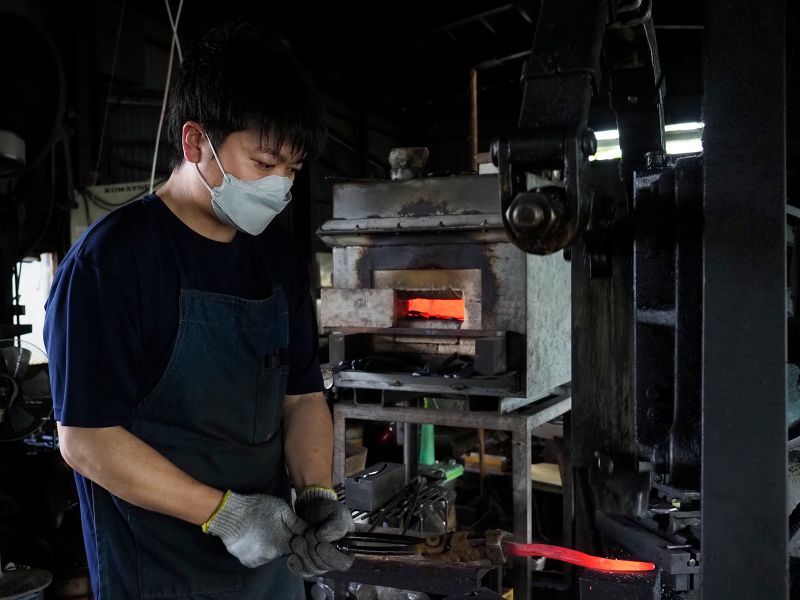
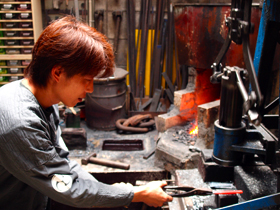
<img src="https://www.tetsufuku.com/data/tetsufuku/product/_U012480.JPG" alt="Daiki Tobitsuka, fourth-generation master blacksmith of Tobisho, forging pruning shears in Yamagata Japan" />
</figure>

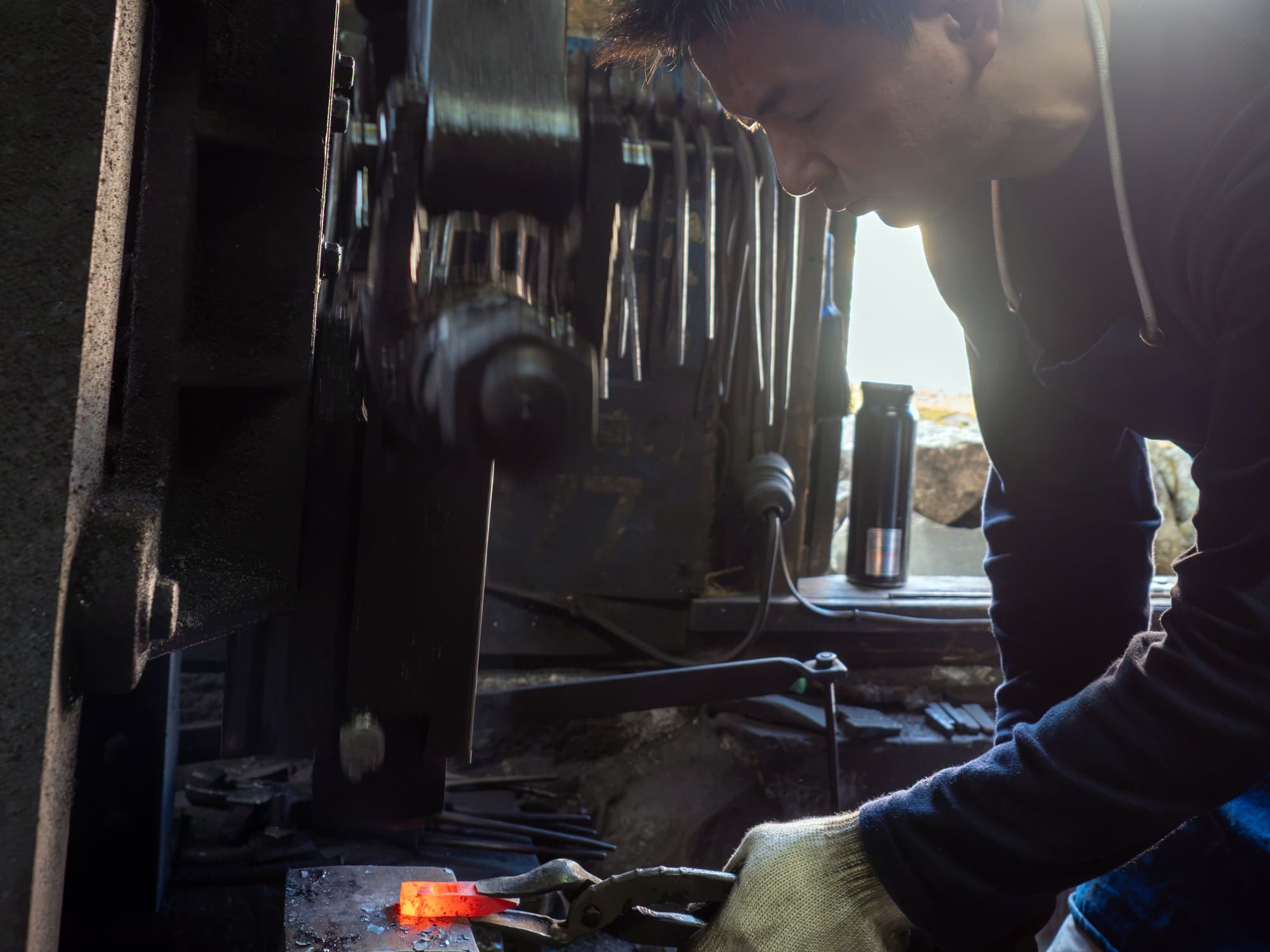
<p>Tobisho has been forging blades in Yamagata since 1804, ten generations of blacksmiths, four of them dedicated to pruning shears. It was Syojiro Tobitsuka, the seventh-generation bladesmith in his family line, who founded Tobisho as a pruning shear forge in 1930, making him the first of four generations dedicated to shears.</p>

<p>Syojiro's shears served both the silkworm farmers already working the region and the orchardists who followed as Yamagata became one of Japan's great fruit-growing prefectures. The tools had to work. His name is still stamped on every Karikomi Shear Tobisho makes.</p>

<p>Generation by generation, the shears got better. What Tobisho is known for today, their heat treatment, their distinctive surface finish, is accumulated experience, made visible.</p>

<p>The late master Yasuhito Tobitsuka, third generation, developed the SR, the Hiryu, and the Asuka, and redesigned the A-type's handle. Daiki Tobitsuka, the fourth-generation master working at the forge today, has added the Hisui, the Hirei, and a Damascus steel A-type. His philosophy: <em>"Cutting well is the baseline. Beyond that: simple and sturdy."</em>, 質実剛健</p>

<h4>Forging the Handle</h4>
<div class="video-container">
<iframe src="https://www.youtube.com/embed/rSi6K3nqdU8"
title="Tobisho blacksmith forging pruning shear handle, Yamagata Japan"
data-name="15sec. Artisan｜Making Handles for B-type Pruners (Secateurs) — Tobisho, Yamagata"
data-date="2026-05-22T00:00:00+09:00"
data-desc="Tobisho blacksmith forging pruning shear handle, Yamagata Japan"
frameborder="0" allow="accelerometer; autoplay; clipboard-write; encrypted-media; gyroscope; picture-in-picture; web-share"
referrerpolicy="strict-origin-when-cross-origin" allowfullscreen></iframe>
</div>

<h4 class="mt-2em">Sharpening the Blade</h4>
<div class="video-container">
<iframe src="https://www.youtube.com/embed/zw3tS6lXXqI"
title="Tobisho third-generation master Yasuhito Tobitsuka sharpening pruning shear blade, Yamagata Japan"
data-name="15sec. Artisan｜Blade Finishing for A-type Pruners (Secateurs) — Tobisho, Yamagata"
data-date="2026-05-23T00:00:00+09:00"
data-desc="Tobisho third-generation master Yasuhito Tobitsuka sharpening pruning shear blade, Yamagata Japan"
frameborder="0" allow="accelerometer; autoplay; clipboard-write; encrypted-media; gyroscope; picture-in-picture; web-share"
referrerpolicy="strict-origin-when-cross-origin" allowfullscreen></iframe>
</div>

<h3>Notes on use</h3>

<p><b>IMPORTANT: This shear is made of High-Carbon Alloy Steel (Not Stainless Steel). It is exceptionally sharp but prone to rust if not maintained.</b><br>
This shear will not cut thin or soft materials. Do not attempt to force it. Doing so leads directly to damage. For example, forcing it through rope won't cut the rope; instead, the rope becomes wedged between the receiving and cutting blades. That wedging pushes the blades apart and can visibly widen the gap between them.<br>
Do not twist or lever the blade during a cut.<br>
Handle with care, blade-first drops risk chipping.<br>
For one-handed use only. Right hand.<br>
Designed for branches up to the thickness of a little finger. Use a saw beyond that.<br>
Oil and clean regularly to prevent rust and blade separation.<br>
Keep out of reach of children.</p>

<div class="series-options-box">
  <p class="series-options-title">🌿 Other options in this series</p>
  Looking for the contact-blade version? ➔ <a href="https://www.tetsufuku.com/product/295">Hirei Pruning Shears 165mm (6.5")</a>
</div>

<div class="story-manager-box">
    <p class="story-title">💬 Story of This Model - By Shop Manager (Part 1 of 2)</p>
    <p class="story-topic">Topic: What's in a name: Hisui.</p>
    <div class="story-flex-layout">
        <div class="profile-area">
            <img src="https://www.tetsufuku.com/data/tetsufuku/image/20260623_2e4f12.jpg" alt="Hiroshi Urata - Tetsufuku Shop Manager" class="profile-avatar" />
            <p class="profile-name">Hiroshi Urata</p>
        </div>
        <div class="text-content">
            Hisui is written 飛翠 in kanji. The first character, 飛, is the same one that opens Tobisho and Tobitsuka, a quiet signature marking it as their work. The name's pronunciation also matches 翡翠, the Japanese word for jade. Tobisho has never confirmed this connection officially, but I'd guess almost any Japanese speaker hears it too, a name meant to carry something of jade's beauty and sharpness.
            <div class="nav-footer nav-font-bold">
                ➔ <a href="https://www.tetsufuku.com/product/295" class="link-red">Continue to Part 2: Hirei Pruning Shears 165mm (6.5")</a>
            </div>
        </div>
    </div>
</div></p>]]></content:encoded>
                    <dc:subject>Pruning Shears &amp; Secateurs</dc:subject>
                    <dc:creator>TETSUFUKU</dc:creator>
                    <dc:format>26400</dc:format>
                    <dc:date>2026-08-01T20:26:55+09:00</dc:date>
                    <dc:type>shop</dc:type>
                </item>
                
                <item rdf:about="https://www.tetsufuku.com/product/200">
                    <title>[Tobisho] Natural Cowhide Sheath for Hiryu &amp; Asuka Pruning Shears</title>
                    <link>https://www.tetsufuku.com/product/200</link>
                    <description>Made for the Hiryu&#039;s Distinct Silhouette

About Natural Cowhide Sheath for Hiryu &amp; Asuka Pruning S…</description>
                    <content:encoded><![CDATA[<p><a href="https://www.tetsufuku.com/product/200" target="_blank"><img src="https://www.tetsufuku.com/data/tetsufuku/product/20170106_317ab4.JPG" width="250" border="0" alt="[Tobisho] Natural Cowhide Sheath for Hiryu & Asuka Pruning Shears" hspace="5" align="left"/></a><h2>Made for the Hiryu's Distinct Silhouette</h2>

<h3>About Natural Cowhide Sheath for Hiryu & Asuka Pruning Shears</h3>

<p>This sheath is made from vegetable-tanned cowhide and double-stitched for durability, sized for our Hiryu and Asuka pruning shears. It's cut close to the tool, so it fits snugly at first and gradually eases with use as the leather takes the shape of the shear inside it. There's no buckle or clasp; a loop of leather at the back lets you thread it onto a belt. According to Tobisho's official announcement, it can also be used with the 225mm Type A model.</p>

<h3>How to Care for Your Cowhide Sheath</h3>

<p>Wipe off dirt and moisture after use, and let the sheath air dry naturally if it gets wet, away from direct heat. Vegetable-tanned leather like this darkens and softens with handling over time; that's normal wear, not damage.</p></p>]]></content:encoded>
                    <dc:subject>Natural Cowhide Sheaths (Tobisho)</dc:subject>
                    <dc:creator>TETSUFUKU</dc:creator>
                    <dc:format>3630</dc:format>
                    <dc:date>2026-08-01T20:26:55+09:00</dc:date>
                    <dc:type>shop</dc:type>
                </item>
                
                <item rdf:about="https://www.tetsufuku.com/product/151">
                    <title>[MINAMOTO-IZUMIMASA] Yanagiba hocho 300mm White paper foged</title>
                    <link>https://www.tetsufuku.com/product/151</link>
                    <description>We are unable to ship this product to the UK (we cannot ship products with blades longer than 8 inch…</description>
                    <content:encoded><![CDATA[<p><a href="https://www.tetsufuku.com/product/151" target="_blank"><img src="https://www.tetsufuku.com/data/tetsufuku/product/20130410_bc8193.jpg" width="250" border="0" alt="[MINAMOTO-IZUMIMASA] Yanagiba hocho 300mm White paper foged" hspace="5" align="left"/></a><p><span style="color:#FF0000">We are unable to ship this product to the UK (we cannot ship products with blades longer than 8 inches).</span></p>
<p>This kitchen knife is made by forge welding soft iron and steel in traditional way. 300mm's Yanagiba hocho is a standerd size. If you get experience more, you can make the sashimi as intended. When the cook of Japan to buy Yanagiba hocho, it is the size they will purchase first.</p>

<p>This kitchen knife is making the body in a traditional way that is bonded to soft iron and steel. White paper No.2 steel is very hard, so you can cut well. Simply because it is a general manufacturing method, you will notice that the technical capabilities of MINAMOTO-IZUMIMASA is stand out.</p>
<p>It is edged many times in the manufacturing process, this knife is to remove the distortion many times. Blade straight, and even more attractive your food thoroughly.</p>
<p>What is &quot;Haze Polish&quot;? The haze is a border of soft iron and steel. It will appear by sharpen perfectly the body that has been forged in the forge welding and high technology. Haze Polish is a designation given to only the more technical and beautifully.</p>
<p style="color:#FF0000">After receiving an order, in order to produce, it will be necessity about 15 days for longest to send. </p>

<table width="600" border="1" cellspacing="0" cellpadding="3">
  <tr>
    <th colspan="5" align="center">Product List of MINAMOTO-IZUMIMASA </th>
  </tr>
  <tr>
    <th width="110">Product name </th>
    <th width="110">Edge material</th>
    <th width="110">Base material</th>
    <th width="110">Finish</th>
    <th>Handle material</th>
  </tr>
  <tr>
    <td>Mirror and cherry</td>
    <td colspan="2" align="center">White paper steel No.2</td>
    <td align="center">Mirror Polish </td>
    <td align="center">Octagon / Ebony</td>
  </tr>
  <tr>
    <td>All blue paper with mirror</td>
    <td colspan="2" align="center">Blue paper steel No.2</td>
    <td align="center">Mirror Polish </td>
    <td align="center">Octagon / Ebony</td>
  </tr>
  <tr>
    <td>All white paper</td>
    <td colspan="2" align="center">White paper steel No.2</td>
    <td align="center">Hon-yaki Polish </td>
    <td align="center">Octagon / Magnolia</td>
  </tr>
  <tr>
    <td>Blue paper 16 or 32 layer</td>
    <td align="center">Blue paper steel No.2</td>
    <td align="center">Soft iron &amp; steel </td>
    <td align="center">Genuine Haze Polish </td>
    <td align="center">Octagon / Ebony</td>
  </tr>
  <tr>
    <td>Blue paper foged</td>
    <td align="center">Blue paper steel No.2</td>
    <td align="center">Soft iron</td>
    <td align="center">Genuine Haze Polish </td>
    <td align="center">Octagon / Magnolia</td>
  </tr>
  <tr>
    <td bgcolor="#FF99FF">White paper foged<br />
<span style="color:#FF0000">(This product)</span></td>
    <td align="center" bgcolor="#FF99FF">White paper steel No.2</td>
    <td align="center" bgcolor="#FF99FF">Soft iron</td>
    <td align="center" bgcolor="#FF99FF">Genuine Haze Polish </td>
    <td align="center" bgcolor="#FF99FF">Round / Magnolia</td>
  </tr>
  <tr>
    <td>For home use </td>
    <td align="center">White paper steel No.2</td>
    <td align="center">Soft iron</td>
    <td align="center">Haze Polish </td>
    <td align="center">Round / Magnolia</td>
  </tr>
  <tr>
    <td>SAVIN </td>
    <td align="center">V10 GOLD (Stainless) </td>
    <td align="center">SUS440</td>
    <td align="center">Genuine Haze Polish </td>
    <td align="center">Octagon / Magnolia</td>
  </tr>
  <tr>
    <td>Silver paper foged </td>
    <td align="center">Silver paper steel No.3<br />
      (Stainless)</td>
    <td align="center">Stainless</td>
    <td align="center">Genuine Haze Polish </td>
    <td align="center">Octagon / Magnolia</td>
  </tr>
</table>

<div class="makerwaku">
<p class="midashi">About a maker, MINAMOTO-IZUMIMASA = Matsuo edges factory ( SAKAI, OSAKA pref ) </p>
<div class="makerwaku02">
<img src="https://www.tetsufuku.com/data/tetsufuku/image/matsuo.jpg" alt="Yoshiaki Matsuo is a great kitchen knife master. Yanagiba hocho 300mm White paper foged" />
MINAMOTO-IZUMIMASA is a brand name of Matsuo edges factory that is in SAKAI, OSAKA pref. Sakai is a kitchen knife producing area famous in the world. Among the factory of the Sakai, technology MATSUO edges blacksmith is especially good. Prominent cutlery store in Japan is coming to purchase a large number. Therefore, It is a blacksmith and grinder that is selected to chef of Japanese cuisine.<br />
The top of master name is Yoshiaki Matsuo (photo). His skills gained from long experience are used in high-grade products. Kyohei Matsuo and Tsubasa Matsuo are Yoshiaki's cousin. They are also masters of kitchen knife griding. <br />
* MATSUO edges factory has still a repertoire of size and material. If you want another material or another size, please let me know your request.
<br class="clear-both" />
</div>
</div>

<h3>How to Sharpen a Single-Bevel Knife</h3>
<p>This video shows how Tsubasa Matsuo sharpens a deba knife. It serves as a practical reference for sharpening single-bevel knives of any style and from any maker. A Japanese knife cannot truly perform until it has been properly sharpened, please watch and give it a try.<br>
This is everyday maintenance sharpening, not the more intensive process used when finishing a knife for sale.<br>
* Subtitles available in 15 languages.</p>
<div class="video-container">
<iframe src="https://www.youtube.com/embed/A2fPPNEaaTk?si=7LADALSik6ceVPFc"
title="How to Sharpen a Single-Bevel Knife — Tsubasa Matsuo"
data-name="Maker Speaks｜Sharpening a Deba Knife (Single-Bevel) — Tsubasa Matsuo"
data-date="2017-09-24T00:00:00+09:00"
data-desc="Tsubasa Matsuo of Matsuo Hamono (Izumimasa) demonstrates everyday whetstone sharpening of a deba knife, Sakai, Osaka"
frameborder="0" allow="accelerometer; autoplay; clipboard-write; encrypted-media; gyroscope; picture-in-picture; web-share"
referrerpolicy="strict-origin-when-cross-origin" allowfullscreen></iframe>
</div>
<p><strong>Key steps for sharpening a deba knife</strong><br>
Before sharpening, carefully inspect the condition of the blade.<br>
Make sure the whetstone surface is flat.<br>
Front: rough whetstone to restore blade geometry, then a medium whetstone to establish the edge. Matsuo Hamono adds one additional whetstone between the rough and medium grades.<br>
Back: medium whetstone to remove the burr.<br>
Finish: raise the front slightly and sharpen to create a micro-bevel, then wipe the blade two to three times with a cloth.</p>
<p>One step unique to Matsuo Hamono: at the very end, the edge is tested against the craftsman's own hair. It's also worth watching for the posture, body mechanics, and working habits of a professional sharpening workshop.</p>
<p>Demonstrated by Tsubasa Matsuo of Matsuo Hamono Co., Ltd. (Izumimasa), Sakai, Osaka.</p>


<h3>How Izumimasa Makes a Knife</h3>
<p>In Sakai, the crafts of forging, sharpening, and handle-fitting are each handled by separate specialists. Among them, the sharpener acts as the producer of the finished product, responsible for the final edge and accountable to the customer for everything. This video captures the process by which Izumimasa takes a forged knife blank and sharpens it into a finished product ready for use.</p>
<div class="video-container">
<iframe src="https://www.youtube.com/embed/w_6JeUSZD6c?si=Yncg9B1ps16ftahb"
title="How Izumimasa Makes a Knife — Sakai Knife Making Process"
data-name="The Making｜Grinding & Sharpening Japanese Kitchen Knives — Matsuo Hamono (Izumimasa), Sakai"
data-date="2017-09-25T00:00:00+09:00"
data-desc="Tsubasa Matsuo of Matsuo Hamono (Izumimasa) grinds and sharpens a forged knife blank into a finished kitchen knife, Sakai, Osaka"
frameborder="0" allow="accelerometer; autoplay; clipboard-write; encrypted-media; gyroscope; picture-in-picture; web-share"
referrerpolicy="strict-origin-when-cross-origin" allowfullscreen></iframe>
</div>
<p>Matsuo Hamono, founded in the Meiji era (1906), operates under the registered trademark Izumimasa, supplying knives to professional kitchens, hotels, ryokan, restaurants, and kappo dining, both in Japan and abroad. Working across large rotating whetstones and changing grit as he goes, master sharpener Tsubasa Matsuo's most critical task is eliminating morā, microscopic irregularities in the flat of the blade that affect both sharpness and ease of future sharpening. Training the eye and fingertips to detect and correct these invisible imperfections alone takes years. Between passes on the whetstone, he repeatedly holds the blade up to check that the edge runs perfectly straight.</p>
<p>From machine grinding to hand finishing, the knife becomes something new at each stage. At the very end, Matsuo tests the finished edge against his own hair, a method unique to Matsuo Hamono, where the craftsman's own body becomes the final instrument of quality control.</p>
<p>Demonstrated by Tsubasa Matsuo of Matsuo Hamono Co., Ltd. (Izumimasa), Sakai, Osaka.</p>

<p><strong>The notes on use about Yanagiba hocho 300mm White paper foged [MINANMOTO-IZUMIMASA]</strong></p>
<p>* Please do not twist.<br /> 
* This kitchen knife has been optimized to work to slice raw fish. (Can be meat that contains no bone)<br />
* It rusts for a steel part. Please wipe after use well.<br />
* Please grind with a whetstone, if it becomes difficult to cut. <br />
* If edged tool oil is applied, it will last long more. </p></p>]]></content:encoded>
                    <dc:subject>Yanagiba hocho (Sushi knife) [Pro]</dc:subject>
                    <dc:creator>TETSUFUKU</dc:creator>
                    <dc:format>44000</dc:format>
                    <dc:date>2026-07-30T10:46:04+09:00</dc:date>
                    <dc:type>shop</dc:type>
                </item>
                
                <item rdf:about="https://www.tetsufuku.com/product/224">
                    <title>[Tobisho] Natural Cowhide Sheath for Karikomi Shears</title>
                    <link>https://www.tetsufuku.com/product/224</link>
                    <description>A Sheath for the Two-Handed Shear

About Natural Cowhide Sheath for Karikomi Shears

This sheath…</description>
                    <content:encoded><![CDATA[<p><a href="https://www.tetsufuku.com/product/224" target="_blank"><img src="https://www.tetsufuku.com/data/tetsufuku/product/20170304_8bfa3e.jpg" width="250" border="0" alt="[Tobisho] Natural Cowhide Sheath for Karikomi Shears" hspace="5" align="left"/></a><h2>A Sheath for the Two-Handed Shear</h2>

<h3>About Natural Cowhide Sheath for Karikomi Shears</h3>

<p>This sheath is made from vegetable-tanned cowhide and double-stitched for durability, cut to fit our two-handed Karikomi Shears. Unlike our other sheaths, it has no belt loop, since a shear of this size and reach isn't meant to be carried on your belt; it's designed simply to protect the blade in storage or transit. It's snug at first and gradually eases with use as the leather takes the shape of the shear inside it.</p>

<h3>How to Care for Your Cowhide Sheath</h3>

<p>Wipe off dirt and moisture after use, and let the sheath air dry naturally if it gets wet, away from direct heat. Vegetable-tanned leather like this darkens and softens with handling over time; that's normal wear, not damage.</p></p>]]></content:encoded>
                    <dc:subject>Natural Cowhide Sheaths (Tobisho)</dc:subject>
                    <dc:creator>TETSUFUKU</dc:creator>
                    <dc:format>3080</dc:format>
                    <dc:date>2026-07-27T18:56:50+09:00</dc:date>
                    <dc:type>shop</dc:type>
                </item>
                
                <item rdf:about="https://www.tetsufuku.com/product/278">
                    <title>[Tobisho] Natural Cowhide Sheath for 230mm (9.1&quot;) Pine Needle Shears with Guard-Ring</title>
                    <link>https://www.tetsufuku.com/product/278</link>
                    <description>Fitted for the Guard-Ring Version

About Natural Cowhide Sheath for 230mm (9.1&quot;) Pine Needle Shear…</description>
                    <content:encoded><![CDATA[<p><a href="https://www.tetsufuku.com/product/278" target="_blank"><img src="https://www.tetsufuku.com/data/tetsufuku/product/20221021_ef8a9d.jpg" width="250" border="0" alt="[Tobisho] Natural Cowhide Sheath for 230mm (9.1") Pine Needle Shears with Guard-Ring" hspace="5" align="left"/></a><h2>Fitted for the Guard-Ring Version</h2>

<h3>About Natural Cowhide Sheath for 230mm (9.1") Pine Needle Shears with Guard-Ring</h3>

<p>This sheath is made from vegetable-tanned cowhide and double-stitched for durability, cut to accommodate the guard ring on our 230mm Pine Needle Shears with Guard-Ring. It's snug at first and gradually eases with use as the leather takes the shape of the shear inside it. There's no buckle or clasp; a loop of leather at the back lets you thread it onto a belt.</p>

<h3>How to Care for Your Cowhide Sheath</h3>

<p>Wipe off dirt and moisture after use, and let the sheath air dry naturally if it gets wet, away from direct heat. Vegetable-tanned leather like this darkens and softens with handling over time; that's normal wear, not damage.</p></p>]]></content:encoded>
                    <dc:subject>Natural Cowhide Sheaths (Tobisho)</dc:subject>
                    <dc:creator>TETSUFUKU</dc:creator>
                    <dc:format>3410</dc:format>
                    <dc:date>2026-07-27T18:52:14+09:00</dc:date>
                    <dc:type>shop</dc:type>
                </item>
                
                <item rdf:about="https://www.tetsufuku.com/product/277">
                    <title>[Tobisho] Natural Cowhide Sheath for 230mm (9.1&quot;) Pine Needle Shears</title>
                    <link>https://www.tetsufuku.com/product/277</link>
                    <description>Sized for the Pine Needle Shears&#039; Reach

About Natural Cowhide Sheath for 230mm (9.1&quot;) Pine Needle…</description>
                    <content:encoded><![CDATA[<p><a href="https://www.tetsufuku.com/product/277" target="_blank"><img src="https://www.tetsufuku.com/data/tetsufuku/product/20221021_ac87d2.jpg" width="250" border="0" alt="[Tobisho] Natural Cowhide Sheath for 230mm (9.1") Pine Needle Shears" hspace="5" align="left"/></a><h2>Sized for the Pine Needle Shears' Reach</h2>

<h3>About Natural Cowhide Sheath for 230mm (9.1") Pine Needle Shears</h3>

<p>This sheath is made from vegetable-tanned cowhide and double-stitched for durability, sized for our 230mm Pine Needle Shears. It's cut close to the tool, so it fits snugly at first and gradually eases with use as the leather takes the shape of the shear inside it. There's no buckle or clasp; a loop of leather at the back lets you thread it onto a belt.</p>

<h3>How to Care for Your Cowhide Sheath</h3>

<p>Wipe off dirt and moisture after use, and let the sheath air dry naturally if it gets wet, away from direct heat. Vegetable-tanned leather like this darkens and softens with handling over time; that's normal wear, not damage.</p></p>]]></content:encoded>
                    <dc:subject>Natural Cowhide Sheaths (Tobisho)</dc:subject>
                    <dc:creator>TETSUFUKU</dc:creator>
                    <dc:format>3080</dc:format>
                    <dc:date>2026-07-27T18:51:10+09:00</dc:date>
                    <dc:type>shop</dc:type>
                </item>
                
                <item rdf:about="https://www.tetsufuku.com/product/239">
                    <title>[Tobisho] Natural Cowhide Sheath for Bud Shears (Mekiri-basami)</title>
                    <link>https://www.tetsufuku.com/product/239</link>
                    <description>One Sheath, the Whole Mekiri-basami Line

About Natural Cowhide Sheath for Bud Shears (Mekiri-basa…</description>
                    <content:encoded><![CDATA[<p><a href="https://www.tetsufuku.com/product/239" target="_blank"><img src="https://www.tetsufuku.com/data/tetsufuku/product/20191016_418d99.jpg" width="250" border="0" alt="[Tobisho] Natural Cowhide Sheath for Bud Shears (Mekiri-basami)" hspace="5" align="left"/></a><h2>One Sheath, the Whole Mekiri-basami Line</h2>

<h3>About Natural Cowhide Sheath for Bud Shears (Mekiri-basami)</h3>

<p>This sheath is made from vegetable-tanned cowhide and double-stitched for durability, sized to fit across our Bud & Harvesting Pruners (Mekiri-basami) lineup, including the Pruning & Bud Shears, Single Bevel Bud Shears, and Double Bevel Bud Shears. It's snug at first and gradually eases with use as the leather takes the shape of the shear inside it. There's no buckle or clasp; a loop of leather at the back lets you thread it onto a belt.</p>

<h3>How to Care for Your Cowhide Sheath</h3>

<p>Wipe off dirt and moisture after use, and let the sheath air dry naturally if it gets wet, away from direct heat. Vegetable-tanned leather like this darkens and softens with handling over time; that's normal wear, not damage.</p></p>]]></content:encoded>
                    <dc:subject>Natural Cowhide Sheaths (Tobisho)</dc:subject>
                    <dc:creator>TETSUFUKU</dc:creator>
                    <dc:format>2420</dc:format>
                    <dc:date>2026-07-27T18:49:45+09:00</dc:date>
                    <dc:type>shop</dc:type>
                </item>
                
                <item rdf:about="https://www.tetsufuku.com/product/304">
                    <title>[Tobisho] Natural Cowhide Sheath for 270mm (10.6&quot;) Topiary Shears with Guard-Ring</title>
                    <link>https://www.tetsufuku.com/product/304</link>
                    <description>Room Made for the Guard-Ring

About Natural Cowhide Sheath for 270mm (10.6&quot;) Topiary Shears with G…</description>
                    <content:encoded><![CDATA[<p><a href="https://www.tetsufuku.com/product/304" target="_blank"><img src="https://www.tetsufuku.com/data/tetsufuku/product/20240910_db1410.jpg" width="250" border="0" alt="[Tobisho] Natural Cowhide Sheath for 270mm (10.6") Topiary Shears with Guard-Ring" hspace="5" align="left"/></a><h2>Room Made for the Guard-Ring</h2>

<h3>About Natural Cowhide Sheath for 270mm (10.6") Topiary Shears with Guard-Ring</h3>

<p>This sheath is made from vegetable-tanned cowhide and double-stitched for durability, cut specifically to accommodate the guard ring on our 270mm Topiary Shears with Guard-Ring. It's snug at first and gradually eases with use as the leather takes the shape of the shear inside it. There's no buckle or clasp; a loop of leather at the back lets you thread it onto a belt.</p>

<h3>How to Care for Your Cowhide Sheath</h3>

<p>Wipe off dirt and moisture after use, and let the sheath air dry naturally if it gets wet, away from direct heat. Vegetable-tanned leather like this darkens and softens with handling over time; that's normal wear, not damage.</p></p>]]></content:encoded>
                    <dc:subject>Natural Cowhide Sheaths (Tobisho)</dc:subject>
                    <dc:creator>TETSUFUKU</dc:creator>
                    <dc:format>3630</dc:format>
                    <dc:date>2026-07-27T18:48:10+09:00</dc:date>
                    <dc:type>shop</dc:type>
                </item>
                
                <item rdf:about="https://www.tetsufuku.com/product/201">
                    <title>[Tobisho] Natural Cowhide Sheath for 270mm (10.6&quot;) Topiary &amp; Root Pruning Shears</title>
                    <link>https://www.tetsufuku.com/product/201</link>
                    <description>Built to the Shape of the 270mm Blade

About Natural Cowhide Sheath for 270mm (10.6&quot;) Topiary &amp; Ro…</description>
                    <content:encoded><![CDATA[<p><a href="https://www.tetsufuku.com/product/201" target="_blank"><img src="https://www.tetsufuku.com/data/tetsufuku/product/20170106_1a99bf.JPG" width="250" border="0" alt="[Tobisho] Natural Cowhide Sheath for 270mm (10.6") Topiary & Root Pruning Shears" hspace="5" align="left"/></a><h2>Built to the Shape of the 270mm Blade</h2>

<h3>About Natural Cowhide Sheath for 270mm (10.6") Topiary & Root Pruning Shears (all of non-guard ring variant)</h3>

<p>This sheath is made from vegetable-tanned cowhide and double-stitched for durability, sized for our 270mm Topiary Shears and Root Pruning Shears. It's cut close to the tool, so it fits snugly at first and gradually eases with use as the leather takes the shape of the shear inside it. There's no buckle or clasp; a loop of leather at the back lets you thread it onto a belt.</p>

<h3>How to Care for Your Cowhide Sheath</h3>

<p>Wipe off dirt and moisture after use, and let the sheath air dry naturally if it gets wet, away from direct heat. Vegetable-tanned leather like this darkens and softens with handling over time; that's normal wear, not damage.</p></p>]]></content:encoded>
                    <dc:subject>Natural Cowhide Sheaths (Tobisho)</dc:subject>
                    <dc:creator>TETSUFUKU</dc:creator>
                    <dc:format>3190</dc:format>
                    <dc:date>2026-07-27T18:46:48+09:00</dc:date>
                    <dc:type>shop</dc:type>
                </item>
                
                <item rdf:about="https://www.tetsufuku.com/product/121">
                    <title>[Tobisho] Natural Cowhide Sheath for 200mm (7.9&quot;) SR-1, A-Type &amp; B-Type Pruning Shears</title>
                    <link>https://www.tetsufuku.com/product/121</link>
                    <description>A Sheath Made to Fit, Not Just to Hold

About Natural Cowhide Sheath for 200mm (7.9&quot;) SR-1, A-Type…</description>
                    <content:encoded><![CDATA[<p><a href="https://www.tetsufuku.com/product/121" target="_blank"><img src="https://www.tetsufuku.com/data/tetsufuku/product/20160714_5203d1.jpg" width="250" border="0" alt="[Tobisho] Natural Cowhide Sheath for 200mm (7.9") SR-1, A-Type & B-Type Pruning Shears" hspace="5" align="left"/></a><h2>A Sheath Made to Fit, Not Just to Hold</h2>

<h3>About Natural Cowhide Sheath for 200mm (7.9") SR-1, A-Type & B-Type Pruning Shears</h3>

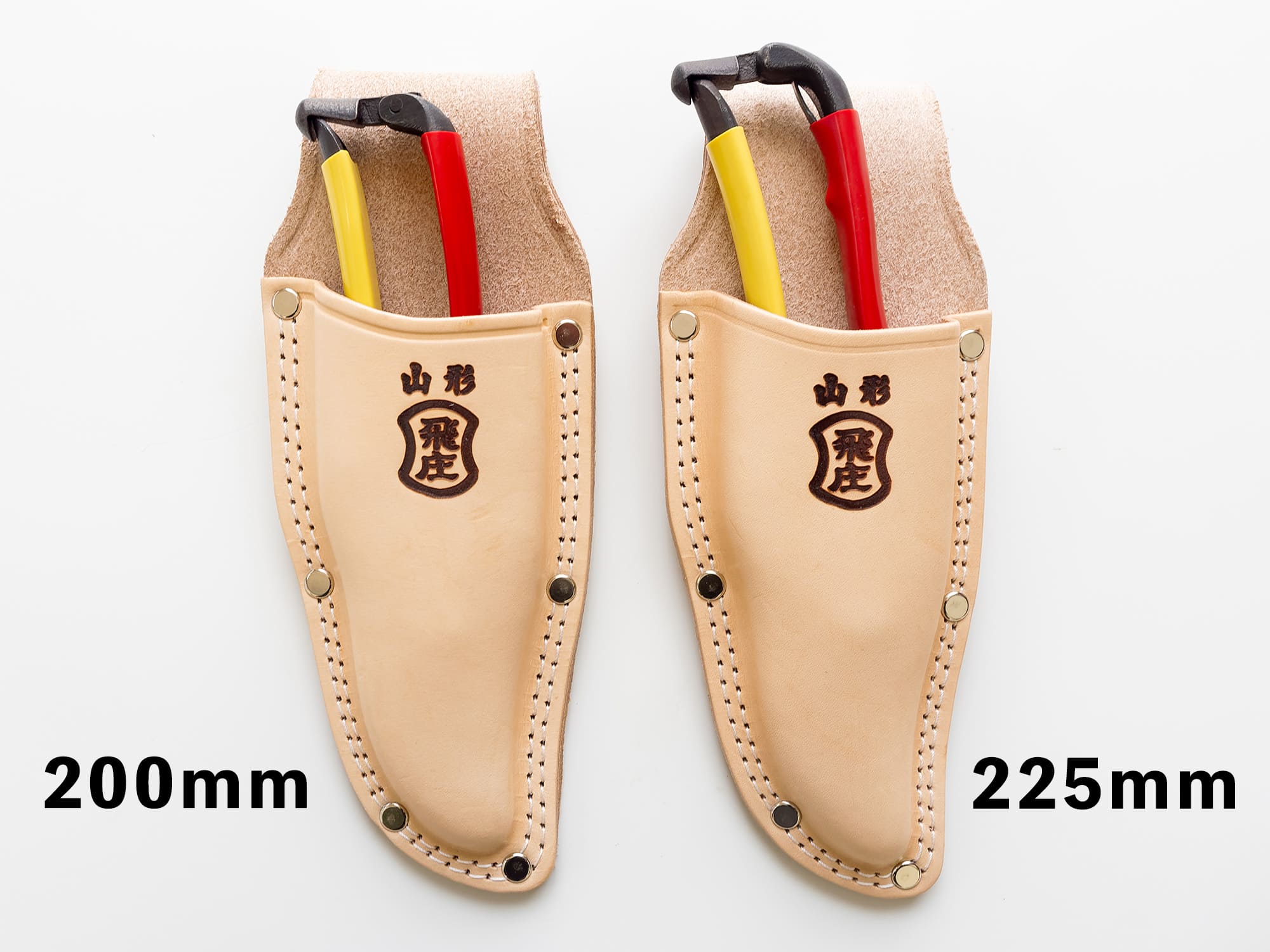
<p>This sheath is made from vegetable-tanned cowhide and double-stitched for durability, sized for our 200mm SR-1, A-type, and B-type pruning shears. It's cut close to the tool, so it fits snugly at first and gradually eases with use as the leather takes the shape of the shear inside it. There's no buckle or clasp; a loop of leather at the back lets you thread it onto a belt.</p>

<p><img src="https://www.tetsufuku.com/data/tetsufuku/product/_3032011.jpg" alt="Tobisho sheath for A-type, B-type" /></p>

<p>This sheath is sized for 200mm models, but Tobisho has officially confirmed it can also be used with the 225mm A-type. We tested this ourselves by fitting both lengths into the same sheath side by side, shown above. The 225mm handle sits a little further out of the sheath, which we actually found made it easier to grip when reaching for it. Insertion felt marginally tighter with the 225mm than the 200mm, but not enough to call it a problem either way.</p>

<h3>How to Care for Your Cowhide Sheath</h3>

<p>Wipe off dirt and moisture after use, and let the sheath air dry naturally if it gets wet, away from direct heat. Vegetable-tanned leather like this darkens and softens with handling over time; that's normal wear, not damage.</p></p>]]></content:encoded>
                    <dc:subject>Natural Cowhide Sheaths (Tobisho)</dc:subject>
                    <dc:creator>TETSUFUKU</dc:creator>
                    <dc:format>2750</dc:format>
                    <dc:date>2026-07-27T15:07:06+09:00</dc:date>
                    <dc:type>shop</dc:type>
                </item>
                
                <item rdf:about="https://www.tetsufuku.com/product/29">
                    <title>[Tobisho] Karikomi Shears Shojiro Kanto-type 210mm (8.3&quot;) Blade</title>
                    <link>https://www.tetsufuku.com/product/29</link>
                    <description>The Sharper Choice for Practiced Hands

About the Karikomi Shears Series

Two-handed Karikomi sh…</description>
                    <content:encoded><![CDATA[<p><a href="https://www.tetsufuku.com/product/29" target="_blank"><img src="https://www.tetsufuku.com/data/tetsufuku/product/20120826_60f2d4.jpg" width="250" border="0" alt="[Tobisho] Karikomi Shears Shojiro Kanto-type 210mm (8.3") Blade" hspace="5" align="left"/></a><h2>The Sharper Choice for Practiced Hands</h2>

<h3>About the Karikomi Shears Series</h3>

<p>Two-handed Karikomi shears sit apart from the rest of our pruning shear lineup. Where most pruning shears are made by specialist secateur blacksmiths, large hedge shears like these are traditionally the domain of ueki-basami (planting shears) blacksmiths, a different craft entirely. Tobisho makes both, each blade forged from Yasuki-produced Blue Paper steel (Aogami steel), the handle carved from magnolia obovata (honoki), a wood chosen for how well it takes and holds an oiled finish over years of use.</p>

<p>The two models here differ in how the blades meet. On the Yamagata-type, the blades don't fully cross when the shear closes, a built-in stopper limits the swing, so there's no risk of catching a finger between them. It's the gentler of the two to learn on, though plenty of professionals use it by choice, not just necessity. The Kanto-type has no such stopper; its blades cross fully and its handles run narrower and closer to parallel, trading that extra safety margin for more direct cutting power. Both blades carry a curve suited to shaping rounded and spherical forms, sliding through material cleanly enough that the bark isn't torn or bruised at the cut.</p>

<p>These shears are built for hedges and shaped shrubs generally, not tied to any one species. We've heard from customers overseas using them on hedges considerably older than the shop itself: a customer in the Netherlands wrote to us after using a Yamagata-type on two Buxus sempervirens (common boxwood) hedges, one planted in 1890, the other in 1920, describing the work as careful and slow, done over the better part of a week, and the shear as having handled it beautifully.</p>

<h3>About Karikomi Shears Shojiro Kanto-type 210mm (8.3") Blade</h3>

<p>The Kanto-type trades the Yamagata-type's built-in stopper for something else entirely: the two blades cross fully as the shear closes, and the handles sit narrower and nearer to parallel than on the Yamagata-type. That combination sharpens the leverage and the bite of the cut, this is the version many professional gardeners in Japan reach for once they're used to handling a two-handed Karikomi shear.</p>

<p>Because there's no stopper, the blades can close all the way, which calls for a slightly more deliberate hand than the Yamagata-type. It's not a shear we'd point a first-time user toward, it's the one experienced hands ask for once they know what they want from it.</p>

<p>This is by far the rarer of our two Karikomi models. Most people, even in Japan, have only ever seen or handled a Yamagata-type; the Kanto-type sees far more limited production.</p>

<p>If in stock, this shear ships within three business days. If not, allow up to three months, it's made to order.</p>

<h3>How to Sharpen Karikomi Shears (Japanese Hedge Shears) on a Whetstone</h3>

<p>This demonstration isn't Tobisho's own work. It's Shunsuke Manaka of Kisuke, a different Japanese blacksmith, sharpening one of his own Karikomi shears. We're including it here because the technique itself, how the two blades are brought back into contact, how the whetstone is worked along the edge, applies to two-handed Karikomi shears from any maker, Tobisho's included.<br>
Note: The first half of the video covers repair work. If you're looking for everyday sharpening technique, use the chapter markers to skip to the second half.<br>
*Subtitles available in 15 languages.</p>
<div class="video-container">
<iframe src="https://www.youtube.com/embed/f7MNDqUK9BM"
title="How to Sharpen Karikomi (Japanese Hedge Shears) — Kisuke, Shunsuke Manaka"
data-name="Maker Speaks｜Sharpening Karikomi Shears (Japanese Hedge Shears) — Kisuke, Shunsuke Manaka"
data-date="2018-01-17T00:00:00+09:00"
data-desc="Shunsuke Manaka of Kisuke demonstrates repairing and sharpening a karikomi hedge shear on a whetstone"
frameborder="0" allow="accelerometer; autoplay; clipboard-write; encrypted-media; gyroscope; picture-in-picture; web-share"
referrerpolicy="strict-origin-when-cross-origin" allowfullscreen></iframe>
</div>

<h3>How to Maintain Your Tobisho Karikomi Shears</h3>

<p><b>Can I use this on individual branches?</b><br>
This shear is built for hedges and foliage, including the thin twigs that naturally get caught up in a hedge face, not for cutting a single thick branch cleanly. For that, use a bypass pruner.</p>

<p><b>How do I keep the blade in condition?</b><br>
Wipe off resin and sap after use where you can. Oil and clean the blade regularly to prevent rust and blade separation, this is an Aogami (Blue Paper) high-carbon steel edge, not stainless, and it will rust if neglected.</p>

<p><b>Can I sharpen it myself?</b><br>
Yes, on a whetstone, once cutting performance starts to decline. See the sharpening demonstration above for technique.</p>

<p><b>What if I drop it?</b><br>
Handle with care. A blade-first drop risks chipping the edge.</p>

<p><b>Anything I shouldn't do?</b><br>
Don't twist or lever the blade mid-cut, and don't use it on wire, rope, or anything that isn't plant material. Keep it out of reach of children.</p>

<h3>About Tobisho: Four Generations of Pruning Shear Hand-Forging</h3>

<figure>
<img src="https://www.tetsufuku.com/data/tetsufuku/product/_U012480.JPG" alt="Daiki Tobitsuka, fourth-generation master blacksmith of Tobisho, forging pruning shears in Yamagata Japan" />
</figure>

<p>Tobisho has been forging blades in Yamagata since 1804, ten generations of blacksmiths, four of them dedicated to pruning shears. It was Syojiro Tobitsuka, the seventh-generation bladesmith in his family line, who founded Tobisho as a pruning shear forge in 1930, making him the first of four generations dedicated to shears.</p>

<p>Syojiro's shears served both the silkworm farmers already working the region and the orchardists who followed as Yamagata became one of Japan's great fruit-growing prefectures. The tools had to work. His name is still stamped on every Karikomi Shear Tobisho makes.</p>

<p>Generation by generation, the shears got better. What Tobisho is known for today, their heat treatment, their distinctive surface finish, is accumulated experience, made visible.</p>

<p>The late master Yasuhito Tobitsuka, third generation, developed the SR, the Hiryu, and the Asuka, and redesigned the A-type's handle. Daiki Tobitsuka, the fourth-generation master working at the forge today, has added the Hisui, the Hirei, and a Damascus steel A-type. His philosophy: <em>"Cutting well is the baseline. Beyond that: simple and sturdy."</em>, 質実剛健</p>

<h4>Forging the Handle</h4>
<div class="video-container">
<iframe src="https://www.youtube.com/embed/rSi6K3nqdU8"
title="Tobisho blacksmith forging pruning shear handle, Yamagata Japan"
data-name="15sec. Artisan｜Making Handles for B-type Pruners (Secateurs) — Tobisho, Yamagata"
data-date="2026-05-22T00:00:00+09:00"
data-desc="Tobisho blacksmith forging pruning shear handle, Yamagata Japan"
frameborder="0" allow="accelerometer; autoplay; clipboard-write; encrypted-media; gyroscope; picture-in-picture; web-share"
referrerpolicy="strict-origin-when-cross-origin" allowfullscreen></iframe>
</div>

<h4 class="mt-2em">Sharpening the Blade</h4>
<div class="video-container">
<iframe src="https://www.youtube.com/embed/zw3tS6lXXqI"
title="Tobisho third-generation master Yasuhito Tobitsuka sharpening pruning shear blade, Yamagata Japan"
data-name="15sec. Artisan｜Blade Finishing for A-type Pruners (Secateurs) — Tobisho, Yamagata"
data-date="2026-05-23T00:00:00+09:00"
data-desc="Tobisho third-generation master Yasuhito Tobitsuka sharpening pruning shear blade, Yamagata Japan"
frameborder="0" allow="accelerometer; autoplay; clipboard-write; encrypted-media; gyroscope; picture-in-picture; web-share"
referrerpolicy="strict-origin-when-cross-origin" allowfullscreen></iframe>
</div>

<h3>Notes on use</h3>

<p><b>IMPORTANT: This shear is made of Aogami Steel (High-Carbon Steel, Not Stainless Steel). It is exceptionally sharp but prone to rust if not maintained.</b><br>
Do not twist or lever the blade during a cut.<br>
Handle with care, blade-first drops risk chipping.<br>
For two-handed use.<br>
Designed for trimming hedges and foliage, including the thin twigs naturally caught up in a hedge, not for cutting individual thick branches.<br>
Oil and clean regularly to prevent rust and blade separation.<br>
Sharpen on a whetstone when cutting performance declines.<br>
Do not use on wire, rope, or any non-plant material.<br>
Keep out of reach of children.</p>

<div class="series-options-box">
  <p class="series-options-title">🌿 Other options in this series</p>
  New to two-handed Karikomi shears? Prefer a built-in safety stopper? ➔ <a href="https://www.tetsufuku.com/product/28" class="link-red-bold">Karikomi Shears Shojiro Yamagata-type 195mm</a>
</div>

<div class="story-manager-box">
    <p class="story-title">💬 Story of This Model - By Shop Manager (Part 2 of 2)</p>
    <p class="story-topic">Topic: Why Tobisho started making these at all.</p>
    <div class="story-flex-layout">
        <div class="profile-area">
            <img src="https://www.tetsufuku.com/data/tetsufuku/image/20260623_2e4f12.jpg" alt="Hiroshi Urata - Tetsufuku Shop Manager" class="profile-avatar" />
            <p class="profile-name">Hiroshi Urata</p>
        </div>
        <div class="text-content">
            I've always been a fan of Tobisho as a maker, which is exactly why I never pictured them making a two-handed hedge shear. Using these, though, that assumption was overturned, in the best way. Yasuhito Tobitsuka, Tobisho's third-generation master, once told me that older pruning shear makers mostly served silkworm farmers and orchardists. Tobisho, by contrast, started serving professional gardeners relatively early on, and it was those gardeners who came to Tobisho and asked, directly, "make us hedge shears too." Looking back now, I find myself grateful, both to the gardener bold enough to make that request, and to the Tobisho master at the time who said yes.
            <div class="nav-footer nav-font-bold">
                <a href="https://www.tetsufuku.com/product/28" class="link-gray">⏪ Return to Part 1</a>
            </div>
        </div>
    </div>
</div></p>]]></content:encoded>
                    <dc:subject>Hedge &amp; Topiary Shears (including Single-Handed)</dc:subject>
                    <dc:creator>TETSUFUKU</dc:creator>
                    <dc:format>64900</dc:format>
                    <dc:date>2026-07-27T14:32:58+09:00</dc:date>
                    <dc:type>shop</dc:type>
                </item>
                
                <item rdf:about="https://www.tetsufuku.com/product/28">
                    <title>[Tobisho] Karikomi Shears (Japanese Hedge Shears) Shojiro Yamagata-type 195mm (7.7&quot;) Blade</title>
                    <link>https://www.tetsufuku.com/product/28</link>
                    <description>A Craftsman&#039;s Cut, Made Safe to Learn

About the Karikomi Shears Series

Two-handed Karikomi she…</description>
                    <content:encoded><![CDATA[<p><a href="https://www.tetsufuku.com/product/28" target="_blank"><img src="https://www.tetsufuku.com/data/tetsufuku/product/20120826_ae374c.jpg" width="250" border="0" alt="[Tobisho] Karikomi Shears (Japanese Hedge Shears) Shojiro Yamagata-type 195mm (7.7") Blade" hspace="5" align="left"/></a><h2>A Craftsman's Cut, Made Safe to Learn</h2>

<h3>About the Karikomi Shears Series</h3>

<p>Two-handed Karikomi shears sit apart from the rest of our pruning shear lineup. Where most pruning shears are made by specialist secateur blacksmiths, large hedge shears like these are traditionally the domain of ueki-basami (planting shears) blacksmiths, a different craft entirely. Tobisho makes both, each blade forged from Yasuki-produced Blue Paper steel (Aogami steel), the handle carved from magnolia obovata (honoki), a wood chosen for how well it takes and holds an oiled finish over years of use.</p>

<p>The two models here differ in how the blades meet. On the Yamagata-type, the blades don't fully cross when the shear closes, a built-in stopper limits the swing, so there's no risk of catching a finger between them. It's the gentler of the two to learn on, though plenty of professionals use it by choice, not just necessity. The Kanto-type has no such stopper; its blades cross fully and its handles run narrower and closer to parallel, trading that extra safety margin for more direct cutting power. Both blades carry a curve suited to shaping rounded and spherical forms, sliding through material cleanly enough that the bark isn't torn or bruised at the cut.</p>

<p>These shears are built for hedges and shaped shrubs generally, not tied to any one species. We've heard from customers overseas using them on hedges considerably older than the shop itself: a customer in the Netherlands wrote to us after using a Yamagata-type on two Buxus sempervirens (common boxwood) hedges, one planted in 1890, the other in 1920, describing the work as careful and slow, done over the better part of a week, and the shear as having handled it beautifully.</p>

<h3>About Karikomi Shears (Japanese Hedge Shears) Shojiro Yamagata-type 195mm (7.7") Blade</h3>

<p>Seen fully open, this shear's profile forms a capital Y: the two magnolia handles spread apart like the letter's upper arms, meeting at the pivot where the single curved blade continues downward like its stem. The built-in stopper keeps the blades from ever fully crossing, which is what makes this the more forgiving of our two Karikomi models to pick up and learn on.</p>

<p>Named for Shojiro, the founder whose name is stamped on every Karikomi shear Tobisho makes, this is also the model most people mean when they picture a Tobisho hedge shear; the Kanto-type is rarer, and far fewer people have handled one. Fewer than a hundred of these are forged in a given year.</p>

<p>If in stock, this shear ships within three business days. If not, allow up to three months, it's made to order.</p>

<h3>How to Sharpen Karikomi Shears (Japanese Hedge Shears) on a Whetstone</h3>

<p>This demonstration isn't Tobisho's own work. It's Shunsuke Manaka of Kisuke, a different Japanese blacksmith, sharpening one of his own Karikomi shears. We're including it here because the technique itself, how the two blades are brought back into contact, how the whetstone is worked along the edge, applies to two-handed Karikomi shears from any maker, Tobisho's included.<br>
Note: The first half of the video covers repair work. If you're looking for everyday sharpening technique, use the chapter markers to skip to the second half.<br>
*Subtitles available in 15 languages.</p>
<div class="video-container">
<iframe src="https://www.youtube.com/embed/f7MNDqUK9BM"
title="How to Sharpen Karikomi (Japanese Hedge Shears) — Kisuke, Shunsuke Manaka"
data-name="Maker Speaks｜Sharpening Karikomi Shears (Japanese Hedge Shears) — Kisuke, Shunsuke Manaka"
data-date="2018-01-17T00:00:00+09:00"
data-desc="Shunsuke Manaka of Kisuke demonstrates repairing and sharpening a karikomi hedge shear on a whetstone"
frameborder="0" allow="accelerometer; autoplay; clipboard-write; encrypted-media; gyroscope; picture-in-picture; web-share"
referrerpolicy="strict-origin-when-cross-origin" allowfullscreen></iframe>
</div>

<h3>How to Maintain Your Tobisho Karikomi Shears</h3>

<p><b>Can I use this on individual branches?</b><br>
This shear is built for hedges and foliage, including the thin twigs that naturally get caught up in a hedge face, not for cutting a single thick branch cleanly. For that, use a bypass pruner.</p>

<p><b>How do I keep the blade in condition?</b><br>
Wipe off resin and sap after use where you can. Oil and clean the blade regularly to prevent rust and blade separation, this is an Aogami (Blue Paper) high-carbon steel edge, not stainless, and it will rust if neglected.</p>

<p><b>Can I sharpen it myself?</b><br>
Yes, on a whetstone, once cutting performance starts to decline. See the sharpening demonstration above for technique.</p>

<p><b>What if I drop it?</b><br>
Handle with care. A blade-first drop risks chipping the edge.</p>

<p><b>Anything I shouldn't do?</b><br>
Don't twist or lever the blade mid-cut, and don't use it on wire, rope, or anything that isn't plant material. Keep it out of reach of children.</p>

<h3>About Tobisho: Four Generations of Pruning Shear Hand-Forging</h3>

<figure>
<img src="https://www.tetsufuku.com/data/tetsufuku/product/_U012480.JPG" alt="Daiki Tobitsuka, fourth-generation master blacksmith of Tobisho, forging pruning shears in Yamagata Japan" />
</figure>

<p>Tobisho has been forging blades in Yamagata since 1804, ten generations of blacksmiths, four of them dedicated to pruning shears. It was Syojiro Tobitsuka, the seventh-generation bladesmith in his family line, who founded Tobisho as a pruning shear forge in 1930, making him the first of four generations dedicated to shears.</p>

<p>Syojiro's shears served both the silkworm farmers already working the region and the orchardists who followed as Yamagata became one of Japan's great fruit-growing prefectures. The tools had to work. His name is still stamped on every Karikomi Shear Tobisho makes.</p>

<p>Generation by generation, the shears got better. What Tobisho is known for today, their heat treatment, their distinctive surface finish, is accumulated experience, made visible.</p>

<p>The late master Yasuhito Tobitsuka, third generation, developed the SR, the Hiryu, and the Asuka, and redesigned the A-type's handle. Daiki Tobitsuka, the fourth-generation master working at the forge today, has added the Hisui, the Hirei, and a Damascus steel A-type. His philosophy: <em>"Cutting well is the baseline. Beyond that: simple and sturdy."</em>, 質実剛健</p>

<h4>Forging the Handle</h4>
<div class="video-container">
<iframe src="https://www.youtube.com/embed/rSi6K3nqdU8"
title="Tobisho blacksmith forging pruning shear handle, Yamagata Japan"
data-name="15sec. Artisan｜Making Handles for B-type Pruners (Secateurs) — Tobisho, Yamagata"
data-date="2026-05-22T00:00:00+09:00"
data-desc="Tobisho blacksmith forging pruning shear handle, Yamagata Japan"
frameborder="0" allow="accelerometer; autoplay; clipboard-write; encrypted-media; gyroscope; picture-in-picture; web-share"
referrerpolicy="strict-origin-when-cross-origin" allowfullscreen></iframe>
</div>

<h4 class="mt-2em">Sharpening the Blade</h4>
<div class="video-container">
<iframe src="https://www.youtube.com/embed/zw3tS6lXXqI"
title="Tobisho third-generation master Yasuhito Tobitsuka sharpening pruning shear blade, Yamagata Japan"
data-name="15sec. Artisan｜Blade Finishing for A-type Pruners (Secateurs) — Tobisho, Yamagata"
data-date="2026-05-23T00:00:00+09:00"
data-desc="Tobisho third-generation master Yasuhito Tobitsuka sharpening pruning shear blade, Yamagata Japan"
frameborder="0" allow="accelerometer; autoplay; clipboard-write; encrypted-media; gyroscope; picture-in-picture; web-share"
referrerpolicy="strict-origin-when-cross-origin" allowfullscreen></iframe>
</div>

<h3>Notes on use</h3>

<p><b>IMPORTANT: This shear is made of Aogami Steel (High-Carbon Steel, Not Stainless Steel). It is exceptionally sharp but prone to rust if not maintained.</b><br>
Do not twist or lever the blade during a cut.<br>
Handle with care, blade-first drops risk chipping.<br>
For two-handed use.<br>
Designed for trimming hedges and foliage, including the thin twigs naturally caught up in a hedge, not for cutting individual thick branches.<br>
Oil and clean regularly to prevent rust and blade separation.<br>
Sharpen on a whetstone when cutting performance declines.<br>
Do not use on wire, rope, or any non-plant material.<br>
Keep out of reach of children.</p>

<div class="series-options-box">
  <p class="series-options-title">🌿 Other options in this series</p>
  Looking for more cutting power and don't mind losing the stopper? ➔ <a href="https://www.tetsufuku.com/product/29" class="link-red-bold">Karikomi Shears Shojiro Kanto-type 210mm</a>
</div>

<div class="story-manager-box">
    <p class="story-title">💬 Story of This Model - By Shop Manager (Part 1 of 2)</p>
    <p class="story-topic">Topic: The moment two-handed shears surprised me.</p>
    <div class="story-flex-layout">
        <div class="profile-area">
            <img src="https://www.tetsufuku.com/data/tetsufuku/image/20260623_2e4f12.jpg" alt="Hiroshi Urata - Tetsufuku Shop Manager" class="profile-avatar" />
            <p class="profile-name">Hiroshi Urata</p>
        </div>
        <div class="text-content">
            Trying these out, I was struck by just how sharply they cut. And they cut with a clean, satisfying snap that makes the work genuinely enjoyable, true of both the Yamagata-type and the Kanto-type equally. There's a reason I found myself this surprised: large, two-handed Karikomi shears sit closer to the world of traditional Japanese ueki-basami blacksmiths than to pruning shear makers. Most pruning shear manufacturers don't make two-handed hedge shears at all. Having spent years documenting garden tools and the people who make them, it felt to me like Tobisho had stepped past the boundaries of pruning shears and into the territory of Japan's traditional shear-forging tradition.
            <div class="nav-footer nav-font-bold">
                <a href="https://www.tetsufuku.com/product/29" class="link-red-bold">Continue to Part 2 ➔</a>
            </div>
        </div>
    </div>
</div></p>]]></content:encoded>
                    <dc:subject>Hedge &amp; Topiary Shears (including Single-Handed)</dc:subject>
                    <dc:creator>TETSUFUKU</dc:creator>
                    <dc:format>53900</dc:format>
                    <dc:date>2026-07-27T14:29:41+09:00</dc:date>
                    <dc:type>shop</dc:type>
                </item>
                
                <item rdf:about="https://www.tetsufuku.com/product/251">
                    <title>[Tobisho] Pine Needle Shears 230mm (9.1&quot;) with Guard-Ring</title>
                    <link>https://www.tetsufuku.com/product/251</link>
                    <description>Reach Further, Drop Nothing

About the Pine Needle Shears Series

Despite the name, this isn&#039;t a…</description>
                    <content:encoded><![CDATA[<p><a href="https://www.tetsufuku.com/product/251" target="_blank"><img src="https://www.tetsufuku.com/data/tetsufuku/product/20211224_6f4bc0.jpg" width="250" border="0" alt="[Tobisho] Pine Needle Shears 230mm (9.1") with Guard-Ring" hspace="5" align="left"/></a><h2>Reach Further, Drop Nothing</h2>

<h3>About the Pine Needle Shears Series</h3>

<p>Despite the name, this isn't a tool for candling or needle-plucking, the hand techniques most often associated with pine care. This is a cutting shear, used for the short-leaf method (tanyoho), trimming elongated new needles back by roughly half to encourage denser, shorter growth, and for old-needle removal (furubatori), thinning out the previous year's needles from crowded interior branches to improve light and airflow.</p>

<p>Tobisho used to also make a dedicated 230mm single-handed Karikomi shear for general hedge work. That model has since been folded into this line: Pine Needle Shears now cover both roles, needle work on pines and other conifers, and general single-handed hedge and topiary trimming, in one shear.</p>

<p>The blade shape sets this apart from our double-bevel Topiary Shears, even though the two share nearly identical bodies and handles. Topiary Shears keep their width for roughly 80% of the blade's length before narrowing sharply near the tip, built for shearing across a broad leaf surface. This shear's widest point is at the base near the pivot, tapering gradually toward a narrower tip, built to slip into dense foliage rather than shear across it. That difference in profile is also what makes it useful well beyond pine: the pointed blade suits bonsai work broadly, and some gardeners use it for traditional pruning styles where the blade shape recalls older warabite-style shears such as the Okubo-gata.</p>

<h3>About Pine Needle Shears 230mm (9.1") with Guard-Ring</h3>

<p>This version is built on the same 230mm shear as our standard model, with a guard ring added at the base of the handle, where the little finger rests. According to Tobisho, the ring serves three purposes: it protects the hand if it slips during a cut, it improves the grip and hold on the shear, and it helps prevent the shear from dropping, which matters most when you're working off a ladder or reaching up into a tree, the same reasoning behind the guard-ring version of our Topiary Shears.</p>

<p>The blade, edge geometry, and cutting performance are identical to the standard model, this version adds the ring and nothing else. The extra material brings the weight to approximately 260g, about 20g over the standard shear. This model is right-handed only.</p>

<p>Hold the shear with your index finger resting along the spine near the pivot, the rest of your fingers and palm wrapping around the handle. Rather than closing the blades in a single pinch, slide them forward slightly as you cut, a push-cut that lets the 230mm blade pass through even stiff pine needles with very little effort.</p>

<p>For old-needle removal, slip the blade in near the base of the needle and cut just above the hakama, the small sheath at the base, rather than pulling the needle out by hand, which can tear the bark. Left in place, the remaining stub dries and drops off naturally within a few months. Approach the needle from along the branch's own angle, not straight across it, cutting into it vertically or at a diagonal; a straight, sideways cut risks nicking the needles you mean to keep, leaving a browned cut edge.</p>

<p>This model is available only at 230mm.</p>

<h3>How to Maintain Your Tobisho Pruning Shears</h3>

<p><b>Can I use this on a branch?</b><br>
No. This shear is built for pine needles and thin, dense foliage, not for cutting branches, of any thickness. It has no cutting margin for woody material, forcing a branch through it risks bending the blade or damaging the pivot. For branches, use a bypass pruner or a single-bevel shear instead.</p>

<p><b>How do I keep the blade in condition?</b><br>
Wipe off resin after every use, ideally. Resin buildup gradually forces the blade trajectory outward, the two cutting edges stop meeting cleanly, and the pivot bolt begins to wear along that same outward path, compounding the problem. If wiping after every use isn't practical, clean the blades regularly. Carrying a small cloth and blade cleaner means you can do it on a break.</p>

<p><b>How do I lubricate the pivot?</b><br>
Ideally, remove the bolt periodically and pack grease inside, grease holds longer than oil. That said, this requires skill and confidence to do correctly. A practical alternative: one drop of oil on the pivot once a month. It's not the full solution, but it keeps things running smoothly.</p>

<p><b>Can the shear get wet?</b><br>
Avoid it where possible, and never leave the shear wet. After working in rain or morning dew, wipe it dry thoroughly. The pivot area retains moisture longest, use a blower or compressed air if you have one. Regular oiling helps here too: a well-oiled blade sheds water rather than holding it.</p>

<p><b>What if I drop it?</b><br>
It depends on how and where it lands. A handle-first drop can bend the handle, affecting feel and the locking mechanism. A blade-first drop risks chipping. As a general rule: the sharper the blade, the harder and more brittle the steel, and the thinner the edge. Handle forged Japanese blades accordingly.</p>

<p><b>Can I sharpen it myself?</b><br>
Yes, if you understand the blade geometry and have the skill. Sharpening scissors is significantly harder than sharpening knives: you are managing the contact between two blades, and as you sharpen, the blade face recedes, which can cause the edges to lose contact. If you are confident, sharpen only the face of each blade, never the inner flat side. When the blades stop meeting cleanly despite sharpening, that is the point to send it back to the maker. If you are not confident, leave it to a professional. A blade sharpened incorrectly is harder to recover than a dull one.</p>

<h3>About Tobisho: Four Generations of Pruning Shear Hand-Forging</h3>

<figure>
<img src="https://www.tetsufuku.com/data/tetsufuku/product/_U012480.JPG" alt="Daiki Tobitsuka, fourth-generation master blacksmith of Tobisho, forging pruning shears in Yamagata Japan" />
</figure>

<p>Tobisho has been forging blades in Yamagata since 1804, ten generations of blacksmiths, four of them dedicated to pruning shears. It was Syojiro Tobitsuka, the seventh-generation bladesmith in his family line, who founded Tobisho as a pruning shear forge in 1930, making him the first of four generations dedicated to shears.</p>

<p>Syojiro's shears served both the silkworm farmers already working the region and the orchardists who followed as Yamagata became one of Japan's great fruit-growing prefectures. The tools had to work. His name is still stamped on every Karikomi Shear Tobisho makes.</p>

<p>Generation by generation, the shears got better. What Tobisho is known for today, their heat treatment, their distinctive surface finish, is accumulated experience, made visible.</p>

<p>The late master Yasuhito Tobitsuka, third generation, developed the SR, the Hiryu, and the Asuka, and redesigned the A-type's handle. Daiki Tobitsuka, the fourth-generation master working at the forge today, has added the Hisui, the Hirei, and a Damascus steel A-type. His philosophy: <em>"Cutting well is the baseline. Beyond that: simple and sturdy."</em>, 質実剛健</p>

<h4>Forging the Handle</h4>
<div class="video-container">
<iframe src="https://www.youtube.com/embed/rSi6K3nqdU8"
title="Tobisho blacksmith forging pruning shear handle, Yamagata Japan"
data-name="15sec. Artisan｜Making Handles for B-type Pruners (Secateurs) — Tobisho, Yamagata"
data-date="2026-05-22T00:00:00+09:00"
data-desc="Tobisho blacksmith forging pruning shear handle, Yamagata Japan"
frameborder="0" allow="accelerometer; autoplay; clipboard-write; encrypted-media; gyroscope; picture-in-picture; web-share"
referrerpolicy="strict-origin-when-cross-origin" allowfullscreen></iframe>
</div>

<h4 class="mt-2em">Sharpening the Blade</h4>
<div class="video-container">
<iframe src="https://www.youtube.com/embed/zw3tS6lXXqI"
title="Tobisho third-generation master Yasuhito Tobitsuka sharpening pruning shear blade, Yamagata Japan"
data-name="15sec. Artisan｜Blade Finishing for A-type Pruners (Secateurs) — Tobisho, Yamagata"
data-date="2026-05-23T00:00:00+09:00"
data-desc="Tobisho third-generation master Yasuhito Tobitsuka sharpening pruning shear blade, Yamagata Japan"
frameborder="0" allow="accelerometer; autoplay; clipboard-write; encrypted-media; gyroscope; picture-in-picture; web-share"
referrerpolicy="strict-origin-when-cross-origin" allowfullscreen></iframe>
</div>

<h3>Notes on use</h3>

<p><b>IMPORTANT: This shear is made of High-Carbon Alloy Steel (Not Stainless Steel). It is exceptionally sharp but prone to rust if not maintained.</b><br>
Designed for pine needles and thin, dense foliage. Not suited to cutting branches; use a bypass pruner or single-bevel shear instead.<br>
Do not twist or lever the blade during a cut.<br>
Handle with care, blade-first drops risk chipping.<br>
For one-handed use only. Right hand.<br>
Oil and clean regularly to prevent rust and blade separation.<br>
Do not use on wire, rope, or any non-plant material.<br>
Keep out of reach of children.</p>

<div class="series-options-box">
  <p class="series-options-title">🌿 Other options in this series</p>
  Prefer the standard model without the guard? ➔ <a href="https://www.tetsufuku.com/product/208" class="link-red-bold">Pine Needle Shears 230mm</a><br>
  Prefer a taped handle? ➔ <a href="https://www.tetsufuku.com/product/269" class="link-red-bold">Pine Needle Shears 230mm, Red & Yellow Taped Handle</a>
</div>

<div class="story-manager-box">
    <p class="story-title">💬 Story of This Model - By Shop Manager (Part 3 of 3)</p>
    <p class="story-topic">Topic: A shear that goes well beyond pine.</p>
    <div class="story-flex-layout">
        <div class="profile-area">
            <img src="https://www.tetsufuku.com/data/tetsufuku/image/20260623_2e4f12.jpg" alt="Hiroshi Urata - Tetsufuku Shop Manager" class="profile-avatar" />
            <p class="profile-name">Hiroshi Urata</p>
        </div>
        <div class="text-content">
            Pine Needle Shears are a genuinely versatile tool. That pointed, slip-in blade shape isn't just for pine, it suits bonsai work in general, and some Japanese gardeners reach for it in traditional pruning because the blade recalls older warabite-style shears like the Okubo-gata. On top of all that, it can still do what our Topiary Shears do: shear across a leaf surface for general hedge and topiary work. One shear, several jobs.
            <div class="nav-footer nav-font-bold">
                <a href="https://www.tetsufuku.com/product/208" class="link-gray">⏪ Return to Part 1</a>
            </div>
        </div>
    </div>
</div></p>]]></content:encoded>
                    <dc:subject>Hedge &amp; Topiary Shears (including Single-Handed)</dc:subject>
                    <dc:creator>TETSUFUKU</dc:creator>
                    <dc:format>11660</dc:format>
                    <dc:date>2026-07-27T13:11:51+09:00</dc:date>
                    <dc:type>shop</dc:type>
                </item>
                
                <item rdf:about="https://www.tetsufuku.com/product/269">
                    <title>[Tobisho] Pine Needle Shears 230mm (9.1&quot;) Red &amp; Yellow Taped Handle</title>
                    <link>https://www.tetsufuku.com/product/269</link>
                    <description>Precision That Holds Its Line

About the Pine Needle Shears Series

Despite the name, this isn&#039;t…</description>
                    <content:encoded><![CDATA[<p><a href="https://www.tetsufuku.com/product/269" target="_blank"><img src="https://www.tetsufuku.com/data/tetsufuku/product/20221021_43e14c.jpg" width="250" border="0" alt="[Tobisho] Pine Needle Shears 230mm (9.1") Red & Yellow Taped Handle" hspace="5" align="left"/></a><h2>Precision That Holds Its Line</h2>

<h3>About the Pine Needle Shears Series</h3>

<p>Despite the name, this isn't a tool for candling or needle-plucking, the hand techniques most often associated with pine care. This is a cutting shear, used for the short-leaf method (tanyoho), trimming elongated new needles back by roughly half to encourage denser, shorter growth, and for old-needle removal (furubatori), thinning out the previous year's needles from crowded interior branches to improve light and airflow.</p>

<p>Tobisho used to also make a dedicated 230mm single-handed Karikomi shear for general hedge work. That model has since been folded into this line: Pine Needle Shears now cover both roles, needle work on pines and other conifers, and general single-handed hedge and topiary trimming, in one shear.</p>

<p>The blade shape sets this apart from our double-bevel Topiary Shears, even though the two share nearly identical bodies and handles. Topiary Shears keep their width for roughly 80% of the blade's length before narrowing sharply near the tip, built for shearing across a broad leaf surface. This shear's widest point is at the base near the pivot, tapering gradually toward a narrower tip, built to slip into dense foliage rather than shear across it. That difference in profile is also what makes it useful well beyond pine: the pointed blade suits bonsai work broadly, and some gardeners use it for traditional pruning styles where the blade shape recalls older warabite-style shears such as the Okubo-gata.</p>

<h3>About Pine Needle Shears 230mm (9.1") Red & Yellow Taped Handle</h3>

<p>This is the same 230mm shear as our standard model, finished with our red and yellow vinyl taped handle in place of the black finish. Blade shape, weight, and cutting performance are identical, this version is a handle finish choice only.</p>

<p>Hold the shear with your index finger resting along the spine near the pivot, the rest of your fingers and palm wrapping around the handle. Rather than closing the blades in a single pinch, slide them forward slightly as you cut, a push-cut that lets the 230mm blade pass through even stiff pine needles with very little effort.</p>

<p>For old-needle removal, slip the blade in near the base of the needle and cut just above the hakama, the small sheath at the base, rather than pulling the needle out by hand, which can tear the bark. Left in place, the remaining stub dries and drops off naturally within a few months. Approach the needle from along the branch's own angle, not straight across it, cutting into it vertically or at a diagonal; a straight, sideways cut risks nicking the needles you mean to keep, leaving a browned cut edge.</p>

<p>Used as a single-handed hedge shear, this model favors keeping the lower blade steady, against the branch or braced in your grip, while the upper blade does the moving. Trying to move both blades evenly tends to wander off-line; letting one stay fixed keeps a straight or curved cut clean.</p>

<p>Tobisho designed this shear to hold up over long sessions: removing steel from areas that don't carry load, and controlling how far the handles open, so it doesn't tire the hand under repeated use. This model is available only at 230mm, and is right-handed only.</p>

<h3>How to Maintain Your Tobisho Pruning Shears</h3>

<p><b>Can I use this on a branch?</b><br>
No. This shear is built for pine needles and thin, dense foliage, not for cutting branches, of any thickness. It has no cutting margin for woody material, forcing a branch through it risks bending the blade or damaging the pivot. For branches, use a bypass pruner or a single-bevel shear instead.</p>

<p><b>How do I keep the blade in condition?</b><br>
Wipe off resin after every use, ideally. Resin buildup gradually forces the blade trajectory outward, the two cutting edges stop meeting cleanly, and the pivot bolt begins to wear along that same outward path, compounding the problem. If wiping after every use isn't practical, clean the blades regularly. Carrying a small cloth and blade cleaner means you can do it on a break.</p>

<p><b>How do I lubricate the pivot?</b><br>
Ideally, remove the bolt periodically and pack grease inside, grease holds longer than oil. That said, this requires skill and confidence to do correctly. A practical alternative: one drop of oil on the pivot once a month. It's not the full solution, but it keeps things running smoothly.</p>

<p><b>Can the shear get wet?</b><br>
Avoid it where possible, and never leave the shear wet. After working in rain or morning dew, wipe it dry thoroughly. The pivot area retains moisture longest, use a blower or compressed air if you have one. Regular oiling helps here too: a well-oiled blade sheds water rather than holding it.</p>

<p><b>What if I drop it?</b><br>
It depends on how and where it lands. A handle-first drop can bend the handle, affecting feel and the locking mechanism. A blade-first drop risks chipping. As a general rule: the sharper the blade, the harder and more brittle the steel, and the thinner the edge. Handle forged Japanese blades accordingly.</p>

<p><b>Can I sharpen it myself?</b><br>
Yes, if you understand the blade geometry and have the skill. Sharpening scissors is significantly harder than sharpening knives: you are managing the contact between two blades, and as you sharpen, the blade face recedes, which can cause the edges to lose contact. If you are confident, sharpen only the face of each blade, never the inner flat side. When the blades stop meeting cleanly despite sharpening, that is the point to send it back to the maker. If you are not confident, leave it to a professional. A blade sharpened incorrectly is harder to recover than a dull one.</p>

<h3>About Tobisho: Four Generations of Pruning Shear Hand-Forging</h3>

<figure>
<img src="https://www.tetsufuku.com/data/tetsufuku/product/_U012480.JPG" alt="Daiki Tobitsuka, fourth-generation master blacksmith of Tobisho, forging pruning shears in Yamagata Japan" />
</figure>

<p>Tobisho has been forging blades in Yamagata since 1804, ten generations of blacksmiths, four of them dedicated to pruning shears. It was Syojiro Tobitsuka, the seventh-generation bladesmith in his family line, who founded Tobisho as a pruning shear forge in 1930, making him the first of four generations dedicated to shears.</p>

<p>Syojiro's shears served both the silkworm farmers already working the region and the orchardists who followed as Yamagata became one of Japan's great fruit-growing prefectures. The tools had to work. His name is still stamped on every Karikomi Shear Tobisho makes.</p>

<p>Generation by generation, the shears got better. What Tobisho is known for today, their heat treatment, their distinctive surface finish, is accumulated experience, made visible.</p>

<p>The late master Yasuhito Tobitsuka, third generation, developed the SR, the Hiryu, and the Asuka, and redesigned the A-type's handle. Daiki Tobitsuka, the fourth-generation master working at the forge today, has added the Hisui, the Hirei, and a Damascus steel A-type. His philosophy: <em>"Cutting well is the baseline. Beyond that: simple and sturdy."</em>, 質実剛健</p>

<h4>Forging the Handle</h4>
<div class="video-container">
<iframe src="https://www.youtube.com/embed/rSi6K3nqdU8"
title="Tobisho blacksmith forging pruning shear handle, Yamagata Japan"
data-name="15sec. Artisan｜Making Handles for B-type Pruners (Secateurs) — Tobisho, Yamagata"
data-date="2026-05-22T00:00:00+09:00"
data-desc="Tobisho blacksmith forging pruning shear handle, Yamagata Japan"
frameborder="0" allow="accelerometer; autoplay; clipboard-write; encrypted-media; gyroscope; picture-in-picture; web-share"
referrerpolicy="strict-origin-when-cross-origin" allowfullscreen></iframe>
</div>

<h4 class="mt-2em">Sharpening the Blade</h4>
<div class="video-container">
<iframe src="https://www.youtube.com/embed/zw3tS6lXXqI"
title="Tobisho third-generation master Yasuhito Tobitsuka sharpening pruning shear blade, Yamagata Japan"
data-name="15sec. Artisan｜Blade Finishing for A-type Pruners (Secateurs) — Tobisho, Yamagata"
data-date="2026-05-23T00:00:00+09:00"
data-desc="Tobisho third-generation master Yasuhito Tobitsuka sharpening pruning shear blade, Yamagata Japan"
frameborder="0" allow="accelerometer; autoplay; clipboard-write; encrypted-media; gyroscope; picture-in-picture; web-share"
referrerpolicy="strict-origin-when-cross-origin" allowfullscreen></iframe>
</div>

<h3>Notes on use</h3>

<p><b>IMPORTANT: This shear is made of High-Carbon Alloy Steel (Not Stainless Steel). It is exceptionally sharp but prone to rust if not maintained.</b><br>
Designed for pine needles and thin, dense foliage. Not suited to cutting branches; use a bypass pruner or single-bevel shear instead.<br>
Do not twist or lever the blade during a cut.<br>
Handle with care, blade-first drops risk chipping.<br>
For one-handed use only. Right hand.<br>
Oil and clean regularly to prevent rust and blade separation.<br>
Do not use on wire, rope, or any non-plant material.<br>
Keep out of reach of children.</p>

<div class="series-options-box">
  <p class="series-options-title">🌿 Other options in this series</p>
  Prefer a black finish handle? ➔ <a href="https://www.tetsufuku.com/product/208" class="link-red-bold">Pine Needle Shears 230mm</a><br>
  Need a guard for high or tight work? ➔ <a href="https://www.tetsufuku.com/product/251" class="link-red-bold">Pine Needle Shears 230mm with Guard-Ring</a>
</div>

<div class="story-manager-box">
    <p class="story-title">💬 Story of This Model - By Shop Manager (Part 2 of 3)</p>
    <p class="story-topic">Topic: A pointed blade versus a broad one.</p>
    <div class="story-flex-layout">
        <div class="profile-area">
            <img src="https://www.tetsufuku.com/data/tetsufuku/image/20260623_2e4f12.jpg" alt="Hiroshi Urata - Tetsufuku Shop Manager" class="profile-avatar" />
            <p class="profile-name">Hiroshi Urata</p>
        </div>
        <div class="text-content">
            Where the Pine Needle Shears differ is at the base: this is where the blade is widest, tapering gradually as it runs out toward the tip. Topiary Shears are built to shear across a broad leaf surface, so they carry that width. This shear is built to slip into a dense, layered branch, so it narrows to a point instead. Even so, as Tobisho themselves have said in folding the two lines together, the difference between them isn't a large one.
            <div class="nav-footer nav-font-bold">
                <a href="https://www.tetsufuku.com/product/251" class="link-red-bold">Continue to Part 3 ➔</a>
            </div>
        </div>
    </div>
</div></p>]]></content:encoded>
                    <dc:subject>Hedge &amp; Topiary Shears (including Single-Handed)</dc:subject>
                    <dc:creator>TETSUFUKU</dc:creator>
                    <dc:format>11440</dc:format>
                    <dc:date>2026-07-27T13:11:38+09:00</dc:date>
                    <dc:type>shop</dc:type>
                </item>
                
                <item rdf:about="https://www.tetsufuku.com/product/208">
                    <title>[Tobisho] Pine Needle Shears 230mm (9.1&quot;)</title>
                    <link>https://www.tetsufuku.com/product/208</link>
                    <description>A Blade Built to Slip In, Not Cut Across

About the Pine Needle Shears Series

Despite the name,…</description>
                    <content:encoded><![CDATA[<p><a href="https://www.tetsufuku.com/product/208" target="_blank"><img src="https://www.tetsufuku.com/data/tetsufuku/product/20161005_e211e8.jpg" width="250" border="0" alt="[Tobisho] Pine Needle Shears 230mm (9.1")" hspace="5" align="left"/></a><h2>A Blade Built to Slip In, Not Cut Across</h2>

<h3>About the Pine Needle Shears Series</h3>

<p>Despite the name, this isn't a tool for candling or needle-plucking, the hand techniques most often associated with pine care. This is a cutting shear, used for the short-leaf method (tanyoho), trimming elongated new needles back by roughly half to encourage denser, shorter growth, and for old-needle removal (furubatori), thinning out the previous year's needles from crowded interior branches to improve light and airflow.</p>

<p>Tobisho used to also make a dedicated 230mm single-handed Karikomi shear for general hedge work. That model has since been folded into this line: Pine Needle Shears now cover both roles, needle work on pines and other conifers, and general single-handed hedge and topiary trimming, in one shear.</p>

<p>The blade shape sets this apart from our double-bevel Topiary Shears, even though the two share nearly identical bodies and handles. Topiary Shears keep their width for roughly 80% of the blade's length before narrowing sharply near the tip, built for shearing across a broad leaf surface. This shear's widest point is at the base near the pivot, tapering gradually toward a narrower tip, built to slip into dense foliage rather than shear across it. That difference in profile is also what makes it useful well beyond pine: the pointed blade suits bonsai work broadly, and some gardeners use it for traditional pruning styles where the blade shape recalls older warabite-style shears such as the Okubo-gata.</p>

<h3>About Pine Needle Shears 230mm (9.1")</h3>

<p>Hold the shear with your index finger resting along the spine near the pivot, the rest of your fingers and palm wrapping around the handle. Rather than closing the blades in a single pinch, slide them forward slightly as you cut, a push-cut that lets the 230mm blade pass through even stiff pine needles with very little effort.</p>

<p>For old-needle removal, slip the blade in near the base of the needle and cut just above the hakama, the small sheath at the base, rather than pulling the needle out by hand, which can tear the bark. Left in place, the remaining stub dries and drops off naturally within a few months. Approach the needle from along the branch's own angle, not straight across it, cutting into it vertically or at a diagonal; a straight, sideways cut risks nicking the needles you mean to keep, leaving a browned cut edge.</p>

<p>Used as a single-handed hedge shear, this model favors keeping the lower blade steady, against the branch or braced in your grip, while the upper blade does the moving. Trying to move both blades evenly tends to wander off-line; letting one stay fixed keeps a straight or curved cut clean.</p>

<p>Tobisho designed this shear to hold up over long sessions: removing steel from areas that don't carry load, and controlling how far the handles open, so it doesn't tire the hand under repeated use. The standard handle uses black finish (this model only, R&Y taped and guard-ring versions are also available). This model is available only at 230mm, and is right-handed only.</p>

<h3>How to Maintain Your Tobisho Pruning Shears</h3>

<p><b>Can I use this on a branch?</b><br>
No. This shear is built for pine needles and thin, dense foliage, not for cutting branches, of any thickness. It has no cutting margin for woody material, forcing a branch through it risks bending the blade or damaging the pivot. For branches, use a bypass pruner or a single-bevel shear instead.</p>

<p><b>How do I keep the blade in condition?</b><br>
Wipe off resin after every use, ideally. Resin buildup gradually forces the blade trajectory outward, the two cutting edges stop meeting cleanly, and the pivot bolt begins to wear along that same outward path, compounding the problem. If wiping after every use isn't practical, clean the blades regularly. Carrying a small cloth and blade cleaner means you can do it on a break.</p>

<p><b>How do I lubricate the pivot?</b><br>
Ideally, remove the bolt periodically and pack grease inside, grease holds longer than oil. That said, this requires skill and confidence to do correctly. A practical alternative: one drop of oil on the pivot once a month. It's not the full solution, but it keeps things running smoothly.</p>

<p><b>Can the shear get wet?</b><br>
Avoid it where possible, and never leave the shear wet. After working in rain or morning dew, wipe it dry thoroughly. The pivot area retains moisture longest, use a blower or compressed air if you have one. Regular oiling helps here too: a well-oiled blade sheds water rather than holding it.</p>

<p><b>What if I drop it?</b><br>
It depends on how and where it lands. A handle-first drop can bend the handle, affecting feel and the locking mechanism. A blade-first drop risks chipping. As a general rule: the sharper the blade, the harder and more brittle the steel, and the thinner the edge. Handle forged Japanese blades accordingly.</p>

<p><b>Can I sharpen it myself?</b><br>
Yes, if you understand the blade geometry and have the skill. Sharpening scissors is significantly harder than sharpening knives: you are managing the contact between two blades, and as you sharpen, the blade face recedes, which can cause the edges to lose contact. If you are confident, sharpen only the face of each blade, never the inner flat side. When the blades stop meeting cleanly despite sharpening, that is the point to send it back to the maker. If you are not confident, leave it to a professional. A blade sharpened incorrectly is harder to recover than a dull one.</p>

<h3>About Tobisho: Four Generations of Pruning Shear Hand-Forging</h3>

<figure>
<img src="https://www.tetsufuku.com/data/tetsufuku/product/_U012480.JPG" alt="Daiki Tobitsuka, fourth-generation master blacksmith of Tobisho, forging pruning shears in Yamagata Japan" />
</figure>

<p>Tobisho has been forging blades in Yamagata since 1804, ten generations of blacksmiths, four of them dedicated to pruning shears. It was Syojiro Tobitsuka, the seventh-generation bladesmith in his family line, who founded Tobisho as a pruning shear forge in 1930, making him the first of four generations dedicated to shears.</p>

<p>Syojiro's shears served both the silkworm farmers already working the region and the orchardists who followed as Yamagata became one of Japan's great fruit-growing prefectures. The tools had to work. His name is still stamped on every Karikomi Shear Tobisho makes.</p>

<p>Generation by generation, the shears got better. What Tobisho is known for today, their heat treatment, their distinctive surface finish, is accumulated experience, made visible.</p>

<p>The late master Yasuhito Tobitsuka, third generation, developed the SR, the Hiryu, and the Asuka, and redesigned the A-type's handle. Daiki Tobitsuka, the fourth-generation master working at the forge today, has added the Hisui, the Hirei, and a Damascus steel A-type. His philosophy: <em>"Cutting well is the baseline. Beyond that: simple and sturdy."</em>, 質実剛健</p>

<h4>Forging the Handle</h4>
<div class="video-container">
<iframe src="https://www.youtube.com/embed/rSi6K3nqdU8"
title="Tobisho blacksmith forging pruning shear handle, Yamagata Japan"
data-name="15sec. Artisan｜Making Handles for B-type Pruners (Secateurs) — Tobisho, Yamagata"
data-date="2026-05-22T00:00:00+09:00"
data-desc="Tobisho blacksmith forging pruning shear handle, Yamagata Japan"
frameborder="0" allow="accelerometer; autoplay; clipboard-write; encrypted-media; gyroscope; picture-in-picture; web-share"
referrerpolicy="strict-origin-when-cross-origin" allowfullscreen></iframe>
</div>

<h4 class="mt-2em">Sharpening the Blade</h4>
<div class="video-container">
<iframe src="https://www.youtube.com/embed/zw3tS6lXXqI"
title="Tobisho third-generation master Yasuhito Tobitsuka sharpening pruning shear blade, Yamagata Japan"
data-name="15sec. Artisan｜Blade Finishing for A-type Pruners (Secateurs) — Tobisho, Yamagata"
data-date="2026-05-23T00:00:00+09:00"
data-desc="Tobisho third-generation master Yasuhito Tobitsuka sharpening pruning shear blade, Yamagata Japan"
frameborder="0" allow="accelerometer; autoplay; clipboard-write; encrypted-media; gyroscope; picture-in-picture; web-share"
referrerpolicy="strict-origin-when-cross-origin" allowfullscreen></iframe>
</div>

<h3>Notes on use</h3>

<p><b>IMPORTANT: This shear is made of High-Carbon Alloy Steel (Not Stainless Steel). It is exceptionally sharp but prone to rust if not maintained.</b><br>
Designed for pine needles and thin, dense foliage. Not suited to cutting branches; use a bypass pruner or single-bevel shear instead.<br>
Do not twist or lever the blade during a cut.<br>
Handle with care, blade-first drops risk chipping.<br>
For one-handed use only. Right hand.<br>
Oil and clean regularly to prevent rust and blade separation.<br>
Do not use on wire, rope, or any non-plant material.<br>
Keep out of reach of children.</p>

<div class="series-options-box">
  <p class="series-options-title">🌿 Other options in this series</p>
  Prefer a taped handle? ➔ <a href="https://www.tetsufuku.com/product/269" class="link-red-bold">Pine Needle Shears 230mm, Red & Yellow Taped Handle</a><br>
  Need a guard for high or tight work? ➔ <a href="https://www.tetsufuku.com/product/251" class="link-red-bold">Pine Needle Shears 230mm with Guard-Ring</a>
</div>

<div class="story-manager-box">
    <p class="story-title">💬 Story of This Model - By Shop Manager (Part 1 of 3)</p>
    <p class="story-topic">Topic: Two shears that look almost the same.</p>
    <div class="story-flex-layout">
        <div class="profile-area">
            <img src="https://www.tetsufuku.com/data/tetsufuku/image/20260623_2e4f12.jpg" alt="Hiroshi Urata - Tetsufuku Shop Manager" class="profile-avatar" />
            <p class="profile-name">Hiroshi Urata</p>
        </div>
        <div class="text-content">
            In the product description, I mentioned that the 230mm Topiary Shears were folded into these Pine Needle Shears. The two really are strikingly similar in shape: the area near the pivot and the handles are almost identical in profile. What differs is the blade. Topiary Shears keep their width for roughly 80% of the blade's length, if anything widening slightly, before narrowing sharply right at the tip.
            <div class="nav-footer nav-font-bold">
                <a href="https://www.tetsufuku.com/product/269" class="link-red-bold">Continue to Part 2 ➔</a>
            </div>
        </div>
    </div>
</div></p>]]></content:encoded>
                    <dc:subject>Hedge &amp; Topiary Shears (including Single-Handed)</dc:subject>
                    <dc:creator>TETSUFUKU</dc:creator>
                    <dc:format>11000</dc:format>
                    <dc:date>2026-07-27T13:11:00+09:00</dc:date>
                    <dc:type>shop</dc:type>
                </item>
                
                <item rdf:about="https://www.tetsufuku.com/product/266">
                    <title>[Tobisho] Left-Handed Root Pruning Shears 270mm (10.6&quot;) Single Bevel</title>
                    <link>https://www.tetsufuku.com/product/266</link>
                    <description>The Blade&#039;s Angle, Reforged in Reverse

About the Root Pruning Shears Series

Root Pruning Shear…</description>
                    <content:encoded><![CDATA[<p><a href="https://www.tetsufuku.com/product/266" target="_blank"><img src="https://www.tetsufuku.com/data/tetsufuku/product/20221021_03429c.jpg" width="250" border="0" alt="[Tobisho] Left-Handed Root Pruning Shears 270mm (10.6") Single Bevel" hspace="5" align="left"/></a><h2>The Blade's Angle, Reforged in Reverse</h2>

<h3>About the Root Pruning Shears Series</h3>

<p>Root Pruning Shears are built for a different job than the leaf-trimming shears elsewhere in our lineup. Their real purpose is cutting through suckers (hikobae) growing from the base of a tree or stump, and severing thick, tangled roots when repotting or transplanting, work that happens low to the ground, in soil, not up in the canopy.</p>

<p>That job shapes the blade. Where our double-bevel hedge and topiary shears use a hollow-ground back (urasuki) to shed sap and glide through foliage with minimal effort, this single-bevel root shear uses a flat, solid back (beta-ura) instead. Down at soil level, a hollow-ground edge would trap dirt and grit, jamming the blade or chipping it. A flat back holds up to that environment instead.</p>

<p>The single bevel also changes how the cut itself works. Rather than pinching material between two edges, it works more like a knife coming down against a cutting board, a push-cut that shears cleanly through fibrous material without crushing it. That's what lets it bite into a tough sucker or a root, close to the ground, in a single controlled motion.</p>

<h3>About Left-Handed Root Pruning Shears 270mm (10.6") Single Bevel</h3>

<p>Unlike a double-bevel blade, this shear's edge is asymmetric by design, and that asymmetry is what makes it cut the way it does. Making a left-handed version means the bevel has to be forged in the correct direction from the start; there's no mold to flip, and no way to reverse the angle after the fact. It's a separate forging process from beginning to end, not a mirrored copy of the right-handed shear.</p>

<p>Otherwise, this shear matches the right-handed model in every respect: it handles the same suckers and tangled roots, close to the ground, that the right-handed version does, with the same push-cut action built into a single-bevel edge.</p>

<p>Tobisho designed this shear to hold up over long sessions: removing steel from areas that don't carry load, and controlling how far the handles open, so it doesn't tire the hand under repeated use. It weighs approximately 300g, around 50g more than a standard pruning shear, but the balance is set so it doesn't feel that way in the hand.</p>

<p>The standard handle uses red and yellow vinyl tape; a black finish is not offered for this model. This model is available only at 270mm.</p>

<h3>How to Maintain Your Tobisho Pruning Shears</h3>

<p><b>What if I force it through material that's too thick?</b><br>
Don't. Twisting or levering the shear to force a cut transfers lateral stress directly to the blade, chipping, blade separation, handle damage. This shear is not designed for material thicker than a little finger. That is what a saw is for. The boundary is the thickness of a little finger. Remember it.</p>

<p><b>Can I twist the shear to cut through a tough root?</b><br>
You may come across gardeners online describing a twisting motion to force this shear through an oversized root. This is not a technique Tobisho recommends. Twisting applies sideways force to a blade that's built to cut straight through, and a single-bevel edge is particularly prone to chipping under that kind of lateral stress. If you try it and the blade chips, that's not a manufacturing fault, it's outside the intended use of the tool.</p>

<p><b>How do I keep the blade in condition?</b><br>
Wipe off resin after every use, ideally. Resin buildup gradually forces the blade trajectory outward, the two cutting edges stop meeting cleanly, and the pivot bolt begins to wear along that same outward path, compounding the problem. If wiping after every use isn't practical, clean the blades regularly. Carrying a small cloth and blade cleaner means you can do it on a break.</p>

<p><b>How do I lubricate the pivot?</b><br>
Ideally, remove the bolt periodically and pack grease inside, grease holds longer than oil. That said, this requires skill and confidence to do correctly. A practical alternative: one drop of oil on the pivot once a month. It's not the full solution, but it keeps things running smoothly.</p>

<p><b>Can the shear get wet?</b><br>
Avoid it where possible, and never leave the shear wet. Root and sucker work often means soil and moisture on the blade, wipe it dry thoroughly after use. The pivot area retains moisture longest, use a blower or compressed air if you have one. Regular oiling helps here too: a well-oiled blade sheds water rather than holding it.</p>

<p><b>What if I drop it?</b><br>
It depends on how and where it lands. A handle-first drop can bend the handle, affecting feel and the locking mechanism. A blade-first drop risks chipping. As a general rule: the sharper the blade, the harder and more brittle the steel, and the thinner the edge. Handle forged Japanese blades accordingly.</p>

<p><b>Can I sharpen it myself?</b><br>
Yes, if you understand the blade geometry and have the skill. A single-bevel edge is sharpened differently from a double-bevel one: sharpen the beveled face, and only touch up the flat back lightly to remove the burr, never sharpen the flat back itself down to a new angle. If you are not confident, leave it to a professional. A blade sharpened incorrectly is harder to recover than a dull one.</p>

<h3>About Tobisho: Four Generations of Pruning Shear Hand-Forging</h3>

<figure>
<img src="https://www.tetsufuku.com/data/tetsufuku/product/_U012480.JPG" alt="Daiki Tobitsuka, fourth-generation master blacksmith of Tobisho, forging pruning shears in Yamagata Japan" />
</figure>

<p>Tobisho has been forging blades in Yamagata since 1804, ten generations of blacksmiths, four of them dedicated to pruning shears. It was Syojiro Tobitsuka, the seventh-generation bladesmith in his family line, who founded Tobisho as a pruning shear forge in 1930, making him the first of four generations dedicated to shears.</p>

<p>Syojiro's shears served both the silkworm farmers already working the region and the orchardists who followed as Yamagata became one of Japan's great fruit-growing prefectures. The tools had to work. His name is still stamped on every Karikomi Shear Tobisho makes.</p>

<p>Generation by generation, the shears got better. What Tobisho is known for today, their heat treatment, their distinctive surface finish, is accumulated experience, made visible.</p>

<p>The late master Yasuhito Tobitsuka, third generation, developed the SR, the Hiryu, and the Asuka, and redesigned the A-type's handle. Daiki Tobitsuka, the fourth-generation master working at the forge today, has added the Hisui, the Hirei, and a Damascus steel A-type. His philosophy: <em>"Cutting well is the baseline. Beyond that: simple and sturdy."</em>, 質実剛健</p>

<h4>Forging the Handle</h4>
<div class="video-container">
<iframe src="https://www.youtube.com/embed/rSi6K3nqdU8"
title="Tobisho blacksmith forging pruning shear handle, Yamagata Japan"
data-name="15sec. Artisan｜Making Handles for B-type Pruners (Secateurs) — Tobisho, Yamagata"
data-date="2026-05-22T00:00:00+09:00"
data-desc="Tobisho blacksmith forging pruning shear handle, Yamagata Japan"
frameborder="0" allow="accelerometer; autoplay; clipboard-write; encrypted-media; gyroscope; picture-in-picture; web-share"
referrerpolicy="strict-origin-when-cross-origin" allowfullscreen></iframe>
</div>

<h4 class="mt-2em">Sharpening the Blade</h4>
<div class="video-container">
<iframe src="https://www.youtube.com/embed/zw3tS6lXXqI"
title="Tobisho third-generation master Yasuhito Tobitsuka sharpening pruning shear blade, Yamagata Japan"
data-name="15sec. Artisan｜Blade Finishing for A-type Pruners (Secateurs) — Tobisho, Yamagata"
data-date="2026-05-23T00:00:00+09:00"
data-desc="Tobisho third-generation master Yasuhito Tobitsuka sharpening pruning shear blade, Yamagata Japan"
frameborder="0" allow="accelerometer; autoplay; clipboard-write; encrypted-media; gyroscope; picture-in-picture; web-share"
referrerpolicy="strict-origin-when-cross-origin" allowfullscreen></iframe>
</div>

<h3>Notes on use</h3>

<p><b>IMPORTANT: This shear is made of High-Carbon Alloy Steel (Not Stainless Steel). It is exceptionally sharp but prone to rust if not maintained.</b><br>
Designed for suckers and roots up to the thickness of a little finger. Use a saw beyond that.<br>
Do not twist or lever the blade during a cut.<br>
Handle with care, blade-first drops risk chipping.<br>
For one-handed use only. Left hand.<br>
Oil and clean regularly to prevent rust and blade separation.<br>
Do not use on wire, rope, or any non-plant material.<br>
Keep out of reach of children.</p>

<div class="series-options-box">
  <p class="series-options-title">🌿 Other options in this series</p>
  Looking for the standard, right-handed model? ➔ <a href="https://www.tetsufuku.com/product/11" class="link-red-bold">Root Pruning Shears 270mm</a>
</div>

<div class="story-manager-box">
    <p class="story-title">💬 Story of This Model - By Shop Manager (Part 2 of 2)</p>
    <p class="story-topic">Topic: Same silhouette, two completely different shears.</p>
    <div class="story-flex-layout">
        <div class="profile-area">
            <img src="https://www.tetsufuku.com/data/tetsufuku/image/20260623_2e4f12.jpg" alt="Hiroshi Urata - Tetsufuku Shop Manager" class="profile-avatar" />
            <p class="profile-name">Hiroshi Urata</p>
        </div>
        <div class="text-content">
            We were puzzled by this too, at first. Topiary Shears and Root Pruning Shears look almost identical, yet they're used for completely different work. Same overall length, same handle, even the same structure near the pivot. What separates them is simply double-bevel versus single-bevel, but that one difference makes one a shear built purely for cutting leaves, and the other a shear for rougher work like clearing suckers. It might seem like just a difference in blade shape, but the double-bevel blade is ground with a clean hollow back, built on the assumption that it's cutting something soft, while the single-bevel blade has a flat, solid back instead, because it's cutting harder material and may pick up dirt or soil along the way. Every detail is set up around its intended use, down to specifics like that, and the result is two genuinely different shears, not variations on the same one.
            <div class="nav-footer nav-font-bold">
                <a href="https://www.tetsufuku.com/product/11" class="link-gray">⏪ Return to Part 1</a>
            </div>
        </div>
    </div>
</div></p>]]></content:encoded>
                    <dc:subject>Hedge &amp; Topiary Shears (including Single-Handed)</dc:subject>
                    <dc:creator>TETSUFUKU</dc:creator>
                    <dc:format>21065</dc:format>
                    <dc:date>2026-07-27T07:27:09+09:00</dc:date>
                    <dc:type>shop</dc:type>
                </item>
                
                <item rdf:about="https://www.tetsufuku.com/product/11">
                    <title>[Tobisho] Root Pruning Shears 270mm (10.6&quot;) Single Bevel</title>
                    <link>https://www.tetsufuku.com/product/11</link>
                    <description>Built for What Won&#039;t Give Easily

About the Root Pruning Shears Series

Root Pruning Shears are …</description>
                    <content:encoded><![CDATA[<p><a href="https://www.tetsufuku.com/product/11" target="_blank"><img src="https://www.tetsufuku.com/data/tetsufuku/product/20240124_a267fb.jpg" width="250" border="0" alt="[Tobisho] Root Pruning Shears 270mm (10.6") Single Bevel" hspace="5" align="left"/></a><h2>Built for What Won't Give Easily</h2>

<h3>About the Root Pruning Shears Series</h3>

<p>Root Pruning Shears are built for a different job than the leaf-trimming shears elsewhere in our lineup. Their real purpose is cutting through suckers (hikobae) growing from the base of a tree or stump, and severing thick, tangled roots when repotting or transplanting, work that happens low to the ground, in soil, not up in the canopy.</p>

<p>That job shapes the blade. Where our double-bevel hedge and topiary shears use a hollow-ground back (urasuki) to shed sap and glide through foliage with minimal effort, this single-bevel root shear uses a flat, solid back (beta-ura) instead. Down at soil level, a hollow-ground edge would trap dirt and grit, jamming the blade or chipping it. A flat back holds up to that environment instead.</p>

<p>The single bevel also changes how the cut itself works. Rather than pinching material between two edges, it works more like a knife coming down against a cutting board, a push-cut that shears cleanly through fibrous material without crushing it. That's what lets it bite into a tough sucker or a root, close to the ground, in a single controlled motion.</p>

<h3>About Root Pruning Shears 270mm (10.6") Single Bevel</h3>

<p>This shear handles the toughest material in our Bud & Harvesting lineup: suckers growing back from a cut stump or trunk base, and roots thick and tangled enough to need cutting down when you repot or transplant. The single-bevel blade is built for exactly that, pushing straight through fibrous, woody material rather than pinching or slicing it apart.</p>

<p>Tobisho designed this shear to hold up over long sessions: removing steel from areas that don't carry load, and controlling how far the handles open, so it doesn't tire the hand under repeated use. It weighs approximately 300g, around 50g more than a standard pruning shear, but the balance is set so it doesn't feel that way in the hand.</p>

<p>The standard handle uses red and yellow vinyl tape; a black finish is not offered for this model. This model is available only at 270mm, and is right-handed only.</p>

<h3>How to Maintain Your Tobisho Pruning Shears</h3>

<p><b>What if I force it through material that's too thick?</b><br>
Don't. Twisting or levering the shear to force a cut transfers lateral stress directly to the blade, chipping, blade separation, handle damage. This shear is not designed for material thicker than a little finger. That is what a saw is for. The boundary is the thickness of a little finger. Remember it.</p>

<p><b>Can I twist the shear to cut through a tough root?</b><br>
You may come across gardeners online describing a twisting motion to force this shear through an oversized root. This is not a technique Tobisho recommends. Twisting applies sideways force to a blade that's built to cut straight through, and a single-bevel edge is particularly prone to chipping under that kind of lateral stress. If you try it and the blade chips, that's not a manufacturing fault, it's outside the intended use of the tool.</p>

<p><b>How do I keep the blade in condition?</b><br>
Wipe off resin after every use, ideally. Resin buildup gradually forces the blade trajectory outward, the two cutting edges stop meeting cleanly, and the pivot bolt begins to wear along that same outward path, compounding the problem. If wiping after every use isn't practical, clean the blades regularly. Carrying a small cloth and blade cleaner means you can do it on a break.</p>

<p><b>How do I lubricate the pivot?</b><br>
Ideally, remove the bolt periodically and pack grease inside, grease holds longer than oil. That said, this requires skill and confidence to do correctly. A practical alternative: one drop of oil on the pivot once a month. It's not the full solution, but it keeps things running smoothly.</p>

<p><b>Can the shear get wet?</b><br>
Avoid it where possible, and never leave the shear wet. Root and sucker work often means soil and moisture on the blade, wipe it dry thoroughly after use. The pivot area retains moisture longest, use a blower or compressed air if you have one. Regular oiling helps here too: a well-oiled blade sheds water rather than holding it.</p>

<p><b>What if I drop it?</b><br>
It depends on how and where it lands. A handle-first drop can bend the handle, affecting feel and the locking mechanism. A blade-first drop risks chipping. As a general rule: the sharper the blade, the harder and more brittle the steel, and the thinner the edge. Handle forged Japanese blades accordingly.</p>

<p><b>Can I sharpen it myself?</b><br>
Yes, if you understand the blade geometry and have the skill. A single-bevel edge is sharpened differently from a double-bevel one: sharpen the beveled face, and only touch up the flat back lightly to remove the burr, never sharpen the flat back itself down to a new angle. If you are not confident, leave it to a professional. A blade sharpened incorrectly is harder to recover than a dull one.</p>

<h3>About Tobisho: Four Generations of Pruning Shear Hand-Forging</h3>

<figure>
<img src="https://www.tetsufuku.com/data/tetsufuku/product/_U012480.JPG" alt="Daiki Tobitsuka, fourth-generation master blacksmith of Tobisho, forging pruning shears in Yamagata Japan" />
</figure>

<p>Tobisho has been forging blades in Yamagata since 1804, ten generations of blacksmiths, four of them dedicated to pruning shears. It was Syojiro Tobitsuka, the seventh-generation bladesmith in his family line, who founded Tobisho as a pruning shear forge in 1930, making him the first of four generations dedicated to shears.</p>

<p>Syojiro's shears served both the silkworm farmers already working the region and the orchardists who followed as Yamagata became one of Japan's great fruit-growing prefectures. The tools had to work. His name is still stamped on every Karikomi Shear Tobisho makes.</p>

<p>Generation by generation, the shears got better. What Tobisho is known for today, their heat treatment, their distinctive surface finish, is accumulated experience, made visible.</p>

<p>The late master Yasuhito Tobitsuka, third generation, developed the SR, the Hiryu, and the Asuka, and redesigned the A-type's handle. Daiki Tobitsuka, the fourth-generation master working at the forge today, has added the Hisui, the Hirei, and a Damascus steel A-type. His philosophy: <em>"Cutting well is the baseline. Beyond that: simple and sturdy."</em>, 質実剛健</p>

<h4>Forging the Handle</h4>
<div class="video-container">
<iframe src="https://www.youtube.com/embed/rSi6K3nqdU8"
title="Tobisho blacksmith forging pruning shear handle, Yamagata Japan"
data-name="15sec. Artisan｜Making Handles for B-type Pruners (Secateurs) — Tobisho, Yamagata"
data-date="2026-05-22T00:00:00+09:00"
data-desc="Tobisho blacksmith forging pruning shear handle, Yamagata Japan"
frameborder="0" allow="accelerometer; autoplay; clipboard-write; encrypted-media; gyroscope; picture-in-picture; web-share"
referrerpolicy="strict-origin-when-cross-origin" allowfullscreen></iframe>
</div>

<h4 class="mt-2em">Sharpening the Blade</h4>
<div class="video-container">
<iframe src="https://www.youtube.com/embed/zw3tS6lXXqI"
title="Tobisho third-generation master Yasuhito Tobitsuka sharpening pruning shear blade, Yamagata Japan"
data-name="15sec. Artisan｜Blade Finishing for A-type Pruners (Secateurs) — Tobisho, Yamagata"
data-date="2026-05-23T00:00:00+09:00"
data-desc="Tobisho third-generation master Yasuhito Tobitsuka sharpening pruning shear blade, Yamagata Japan"
frameborder="0" allow="accelerometer; autoplay; clipboard-write; encrypted-media; gyroscope; picture-in-picture; web-share"
referrerpolicy="strict-origin-when-cross-origin" allowfullscreen></iframe>
</div>

<h3>Notes on use</h3>

<p><b>IMPORTANT: This shear is made of High-Carbon Alloy Steel (Not Stainless Steel). It is exceptionally sharp but prone to rust if not maintained.</b><br>
Designed for suckers and roots up to the thickness of a little finger. Use a saw beyond that.<br>
Do not twist or lever the blade during a cut.<br>
Handle with care, blade-first drops risk chipping.<br>
For one-handed use only. Right hand.<br>
Oil and clean regularly to prevent rust and blade separation.<br>
Do not use on wire, rope, or any non-plant material.<br>
Keep out of reach of children.</p>

<div class="series-options-box">
  <p class="series-options-title">🌿 Other options in this series</p>
  Left-handed? ➔ <a href="https://www.tetsufuku.com/product/266" class="link-red-bold">Left-Handed Root Pruning Shears 270mm</a>
</div>

<div class="story-manager-box">
    <p class="story-title">💬 Story of This Model - By Shop Manager (Part 1 of 2)</p>
    <p class="story-topic">Topic: Barracuda Clippers, and the name we'd rather use.</p>
    <div class="story-flex-layout">
        <div class="profile-area">
            <img src="https://www.tetsufuku.com/data/tetsufuku/image/20260623_2e4f12.jpg" alt="Hiroshi Urata - Tetsufuku Shop Manager" class="profile-avatar" />
            <p class="profile-name">Hiroshi Urata</p>
        </div>
        <div class="text-content">
            You'll often see this shear sold under the name "Barracuda Clippers" on various websites. It's a memorable name, but it isn't one Tobisho gave it, nor is it a name commonly used in Japan. As a category of tool, this is the single-bevel version of a single-handed hedge shear, and by its actual use, it has a name: root pruning shears (根切鋏). At Tetsufuku, we care about a tool's own identity, so rather than attaching a catchy name for the sake of selling it, we sell it under the name used in Japan, or a straightforward translation of what that name means.
            <div class="nav-footer nav-font-bold">
                <a href="https://www.tetsufuku.com/product/266" class="link-red-bold">Continue to Part 2 ➔</a>
            </div>
        </div>
    </div>
</div></p>]]></content:encoded>
                    <dc:subject>Hedge &amp; Topiary Shears (including Single-Handed)</dc:subject>
                    <dc:creator>TETSUFUKU</dc:creator>
                    <dc:format>13750</dc:format>
                    <dc:date>2026-07-27T07:26:06+09:00</dc:date>
                    <dc:type>shop</dc:type>
                </item>
                
                <item rdf:about="https://www.tetsufuku.com/product/242">
                    <title>[Tobisho] Topiary Shears 270mm (10.6&quot;) Double Bevel, Curved Blade</title>
                    <link>https://www.tetsufuku.com/product/242</link>
                    <description>Not Everything Is Meant to Be Straight

About the Topiary Shears Series

Single-handed Topiary S…</description>
                    <content:encoded><![CDATA[<p><a href="https://www.tetsufuku.com/product/242" target="_blank"><img src="https://www.tetsufuku.com/data/tetsufuku/product/20240124_ef20de.jpg" width="250" border="0" alt="[Tobisho] Topiary Shears 270mm (10.6") Double Bevel, Curved Blade" hspace="5" align="left"/></a><h2>Not Everything Is Meant to Be Straight</h2>

<h3>About the Topiary Shears Series</h3>

<p>Single-handed Topiary Shears have long been used across Japan for trimming leaves on hedges and shaped shrubs, working alongside two-handed Karikomi shears for the broader hedge face. This style of fine, one-handed pruning has old roots in Japanese gardening, going back to the ball-shaped tama-zukuri topiary that took hold with the tea gardens of the Muromachi and Momoyama periods, and it remained a mainstay of the Japanese garden until as recently as the last thirty years or so.</p>

<p>There's nothing especially secretive about how Tobisho makes this shear, no unique heat treatment, no method Tobisho alone holds. What Tobisho brings is care taken in the ordinary steps: keeping the blade thin without losing carbon at the edge, and holding the two blades to a tolerance close enough that the shear needs little adjustment for years. It's not a shear that leans on a single trick; it's a shear made carefully, the same way, every time.</p>

<p>These shears suit trees and shrubs with small, dense leaves: needle evergreens such as pine (after candling and green-picking), Podocarpus macrophyllus (rakanmaki), and Chinese yew (inumaki); fine-leaved broadleaf evergreens such as boxwood (inutsuge), azalea (satsuki, tsutsuji), Ubame oak, and red-tip photinia; hedge species such as fragrant olive (hiiragi mokusei), privet, and Chinese privet; and bonsai and small garden work on shimpaku juniper, Japanese maple, and similar material. On a flat hedge, a two-handed Karikomi shear covers the broad face; a single-handed shear like this one follows, for the corners and for thinning gaps the larger blade can't reach cleanly.</p>

<h3>About Topiary Shears 270mm (10.6") Double Bevel, Curved Blade</h3>

<p>Where the standard model runs a straight edge, this one carries a gently curved blade. The common understanding, shared by gardeners and manufacturers alike, is that a curved blade suits curved and convex surfaces, the rounded, ball-shaped forms of tama-zukuri topiary in particular, where a straight blade doesn't sit flush against the curve of the work.</p>

<p>There's also a well-known technique among experienced gardeners: turning the shear over, so the curve faces outward, and using it that way tends to produce a cleaner, rounder result on ball-shaped work. As far as we know, neither Tobisho nor any other maker originally designed this blade with that reversed grip in mind, if they had, they would have forged the curve the other way and given it a separate model name of its own. This looks like a technique generations of gardeners worked out through use, not one any manufacturer set out to build. It's become common enough by now that makers, Tobisho included, describe it themselves when asked.</p>

<p>Beyond the blade curvature, this shear matches the standard model in every other respect: same 270mm length, same weight at approximately 300g, right-handed only. The standard handle uses red and yellow vinyl tape; a black finish is not offered for this model.</p>

<h3>How to Maintain Your Tobisho Pruning Shears</h3>

<p><b>Can I use this on a branch?</b><br>
No. This shear is built for trimming leaves, not for cutting branches, of any thickness. It has no cutting margin for woody material, forcing a branch through it risks bending the blade or damaging the pivot. For branches, use a bypass pruner or a single-bevel shear instead.</p>

<p><b>How do I keep the blade in condition?</b><br>
Wipe off resin after every use, ideally. Resin buildup gradually forces the blade trajectory outward, the two cutting edges stop meeting cleanly, and the pivot bolt begins to wear along that same outward path, compounding the problem. If wiping after every use isn't practical, clean the blades regularly. Carrying a small cloth and blade cleaner means you can do it on a break.</p>

<p><b>How do I lubricate the pivot?</b><br>
Ideally, remove the bolt periodically and pack grease inside, grease holds longer than oil. That said, this requires skill and confidence to do correctly. A practical alternative: one drop of oil on the pivot once a month. It's not the full solution, but it keeps things running smoothly.</p>

<p><b>Can the shear get wet?</b><br>
Avoid it where possible, and never leave the shear wet. After working in rain or morning dew, wipe it dry thoroughly. The pivot area retains moisture longest, use a blower or compressed air if you have one. Regular oiling helps here too: a well-oiled blade sheds water rather than holding it.</p>

<p><b>What if I drop it?</b><br>
It depends on how and where it lands. A handle-first drop can bend the handle, affecting feel and the locking mechanism. A blade-first drop risks chipping. As a general rule: the sharper the blade, the harder and more brittle the steel, and the thinner the edge. Handle forged Japanese blades accordingly.</p>

<p><b>Can I sharpen it myself?</b><br>
Yes, if you understand the blade geometry and have the skill. Sharpening scissors is significantly harder than sharpening knives: you are managing the contact between two blades, and as you sharpen, the blade face recedes, which can cause the edges to lose contact. If you are confident, sharpen only the face of each blade, never the inner flat side. When the blades stop meeting cleanly despite sharpening, that is the point to send it back to the maker. If you are not confident, leave it to a professional. A blade sharpened incorrectly is harder to recover than a dull one. That said: when you reach the point where you can sharpen your own tools, your relationship with them changes entirely.</p>

<h3>About Tobisho: Four Generations of Pruning Shear Hand-Forging</h3>

<figure>
<img src="https://www.tetsufuku.com/data/tetsufuku/product/_U012480.JPG" alt="Daiki Tobitsuka, fourth-generation master blacksmith of Tobisho, forging pruning shears in Yamagata Japan" />
</figure>

<p>Tobisho has been forging blades in Yamagata since 1804, ten generations of blacksmiths, four of them dedicated to pruning shears. It was Syojiro Tobitsuka, the seventh-generation bladesmith in his family line, who founded Tobisho as a pruning shear forge in 1930, making him the first of four generations dedicated to shears.</p>

<p>Syojiro's shears served both the silkworm farmers already working the region and the orchardists who followed as Yamagata became one of Japan's great fruit-growing prefectures. The tools had to work. His name is still stamped on every Karikomi Shear Tobisho makes.</p>

<p>Generation by generation, the shears got better. What Tobisho is known for today, their heat treatment, their distinctive surface finish, is accumulated experience, made visible.</p>

<p>The late master Yasuhito Tobitsuka, third generation, developed the SR, the Hiryu, and the Asuka, and redesigned the A-type's handle. Daiki Tobitsuka, the fourth-generation master working at the forge today, has added the Hisui, the Hirei, and a Damascus steel A-type. His philosophy: <em>"Cutting well is the baseline. Beyond that: simple and sturdy."</em>, 質実剛健</p>

<h4>Forging the Handle</h4>
<div class="video-container">
<iframe src="https://www.youtube.com/embed/rSi6K3nqdU8"
title="Tobisho blacksmith forging pruning shear handle, Yamagata Japan"
data-name="15sec. Artisan｜Making Handles for B-type Pruners (Secateurs) — Tobisho, Yamagata"
data-date="2026-05-22T00:00:00+09:00"
data-desc="Tobisho blacksmith forging pruning shear handle, Yamagata Japan"
frameborder="0" allow="accelerometer; autoplay; clipboard-write; encrypted-media; gyroscope; picture-in-picture; web-share"
referrerpolicy="strict-origin-when-cross-origin" allowfullscreen></iframe>
</div>

<h4 class="mt-2em">Sharpening the Blade</h4>
<div class="video-container">
<iframe src="https://www.youtube.com/embed/zw3tS6lXXqI"
title="Tobisho third-generation master Yasuhito Tobitsuka sharpening pruning shear blade, Yamagata Japan"
data-name="15sec. Artisan｜Blade Finishing for A-type Pruners (Secateurs) — Tobisho, Yamagata"
data-date="2026-05-23T00:00:00+09:00"
data-desc="Tobisho third-generation master Yasuhito Tobitsuka sharpening pruning shear blade, Yamagata Japan"
frameborder="0" allow="accelerometer; autoplay; clipboard-write; encrypted-media; gyroscope; picture-in-picture; web-share"
referrerpolicy="strict-origin-when-cross-origin" allowfullscreen></iframe>
</div>

<h3>Notes on use</h3>

<p><b>IMPORTANT: This shear is made of High-Carbon Alloy Steel (Not Stainless Steel). It is exceptionally sharp but prone to rust if not maintained.</b><br>
Designed for trimming leaves and light foliage on hedges and topiary. Not suited to cutting branches; use a bypass pruner or single-bevel shear instead.<br>
Do not twist or lever the blade during a cut.<br>
Handle with care, blade-first drops risk chipping.<br>
For one-handed use only. Right hand.<br>
Oil and clean regularly to prevent rust and blade separation.<br>
Do not use on wire, rope, or any non-plant material.<br>
Keep out of reach of children.</p>

<div class="series-options-box">
  <p class="series-options-title">🌿 Other options in this series</p>
  Looking for the standard, straight-blade model? ➔ <a href="https://www.tetsufuku.com/product/10" class="link-red-bold">Topiary Shears 270mm</a><br>
  Need a guard for high, one-handed work? ➔ <a href="https://www.tetsufuku.com/product/303" class="link-red-bold">Topiary Shears 270mm with Guard-Ring</a><br>
  Left-handed? ➔ <a href="https://www.tetsufuku.com/product/265" class="link-red-bold">Left-Handed Topiary Shears 270mm</a>
</div>

<div class="story-manager-box">
    <p class="story-title">💬 Story of This Model - By Shop Manager (Part 4 of 4)</p>
    <p class="story-topic">Topic: Straight vs. curved, an argument nobody's won.</p>
    <div class="story-flex-layout">
        <div class="profile-area">
            <img src="https://www.tetsufuku.com/data/tetsufuku/image/20260623_2e4f12.jpg" alt="Hiroshi Urata - Tetsufuku Shop Manager" class="profile-avatar" />
            <p class="profile-name">Hiroshi Urata</p>
        </div>
        <div class="text-content">
            I have an axe to grind about straight blades and curved blades. Everyone, manufacturers, gardeners, all of them, says the same thing: the straight blade is for cutting flat lines, and you flip the curved blade over to shape curved surfaces. I don't buy it, and I'd genuinely like someone to prove me wrong.<br><br>
            Try cutting a flat, straight hedge face with a straight blade, and the hand holding the far side ends up bumping right into the surface you just cut. Lift your hand to avoid that, and the blade starts cutting inward, eating into the hedge instead of running along it. A curved blade solves both problems: it lets you cut a flat plane straight and clean without your hand ever touching what you just trimmed. And on a curved, convex surface, it's the straight blade that gives you control, because nothing ever touches down where you've already cut.<br><br>
            Here's the other half of the argument. Japan's traditional garden style was tama-zukuri, ball-shaped topiary, round and convex by definition. That's a curve. If curved surfaces really call for the straight blade, as I'm arguing, then it makes sense that the straight blade became the standard model here, a shaping style with roots going back to the tea gardens of the Muromachi and Momoyama periods, and one that stayed dominant until just thirty-odd years ago. Prove me wrong.
            <div class="nav-footer nav-font-bold">
                <a href="https://www.tetsufuku.com/product/10" class="link-gray">⏪ Return to Part 1</a>
            </div>
        </div>
    </div>
</div></p>]]></content:encoded>
                    <dc:subject>Hedge &amp; Topiary Shears (including Single-Handed)</dc:subject>
                    <dc:creator>TETSUFUKU</dc:creator>
                    <dc:format>13750</dc:format>
                    <dc:date>2026-07-26T14:26:06+09:00</dc:date>
                    <dc:type>shop</dc:type>
                </item>
                
                <item rdf:about="https://www.tetsufuku.com/product/265">
                    <title>[Tobisho] Left-Handed Topiary Shears 270mm (10.6&quot;) Double Bevel, Straight Blade</title>
                    <link>https://www.tetsufuku.com/product/265</link>
                    <description>Precise Work, Now Made for Your Left Hand Too

About the Topiary Shears Series

Single-handed To…</description>
                    <content:encoded><![CDATA[<p><a href="https://www.tetsufuku.com/product/265" target="_blank"><img src="https://www.tetsufuku.com/data/tetsufuku/product/20221021_c2107b.jpg" width="250" border="0" alt="[Tobisho] Left-Handed Topiary Shears 270mm (10.6") Double Bevel, Straight Blade" hspace="5" align="left"/></a><h2>Precise Work, Now Made for Your Left Hand Too</h2>

<h3>About the Topiary Shears Series</h3>

<p>Single-handed Topiary Shears have long been used across Japan for trimming leaves on hedges and shaped shrubs, working alongside two-handed Karikomi shears for the broader hedge face. This style of fine, one-handed pruning has old roots in Japanese gardening, going back to the ball-shaped tama-zukuri topiary that took hold with the tea gardens of the Muromachi and Momoyama periods, and it remained a mainstay of the Japanese garden until as recently as the last thirty years or so.</p>

<p>There's nothing especially secretive about how Tobisho makes this shear, no unique heat treatment, no method Tobisho alone holds. What Tobisho brings is care taken in the ordinary steps: keeping the blade thin without losing carbon at the edge, and holding the two blades to a tolerance close enough that the shear needs little adjustment for years. It's not a shear that leans on a single trick; it's a shear made carefully, the same way, every time.</p>

<p>These shears suit trees and shrubs with small, dense leaves: needle evergreens such as pine (after candling and green-picking), Podocarpus macrophyllus (rakanmaki), and Chinese yew (inumaki); fine-leaved broadleaf evergreens such as boxwood (inutsuge), azalea (satsuki, tsutsuji), Ubame oak, and red-tip photinia; hedge species such as fragrant olive (hiiragi mokusei), privet, and Chinese privet; and bonsai and small garden work on shimpaku juniper, Japanese maple, and similar material. On a flat hedge, a two-handed Karikomi shear covers the broad face; a single-handed shear like this one follows, for the corners and for thinning gaps the larger blade can't reach cleanly.</p>

<h3>About Left-Handed Topiary Shears 270mm (10.6") Double Bevel, Straight Blade</h3>

<p>The blade geometry here is a complete geometric mirror image of the standard, right-handed shear. But making that mirror image is its own challenge: the blacksmith's stance, the orientation of the equipment, even the way the blade is held during sharpening, all of it has to be reversed. None of this can simply be flipped on the spot. Building a left-handed shear means setting up an entire process, body position, tooling, and a separate set of sharpening skill, specifically for it.</p>

<p>Left-handed demand for this shear isn't a niche request. Topiary shears like this one saw wide use across Japan when sculpted, tama-zukuri-style pruning was still the norm, and left-handed demand was substantial right along with it. This version exists because that demand has always been there, not as an afterthought added later.</p>

<p>Beyond the mirrored blade, this shear matches the standard model in every respect: same 270mm length, same weight at approximately 300g, same balance. The standard handle uses red and yellow vinyl tape; a black finish is not offered for this model.</p>

<h3>How to Maintain Your Tobisho Pruning Shears</h3>

<p><b>Can I use this on a branch?</b><br>
No. This shear is built for trimming leaves, not for cutting branches, of any thickness. It has no cutting margin for woody material, forcing a branch through it risks bending the blade or damaging the pivot. For branches, use a bypass pruner or a single-bevel shear instead.</p>

<p><b>How do I keep the blade in condition?</b><br>
Wipe off resin after every use, ideally. Resin buildup gradually forces the blade trajectory outward, the two cutting edges stop meeting cleanly, and the pivot bolt begins to wear along that same outward path, compounding the problem. If wiping after every use isn't practical, clean the blades regularly. Carrying a small cloth and blade cleaner means you can do it on a break.</p>

<p><b>How do I lubricate the pivot?</b><br>
Ideally, remove the bolt periodically and pack grease inside, grease holds longer than oil. That said, this requires skill and confidence to do correctly. A practical alternative: one drop of oil on the pivot once a month. It's not the full solution, but it keeps things running smoothly.</p>

<p><b>Can the shear get wet?</b><br>
Avoid it where possible, and never leave the shear wet. After working in rain or morning dew, wipe it dry thoroughly. The pivot area retains moisture longest, use a blower or compressed air if you have one. Regular oiling helps here too: a well-oiled blade sheds water rather than holding it.</p>

<p><b>What if I drop it?</b><br>
It depends on how and where it lands. A handle-first drop can bend the handle, affecting feel and the locking mechanism. A blade-first drop risks chipping. As a general rule: the sharper the blade, the harder and more brittle the steel, and the thinner the edge. Handle forged Japanese blades accordingly.</p>

<p><b>Can I sharpen it myself?</b><br>
Yes, if you understand the blade geometry and have the skill. Sharpening scissors is significantly harder than sharpening knives: you are managing the contact between two blades, and as you sharpen, the blade face recedes, which can cause the edges to lose contact. If you are confident, sharpen only the face of each blade, never the inner flat side. When the blades stop meeting cleanly despite sharpening, that is the point to send it back to the maker. If you are not confident, leave it to a professional. A blade sharpened incorrectly is harder to recover than a dull one. That said: when you reach the point where you can sharpen your own tools, your relationship with them changes entirely.</p>

<h3>About Tobisho: Four Generations of Pruning Shear Hand-Forging</h3>

<figure>
<img src="https://www.tetsufuku.com/data/tetsufuku/product/_U012480.JPG" alt="Daiki Tobitsuka, fourth-generation master blacksmith of Tobisho, forging pruning shears in Yamagata Japan" />
</figure>

<p>Tobisho has been forging blades in Yamagata since 1804, ten generations of blacksmiths, four of them dedicated to pruning shears. It was Syojiro Tobitsuka, the seventh-generation bladesmith in his family line, who founded Tobisho as a pruning shear forge in 1930, making him the first of four generations dedicated to shears.</p>

<p>Syojiro's shears served both the silkworm farmers already working the region and the orchardists who followed as Yamagata became one of Japan's great fruit-growing prefectures. The tools had to work. His name is still stamped on every Karikomi Shear Tobisho makes.</p>

<p>Generation by generation, the shears got better. What Tobisho is known for today, their heat treatment, their distinctive surface finish, is accumulated experience, made visible.</p>

<p>The late master Yasuhito Tobitsuka, third generation, developed the SR, the Hiryu, and the Asuka, and redesigned the A-type's handle. Daiki Tobitsuka, the fourth-generation master working at the forge today, has added the Hisui, the Hirei, and a Damascus steel A-type. His philosophy: <em>"Cutting well is the baseline. Beyond that: simple and sturdy."</em>, 質実剛健</p>

<h4>Forging the Handle</h4>
<div class="video-container">
<iframe src="https://www.youtube.com/embed/rSi6K3nqdU8"
title="Tobisho blacksmith forging pruning shear handle, Yamagata Japan"
data-name="15sec. Artisan｜Making Handles for B-type Pruners (Secateurs) — Tobisho, Yamagata"
data-date="2026-05-22T00:00:00+09:00"
data-desc="Tobisho blacksmith forging pruning shear handle, Yamagata Japan"
frameborder="0" allow="accelerometer; autoplay; clipboard-write; encrypted-media; gyroscope; picture-in-picture; web-share"
referrerpolicy="strict-origin-when-cross-origin" allowfullscreen></iframe>
</div>

<h4 class="mt-2em">Sharpening the Blade</h4>
<div class="video-container">
<iframe src="https://www.youtube.com/embed/zw3tS6lXXqI"
title="Tobisho third-generation master Yasuhito Tobitsuka sharpening pruning shear blade, Yamagata Japan"
data-name="15sec. Artisan｜Blade Finishing for A-type Pruners (Secateurs) — Tobisho, Yamagata"
data-date="2026-05-23T00:00:00+09:00"
data-desc="Tobisho third-generation master Yasuhito Tobitsuka sharpening pruning shear blade, Yamagata Japan"
frameborder="0" allow="accelerometer; autoplay; clipboard-write; encrypted-media; gyroscope; picture-in-picture; web-share"
referrerpolicy="strict-origin-when-cross-origin" allowfullscreen></iframe>
</div>

<h3>Notes on use</h3>

<p><b>IMPORTANT: This shear is made of High-Carbon Alloy Steel (Not Stainless Steel). It is exceptionally sharp but prone to rust if not maintained.</b><br>
Designed for trimming leaves and light foliage on hedges and topiary. Not suited to cutting branches; use a bypass pruner or single-bevel shear instead.<br>
Do not twist or lever the blade during a cut.<br>
Handle with care, blade-first drops risk chipping.<br>
For one-handed use only. Left hand.<br>
Oil and clean regularly to prevent rust and blade separation.<br>
Do not use on wire, rope, or any non-plant material.<br>
Keep out of reach of children.</p>

<div class="series-options-box">
  <p class="series-options-title">🌿 Other options in this series</p>
  Looking for the standard, right-handed model? ➔ <a href="https://www.tetsufuku.com/product/10" class="link-red-bold">Topiary Shears 270mm</a><br>
  Need a guard for high, one-handed work? ➔ <a href="https://www.tetsufuku.com/product/303" class="link-red-bold">Topiary Shears 270mm with Guard-Ring</a><br>
  Working curved surfaces? ➔ <a href="https://www.tetsufuku.com/product/242" class="link-red-bold">Topiary Shears 270mm, Curved Blade</a>
</div>

<div class="story-manager-box">
    <p class="story-title">💬 Story of This Model - By Shop Manager (Part 3 of 4)</p>
    <p class="story-topic">Topic: Why a left-handed version exists at all.</p>
    <div class="story-flex-layout">
        <div class="profile-area">
            <img src="https://www.tetsufuku.com/data/tetsufuku/image/20260623_2e4f12.jpg" alt="Hiroshi Urata - Tetsufuku Shop Manager" class="profile-avatar" />
            <p class="profile-name">Hiroshi Urata</p>
        </div>
        <div class="text-content">
            Sculpted, tama-zukuri-style topiary fell out of fashion in Japan more than thirty years ago, but its history runs much deeper than that. It was once the face of the Japanese garden, in wide enough use that a left-handed version was a given, not an afterthought, and left-handed demand for this shear was substantial in its own right. Today, Japanese pruning shears are gaining a following overseas, and that's brought an odd kind of second life to a shear that had quietly fallen out of the spotlight at home.
            <div class="nav-footer nav-font-bold">
                <a href="https://www.tetsufuku.com/product/242" class="link-red-bold">Continue to Part 4 ➔</a>
            </div>
        </div>
    </div>
</div></p>]]></content:encoded>
                    <dc:subject>Hedge &amp; Topiary Shears (including Single-Handed)</dc:subject>
                    <dc:creator>TETSUFUKU</dc:creator>
                    <dc:format>17820</dc:format>
                    <dc:date>2026-07-26T14:15:40+09:00</dc:date>
                    <dc:type>shop</dc:type>
                </item>
                
                <item rdf:about="https://www.tetsufuku.com/product/303">
                    <title>[Tobisho] Topiary Shears 270mm (10.6&quot;) with Guard-Ring, Double Bevel, Straight Blade</title>
                    <link>https://www.tetsufuku.com/product/303</link>
                    <description>A Secure Grip for Work at Height

About the Topiary Shears Series

Single-handed Topiary Shears …</description>
                    <content:encoded><![CDATA[<p><a href="https://www.tetsufuku.com/product/303" target="_blank"><img src="https://www.tetsufuku.com/data/tetsufuku/product/20240910_12a460.jpg" width="250" border="0" alt="[Tobisho] Topiary Shears 270mm (10.6") with Guard-Ring, Double Bevel, Straight Blade" hspace="5" align="left"/></a><h2>A Secure Grip for Work at Height</h2>

<h3>About the Topiary Shears Series</h3>

<p>Single-handed Topiary Shears have long been used across Japan for trimming leaves on hedges and shaped shrubs, working alongside two-handed Karikomi shears for the broader hedge face. This style of fine, one-handed pruning has old roots in Japanese gardening, going back to the ball-shaped tama-zukuri topiary that took hold with the tea gardens of the Muromachi and Momoyama periods, and it remained a mainstay of the Japanese garden until as recently as the last thirty years or so.</p>

<p>There's nothing especially secretive about how Tobisho makes this shear, no unique heat treatment, no method Tobisho alone holds. What Tobisho brings is care taken in the ordinary steps: keeping the blade thin without losing carbon at the edge, and holding the two blades to a tolerance close enough that the shear needs little adjustment for years. It's not a shear that leans on a single trick; it's a shear made carefully, the same way, every time.</p>

<p>These shears suit trees and shrubs with small, dense leaves: needle evergreens such as pine (after candling and green-picking), Podocarpus macrophyllus (rakanmaki), and Chinese yew (inumaki); fine-leaved broadleaf evergreens such as boxwood (inutsuge), azalea (satsuki, tsutsuji), Ubame oak, and red-tip photinia; hedge species such as fragrant olive (hiiragi mokusei), privet, and Chinese privet; and bonsai and small garden work on shimpaku juniper, Japanese maple, and similar material. On a flat hedge, a two-handed Karikomi shear covers the broad face; a single-handed shear like this one follows, for the corners and for thinning gaps the larger blade can't reach cleanly.</p>

<h3>About Topiary Shears 270mm (10.6") with Guard-Ring, Double Bevel, Straight Blade</h3>

<p>This version is built on the same 270mm double-bevel, straight-blade shear as our standard model, with a guard ring added at the base of the handle, where the little finger rests. According to Tobisho, the ring serves three purposes: it protects the hand if it slips during a cut, it improves the grip and hold on the shear, and it helps prevent the shear from dropping. That last point matters most when you're working off a ladder or up in a tree, the same reasoning behind the guard-ring version of our Pine Needle Shears.</p>

<p>The blade, edge geometry, and cutting performance are identical to the standard model, this version adds the ring and nothing else. The extra material brings the weight to approximately 310g, about 10g over the standard shear. This model is right-handed only.</p>

<p>The standard handle uses red and yellow vinyl tape; a black finish is not offered for this model.</p>

<h3>How to Maintain Your Tobisho Pruning Shears</h3>

<p><b>Can I use this on a branch?</b><br>
No. This shear is built for trimming leaves, not for cutting branches, of any thickness. It has no cutting margin for woody material, forcing a branch through it risks bending the blade or damaging the pivot. For branches, use a bypass pruner or a single-bevel shear instead.</p>

<p><b>How do I keep the blade in condition?</b><br>
Wipe off resin after every use, ideally. Resin buildup gradually forces the blade trajectory outward, the two cutting edges stop meeting cleanly, and the pivot bolt begins to wear along that same outward path, compounding the problem. If wiping after every use isn't practical, clean the blades regularly. Carrying a small cloth and blade cleaner means you can do it on a break.</p>

<p><b>How do I lubricate the pivot?</b><br>
Ideally, remove the bolt periodically and pack grease inside, grease holds longer than oil. That said, this requires skill and confidence to do correctly. A practical alternative: one drop of oil on the pivot once a month. It's not the full solution, but it keeps things running smoothly.</p>

<p><b>Can the shear get wet?</b><br>
Avoid it where possible, and never leave the shear wet. After working in rain or morning dew, wipe it dry thoroughly. The pivot area retains moisture longest, use a blower or compressed air if you have one. Regular oiling helps here too: a well-oiled blade sheds water rather than holding it.</p>

<p><b>What if I drop it?</b><br>
It depends on how and where it lands. A handle-first drop can bend the handle, affecting feel and the locking mechanism. A blade-first drop risks chipping. As a general rule: the sharper the blade, the harder and more brittle the steel, and the thinner the edge. Handle forged Japanese blades accordingly.</p>

<p><b>Can I sharpen it myself?</b><br>
Yes, if you understand the blade geometry and have the skill. Sharpening scissors is significantly harder than sharpening knives: you are managing the contact between two blades, and as you sharpen, the blade face recedes, which can cause the edges to lose contact. If you are confident, sharpen only the face of each blade, never the inner flat side. When the blades stop meeting cleanly despite sharpening, that is the point to send it back to the maker. If you are not confident, leave it to a professional. A blade sharpened incorrectly is harder to recover than a dull one. That said: when you reach the point where you can sharpen your own tools, your relationship with them changes entirely.</p>

<h3>About Tobisho: Four Generations of Pruning Shear Hand-Forging</h3>

<figure>
<img src="https://www.tetsufuku.com/data/tetsufuku/product/_U012480.JPG" alt="Daiki Tobitsuka, fourth-generation master blacksmith of Tobisho, forging pruning shears in Yamagata Japan" />
</figure>

<p>Tobisho has been forging blades in Yamagata since 1804, ten generations of blacksmiths, four of them dedicated to pruning shears. It was Syojiro Tobitsuka, the seventh-generation bladesmith in his family line, who founded Tobisho as a pruning shear forge in 1930, making him the first of four generations dedicated to shears.</p>

<p>Syojiro's shears served both the silkworm farmers already working the region and the orchardists who followed as Yamagata became one of Japan's great fruit-growing prefectures. The tools had to work. His name is still stamped on every Karikomi Shear Tobisho makes.</p>

<p>Generation by generation, the shears got better. What Tobisho is known for today, their heat treatment, their distinctive surface finish, is accumulated experience, made visible.</p>

<p>The late master Yasuhito Tobitsuka, third generation, developed the SR, the Hiryu, and the Asuka, and redesigned the A-type's handle. Daiki Tobitsuka, the fourth-generation master working at the forge today, has added the Hisui, the Hirei, and a Damascus steel A-type. His philosophy: <em>"Cutting well is the baseline. Beyond that: simple and sturdy."</em>, 質実剛健</p>

<h4>Forging the Handle</h4>
<div class="video-container">
<iframe src="https://www.youtube.com/embed/rSi6K3nqdU8"
title="Tobisho blacksmith forging pruning shear handle, Yamagata Japan"
data-name="15sec. Artisan｜Making Handles for B-type Pruners (Secateurs) — Tobisho, Yamagata"
data-date="2026-05-22T00:00:00+09:00"
data-desc="Tobisho blacksmith forging pruning shear handle, Yamagata Japan"
frameborder="0" allow="accelerometer; autoplay; clipboard-write; encrypted-media; gyroscope; picture-in-picture; web-share"
referrerpolicy="strict-origin-when-cross-origin" allowfullscreen></iframe>
</div>

<h4 class="mt-2em">Sharpening the Blade</h4>
<div class="video-container">
<iframe src="https://www.youtube.com/embed/zw3tS6lXXqI"
title="Tobisho third-generation master Yasuhito Tobitsuka sharpening pruning shear blade, Yamagata Japan"
data-name="15sec. Artisan｜Blade Finishing for A-type Pruners (Secateurs) — Tobisho, Yamagata"
data-date="2026-05-23T00:00:00+09:00"
data-desc="Tobisho third-generation master Yasuhito Tobitsuka sharpening pruning shear blade, Yamagata Japan"
frameborder="0" allow="accelerometer; autoplay; clipboard-write; encrypted-media; gyroscope; picture-in-picture; web-share"
referrerpolicy="strict-origin-when-cross-origin" allowfullscreen></iframe>
</div>

<h3>Notes on use</h3>

<p><b>IMPORTANT: This shear is made of High-Carbon Alloy Steel (Not Stainless Steel). It is exceptionally sharp but prone to rust if not maintained.</b><br>
Designed for trimming leaves and light foliage on hedges and topiary. Not suited to cutting branches; use a bypass pruner or single-bevel shear instead.<br>
Do not twist or lever the blade during a cut.<br>
Handle with care, blade-first drops risk chipping.<br>
For one-handed use only. Right hand.<br>
Oil and clean regularly to prevent rust and blade separation.<br>
Do not use on wire, rope, or any non-plant material.<br>
Keep out of reach of children.</p>

<div class="series-options-box">
  <p class="series-options-title">🌿 Other options in this series</p>
  Looking for the standard model without the guard? ➔ <a href="https://www.tetsufuku.com/product/10" class="link-red-bold">Topiary Shears 270mm</a><br>
  Working curved surfaces? ➔ <a href="https://www.tetsufuku.com/product/242" class="link-red-bold">Topiary Shears 270mm, Curved Blade</a><br>
  Left-handed? ➔ <a href="https://www.tetsufuku.com/product/265" class="link-red-bold">Left-Handed Topiary Shears 270mm</a>
</div>

<div class="story-manager-box">
    <p class="story-title">💬 Story of This Model - By Shop Manager (Part 2 of 4)</p>
    <p class="story-topic">Topic: What the guard ring is really for.</p>
    <div class="story-flex-layout">
        <div class="profile-area">
            <img src="https://www.tetsufuku.com/data/tetsufuku/image/20260623_2e4f12.jpg" alt="Hiroshi Urata - Tetsufuku Shop Manager" class="profile-avatar" />
            <p class="profile-name">Hiroshi Urata</p>
        </div>
        <div class="text-content">
            I get asked, now and then, why the guard ring is even there. Tobisho has an official answer for this: it prevents injury, it improves the grip, and it helps stop the shear from being dropped. But watching gardener friends actually use one, I've seen a fourth use that isn't official at all: they rest a branch against the ring to push it out of the way mid-cut, rather than catching it on bare fingers. It's not something Tobisho put in the manual, but I find it a nice bit of use nobody designed for.
            <div class="nav-footer nav-font-bold">
                <a href="https://www.tetsufuku.com/product/265" class="link-red-bold">Continue to Part 3 ➔</a>
            </div>
        </div>
    </div>
</div></p>]]></content:encoded>
                    <dc:subject>Hedge &amp; Topiary Shears (including Single-Handed)</dc:subject>
                    <dc:creator>TETSUFUKU</dc:creator>
                    <dc:format>12870</dc:format>
                    <dc:date>2026-07-26T14:06:45+09:00</dc:date>
                    <dc:type>shop</dc:type>
                </item>
                
                <item rdf:about="https://www.tetsufuku.com/product/10">
                    <title>[Tobisho] Topiary Shears 270mm (10.6&quot;) Double Bevel, Straight Blade</title>
                    <link>https://www.tetsufuku.com/product/10</link>
                    <description>Where Precision Meets Every Leaf

About the Topiary Shears Series

Single-handed Topiary Shears …</description>
                    <content:encoded><![CDATA[<p><a href="https://www.tetsufuku.com/product/10" target="_blank"><img src="https://www.tetsufuku.com/data/tetsufuku/product/20240124_e6e4ab.jpg" width="250" border="0" alt="[Tobisho] Topiary Shears 270mm (10.6") Double Bevel, Straight Blade" hspace="5" align="left"/></a><h2>Where Precision Meets Every Leaf</h2>

<h3>About the Topiary Shears Series</h3>

<p>Single-handed Topiary Shears have long been used across Japan for trimming leaves on hedges and shaped shrubs, working alongside two-handed Karikomi shears for the broader hedge face. This style of fine, one-handed pruning has old roots in Japanese gardening, going back to the ball-shaped tama-zukuri topiary that took hold with the tea gardens of the Muromachi and Momoyama periods, and it remained a mainstay of the Japanese garden until as recently as the last thirty years or so.</p>

<p>There's nothing especially secretive about how Tobisho makes this shear, no unique heat treatment, no method Tobisho alone holds. What Tobisho brings is care taken in the ordinary steps: keeping the blade thin without losing carbon at the edge, and holding the two blades to a tolerance close enough that the shear needs little adjustment for years. It's not a shear that leans on a single trick; it's a shear made carefully, the same way, every time.</p>

<p>These shears suit trees and shrubs with small, dense leaves: needle evergreens such as pine (after candling and green-picking), Podocarpus macrophyllus (rakanmaki), and Chinese yew (inumaki); fine-leaved broadleaf evergreens such as boxwood (inutsuge), azalea (satsuki, tsutsuji), Ubame oak, and red-tip photinia; hedge species such as fragrant olive (hiiragi mokusei), privet, and Chinese privet; and bonsai and small garden work on shimpaku juniper, Japanese maple, and similar material. On a flat hedge, a two-handed Karikomi shear covers the broad face; a single-handed shear like this one follows, for the corners and for thinning gaps the larger blade can't reach cleanly.</p>

<h3>About Topiary Shears 270mm (10.6") Double Bevel, Straight Blade</h3>

<p>With this shear, one hand does the cutting while the other stays free, to steady a branch, or hold onto a ladder for balance. The double-bevel blade is built for cutting leaves rather than branches, and the straight edge is the general-purpose choice: suited to trimming straight lines and flat, convex surfaces, the everyday shape of most hedge and shrub work.</p>

<p>This model is available only at 270mm. Tobisho used to also make a 230mm version of this single-handed shear, but according to Tobisho directly, that length has since been folded into the Pine Needle Shears line, which is built at 230mm. If you're looking for something closer to that size, the Pine Needle Shears are the equivalent today.</p>

<p>Tobisho designed this shear to hold up over long sessions: removing steel from areas that don't carry load, and controlling how far the handles open, so it doesn't tire the hand under repeated use. It weighs approximately 300g, around 50g more than a standard pruning shear, but the balance is set so it doesn't feel that way in the hand. Some of our customers, gardeners among them, have told us the same thing unprompted: it feels lighter than it looks.</p>

<p>The standard handle uses red and yellow vinyl tape; a black finish is not offered for this model.</p>

<h3>How to Maintain Your Tobisho Pruning Shears</h3>

<p><b>Can I use this on a branch?</b><br>
No. This shear is built for trimming leaves, not for cutting branches, of any thickness. It has no cutting margin for woody material, forcing a branch through it risks bending the blade or damaging the pivot. For branches, use a bypass pruner or a single-bevel shear instead.</p>

<p><b>How do I keep the blade in condition?</b><br>
Wipe off resin after every use, ideally. Resin buildup gradually forces the blade trajectory outward, the two cutting edges stop meeting cleanly, and the pivot bolt begins to wear along that same outward path, compounding the problem. If wiping after every use isn't practical, clean the blades regularly. Carrying a small cloth and blade cleaner means you can do it on a break.</p>

<p><b>How do I lubricate the pivot?</b><br>
Ideally, remove the bolt periodically and pack grease inside, grease holds longer than oil. That said, this requires skill and confidence to do correctly. A practical alternative: one drop of oil on the pivot once a month. It's not the full solution, but it keeps things running smoothly.</p>

<p><b>Can the shear get wet?</b><br>
Avoid it where possible, and never leave the shear wet. After working in rain or morning dew, wipe it dry thoroughly. The pivot area retains moisture longest, use a blower or compressed air if you have one. Regular oiling helps here too: a well-oiled blade sheds water rather than holding it.</p>

<p><b>What if I drop it?</b><br>
It depends on how and where it lands. A handle-first drop can bend the handle, affecting feel and the locking mechanism. A blade-first drop risks chipping. As a general rule: the sharper the blade, the harder and more brittle the steel, and the thinner the edge. Handle forged Japanese blades accordingly.</p>

<p><b>Can I sharpen it myself?</b><br>
Yes, if you understand the blade geometry and have the skill. Sharpening scissors is significantly harder than sharpening knives: you are managing the contact between two blades, and as you sharpen, the blade face recedes, which can cause the edges to lose contact. If you are confident, sharpen only the face of each blade, never the inner flat side. When the blades stop meeting cleanly despite sharpening, that is the point to send it back to the maker. If you are not confident, leave it to a professional. A blade sharpened incorrectly is harder to recover than a dull one. That said: when you reach the point where you can sharpen your own tools, your relationship with them changes entirely.</p>

<h3>About Tobisho: Four Generations of Pruning Shear Hand-Forging</h3>

<figure>
<img src="https://www.tetsufuku.com/data/tetsufuku/product/_U012480.JPG" alt="Daiki Tobitsuka, fourth-generation master blacksmith of Tobisho, forging pruning shears in Yamagata Japan" />
</figure>

<p>Tobisho has been forging blades in Yamagata since 1804, ten generations of blacksmiths, four of them dedicated to pruning shears. It was Syojiro Tobitsuka, the seventh-generation bladesmith in his family line, who founded Tobisho as a pruning shear forge in 1930, making him the first of four generations dedicated to shears.</p>

<p>Syojiro's shears served both the silkworm farmers already working the region and the orchardists who followed as Yamagata became one of Japan's great fruit-growing prefectures. The tools had to work. His name is still stamped on every Karikomi Shear Tobisho makes.</p>

<p>Generation by generation, the shears got better. What Tobisho is known for today, their heat treatment, their distinctive surface finish, is accumulated experience, made visible.</p>

<p>The late master Yasuhito Tobitsuka, third generation, developed the SR, the Hiryu, and the Asuka, and redesigned the A-type's handle. Daiki Tobitsuka, the fourth-generation master working at the forge today, has added the Hisui, the Hirei, and a Damascus steel A-type. His philosophy: <em>"Cutting well is the baseline. Beyond that: simple and sturdy."</em>, 質実剛健</p>

<h4>Forging the Handle</h4>
<div class="video-container">
<iframe src="https://www.youtube.com/embed/rSi6K3nqdU8"
title="Tobisho blacksmith forging pruning shear handle, Yamagata Japan"
data-name="15sec. Artisan｜Making Handles for B-type Pruners (Secateurs) — Tobisho, Yamagata"
data-date="2026-05-22T00:00:00+09:00"
data-desc="Tobisho blacksmith forging pruning shear handle, Yamagata Japan"
frameborder="0" allow="accelerometer; autoplay; clipboard-write; encrypted-media; gyroscope; picture-in-picture; web-share"
referrerpolicy="strict-origin-when-cross-origin" allowfullscreen></iframe>
</div>

<h4 class="mt-2em">Sharpening the Blade</h4>
<div class="video-container">
<iframe src="https://www.youtube.com/embed/zw3tS6lXXqI"
title="Tobisho third-generation master Yasuhito Tobitsuka sharpening pruning shear blade, Yamagata Japan"
data-name="15sec. Artisan｜Blade Finishing for A-type Pruners (Secateurs) — Tobisho, Yamagata"
data-date="2026-05-23T00:00:00+09:00"
data-desc="Tobisho third-generation master Yasuhito Tobitsuka sharpening pruning shear blade, Yamagata Japan"
frameborder="0" allow="accelerometer; autoplay; clipboard-write; encrypted-media; gyroscope; picture-in-picture; web-share"
referrerpolicy="strict-origin-when-cross-origin" allowfullscreen></iframe>
</div>

<h3>Notes on use</h3>

<p><b>IMPORTANT: This shear is made of High-Carbon Alloy Steel (Not Stainless Steel). It is exceptionally sharp but prone to rust if not maintained.</b><br>
Designed for trimming leaves and light foliage on hedges and topiary. Not suited to cutting branches; use a bypass pruner or single-bevel shear instead.<br>
Do not twist or lever the blade during a cut.<br>
Handle with care, blade-first drops risk chipping.<br>
For one-handed use only. Right hand.<br>
Oil and clean regularly to prevent rust and blade separation.<br>
Do not use on wire, rope, or any non-plant material.<br>
Keep out of reach of children.</p>

<div class="series-options-box">
  <p class="series-options-title">🌿 Other options in this series</p>
  Need a guard for high, one-handed work? ➔ <a href="https://www.tetsufuku.com/product/303" class="link-red-bold">Topiary Shears 270mm with Guard-Ring</a><br>
  Working curved surfaces? ➔ <a href="https://www.tetsufuku.com/product/242" class="link-red-bold">Topiary Shears 270mm, Curved Blade</a><br>
  Left-handed? ➔ <a href="https://www.tetsufuku.com/product/265" class="link-red-bold">Left-Handed Topiary Shears 270mm</a>
</div>

<div class="story-manager-box">
    <p class="story-title">💬 Story of This Model - By Shop Manager (Part 1 of 4)</p>
    <p class="story-topic">Topic: Would anyone still want this shear?</p>
    <div class="story-flex-layout">
        <div class="profile-area">
            <img src="https://www.tetsufuku.com/data/tetsufuku/image/20260623_2e4f12.jpg" alt="Hiroshi Urata - Tetsufuku Shop Manager" class="profile-avatar" />
            <p class="profile-name">Hiroshi Urata</p>
        </div>
        <div class="text-content">
            When I started Tetsufuku in 2012, I honestly wondered whether this Topiary Shear would sell at all. In Japan at the time, sculpted forms like tama-zukuri topiary were seen as a thing of the past, and the "zoki" style, loose, naturalistic plantings, was the trend. That worry turned out to be unfounded. In the US and Europe, demand moved the other way: gardeners wanted more precise, more deliberate trimming, and interest in this shear grew right alongside it.
            <div class="nav-footer nav-font-bold">
                <a href="https://www.tetsufuku.com/product/303" class="link-red-bold">Continue to Part 2 ➔</a>
            </div>
        </div>
    </div>
</div></p>]]></content:encoded>
                    <dc:subject>Hedge &amp; Topiary Shears (including Single-Handed)</dc:subject>
                    <dc:creator>TETSUFUKU</dc:creator>
                    <dc:format>11880</dc:format>
                    <dc:date>2026-07-26T13:23:40+09:00</dc:date>
                    <dc:type>shop</dc:type>
                </item>
                
                <item rdf:about="https://www.tetsufuku.com/product/282">
                    <title>[Tobisho] Left-Handed Hiryu Pruning Shears 190mm (7.5&quot;)</title>
                    <link>https://www.tetsufuku.com/product/282</link>
                    <description>The edges never meet. That&#039;s the point. For the left hand. — Premium Japanese Hand-Forged Pruning Sh…</description>
                    <content:encoded><![CDATA[<p><a href="https://www.tetsufuku.com/product/282" target="_blank"><img src="https://www.tetsufuku.com/data/tetsufuku/product/20230317_b89af9.jpg" width="250" border="0" alt="[Tobisho] Left-Handed Hiryu Pruning Shears 190mm (7.5")" hspace="5" align="left"/></a><h2>The edges never meet. That's the point. For the left hand. — Premium Japanese Hand-Forged Pruning Shears</h2>

<h3>About the Tobisho Asuka & Hiryu Series</h3>

<p>Both the Asuka and the Hiryu trace back to the Tsugaru-type apple pruning shear, developed in Aomori Prefecture. Tobisho once made a straight-handled shear of its own in that same tradition, known simply as the Tsugaru-type, similar in silhouette to what would become the Asuka and Hiryu. That line was eventually consolidated into the Asuka.</p>

<p>The idea that led to the Hiryu came from an apple shear brought in for repair. Yasuhito Tobitsuka, Tobisho's third-generation master, noticed that its blades didn't touch as they cut. "I couldn't tell whether they were built that way from the start, or had simply worn down to that point through use," he said, "since some Tsugaru-type shears already had blades that didn't touch." That observation became the starting point for a shear built around reducing resistance wherever possible. What began as a single idea grew, over time, into a shear shaped entirely around the hand holding it.</p>

<p>The Asuka shares the same body as the Hiryu, forged full-body in Yamagata, but its blades are finished to meet and slide against each other, cutting the way an ordinary pair of shears does. The Hiryu's blades are shaped, and finished with further refinements, so that they never touch at all.</p>

<p>The Hiryu also has dedicated grease holes built into the body near the pivot. Its blade is ground slightly thinner than the Asuka's, and the back-bevel (urasuki) is set differently as well.</p>

<h3>About Tobisho Hiryu Pruning Shears 190mm (7.5")</h3>

<p>The Hiryu 190mm (7.5") Left-Handed is built specifically for left-handed use, not a mirrored version of the right-handed model. Steel: YCS-3, full-body forged in Yamagata, Japan.</p>

<p>Because the Hiryu's blades cut through a circular, non-contact motion rather than a direct pinch, the direction of that motion has to be built into the shear from the start, it isn't something that can simply be flipped. The receiving blade, the cutting blade, the geometry that lets them pass without touching, all of it is shaped from scratch for a left hand closing the shear.</p>

<p>The same trade-off applies here as on the right-handed Hiryu: because the blades never touch, thin or soft materials like paper or rope won't cut cleanly, they simply fold between the blades. What you gain in exchange is a real drop in resistance, cut after cut, which is why this shear has such a loyal following among gardeners with tendonitis, or on the edge of it.</p>

<p>Four grease holes sit around the pivot screw, keeping the moving parts lubricated and slowing wear on the screw itself. Inside the handle, two springs absorb the shock at the end of a cut and help the handle spring back open smoothly. No bolt is visible on the back, intentionally, keeping the shear slim enough to work into dense, tangled branches.</p>

<p>The Hiryu has roots in Yamagata's apple-growing tradition and has since spread to a broader range of pruning work. Used by professional gardeners, orchardists, vineyard workers, and serious enthusiasts worldwide. A right-handed version, and the Hiryu Alpha with its raised-heel grip, are also available.</p>

<h3>How to Maintain Your Tobisho Pruning Shears</h3>

<p><strong>Why won't it cut rope or paper?</strong><br>
That's expected with the Hiryu. It's built specifically for materials with the hardness and thickness of a branch. Because there's a gap between the blades, soft or thin materials won't cut, and that isn't a defect or a fault.</p>

<p><strong>How do I keep the blade in condition?</strong><br>
Wipe off resin after every use, ideally. Resin buildup gradually forces the blade trajectory outward, the two cutting edges stop meeting cleanly, and the pivot bolt begins to wear along that same outward path, compounding the problem. If wiping after every use isn't practical, clean the blades regularly. Carrying a small cloth and blade cleaner means you can do it on a break.</p>

<p><strong>How do I lubricate the pivot?</strong><br>
The Hiryu has built-in grease holes, so refill them with grease periodically through those. Grease holds longer than oil. If refilling isn't practical, a workable alternative is one drop of oil on the pivot once a month. It's not the full solution, but it keeps things running smoothly.</p>

<p><strong>Can the shear get wet?</strong><br>
Avoid it where possible, and never leave the shear wet. After working in rain or morning dew, wipe it dry thoroughly. The pivot area retains moisture longest, use a blower or compressed air if you have one. Regular oiling helps here too: a well-oiled blade sheds water rather than holding it.</p>

<p><strong>What if I drop it?</strong><br>
It depends on how and where it lands. A handle-first drop can bend the handle, affecting feel and the locking mechanism. A blade-first drop risks chipping. As a general rule: the sharper the blade, the harder and more brittle the steel, and the thinner the edge. Handle forged Japanese blades accordingly.</p>

<p><strong>Can I sharpen it myself?</strong><br>
The Hiryu's blade is ground to a shape unlike a standard pruning shear, so we don't recommend sharpening it yourself. Because the blades are built never to touch, even a small sharpening error can throw off the cutting performance and balance significantly. If you notice the cutting performance declining, we'd recommend sending it to the maker instead.</p>

<p><strong>What if I force it through a branch that's too thick?</strong><br>
Don't. Twisting or levering the shear to force a cut transfers lateral stress directly to the blade, chipping, blade separation, handle damage. Pruning shears, regardless of maker, are not designed for branches thicker than a little finger. That is what a saw is for. The boundary is the thickness of a little finger. Remember it.</p>

<h3>About Tobisho: Four Generations of Pruning Shear Hand-Forging</h3>

<figure>
<img src="https://www.tetsufuku.com/data/tetsufuku/product/_U012480.JPG" alt="Daiki Tobitsuka, fourth-generation master blacksmith of Tobisho, forging pruning shears in Yamagata Japan" />
</figure>

<p>Tobisho has been forging blades in Yamagata since 1804, ten generations of blacksmiths, four of them dedicated to pruning shears. It was Syojiro Tobitsuka, the seventh-generation bladesmith in his family line, who founded Tobisho as a pruning shear forge in 1930, making him the first of four generations dedicated to shears.</p>

<p>Syojiro's shears served both the silkworm farmers already working the region and the orchardists who followed as Yamagata became one of Japan's great fruit-growing prefectures. The tools had to work. His name is still stamped on every Karikomi Shear Tobisho makes.</p>

<p>Generation by generation, the shears got better. What Tobisho is known for today, their heat treatment, their distinctive surface finish, is accumulated experience, made visible.</p>

<p>The late master Yasuhito Tobitsuka, third generation, developed the SR, the Hiryu, and the Asuka, and redesigned the A-type's handle. Daiki Tobitsuka, the fourth-generation master working at the forge today, has added the Hisui, the Hirei, and a Damascus steel A-type. His philosophy: <em>"Cutting well is the baseline. Beyond that: simple and sturdy."</em>, 質実剛健</p>

<h4>Forging the Handle</h4>
<div class="video-container">
<iframe src="https://www.youtube.com/embed/rSi6K3nqdU8"
title="Tobisho blacksmith forging pruning shear handle, Yamagata Japan"
data-name="15sec. Artisan｜Making Handles for B-type Pruners (Secateurs) — Tobisho, Yamagata"
data-date="2026-05-22T00:00:00+09:00"
data-desc="Tobisho blacksmith forging pruning shear handle, Yamagata Japan"
frameborder="0" allow="accelerometer; autoplay; clipboard-write; encrypted-media; gyroscope; picture-in-picture; web-share"
referrerpolicy="strict-origin-when-cross-origin" allowfullscreen></iframe>
</div>

<h4 class="mt-2em">Sharpening the Blade</h4>
<div class="video-container">
<iframe src="https://www.youtube.com/embed/zw3tS6lXXqI"
title="Tobisho third-generation master Yasuhito Tobitsuka sharpening pruning shear blade, Yamagata Japan"
data-name="15sec. Artisan｜Blade Finishing for A-type Pruners (Secateurs) — Tobisho, Yamagata"
data-date="2026-05-23T00:00:00+09:00"
data-desc="Tobisho third-generation master Yasuhito Tobitsuka sharpening pruning shear blade, Yamagata Japan"
frameborder="0" allow="accelerometer; autoplay; clipboard-write; encrypted-media; gyroscope; picture-in-picture; web-share"
referrerpolicy="strict-origin-when-cross-origin" allowfullscreen></iframe>
</div>

<h3>Notes on use</h3>

<p><b>IMPORTANT: This shear is made of High-Carbon Alloy Steel (Not Stainless Steel). It is exceptionally sharp but prone to rust if not maintained.</b><br>
This shear will not cut thin or soft materials. Do not attempt to force it. Doing so leads directly to damage. For example, forcing it through rope won't cut the rope; instead, the rope becomes wedged between the receiving and cutting blades. That wedging pushes the blades apart and can visibly widen the gap between them.<br>
Do not twist or lever the blade during a cut.<br>
Handle with care, blade-first drops risk chipping.<br>
For one-handed use only. Left hand.<br>
Designed for branches up to the thickness of a little finger. Use a saw beyond that.<br>
Oil and clean regularly to prevent rust and blade separation.<br>
Keep out of reach of children.</p>

<div class="series-options-box">
  <p class="series-options-title">🌿 Other options in this series</p>
  Looking for the right-handed version? ➔ <a href="https://www.tetsufuku.com/product/17">Hiryu 190mm (7.5")</a><br>
  Looking for a raised-heel grip? ➔ <a href="https://www.tetsufuku.com/product/197">Hiryu Alpha 190mm (7.5")</a>
</div>

<div class="story-manager-box">
    <p class="story-title">💬 Story of This Model - By Shop Manager (Part 5 of 5)</p>
    <p class="story-topic">Topic: The shear I underestimated for years.</p>
    <div class="story-flex-layout">
        <div class="profile-area">
            <img src="https://www.tetsufuku.com/data/tetsufuku/image/20260623_2e4f12.jpg" alt="Hiroshi Urata - Tetsufuku Shop Manager" class="profile-avatar" />
            <p class="profile-name">Hiroshi Urata</p>
        </div>
        <div class="text-content">
            The Asuka shares the Hiryu's body, though the blade itself is finished differently. For years, I thought of it as little more than an ordinary shear shaped like a Hiryu, and honestly, I didn't think much of it. But then I kept hearing the same thing from gardeners around me: "When my hand gets tired, I find I've reached for the Asuka." It turns out the Asuka is a quietly excellent shear, and the gardeners who put the most strain on their hands are the ones who reach for it most.
            <div class="nav-footer nav-font-bold">
                ➔ <a href="https://www.tetsufuku.com/product/16" class="link-red">Return to Part 1 (Asuka)</a>
            </div>
        </div>
    </div>
</div></p>]]></content:encoded>
                    <dc:subject>Pruning Shears &amp; Secateurs</dc:subject>
                    <dc:creator>TETSUFUKU</dc:creator>
                    <dc:format>42570</dc:format>
                    <dc:date>2026-07-26T13:18:39+09:00</dc:date>
                    <dc:type>shop</dc:type>
                </item>
                
                <item rdf:about="https://www.tetsufuku.com/product/197">
                    <title>[Tobisho] Hiryu Alpha Pruning Shears 190mm (7.5&quot;)</title>
                    <link>https://www.tetsufuku.com/product/197</link>
                    <description>The edges never meet. That&#039;s the point. With a raised heel. — Premium Japanese Hand-Forged Pruning S…</description>
                    <content:encoded><![CDATA[<p><a href="https://www.tetsufuku.com/product/197" target="_blank"><img src="https://www.tetsufuku.com/data/tetsufuku/product/20240124_6fc7fa.jpg" width="250" border="0" alt="[Tobisho] Hiryu Alpha Pruning Shears 190mm (7.5")" hspace="5" align="left"/></a><h2>The edges never meet. That's the point. With a raised heel. — Premium Japanese Hand-Forged Pruning Shears</h2>

<h3>About the Tobisho Asuka & Hiryu Series</h3>

<p>Both the Asuka and the Hiryu trace back to the Tsugaru-type apple pruning shear, developed in Aomori Prefecture. Tobisho once made a straight-handled shear of its own in that same tradition, known simply as the Tsugaru-type, similar in silhouette to what would become the Asuka and Hiryu. That line was eventually consolidated into the Asuka.</p>

<p>The idea that led to the Hiryu came from an apple shear brought in for repair. Yasuhito Tobitsuka, Tobisho's third-generation master, noticed that its blades didn't touch as they cut. "I couldn't tell whether they were built that way from the start, or had simply worn down to that point through use," he said, "since some Tsugaru-type shears already had blades that didn't touch." That observation became the starting point for a shear built around reducing resistance wherever possible. What began as a single idea grew, over time, into a shear shaped entirely around the hand holding it.</p>

<p>The Asuka shares the same body as the Hiryu, forged full-body in Yamagata, but its blades are finished to meet and slide against each other, cutting the way an ordinary pair of shears does. The Hiryu's blades are shaped, and finished with further refinements, so that they never touch at all.</p>

<p>The Hiryu also has dedicated grease holes built into the body near the pivot. Its blade is ground slightly thinner than the Asuka's, and the back-bevel (urasuki) is set differently as well.</p>

<h3>About Tobisho Hiryu Alpha Pruning Shears 190mm (7.5")</h3>

<p>The Hiryu Alpha 190mm (7.5") is right-handed only. Steel: YCS-3, full-body forged in Yamagata, Japan. The blade is identical to the standard Hiryu, the same non-contact cutting structure, the same grease holes, the same internal springs. The difference is entirely in the handle.</p>

<p>Where the standard Hiryu runs straight to the end, the Hiryu Alpha's handle curves upward at the heel, just beneath where your little finger sits. That raised heel gives the hand something to brace against, acting as a built-in guide against slipping, and makes the shear easier to draw smoothly from a hip-mounted leather sheath.</p>

<figure>
<img src="https://www.tetsufuku.com/data/tetsufuku/product/20260709_73c9cc.jpg" alt="A hand gripping the Tobisho Hiryu Alpha handle, showing how the raised heel sits under the little finger, forged in Yamagata Japan" />
<figcaption>The raised heel sits right beneath the little finger, giving the hand a point to brace against and making the shear easier to draw from a hip-mounted sheath.</figcaption>
</figure>

<figure>
<img src="https://www.tetsufuku.com/data/tetsufuku/product/20260709_4e5ff7.jpg" alt="Tobisho Hiryu and Hiryu Alpha pruning shears side by side, comparing the straight and raised-heel handle shapes, forged in Yamagata Japan" />
<figcaption>Side by side, the two handles reveal their only real difference: one runs straight, the other curves upward at the heel. Sales between the two have stayed close, plenty of people still prefer the straight handle.</figcaption>
</figure>

<p>Since the cutting structure itself is unchanged from the standard Hiryu, the same trade-off applies: because the blades never touch, thin or soft materials like paper or rope won't cut cleanly. The Hiryu Alpha is built, like the standard Hiryu, for cutting hard wooden branches with minimal resistance, not for general-purpose cutting.</p>

<p>The Hiryu has roots in Yamagata's apple-growing tradition and has since spread to a broader range of pruning work. Used by professional gardeners, orchardists, vineyard workers, and serious enthusiasts worldwide. A left-handed version and the straight-handled standard Hiryu are also available.</p>

<h3>How to Maintain Your Tobisho Pruning Shears</h3>

<p><strong>Why won't it cut rope or paper?</strong><br>
That's expected with the Hiryu Alpha, as with the standard Hiryu. It's built specifically for materials with the hardness and thickness of a branch. Because there's a gap between the blades, soft or thin materials won't cut, and that isn't a defect or a fault.</p>

<p><strong>How do I keep the blade in condition?</strong><br>
Wipe off resin after every use, ideally. Resin buildup gradually forces the blade trajectory outward, the two cutting edges stop meeting cleanly, and the pivot bolt begins to wear along that same outward path, compounding the problem. If wiping after every use isn't practical, clean the blades regularly. Carrying a small cloth and blade cleaner means you can do it on a break.</p>

<p><strong>How do I lubricate the pivot?</strong><br>
The Hiryu Alpha has built-in grease holes, so refill them with grease periodically through those. Grease holds longer than oil. If refilling isn't practical, a workable alternative is one drop of oil on the pivot once a month. It's not the full solution, but it keeps things running smoothly.</p>

<p><strong>Can the shear get wet?</strong><br>
Avoid it where possible, and never leave the shear wet. After working in rain or morning dew, wipe it dry thoroughly. The pivot area retains moisture longest, use a blower or compressed air if you have one. Regular oiling helps here too: a well-oiled blade sheds water rather than holding it.</p>

<p><strong>What if I drop it?</strong><br>
It depends on how and where it lands. A handle-first drop can bend the handle, affecting feel and the locking mechanism. A blade-first drop risks chipping. As a general rule: the sharper the blade, the harder and more brittle the steel, and the thinner the edge. Handle forged Japanese blades accordingly.</p>

<p><strong>Can I sharpen it myself?</strong><br>
The Hiryu Alpha's blade is ground to a shape unlike a standard pruning shear, so we don't recommend sharpening it yourself. Because the blades are built never to touch, even a small sharpening error can throw off the cutting performance and balance significantly. If you notice the cutting performance declining, we'd recommend sending it to the maker instead.</p>

<p><strong>What if I force it through a branch that's too thick?</strong><br>
Don't. Twisting or levering the shear to force a cut transfers lateral stress directly to the blade, chipping, blade separation, handle damage. Pruning shears, regardless of maker, are not designed for branches thicker than a little finger. That is what a saw is for. The boundary is the thickness of a little finger. Remember it.</p>

<h3>About Tobisho: Four Generations of Pruning Shear Hand-Forging</h3>

<figure>
<img src="https://www.tetsufuku.com/data/tetsufuku/product/_U012480.JPG" alt="Daiki Tobitsuka, fourth-generation master blacksmith of Tobisho, forging pruning shears in Yamagata Japan" />
</figure>

<p>Tobisho has been forging blades in Yamagata since 1804, ten generations of blacksmiths, four of them dedicated to pruning shears. It was Syojiro Tobitsuka, the seventh-generation bladesmith in his family line, who founded Tobisho as a pruning shear forge in 1930, making him the first of four generations dedicated to shears.</p>

<p>Syojiro's shears served both the silkworm farmers already working the region and the orchardists who followed as Yamagata became one of Japan's great fruit-growing prefectures. The tools had to work. His name is still stamped on every Karikomi Shear Tobisho makes.</p>

<p>Generation by generation, the shears got better. What Tobisho is known for today, their heat treatment, their distinctive surface finish, is accumulated experience, made visible.</p>

<p>The late master Yasuhito Tobitsuka, third generation, developed the SR, the Hiryu, and the Asuka, and redesigned the A-type's handle. Daiki Tobitsuka, the fourth-generation master working at the forge today, has added the Hisui, the Hirei, and a Damascus steel A-type. His philosophy: <em>"Cutting well is the baseline. Beyond that: simple and sturdy."</em>, 質実剛健</p>

<h4>Forging the Handle</h4>
<div class="video-container">
<iframe src="https://www.youtube.com/embed/rSi6K3nqdU8"
title="Tobisho blacksmith forging pruning shear handle, Yamagata Japan"
data-name="15sec. Artisan｜Making Handles for B-type Pruners (Secateurs) — Tobisho, Yamagata"
data-date="2026-05-22T00:00:00+09:00"
data-desc="Tobisho blacksmith forging pruning shear handle, Yamagata Japan"
frameborder="0" allow="accelerometer; autoplay; clipboard-write; encrypted-media; gyroscope; picture-in-picture; web-share"
referrerpolicy="strict-origin-when-cross-origin" allowfullscreen></iframe>
</div>

<h4 class="mt-2em">Sharpening the Blade</h4>
<div class="video-container">
<iframe src="https://www.youtube.com/embed/zw3tS6lXXqI"
title="Tobisho third-generation master Yasuhito Tobitsuka sharpening pruning shear blade, Yamagata Japan"
data-name="15sec. Artisan｜Blade Finishing for A-type Pruners (Secateurs) — Tobisho, Yamagata"
data-date="2026-05-23T00:00:00+09:00"
data-desc="Tobisho third-generation master Yasuhito Tobitsuka sharpening pruning shear blade, Yamagata Japan"
frameborder="0" allow="accelerometer; autoplay; clipboard-write; encrypted-media; gyroscope; picture-in-picture; web-share"
referrerpolicy="strict-origin-when-cross-origin" allowfullscreen></iframe>
</div>

<h3>Notes on use</h3>

<p><b>IMPORTANT: This shear is made of High-Carbon Alloy Steel (Not Stainless Steel). It is exceptionally sharp but prone to rust if not maintained.</b><br>
This shear will not cut thin or soft materials. Do not attempt to force it. Doing so leads directly to damage. For example, forcing it through rope won't cut the rope; instead, the rope becomes wedged between the receiving and cutting blades. That wedging pushes the blades apart and can visibly widen the gap between them.<br>
Handle with care, blade-first drops risk chipping.<br>
Do not twist or lever the blade during a cut.<br>
For one-handed use only. Right hand.<br>
Oil and clean regularly to prevent rust and blade separation.<br>
Designed for branches up to the thickness of a little finger. Use a saw beyond that.<br>
Keep out of reach of children.</p>

<div class="series-options-box">
  <p class="series-options-title">🌿 Other options in this series</p>
  Looking for the straight handle? ➔ <a href="https://www.tetsufuku.com/product/17">Hiryu 190mm (7.5")</a><br>
  Looking for the left-handed version? ➔ <a href="https://www.tetsufuku.com/product/282">Left-Handed Hiryu 190mm (7.5")</a>
</div>

<div class="story-manager-box">
    <p class="story-title">💬 Story of This Model - By Shop Manager (Part 4 of 5)</p>
    <p class="story-topic">Topic: The apple shear that started it all.</p>
    <div class="story-flex-layout">
        <div class="profile-area">
            <img src="https://www.tetsufuku.com/data/tetsufuku/image/20260623_2e4f12.jpg" alt="Hiroshi Urata - Tetsufuku Shop Manager" class="profile-avatar" />
            <p class="profile-name">Hiroshi Urata</p>
        </div>
        <div class="text-content">
            The idea's true origin was an apple shear brought in for repair. Looking at its blades, Yasuhito Tobitsuka noticed they didn't touch, and that observation sparked the idea behind the Hiryu: if resistance could be cut further still, what would that shear look like? What began as that single idea gradually grew into a shear shaped entirely around the hand holding it, the grease holes, the springs built into the handle, all of it.
            <div class="nav-footer nav-font-bold">
                ➔ <a href="https://www.tetsufuku.com/product/282" class="link-red">Continue to Part 5: Left-Handed Hiryu 190mm (7.5")</a>
            </div>
        </div>
    </div>
</div></p>]]></content:encoded>
                    <dc:subject>Pruning Shears &amp; Secateurs</dc:subject>
                    <dc:creator>TETSUFUKU</dc:creator>
                    <dc:format>31350</dc:format>
                    <dc:date>2026-07-26T13:18:24+09:00</dc:date>
                    <dc:type>shop</dc:type>
                </item>
                
                <item rdf:about="https://www.tetsufuku.com/product/17">
                    <title>[Tobisho] Hiryu Pruning Shears 190mm (7.5&quot;)</title>
                    <link>https://www.tetsufuku.com/product/17</link>
                    <description>The edges never meet. That&#039;s the point. — Premium Japanese Hand-Forged Pruning Shears

About the T…</description>
                    <content:encoded><![CDATA[<p><a href="https://www.tetsufuku.com/product/17" target="_blank"><img src="https://www.tetsufuku.com/data/tetsufuku/product/20240124_96bbcc.jpg" width="250" border="0" alt="[Tobisho] Hiryu Pruning Shears 190mm (7.5")" hspace="5" align="left"/></a><h2>The edges never meet. That's the point. — Premium Japanese Hand-Forged Pruning Shears</h2>

<h3>About the Tobisho Asuka & Hiryu Series</h3>

<p>Both the Asuka and the Hiryu trace back to the Tsugaru-type apple pruning shear, developed in Aomori Prefecture. Tobisho once made a straight-handled shear of its own in that same tradition, known simply as the Tsugaru-type, similar in silhouette to what would become the Asuka and Hiryu. That line was eventually consolidated into the Asuka.</p>

<p>The idea that led to the Hiryu came from an apple shear brought in for repair. Yasuhito Tobitsuka, Tobisho's third-generation master, noticed that its blades didn't touch as they cut. "I couldn't tell whether they were built that way from the start, or had simply worn down to that point through use," he said, "since some Tsugaru-type shears already had blades that didn't touch." That observation became the starting point for a shear built around reducing resistance wherever possible. What began as a single idea grew, over time, into a shear shaped entirely around the hand holding it.</p>

<p>The Asuka shares the same body as the Hiryu, forged full-body in Yamagata, but its blades are finished to meet and slide against each other, cutting the way an ordinary pair of shears does. The Hiryu's blades are shaped, and finished with further refinements, so that they never touch at all.</p>

<p>The Hiryu also has dedicated grease holes built into the body near the pivot. Its blade is ground slightly thinner than the Asuka's, and the back-bevel (urasuki) is set differently as well.</p>

<h3>About Tobisho Hiryu Pruning Shears 190mm (7.5")</h3>

<p>The Hiryu 190mm (7.5") is right-handed only. Steel: YCS-3, full-body forged in Yamagata, Japan.</p>

<p>The Hiryu's defining feature is that its two blades never touch. A branch is cut by a drawing, circular motion of the blade rather than a direct pinch. It's easy to overlook, but this is also why the receiving blade holds a branch far more securely than on most pruning shears, gripping and cradling it in place. Because the blades never touch, friction drops substantially, and the thin, mirror-polished finish of the blade reduces resistance even further. The saving on any single cut is small, but multiply it across the hundreds of cuts in a day's pruning, and that accumulation makes a real difference to the hand. This is why gardeners with tendonitis, or on the edge of it, remain such loyal users of the Hiryu.</p>

<p>This construction comes with a trade-off. Because the blades don't touch, thin or soft materials, paper, rope, and the like, won't cut cleanly; they simply bend and fold between the blades instead. The Hiryu is built specifically for cutting hard wooden branches with a thin, razor-sharp edge, not for general-purpose cutting.</p>

<p>Four grease holes are set around the pivot screw, keeping the moving parts continuously lubricated. This also slows wear on the screw itself, keeping play from developing over years of use. Inside the handle are two springs: one absorbs the shock at the end of a cut, and the other helps the handle spring back open smoothly. No bolt is visible on the back of the shear, this is intentional, reducing the shear's overall thickness so it slips more easily into dense, tangled branches. The screw is cut in opposing directions on each side, so the two halves can't come apart.</p>

<figure>
<img src="https://www.tetsufuku.com/data/tetsufuku/image/_U017492.JPG" alt="Close-up of the reverse side of the Tobisho Hiryu pivot, showing the bolt-free design, forged in Yamagata Japan" />
<figcaption>The crimped joint is secured with a reverse-threaded screw. On the back, the bolt has been eliminated entirely, reducing both weight and thickness. Even the thickness of a single bolt head can add resistance when working a shear into dense branches, and this design accounts for that.</figcaption>
</figure>

<p>The Hiryu has roots in Yamagata's apple-growing tradition and has since spread to a broader range of pruning work. Used by professional gardeners, orchardists, vineyard workers, and serious enthusiasts worldwide. A left-handed version and the Hiryu Alpha, with a different grip shape, are also available.</p>

<figure>
<img src="https://www.tetsufuku.com/data/tetsufuku/product/20240124_377eb4.jpg" alt="Tobisho Hiryu and Hiryu Alpha pruning shears side by side, showing the difference in handle shape, forged in Yamagata Japan" />
<figcaption>The difference between the Hiryu and the Hiryu Alpha comes down to handle shape. The upward curve beneath the little finger on the Alpha acts as a non-slip guide, and also makes the shear easier to draw from a hip-mounted leather sheath. Sales have stayed close between the two, plenty of people still prefer the straight handle.</figcaption>
</figure>

<h3>How to Maintain Your Tobisho Pruning Shears</h3>

<p><strong>Why won't it cut rope or paper?</strong><br>
That's expected with the Hiryu. It's built specifically for materials with the hardness and thickness of a branch. Because there's a gap between the blades, soft or thin materials won't cut, and that isn't a defect or a fault.</p>

<p><strong>How do I keep the blade in condition?</strong><br>
Wipe off resin after every use, ideally. Resin buildup gradually forces the blade trajectory outward, the two cutting edges stop meeting cleanly, and the pivot bolt begins to wear along that same outward path, compounding the problem. If wiping after every use isn't practical, clean the blades regularly. Carrying a small cloth and blade cleaner means you can do it on a break.</p>

<p><strong>How do I lubricate the pivot?</strong><br>
The Hiryu has built-in grease holes, so refill them with grease periodically through those. Grease holds longer than oil. If refilling isn't practical, a workable alternative is one drop of oil on the pivot once a month. It's not the full solution, but it keeps things running smoothly.</p>

<p><strong>Can the shear get wet?</strong><br>
Avoid it where possible, and never leave the shear wet. After working in rain or morning dew, wipe it dry thoroughly. The pivot area retains moisture longest, use a blower or compressed air if you have one. Regular oiling helps here too: a well-oiled blade sheds water rather than holding it.</p>

<p><strong>What if I drop it?</strong><br>
It depends on how and where it lands. A handle-first drop can bend the handle, affecting feel and the locking mechanism. A blade-first drop risks chipping. As a general rule: the sharper the blade, the harder and more brittle the steel, and the thinner the edge. Handle forged Japanese blades accordingly.</p>

<p><strong>Can I sharpen it myself?</strong><br>
The Hiryu's blade is ground to a shape unlike a standard pruning shear, so we don't recommend sharpening it yourself. Because the blades are built never to touch, even a small sharpening error can throw off the cutting performance and balance significantly. If you notice the cutting performance declining, we'd recommend sending it to the maker instead.</p>

<p><strong>What if I force it through a branch that's too thick?</strong><br>
Don't. Twisting or levering the shear to force a cut transfers lateral stress directly to the blade, chipping, blade separation, handle damage. Pruning shears, regardless of maker, are not designed for branches thicker than a little finger. That is what a saw is for. The boundary is the thickness of a little finger. Remember it.</p>

<h3>About Tobisho: Four Generations of Pruning Shear Hand-Forging</h3>

<figure>
<img src="https://www.tetsufuku.com/data/tetsufuku/product/_U012480.JPG" alt="Daiki Tobitsuka, fourth-generation master blacksmith of Tobisho, forging pruning shears in Yamagata Japan" />
</figure>

<p>Tobisho has been forging blades in Yamagata since 1804, ten generations of blacksmiths, four of them dedicated to pruning shears. It was Syojiro Tobitsuka, the seventh-generation bladesmith in his family line, who founded Tobisho as a pruning shear forge in 1930, making him the first of four generations dedicated to shears.</p>

<p>Syojiro's shears served both the silkworm farmers already working the region and the orchardists who followed as Yamagata became one of Japan's great fruit-growing prefectures. The tools had to work. His name is still stamped on every Karikomi Shear Tobisho makes.</p>

<p>Generation by generation, the shears got better. What Tobisho is known for today, their heat treatment, their distinctive surface finish, is accumulated experience, made visible.</p>

<p>The late master Yasuhito Tobitsuka, third generation, developed the SR, the Hiryu, and the Asuka, and redesigned the A-type's handle. Daiki Tobitsuka, the fourth-generation master working at the forge today, has added the Hisui, the Hirei, and a Damascus steel A-type. His philosophy: <em>"Cutting well is the baseline. Beyond that: simple and sturdy."</em>, 質実剛健</p>

<h4>Forging the Handle</h4>
<div class="video-container">
<iframe src="https://www.youtube.com/embed/rSi6K3nqdU8"
title="Tobisho blacksmith forging pruning shear handle, Yamagata Japan"
data-name="15sec. Artisan｜Making Handles for B-type Pruners (Secateurs) — Tobisho, Yamagata"
data-date="2026-05-22T00:00:00+09:00"
data-desc="Tobisho blacksmith forging pruning shear handle, Yamagata Japan"
frameborder="0" allow="accelerometer; autoplay; clipboard-write; encrypted-media; gyroscope; picture-in-picture; web-share"
referrerpolicy="strict-origin-when-cross-origin" allowfullscreen></iframe>
</div>

<h4 class="mt-2em">Sharpening the Blade</h4>
<div class="video-container">
<iframe src="https://www.youtube.com/embed/zw3tS6lXXqI"
title="Tobisho third-generation master Yasuhito Tobitsuka sharpening pruning shear blade, Yamagata Japan"
data-name="15sec. Artisan｜Blade Finishing for A-type Pruners (Secateurs) — Tobisho, Yamagata"
data-date="2026-05-23T00:00:00+09:00"
data-desc="Tobisho third-generation master Yasuhito Tobitsuka sharpening pruning shear blade, Yamagata Japan"
frameborder="0" allow="accelerometer; autoplay; clipboard-write; encrypted-media; gyroscope; picture-in-picture; web-share"
referrerpolicy="strict-origin-when-cross-origin" allowfullscreen></iframe>
</div>

<h3>Notes on use</h3>

<p><b>IMPORTANT: This shear is made of High-Carbon Alloy Steel (Not Stainless Steel). It is exceptionally sharp but prone to rust if not maintained.</b><br>
This shear will not cut thin or soft materials. Do not attempt to force it. Doing so leads directly to damage. For example, forcing it through rope won't cut the rope; instead, the rope becomes wedged between the receiving and cutting blades. That wedging pushes the blades apart and can visibly widen the gap between them.<br>
Do not twist or lever the blade during a cut.<br>
Handle with care, blade-first drops risk chipping.<br>
For one-handed use only. Right hand.<br>
Designed for branches up to the thickness of a little finger. Use a saw beyond that.<br>
Oil and clean regularly to prevent rust and blade separation.<br>
Keep out of reach of children.</p>

<div class="series-options-box">
  <p class="series-options-title">🌿 Other options in this series</p>
  Looking for the left-handed version? ➔ <a href="https://www.tetsufuku.com/product/282">Left-Handed Hiryu 190mm (7.5")</a><br>
  Looking for a curved, non-slip grip? ➔ <a href="https://www.tetsufuku.com/product/197">Hiryu Alpha 190mm (7.5")</a>
</div>

<div class="story-manager-box">
    <p class="story-title">💬 Story of This Model - By Shop Manager (Part 3 of 5)</p>
    <p class="story-topic">Topic: What less resistance really means over a full day.</p>
    <div class="story-flex-layout">
        <div class="profile-area">
            <img src="https://www.tetsufuku.com/data/tetsufuku/image/20260623_2e4f12.jpg" alt="Hiroshi Urata - Tetsufuku Shop Manager" class="profile-avatar" />
            <p class="profile-name">Hiroshi Urata</p>
        </div>
        <div class="text-content">
            What I did understand, even early on, was this: because the Hiryu's blades never touch, there's less resistance. Add to that a thin, mirror-polished blade, and the resistance drops even further. Multiply that small reduction across a full day of pruning, and the cumulative relief on the hand becomes real. It wasn't until Tobisho was featured in the magazine NIWA, in January 2020, that I finally understood the fuller picture, through a proper interview rather than a quick shop-floor conversation.
            <div class="nav-footer nav-font-bold">
                ➔ <a href="https://www.tetsufuku.com/product/197" class="link-red">Continue to Part 4: Hiryu Alpha 190mm (7.5")</a>
            </div>
        </div>
    </div>
</div></p>]]></content:encoded>
                    <dc:subject>Pruning Shears &amp; Secateurs</dc:subject>
                    <dc:creator>TETSUFUKU</dc:creator>
                    <dc:format>28380</dc:format>
                    <dc:date>2026-07-26T13:18:08+09:00</dc:date>
                    <dc:type>shop</dc:type>
                </item>
                
                <item rdf:about="https://www.tetsufuku.com/product/281">
                    <title>[Tobisho] Left-Handed Asuka Pruning Shears 195mm (7.7&quot;)</title>
                    <link>https://www.tetsufuku.com/product/281</link>
                    <description>The pruner you forget you own. Until you reach for it. For the left hand. — Premium Japanese Hand-Fo…</description>
                    <content:encoded><![CDATA[<p><a href="https://www.tetsufuku.com/product/281" target="_blank"><img src="https://www.tetsufuku.com/data/tetsufuku/product/20230317_7012cc.jpg" width="250" border="0" alt="[Tobisho] Left-Handed Asuka Pruning Shears 195mm (7.7")" hspace="5" align="left"/></a><h2>The pruner you forget you own. Until you reach for it. For the left hand. — Premium Japanese Hand-Forged Pruning Shears</h2>

<h3>About the Tobisho Asuka & Hiryu Series</h3>

<p>Both the Asuka and the Hiryu trace back to the Tsugaru-type apple pruning shear, developed in Aomori Prefecture. Tobisho once made a straight-handled shear of its own in that same tradition, known simply as the Tsugaru-type, similar in silhouette to what would become the Asuka and Hiryu. That line was eventually consolidated into the Asuka.</p>

<p>The idea that led to the Hiryu came from an apple shear brought in for repair. Yasuhito Tobitsuka, Tobisho's third-generation master, noticed that its blades didn't touch as they cut. "I couldn't tell whether they were built that way from the start, or had simply worn down to that point through use," he said, "since some Tsugaru-type shears already had blades that didn't touch." That observation became the starting point for a shear built around reducing resistance wherever possible. What began as a single idea grew, over time, into a shear shaped entirely around the hand holding it.</p>

<p>The Asuka shares the same body as the Hiryu, forged full-body in Yamagata, but its blades are finished to meet and slide against each other, cutting the way an ordinary pair of shears does. The Hiryu's blades are shaped, and finished with further refinements, so that they never touch at all.</p>

<h3>About Tobisho Asuka Pruning Shears 195mm (7.7")</h3>

<p>The Asuka 195mm (7.7") Left-Handed is built specifically for left-handed use, not simply mirrored from the right-handed model. Steel: YCS-3, full-body forged in Yamagata, Japan.</p>

<p>Unlike the Hiryu, the Asuka's blades meet and slide against each other in the way most pruning shears do. It doesn't chase a single standout trait; it simply performs well across the board, cutting cleanly, holding up over long days, and staying comfortable in the hand. I've heard from gardeners prone to tendonitis, or on the edge of it, that the Asuka is often the shear they end up reaching for. A right-handed version is also available.</p>

<p>The Asuka has roots in Yamagata's apple-growing tradition and has since spread to a broader range of pruning work. Used by professional gardeners, orchardists, vineyard workers, and serious enthusiasts worldwide.</p>

<h3>How to Maintain Your Tobisho Pruning Shears</h3>

<p><strong>How do I keep the blade in condition?</strong><br>
Wipe off resin after every use, ideally. Resin buildup gradually forces the blade trajectory outward, the two cutting edges stop meeting cleanly, and the pivot bolt begins to wear along that same outward path, compounding the problem. If wiping after every use isn't practical, clean the blades regularly. Carrying a small cloth and blade cleaner means you can do it on a break.</p>

<p><strong>How do I lubricate the pivot?</strong><br>
Ideally, remove the bolt periodically and pack grease inside, grease holds longer than oil. That said, this requires skill and confidence to do correctly. A practical alternative: one drop of oil on the pivot once a month. It's not the full solution, but it keeps things running smoothly.</p>

<p><strong>Can the shear get wet?</strong><br>
Avoid it where possible, and never leave the shear wet. After working in rain or morning dew, wipe it dry thoroughly. The pivot area retains moisture longest, use a blower or compressed air if you have one. Regular oiling helps here too: a well-oiled blade sheds water rather than holding it.</p>

<p><strong>What if I drop it?</strong><br>
It depends on how and where it lands. A handle-first drop can bend the handle, affecting feel and the locking mechanism. A blade-first drop risks chipping. As a general rule: the sharper the blade, the harder and more brittle the steel, and the thinner the edge. Handle forged Japanese blades accordingly.</p>

<p><strong>Can I sharpen it myself?</strong><br>
Yes, if you understand the blade geometry and have the skill. Sharpening scissors is significantly harder than sharpening knives: you are managing the contact between two blades, and as you sharpen, the blade face recedes, which can cause the edges to lose contact. If you are confident, sharpen only the face of each blade, never the inner flat side. When the blades stop meeting cleanly despite sharpening, that is the point to send it back to the maker. If you are not confident, leave it to a professional. A blade sharpened incorrectly is harder to recover than a dull one. That said: when you reach the point where you can sharpen your own tools, your relationship with them changes entirely.</p>

<p><strong>What if I force it through a branch that's too thick?</strong><br>
Don't. Twisting or levering the shear to force a cut transfers lateral stress directly to the blade, chipping, blade separation, handle damage. Pruning shears, regardless of maker, are not designed for branches thicker than a little finger. That is what a saw is for. The boundary is the thickness of a little finger. Remember it.</p>

<h3>About Tobisho: Four Generations of Pruning Shear Hand-Forging</h3>

<figure>
<img src="https://www.tetsufuku.com/data/tetsufuku/product/_U012480.JPG" alt="Daiki Tobitsuka, fourth-generation master blacksmith of Tobisho, forging pruning shears in Yamagata Japan" />
</figure>

<p>Tobisho has been forging blades in Yamagata since 1804, ten generations of blacksmiths, four of them dedicated to pruning shears. It was Syojiro Tobitsuka, the seventh-generation bladesmith in his family line, who founded Tobisho as a pruning shear forge in 1930, making him the first of four generations dedicated to shears.</p>

<p>Syojiro's shears served both the silkworm farmers already working the region and the orchardists who followed as Yamagata became one of Japan's great fruit-growing prefectures. The tools had to work. His name is still stamped on every Karikomi Shear Tobisho makes.</p>

<p>Generation by generation, the shears got better. What Tobisho is known for today, their heat treatment, their distinctive surface finish, is accumulated experience, made visible.</p>

<p>The late master Yasuhito Tobitsuka, third generation, developed the SR, the Hiryu, and the Asuka, and redesigned the A-type's handle. Daiki Tobitsuka, the fourth-generation master working at the forge today, has added the Hisui, the Hirei, and a Damascus steel A-type. His philosophy: <em>"Cutting well is the baseline. Beyond that: simple and sturdy."</em>, 質実剛健</p>

<h4>Forging the Handle</h4>
<div class="video-container">
<iframe src="https://www.youtube.com/embed/rSi6K3nqdU8"
title="Tobisho blacksmith forging pruning shear handle, Yamagata Japan"
data-name="15sec. Artisan｜Making Handles for B-type Pruners (Secateurs) — Tobisho, Yamagata"
data-date="2026-05-22T00:00:00+09:00"
data-desc="Tobisho blacksmith forging pruning shear handle, Yamagata Japan"
frameborder="0" allow="accelerometer; autoplay; clipboard-write; encrypted-media; gyroscope; picture-in-picture; web-share"
referrerpolicy="strict-origin-when-cross-origin" allowfullscreen></iframe>
</div>

<h4 class="mt-2em">Sharpening the Blade</h4>
<div class="video-container">
<iframe src="https://www.youtube.com/embed/zw3tS6lXXqI"
title="Tobisho third-generation master Yasuhito Tobitsuka sharpening pruning shear blade, Yamagata Japan"
data-name="15sec. Artisan｜Blade Finishing for A-type Pruners (Secateurs) — Tobisho, Yamagata"
data-date="2026-05-23T00:00:00+09:00"
data-desc="Tobisho third-generation master Yasuhito Tobitsuka sharpening pruning shear blade, Yamagata Japan"
frameborder="0" allow="accelerometer; autoplay; clipboard-write; encrypted-media; gyroscope; picture-in-picture; web-share"
referrerpolicy="strict-origin-when-cross-origin" allowfullscreen></iframe>
</div>

<h3>Notes on use</h3>

<p><b>IMPORTANT: This shear is made of High-Carbon Alloy Steel (Not Stainless Steel). It is exceptionally sharp but prone to rust if not maintained.</b><br>
Do not twist or lever the blade during a cut.<br>
Handle with care, blade-first drops risk chipping.<br>
For one-handed use only. Left hand.<br>
Designed for branches up to the thickness of a little finger. Use a saw beyond that.<br>
Oil and clean regularly to prevent rust and blade separation.<br>
Do not use on wire, rope, or any non-plant material.<br>
Keep out of reach of children.</p>

<div class="series-options-box">
  <p class="series-options-title">🌿 Other options in this series</p>
  Looking for the right-handed version? ➔ <a href="https://www.tetsufuku.com/product/16">Asuka 195mm (7.7")</a>
</div>

<div class="story-manager-box">
    <p class="story-title">💬 Story of This Model - By Shop Manager (Part 2 of 5)</p>
    <p class="story-topic">Topic: The question I couldn't answer, even after asking the man who made it.</p>
    <div class="story-flex-layout">
        <div class="profile-area">
            <img src="https://www.tetsufuku.com/data/tetsufuku/image/20260623_2e4f12.jpg" alt="Hiroshi Urata - Tetsufuku Shop Manager" class="profile-avatar" />
            <p class="profile-name">Hiroshi Urata</p>
        </div>
        <div class="text-content">
            For a long time, I kept asking myself: what's actually different between the Hiryu and the Asuka? I was fortunate enough to meet Yasuhito Tobitsuka himself early on and ask him directly, and even then, I didn't fully get it. What I did come away understanding was that the Asuka's blades meet and slide against each other, just like an ordinary pair of shears. The Hiryu was harder to picture. He described it something like, "the cutting blade moves, well, like a screw," and I still couldn't quite see it in my head.
            <div class="nav-footer nav-font-bold">
                ➔ <a href="https://www.tetsufuku.com/product/17" class="link-red">Continue to Part 3: Hiryu 190mm (7.5")</a>
            </div>
        </div>
    </div>
</div></p>]]></content:encoded>
                    <dc:subject>Pruning Shears &amp; Secateurs</dc:subject>
                    <dc:creator>TETSUFUKU</dc:creator>
                    <dc:format>27720</dc:format>
                    <dc:date>2026-07-26T13:17:50+09:00</dc:date>
                    <dc:type>shop</dc:type>
                </item>
                
                <item rdf:about="https://www.tetsufuku.com/product/16">
                    <title>[Tobisho] Asuka Pruning Shears 195mm (7.7&quot;)</title>
                    <link>https://www.tetsufuku.com/product/16</link>
                    <description>The pruner you forget you own. Until you reach for it. — Premium Japanese Hand-Forged Pruning Shears…</description>
                    <content:encoded><![CDATA[<p><a href="https://www.tetsufuku.com/product/16" target="_blank"><img src="https://www.tetsufuku.com/data/tetsufuku/product/20120825_11deaf.jpg" width="250" border="0" alt="[Tobisho] Asuka Pruning Shears 195mm (7.7")" hspace="5" align="left"/></a><h2>The pruner you forget you own. Until you reach for it. — Premium Japanese Hand-Forged Pruning Shears</h2>

<h3>About the Tobisho Asuka & Hiryu Series</h3>

<p>Both the Asuka and the Hiryu trace back to the Tsugaru-type apple pruning shear, developed in Aomori Prefecture. Tobisho once made a straight-handled shear of its own in that same tradition, known simply as the Tsugaru-type, similar in silhouette to what would become the Asuka and Hiryu. That line was eventually consolidated into the Asuka.</p>

<p>The idea that led to the Hiryu came from an apple shear brought in for repair. Yasuhito Tobitsuka, Tobisho's third-generation master, noticed that its blades didn't touch as they cut. "I couldn't tell whether they were built that way from the start, or had simply worn down to that point through use," he said, "since some Tsugaru-type shears already had blades that didn't touch." That observation became the starting point for a shear built around reducing resistance wherever possible. What began as a single idea grew, over time, into a shear shaped entirely around the hand holding it.</p>

<p>The Asuka shares the same body as the Hiryu, forged full-body in Yamagata, but its blades are finished to meet and slide against each other, cutting the way an ordinary pair of shears does. The Hiryu's blades are shaped, and finished with further refinements, so that they never touch at all.</p>

<h3>About Tobisho Asuka Pruning Shears 195mm (7.7")</h3>

<p>The Asuka 195mm (7.7") is right-handed only. Steel: YCS-3, full-body forged in Yamagata, Japan.</p>

<p>Unlike the Hiryu, the Asuka's blades meet and slide against each other in the way most pruning shears do. It doesn't chase a single standout trait; it simply performs well across the board, cutting cleanly, holding up over long days, and staying comfortable in the hand. I've heard from gardeners prone to tendonitis, or on the edge of it, that the Asuka is often the shear they end up reaching for. A left-handed version is also available.</p>

<p>The Asuka has roots in Yamagata's apple-growing tradition and has since spread to a broader range of pruning work. Used by professional gardeners, orchardists, vineyard workers, and serious enthusiasts worldwide.</p>

<h3>How to Maintain Your Tobisho Pruning Shears</h3>

<p><strong>How do I keep the blade in condition?</strong><br>
Wipe off resin after every use, ideally. Resin buildup gradually forces the blade trajectory outward, the two cutting edges stop meeting cleanly, and the pivot bolt begins to wear along that same outward path, compounding the problem. If wiping after every use isn't practical, clean the blades regularly. Carrying a small cloth and blade cleaner means you can do it on a break.</p>

<p><strong>How do I lubricate the pivot?</strong><br>
Ideally, remove the bolt periodically and pack grease inside, grease holds longer than oil. That said, this requires skill and confidence to do correctly. A practical alternative: one drop of oil on the pivot once a month. It's not the full solution, but it keeps things running smoothly.</p>

<p><strong>Can the shear get wet?</strong><br>
Avoid it where possible, and never leave the shear wet. After working in rain or morning dew, wipe it dry thoroughly. The pivot area retains moisture longest, use a blower or compressed air if you have one. Regular oiling helps here too: a well-oiled blade sheds water rather than holding it.</p>

<p><strong>What if I drop it?</strong><br>
It depends on how and where it lands. A handle-first drop can bend the handle, affecting feel and the locking mechanism. A blade-first drop risks chipping. As a general rule: the sharper the blade, the harder and more brittle the steel, and the thinner the edge. Handle forged Japanese blades accordingly.</p>

<p><strong>Can I sharpen it myself?</strong><br>
Yes, if you understand the blade geometry and have the skill. Sharpening scissors is significantly harder than sharpening knives: you are managing the contact between two blades, and as you sharpen, the blade face recedes, which can cause the edges to lose contact. If you are confident, sharpen only the face of each blade, never the inner flat side. When the blades stop meeting cleanly despite sharpening, that is the point to send it back to the maker. If you are not confident, leave it to a professional. A blade sharpened incorrectly is harder to recover than a dull one. That said: when you reach the point where you can sharpen your own tools, your relationship with them changes entirely.</p>

<p><strong>What if I force it through a branch that's too thick?</strong><br>
Don't. Twisting or levering the shear to force a cut transfers lateral stress directly to the blade, chipping, blade separation, handle damage. Pruning shears, regardless of maker, are not designed for branches thicker than a little finger. That is what a saw is for. The boundary is the thickness of a little finger. Remember it.</p>

<h3>About Tobisho: Four Generations of Pruning Shear Hand-Forging</h3>

<figure>
<img src="https://www.tetsufuku.com/data/tetsufuku/product/_U012480.JPG" alt="Daiki Tobitsuka, fourth-generation master blacksmith of Tobisho, forging pruning shears in Yamagata Japan" />
</figure>

<p>Tobisho has been forging blades in Yamagata since 1804, ten generations of blacksmiths, four of them dedicated to pruning shears. It was Syojiro Tobitsuka, the seventh-generation bladesmith in his family line, who founded Tobisho as a pruning shear forge in 1930, making him the first of four generations dedicated to shears.</p>

<p>Syojiro's shears served both the silkworm farmers already working the region and the orchardists who followed as Yamagata became one of Japan's great fruit-growing prefectures. The tools had to work. His name is still stamped on every Karikomi Shear Tobisho makes.</p>

<p>Generation by generation, the shears got better. What Tobisho is known for today, their heat treatment, their distinctive surface finish, is accumulated experience, made visible.</p>

<p>The late master Yasuhito Tobitsuka, third generation, developed the SR, the Hiryu, and the Asuka, and redesigned the A-type's handle. Daiki Tobitsuka, the fourth-generation master working at the forge today, has added the Hisui, the Hirei, and a Damascus steel A-type. His philosophy: <em>"Cutting well is the baseline. Beyond that: simple and sturdy."</em>, 質実剛健</p>

<h4>Forging the Handle</h4>
<div class="video-container">
<iframe src="https://www.youtube.com/embed/rSi6K3nqdU8"
title="Tobisho blacksmith forging pruning shear handle, Yamagata Japan"
data-name="15sec. Artisan｜Making Handles for B-type Pruners (Secateurs) — Tobisho, Yamagata"
data-date="2026-05-22T00:00:00+09:00"
data-desc="Tobisho blacksmith forging pruning shear handle, Yamagata Japan"
frameborder="0" allow="accelerometer; autoplay; clipboard-write; encrypted-media; gyroscope; picture-in-picture; web-share"
referrerpolicy="strict-origin-when-cross-origin" allowfullscreen></iframe>
</div>

<h4 class="mt-2em">Sharpening the Blade</h4>
<div class="video-container">
<iframe src="https://www.youtube.com/embed/zw3tS6lXXqI"
title="Tobisho third-generation master Yasuhito Tobitsuka sharpening pruning shear blade, Yamagata Japan"
data-name="15sec. Artisan｜Blade Finishing for A-type Pruners (Secateurs) — Tobisho, Yamagata"
data-date="2026-05-23T00:00:00+09:00"
data-desc="Tobisho third-generation master Yasuhito Tobitsuka sharpening pruning shear blade, Yamagata Japan"
frameborder="0" allow="accelerometer; autoplay; clipboard-write; encrypted-media; gyroscope; picture-in-picture; web-share"
referrerpolicy="strict-origin-when-cross-origin" allowfullscreen></iframe>
</div>

<h3>Notes on use</h3>

<p><b>IMPORTANT: This shear is made of High-Carbon Alloy Steel (Not Stainless Steel). It is exceptionally sharp but prone to rust if not maintained.</b><br>
Do not twist or lever the blade during a cut.<br>
Handle with care, blade-first drops risk chipping.<br>
For one-handed use only. Right hand.<br>
Designed for branches up to the thickness of a little finger. Use a saw beyond that.<br>
Oil and clean regularly to prevent rust and blade separation.<br>
Do not use on wire, rope, or any non-plant material.<br>
Keep out of reach of children.</p>

<div class="series-options-box">
  <p class="series-options-title">🌿 Other options in this series</p>
  Looking for the left-handed version? ➔ <a href="https://www.tetsufuku.com/product/281">Left-Handed Asuka 195mm (7.7")</a>
</div>

<div class="story-manager-box">
    <p class="story-title">💬 Story of This Model - By Shop Manager (Part 1 of 5)</p>
    <p class="story-topic">Topic: Where these two shears actually came from.</p>
    <div class="story-flex-layout">
        <div class="profile-area">
            <img src="https://www.tetsufuku.com/data/tetsufuku/image/20260623_2e4f12.jpg" alt="Hiroshi Urata - Tetsufuku Shop Manager" class="profile-avatar" />
            <p class="profile-name">Hiroshi Urata</p>
        </div>
        <div class="text-content">
            Both the Hiryu and the Asuka already existed when we opened Tetsufuku in 2012. I remember Yasuhito's expression whenever he talked about the Hiryu in particular; he always seemed to light up. As the Asuka's description explains, both shears trace back to the Tsugaru-type from Aomori. Yasuhito was a man who boldly redesigned the A-type's handle from the ground up, he could have shaped this line however he liked. That he chose to keep the Tsugaru-type's straight handle here, I've always taken as a quiet gesture of respect toward that history.
            <div class="nav-footer nav-font-bold">
                ➔ <a href="https://www.tetsufuku.com/product/281" class="link-red">Continue to Part 2: Asuka 195mm (7.7") Left-Handed</a>
            </div>
        </div>
    </div>
</div></p>]]></content:encoded>
                    <dc:subject>Pruning Shears &amp; Secateurs</dc:subject>
                    <dc:creator>TETSUFUKU</dc:creator>
                    <dc:format>18480</dc:format>
                    <dc:date>2026-07-26T13:17:33+09:00</dc:date>
                    <dc:type>shop</dc:type>
                </item>
                
                <item rdf:about="https://www.tetsufuku.com/product/305">
                    <title>[Tobisho] Single Bevel Bud Shears 185mm (7.3&quot;) Red &amp; Yellow Taped Handle</title>
                    <link>https://www.tetsufuku.com/product/305</link>
                    <description>The precise cut, with an edge that leans in. With red and yellow. — Premium Japanese Hand-Forged Pru…</description>
                    <content:encoded><![CDATA[<p><a href="https://www.tetsufuku.com/product/305" target="_blank"><img src="https://www.tetsufuku.com/data/tetsufuku/product/20240918_2841f7.jpg" width="250" border="0" alt="[Tobisho] Single Bevel Bud Shears 185mm (7.3") Red & Yellow Taped Handle" hspace="5" align="left"/></a><h2>The precise cut, with an edge that leans in. With red and yellow. — Premium Japanese Hand-Forged Pruning Shears</h2>

<h3>About the Tobisho Single Bevel Bud Shears Series</h3>
<p>Yamagata's blacksmiths have long worked in the space between two demands: the reach and cutting power of a bypass pruner, and the precision of a bud-clearing snip. Within that space, two related shapes emerged side by side. The Single Bevel Bud Shears carries a pronounced, asymmetric curve at the tip, a shape that leans toward cutting power and tends to suit general pruning and shoot work. Its sibling, the Pruning & Bud Shears, keeps a symmetric, willow-leaf profile better suited to straight, precise insertion, work like bonsai, where reaching cleanly into dense growth matters as much as the cut itself. Neither shape replaces the other; gardeners tend to reach for whichever matches the work in front of them.</p>
<p>Like many of the pruning and harvesting tools born in this region, the Single Bevel Bud Shears reflects a shape shared and refined among neighboring Yamagata blacksmiths over generations, each master learning from and building on the other's work. What distinguishes Tobisho's approach is not a claim to sole invention, but a continued commitment to forging each blade by hand, one piece at a time, with an integral structure that carries the weight and balance of a single, unbroken piece of steel.</p>
<p>Tobisho continues to forge the Single Bevel Bud Shears the same way today: each piece shaped and finished by hand, one shear at a time.</p>

<h3>About Tobisho Single Bevel Bud Shears 185mm (7.3") Red & Yellow Taped Handle</h3>
<p>At 185mm (7.3"), this is the smaller of the two sizes in the Single Bevel Bud Shears lineup, built for closer, more controlled work. The blade's pronounced asymmetric curve, tapering to an upturned tip, gives it a cutting bias that general pruning and shoot work tends to favor. It handles small twigs and buds with the same single-bevel, contact-blade cutting action as its sibling, the Pruning & Bud Shears, but leans further toward the cut itself rather than the approach into dense growth.</p>
<p>The smaller frame suits gardeners who want that same cutting bias in a lighter, more maneuverable size, useful for detailed pruning and shoot work in tighter spaces where the 200mm feels a size too large.</p>
<p>This edition wraps the handle in red and yellow tape, a finish that has become a signature across the Tobisho lineup. Beyond the look, the two colors make a smaller shear easier to spot when set down among soil and foliage.</p>
<p>The blade and handle are forged as one integral piece from Premium Blade Steel of an undisclosed grade, a construction that carries its weight forward through the cut rather than concentrating it at the pivot. At about 160g, it stays light through repeated, close-in work.</p>

<h3>How to Maintain Your Tobisho Pruning Shears</h3>

<p><strong>How do I keep the blade in condition?</strong><br>
Wipe off resin after every use, ideally. Resin buildup gradually forces the blade trajectory outward, the two cutting edges stop meeting cleanly, and the pivot bolt begins to wear along that same outward path, compounding the problem. If wiping after every use isn't practical, clean the blades regularly. Carrying a small cloth and blade cleaner means you can do it on a break.</p>

<p><strong>How do I lubricate the pivot?</strong><br>
Ideally, remove the bolt periodically and pack grease inside, grease holds longer than oil. That said, this requires skill and confidence to do correctly. A practical alternative: one drop of oil on the pivot once a month. It's not the full solution, but it keeps things running smoothly.</p>

<p><strong>Can the shear get wet?</strong><br>
Avoid it where possible, and never leave the shear wet. After working in rain or morning dew, wipe it dry thoroughly. The pivot area retains moisture longest, use a blower or compressed air if you have one. Regular oiling helps here too: a well-oiled blade sheds water rather than holding it.</p>

<p><strong>What if I drop it?</strong><br>
It depends on how and where it lands. A handle-first drop can bend the handle, affecting feel and the locking mechanism. A blade-first drop risks chipping. As a general rule: the sharper the blade, the harder and more brittle the steel, and the thinner the edge. Handle forged Japanese blades accordingly.</p>

<p><strong>Can I sharpen it myself?</strong><br>
Yes, if you understand the blade geometry and have the skill. Sharpening scissors is significantly harder than sharpening knives: you are managing the contact between two blades, and as you sharpen, the blade face recedes, which can cause the edges to lose contact. If you are confident, sharpen only the face of each blade, never the inner flat side. When the blades stop meeting cleanly despite sharpening, that is the point to send it back to the maker. If you are not confident, leave it to a professional. A blade sharpened incorrectly is harder to recover than a dull one. That said: when you reach the point where you can sharpen your own tools, your relationship with them changes entirely.</p>

<p><strong>What if I force it through a branch that's too thick?</strong><br>
Don't. Twisting or levering the shear to force a cut transfers lateral stress directly to the blade, chipping, blade separation, handle damage. Pruning shears, regardless of maker, are not designed for branches thicker than a little finger. That is what a saw is for. The boundary is the thickness of a little finger. Remember it.</p>

<h3>About Tobisho: Four Generations of Pruning Shear Hand-Forging</h3>

<figure>
<img src="https://www.tetsufuku.com/data/tetsufuku/product/_U012480.JPG" alt="Daiki Tobitsuka, fourth-generation master blacksmith of Tobisho, forging pruning shears in Yamagata Japan" />
</figure>

<p>Tobisho has been forging blades in Yamagata since 1804, ten generations of blacksmiths, four of them dedicated to pruning shears. It was Syojiro Tobitsuka, the seventh-generation bladesmith in his family line, who founded Tobisho as a pruning shear forge in 1930, making him the first of four generations dedicated to shears.</p>

<p>Syojiro's shears served both the silkworm farmers already working the region and the orchardists who followed as Yamagata became one of Japan's great fruit-growing prefectures. The tools had to work. His name is still stamped on every Karikomi Shear Tobisho makes.</p>

<p>Generation by generation, the shears got better. What Tobisho is known for today, their heat treatment, their distinctive surface finish, is accumulated experience, made visible.</p>

<p>The late master Yasuhito Tobitsuka, third generation, developed the SR, the Hiryu, and the Asuka, and redesigned the A-type's handle. Daiki Tobitsuka, the fourth-generation master working at the forge today, has added the Hisui, the Hirei, and a Damascus steel A-type. His philosophy: <em>"Cutting well is the baseline. Beyond that: simple and sturdy."</em>, 質実剛健</p>

<h4>Forging the Handle</h4>
<div class="video-container">
<iframe src="https://www.youtube.com/embed/rSi6K3nqdU8"
title="Tobisho blacksmith forging pruning shear handle, Yamagata Japan"
data-name="15sec. Artisan｜Making Handles for B-type Pruners (Secateurs) — Tobisho, Yamagata"
data-date="2026-05-22T00:00:00+09:00"
data-desc="Tobisho blacksmith forging pruning shear handle, Yamagata Japan"
frameborder="0" allow="accelerometer; autoplay; clipboard-write; encrypted-media; gyroscope; picture-in-picture; web-share"
referrerpolicy="strict-origin-when-cross-origin" allowfullscreen></iframe>
</div>

<h4 class="mt-2em">Sharpening the Blade</h4>
<div class="video-container">
<iframe src="https://www.youtube.com/embed/zw3tS6lXXqI"
title="Tobisho third-generation master Yasuhito Tobitsuka sharpening pruning shear blade, Yamagata Japan"
data-name="15sec. Artisan｜Blade Finishing for A-type Pruners (Secateurs) — Tobisho, Yamagata"
data-date="2026-05-23T00:00:00+09:00"
data-desc="Tobisho third-generation master Yasuhito Tobitsuka sharpening pruning shear blade, Yamagata Japan"
frameborder="0" allow="accelerometer; autoplay; clipboard-write; encrypted-media; gyroscope; picture-in-picture; web-share"
referrerpolicy="strict-origin-when-cross-origin" allowfullscreen></iframe>
</div>

<h3>Notes on use</h3>

<p><b>IMPORTANT: This shear is made of High-Carbon Alloy Steel (Not Stainless Steel). It is exceptionally sharp but prone to rust if not maintained.</b><br>
Do not twist or lever the blade during a cut.<br>
Handle with care, blade-first drops risk chipping.<br>
For one-handed use only. Right hand.<br>
Designed for branches up to the thickness of a little finger. Use a saw beyond that.<br>
Oil and clean regularly to prevent rust and blade separation.<br>
Do not use on wire, rope, or any non-plant material.<br>
Keep out of reach of children.</p>

<div class="series-options-box">
<p><strong>Also available:</strong></p>
<ul>
<li><a href="https://www.tetsufuku.com/product/243">Single Bevel Bud Shears 185mm (7.3")</a></li>
<li><a href="https://www.tetsufuku.com/product/250">Single Bevel Bud Shears 200mm (7.9")</a></li>
<li><a href="https://www.tetsufuku.com/product/289">Single Bevel Bud Shears 200mm (7.9") Red & Yellow Taped Handle</a></li>
<li><a href="https://www.tetsufuku.com/product/268">Left-Handed Single Bevel Bud Shears 200mm (7.9")</a></li>
</ul>
</div>

<div class="story-manager-box">
    <p class="story-title">💬 Story of This Model - By Shop Manager (Part 5 of 5)</p>
    <p class="story-topic">Topic: What the customers understood before we did.</p>
    <div class="story-flex-layout">
        <div class="profile-area">
            <img src="https://www.tetsufuku.com/data/tetsufuku/image/20260623_2e4f12.jpg" alt="Hiroshi Urata - Tetsufuku Shop Manager" class="profile-avatar" />
            <p class="profile-name">Hiroshi Urata</p>
        </div>
        <div class="text-content">
            There was already a solid base of gardening customers out there. The Pruning & Bud Shears is symmetric, easy to insert straight in. The Single Bevel Bud Shears leans to one side, giving it a bit more cutting power. It's a good example of customers evaluating performance more closely than the makers or sellers ever did.
            <div class="nav-footer nav-font-bold">
                <a href="https://www.tetsufuku.com/product/250" class="link-gray">⏪ Return to Part 1 (200mm Black)</a>
            </div>
        </div>
    </div>
</div></p>]]></content:encoded>
                    <dc:subject>Bud &amp; Harvesting Pruners (Mekiri-basami)</dc:subject>
                    <dc:creator>TETSUFUKU</dc:creator>
                    <dc:format>7920</dc:format>
                    <dc:date>2026-07-26T13:17:16+09:00</dc:date>
                    <dc:type>shop</dc:type>
                </item>
                
                <item rdf:about="https://www.tetsufuku.com/product/243">
                    <title>[Tobisho] Single Bevel Bud Shears 185mm (7.3&quot;)</title>
                    <link>https://www.tetsufuku.com/product/243</link>
                    <description>The precise cut, with an edge that leans in. — Premium Japanese Hand-Forged Pruning Shears

About …</description>
                    <content:encoded><![CDATA[<p><a href="https://www.tetsufuku.com/product/243" target="_blank"><img src="https://www.tetsufuku.com/data/tetsufuku/product/20191016_1f920c.jpg" width="250" border="0" alt="[Tobisho] Single Bevel Bud Shears 185mm (7.3")" hspace="5" align="left"/></a><h2>The precise cut, with an edge that leans in. — Premium Japanese Hand-Forged Pruning Shears</h2>

<h3>About the Tobisho Single Bevel Bud Shears Series</h3>
<p>Yamagata's blacksmiths have long worked in the space between two demands: the reach and cutting power of a bypass pruner, and the precision of a bud-clearing snip. Within that space, two related shapes emerged side by side. The Single Bevel Bud Shears carries a pronounced, asymmetric curve at the tip, a shape that leans toward cutting power and tends to suit general pruning and shoot work. Its sibling, the Pruning & Bud Shears, keeps a symmetric, willow-leaf profile better suited to straight, precise insertion, work like bonsai, where reaching cleanly into dense growth matters as much as the cut itself. Neither shape replaces the other; gardeners tend to reach for whichever matches the work in front of them.</p>
<p>Like many of the pruning and harvesting tools born in this region, the Single Bevel Bud Shears reflects a shape shared and refined among neighboring Yamagata blacksmiths over generations, each master learning from and building on the other's work. What distinguishes Tobisho's approach is not a claim to sole invention, but a continued commitment to forging each blade by hand, one piece at a time, with an integral structure that carries the weight and balance of a single, unbroken piece of steel.</p>
<p>Tobisho continues to forge the Single Bevel Bud Shears the same way today: each piece shaped and finished by hand, one shear at a time.</p>

<h3>About Tobisho Single Bevel Bud Shears 185mm (7.3")</h3>
<p>At 185mm (7.3"), this is the smaller of the two sizes in the Single Bevel Bud Shears lineup, built for closer, more controlled work. The blade's pronounced asymmetric curve, tapering to an upturned tip, gives it a cutting bias that general pruning and shoot work tends to favor. It handles small twigs and buds with the same single-bevel, contact-blade cutting action as its sibling, the Pruning & Bud Shears, but leans further toward the cut itself rather than the approach into dense growth.</p>
<p>The smaller frame suits gardeners who want that same cutting bias in a lighter, more maneuverable size, useful for detailed pruning and shoot work in tighter spaces where the 200mm feels a size too large.</p>
<p>The blade and handle are forged as one integral piece from Premium Blade Steel of an undisclosed grade, a construction that carries its weight forward through the cut rather than concentrating it at the pivot. At about 160g, it stays light through repeated, close-in work.</p>

<h3>How to Maintain Your Tobisho Pruning Shears</h3>

<p><strong>How do I keep the blade in condition?</strong><br>
Wipe off resin after every use, ideally. Resin buildup gradually forces the blade trajectory outward, the two cutting edges stop meeting cleanly, and the pivot bolt begins to wear along that same outward path, compounding the problem. If wiping after every use isn't practical, clean the blades regularly. Carrying a small cloth and blade cleaner means you can do it on a break.</p>

<p><strong>How do I lubricate the pivot?</strong><br>
Ideally, remove the bolt periodically and pack grease inside, grease holds longer than oil. That said, this requires skill and confidence to do correctly. A practical alternative: one drop of oil on the pivot once a month. It's not the full solution, but it keeps things running smoothly.</p>

<p><strong>Can the shear get wet?</strong><br>
Avoid it where possible, and never leave the shear wet. After working in rain or morning dew, wipe it dry thoroughly. The pivot area retains moisture longest, use a blower or compressed air if you have one. Regular oiling helps here too: a well-oiled blade sheds water rather than holding it.</p>

<p><strong>What if I drop it?</strong><br>
It depends on how and where it lands. A handle-first drop can bend the handle, affecting feel and the locking mechanism. A blade-first drop risks chipping. As a general rule: the sharper the blade, the harder and more brittle the steel, and the thinner the edge. Handle forged Japanese blades accordingly.</p>

<p><strong>Can I sharpen it myself?</strong><br>
Yes, if you understand the blade geometry and have the skill. Sharpening scissors is significantly harder than sharpening knives: you are managing the contact between two blades, and as you sharpen, the blade face recedes, which can cause the edges to lose contact. If you are confident, sharpen only the face of each blade, never the inner flat side. When the blades stop meeting cleanly despite sharpening, that is the point to send it back to the maker. If you are not confident, leave it to a professional. A blade sharpened incorrectly is harder to recover than a dull one. That said: when you reach the point where you can sharpen your own tools, your relationship with them changes entirely.</p>

<p><strong>What if I force it through a branch that's too thick?</strong><br>
Don't. Twisting or levering the shear to force a cut transfers lateral stress directly to the blade, chipping, blade separation, handle damage. Pruning shears, regardless of maker, are not designed for branches thicker than a little finger. That is what a saw is for. The boundary is the thickness of a little finger. Remember it.</p>

<h3>About Tobisho: Four Generations of Pruning Shear Hand-Forging</h3>

<figure>
<img src="https://www.tetsufuku.com/data/tetsufuku/product/_U012480.JPG" alt="Daiki Tobitsuka, fourth-generation master blacksmith of Tobisho, forging pruning shears in Yamagata Japan" />
</figure>

<p>Tobisho has been forging blades in Yamagata since 1804, ten generations of blacksmiths, four of them dedicated to pruning shears. It was Syojiro Tobitsuka, the seventh-generation bladesmith in his family line, who founded Tobisho as a pruning shear forge in 1930, making him the first of four generations dedicated to shears.</p>

<p>Syojiro's shears served both the silkworm farmers already working the region and the orchardists who followed as Yamagata became one of Japan's great fruit-growing prefectures. The tools had to work. His name is still stamped on every Karikomi Shear Tobisho makes.</p>

<p>Generation by generation, the shears got better. What Tobisho is known for today, their heat treatment, their distinctive surface finish, is accumulated experience, made visible.</p>

<p>The late master Yasuhito Tobitsuka, third generation, developed the SR, the Hiryu, and the Asuka, and redesigned the A-type's handle. Daiki Tobitsuka, the fourth-generation master working at the forge today, has added the Hisui, the Hirei, and a Damascus steel A-type. His philosophy: <em>"Cutting well is the baseline. Beyond that: simple and sturdy."</em>, 質実剛健</p>

<h4>Forging the Handle</h4>
<div class="video-container">
<iframe src="https://www.youtube.com/embed/rSi6K3nqdU8"
title="Tobisho blacksmith forging pruning shear handle, Yamagata Japan"
data-name="15sec. Artisan｜Making Handles for B-type Pruners (Secateurs) — Tobisho, Yamagata"
data-date="2026-05-22T00:00:00+09:00"
data-desc="Tobisho blacksmith forging pruning shear handle, Yamagata Japan"
frameborder="0" allow="accelerometer; autoplay; clipboard-write; encrypted-media; gyroscope; picture-in-picture; web-share"
referrerpolicy="strict-origin-when-cross-origin" allowfullscreen></iframe>
</div>

<h4 class="mt-2em">Sharpening the Blade</h4>
<div class="video-container">
<iframe src="https://www.youtube.com/embed/zw3tS6lXXqI"
title="Tobisho third-generation master Yasuhito Tobitsuka sharpening pruning shear blade, Yamagata Japan"
data-name="15sec. Artisan｜Blade Finishing for A-type Pruners (Secateurs) — Tobisho, Yamagata"
data-date="2026-05-23T00:00:00+09:00"
data-desc="Tobisho third-generation master Yasuhito Tobitsuka sharpening pruning shear blade, Yamagata Japan"
frameborder="0" allow="accelerometer; autoplay; clipboard-write; encrypted-media; gyroscope; picture-in-picture; web-share"
referrerpolicy="strict-origin-when-cross-origin" allowfullscreen></iframe>
</div>

<h3>Notes on use</h3>

<p><b>IMPORTANT: This shear is made of High-Carbon Alloy Steel (Not Stainless Steel). It is exceptionally sharp but prone to rust if not maintained.</b><br>
Do not twist or lever the blade during a cut.<br>
Handle with care, blade-first drops risk chipping.<br>
For one-handed use only. Right hand.<br>
Designed for branches up to the thickness of a little finger. Use a saw beyond that.<br>
Oil and clean regularly to prevent rust and blade separation.<br>
Do not use on wire, rope, or any non-plant material.<br>
Keep out of reach of children.</p>

<div class="series-options-box">
<p><strong>Also available:</strong></p>
<ul>
<li><a href="https://www.tetsufuku.com/product/250">Single Bevel Bud Shears 200mm (7.9")</a></li>
<li><a href="https://www.tetsufuku.com/product/289">Single Bevel Bud Shears 200mm (7.9") Red & Yellow Taped Handle</a></li>
<li><a href="https://www.tetsufuku.com/product/268">Left-Handed Single Bevel Bud Shears 200mm (7.9")</a></li>
<li><a href="https://www.tetsufuku.com/product/305">Single Bevel Bud Shears 185mm (7.3") Red & Yellow Taped Handle</a></li>
</ul>
</div>

<div class="story-manager-box">
    <p class="story-title">💬 Story of This Model - By Shop Manager (Part 4 of 5)</p>
    <p class="story-topic">Topic: A message from a customer that told me everything.</p>
    <div class="story-flex-layout">
        <div class="profile-area">
            <img src="https://www.tetsufuku.com/data/tetsufuku/image/20260623_2e4f12.jpg" alt="Hiroshi Urata - Tetsufuku Shop Manager" class="profile-avatar" />
            <p class="profile-name">Hiroshi Urata</p>
        </div>
        <div class="text-content">
            At the time, I was happy to stock anything new and interesting, so I brought it in. Soon after, I received a message from a customer: "For me, this Single Bevel Bud Shears is the best pruning shear there is."
            <div class="nav-footer nav-font-bold">
                ➔ <a href="https://www.tetsufuku.com/product/305" class="link-red">Continue to Part 5: Tobisho Single Bevel Bud Shears 185mm (7.3") Red & Yellow Taped Handle</a>
            </div>
        </div>
    </div>
</div></p>]]></content:encoded>
                    <dc:subject>Bud &amp; Harvesting Pruners (Mekiri-basami)</dc:subject>
                    <dc:creator>TETSUFUKU</dc:creator>
                    <dc:format>7590</dc:format>
                    <dc:date>2026-07-26T13:16:58+09:00</dc:date>
                    <dc:type>shop</dc:type>
                </item>
                
                <item rdf:about="https://www.tetsufuku.com/product/268">
                    <title>[Tobisho] Left-Handed Single Bevel Bud Shears 200mm (7.9&quot;)</title>
                    <link>https://www.tetsufuku.com/product/268</link>
                    <description>The precise cut, with an edge that leans in. For the left hand. — Premium Japanese Hand-Forged Pruni…</description>
                    <content:encoded><![CDATA[<p><a href="https://www.tetsufuku.com/product/268" target="_blank"><img src="https://www.tetsufuku.com/data/tetsufuku/product/20221021_25e0bb.jpg" width="250" border="0" alt="[Tobisho] Left-Handed Single Bevel Bud Shears 200mm (7.9")" hspace="5" align="left"/></a><h2>The precise cut, with an edge that leans in. For the left hand. — Premium Japanese Hand-Forged Pruning Shears</h2>

<h3>About the Tobisho Single Bevel Bud Shears Series</h3>
<p>Yamagata's blacksmiths have long worked in the space between two demands: the reach and cutting power of a bypass pruner, and the precision of a bud-clearing snip. Within that space, two related shapes emerged side by side. The Single Bevel Bud Shears carries a pronounced, asymmetric curve at the tip, a shape that leans toward cutting power and tends to suit general pruning and shoot work. Its sibling, the Pruning & Bud Shears, keeps a symmetric, willow-leaf profile better suited to straight, precise insertion, work like bonsai, where reaching cleanly into dense growth matters as much as the cut itself. Neither shape replaces the other; gardeners tend to reach for whichever matches the work in front of them.</p>
<p>Like many of the pruning and harvesting tools born in this region, the Single Bevel Bud Shears reflects a shape shared and refined among neighboring Yamagata blacksmiths over generations, each master learning from and building on the other's work. What distinguishes Tobisho's approach is not a claim to sole invention, but a continued commitment to forging each blade by hand, one piece at a time, with an integral structure that carries the weight and balance of a single, unbroken piece of steel.</p>
<p>Tobisho continues to forge the Single Bevel Bud Shears the same way today: each piece shaped and finished by hand, one shear at a time.</p>

<h3>About Tobisho Left-Handed Single Bevel Bud Shears 200mm (7.9")</h3>
<p>At 200mm (7.9"), this is the larger of the two sizes in the Single Bevel Bud Shears lineup. The blade's pronounced asymmetric curve, tapering to an upturned tip, gives it a cutting bias that general pruning and shoot work tends to favor over straight-in precision tasks. It handles small twigs and buds with the same single-bevel, contact-blade cutting action as its sibling, the Pruning & Bud Shears, but leans further toward the cut itself rather than the approach into dense growth.</p>
<p>This is the left-handed edition, and because the blade's asymmetry is what defines the shear, that asymmetry has to be forged in the correct direction from the start, not reversed afterward. There is no mold to flip: the blade is shaped and ground by hand, curve and all, specifically for the left hand. The same weight of skill and time goes into it as into any right-handed Tobisho shear.</p>
<p>The blade and handle are forged as one integral piece from Premium Blade Steel of an undisclosed grade, a construction that carries its weight forward through the cut rather than concentrating it at the pivot. At about 200g, it holds up through repeated, all-day pruning work.</p>

<h3>How to Maintain Your Tobisho Pruning Shears</h3>

<p><strong>How do I keep the blade in condition?</strong><br>
Wipe off resin after every use, ideally. Resin buildup gradually forces the blade trajectory outward, the two cutting edges stop meeting cleanly, and the pivot bolt begins to wear along that same outward path, compounding the problem. If wiping after every use isn't practical, clean the blades regularly. Carrying a small cloth and blade cleaner means you can do it on a break.</p>

<p><strong>How do I lubricate the pivot?</strong><br>
Ideally, remove the bolt periodically and pack grease inside, grease holds longer than oil. That said, this requires skill and confidence to do correctly. A practical alternative: one drop of oil on the pivot once a month. It's not the full solution, but it keeps things running smoothly.</p>

<p><strong>Can the shear get wet?</strong><br>
Avoid it where possible, and never leave the shear wet. After working in rain or morning dew, wipe it dry thoroughly. The pivot area retains moisture longest, use a blower or compressed air if you have one. Regular oiling helps here too: a well-oiled blade sheds water rather than holding it.</p>

<p><strong>What if I drop it?</strong><br>
It depends on how and where it lands. A handle-first drop can bend the handle, affecting feel and the locking mechanism. A blade-first drop risks chipping. As a general rule: the sharper the blade, the harder and more brittle the steel, and the thinner the edge. Handle forged Japanese blades accordingly.</p>

<p><strong>Can I sharpen it myself?</strong><br>
Yes, if you understand the blade geometry and have the skill. Sharpening scissors is significantly harder than sharpening knives: you are managing the contact between two blades, and as you sharpen, the blade face recedes, which can cause the edges to lose contact. If you are confident, sharpen only the face of each blade, never the inner flat side. When the blades stop meeting cleanly despite sharpening, that is the point to send it back to the maker. If you are not confident, leave it to a professional. A blade sharpened incorrectly is harder to recover than a dull one. That said: when you reach the point where you can sharpen your own tools, your relationship with them changes entirely.</p>

<p><strong>What if I force it through a branch that's too thick?</strong><br>
Don't. Twisting or levering the shear to force a cut transfers lateral stress directly to the blade, chipping, blade separation, handle damage. Pruning shears, regardless of maker, are not designed for branches thicker than a little finger. That is what a saw is for. The boundary is the thickness of a little finger. Remember it.</p>

<h3>About Tobisho: Four Generations of Pruning Shear Hand-Forging</h3>

<figure>
<img src="https://www.tetsufuku.com/data/tetsufuku/product/_U012480.JPG" alt="Daiki Tobitsuka, fourth-generation master blacksmith of Tobisho, forging pruning shears in Yamagata Japan" />
</figure>

<p>Tobisho has been forging blades in Yamagata since 1804, ten generations of blacksmiths, four of them dedicated to pruning shears. It was Syojiro Tobitsuka, the seventh-generation bladesmith in his family line, who founded Tobisho as a pruning shear forge in 1930, making him the first of four generations dedicated to shears.</p>

<p>Syojiro's shears served both the silkworm farmers already working the region and the orchardists who followed as Yamagata became one of Japan's great fruit-growing prefectures. The tools had to work. His name is still stamped on every Karikomi Shear Tobisho makes.</p>

<p>Generation by generation, the shears got better. What Tobisho is known for today, their heat treatment, their distinctive surface finish, is accumulated experience, made visible.</p>

<p>The late master Yasuhito Tobitsuka, third generation, developed the SR, the Hiryu, and the Asuka, and redesigned the A-type's handle. Daiki Tobitsuka, the fourth-generation master working at the forge today, has added the Hisui, the Hirei, and a Damascus steel A-type. His philosophy: <em>"Cutting well is the baseline. Beyond that: simple and sturdy."</em>, 質実剛健</p>

<h4>Forging the Handle</h4>
<div class="video-container">
<iframe src="https://www.youtube.com/embed/rSi6K3nqdU8"
title="Tobisho blacksmith forging pruning shear handle, Yamagata Japan"
data-name="15sec. Artisan｜Making Handles for B-type Pruners (Secateurs) — Tobisho, Yamagata"
data-date="2026-05-22T00:00:00+09:00"
data-desc="Tobisho blacksmith forging pruning shear handle, Yamagata Japan"
frameborder="0" allow="accelerometer; autoplay; clipboard-write; encrypted-media; gyroscope; picture-in-picture; web-share"
referrerpolicy="strict-origin-when-cross-origin" allowfullscreen></iframe>
</div>

<h4 class="mt-2em">Sharpening the Blade</h4>
<div class="video-container">
<iframe src="https://www.youtube.com/embed/zw3tS6lXXqI"
title="Tobisho third-generation master Yasuhito Tobitsuka sharpening pruning shear blade, Yamagata Japan"
data-name="15sec. Artisan｜Blade Finishing for A-type Pruners (Secateurs) — Tobisho, Yamagata"
data-date="2026-05-23T00:00:00+09:00"
data-desc="Tobisho third-generation master Yasuhito Tobitsuka sharpening pruning shear blade, Yamagata Japan"
frameborder="0" allow="accelerometer; autoplay; clipboard-write; encrypted-media; gyroscope; picture-in-picture; web-share"
referrerpolicy="strict-origin-when-cross-origin" allowfullscreen></iframe>
</div>

<h3>Notes on use</h3>

<p><b>IMPORTANT: This shear is made of High-Carbon Alloy Steel (Not Stainless Steel). It is exceptionally sharp but prone to rust if not maintained.</b><br>
Do not twist or lever the blade during a cut.<br>
Handle with care, blade-first drops risk chipping.<br>
For one-handed use only. Left hand.<br>
Designed for branches up to the thickness of a little finger. Use a saw beyond that.<br>
Oil and clean regularly to prevent rust and blade separation.<br>
Do not use on wire, rope, or any non-plant material.<br>
Keep out of reach of children.</p>

<div class="series-options-box">
<p><strong>Also available:</strong></p>
<ul>
<li><a href="https://www.tetsufuku.com/product/250">Single Bevel Bud Shears 200mm (7.9")</a></li>
<li><a href="https://www.tetsufuku.com/product/289">Single Bevel Bud Shears 200mm (7.9") Red & Yellow Taped Handle</a></li>
<li><a href="https://www.tetsufuku.com/product/305">Single Bevel Bud Shears 185mm (7.3") Red & Yellow Taped Handle</a></li>
</ul>
</div>

<div class="story-manager-box">
    <p class="story-title">💬 Story of This Model - By Shop Manager (Part 3 of 5)</p>
    <p class="story-topic">Topic: An answer I didn't expect.</p>
    <div class="story-flex-layout">
        <div class="profile-area">
            <img src="https://www.tetsufuku.com/data/tetsufuku/image/20260623_2e4f12.jpg" alt="Hiroshi Urata - Tetsufuku Shop Manager" class="profile-avatar" />
            <p class="profile-name">Hiroshi Urata</p>
        </div>
        <div class="text-content">
            The answer surprised me. "It's similar to the Pruning & Bud Shears, so we discontinued it once. But a few customers kept asking for it specifically, so we brought it back into production."
            <div class="nav-footer nav-font-bold">
                ➔ <a href="https://www.tetsufuku.com/product/243" class="link-red">Continue to Part 4: Tobisho Single Bevel Bud Shears 185mm (7.3")</a>
            </div>
        </div>
    </div>
</div></p>]]></content:encoded>
                    <dc:subject>Bud &amp; Harvesting Pruners (Mekiri-basami)</dc:subject>
                    <dc:creator>TETSUFUKU</dc:creator>
                    <dc:format>13035</dc:format>
                    <dc:date>2026-07-26T13:16:44+09:00</dc:date>
                    <dc:type>shop</dc:type>
                </item>
                
                <item rdf:about="https://www.tetsufuku.com/product/289">
                    <title>[Tobisho] Single Bevel Bud Shears 200mm (7.9&quot;) Red &amp; Yellow Taped Handle</title>
                    <link>https://www.tetsufuku.com/product/289</link>
                    <description>The precise cut, with an edge that leans in. With red and yellow. — Premium Japanese Hand-Forged Pru…</description>
                    <content:encoded><![CDATA[<p><a href="https://www.tetsufuku.com/product/289" target="_blank"><img src="https://www.tetsufuku.com/data/tetsufuku/product/20230621_ae2784.jpg" width="250" border="0" alt="[Tobisho] Single Bevel Bud Shears 200mm (7.9") Red & Yellow Taped Handle" hspace="5" align="left"/></a><h2>The precise cut, with an edge that leans in. With red and yellow. — Premium Japanese Hand-Forged Pruning Shears</h2>

<h3>About the Tobisho Single Bevel Bud Shears Series</h3>
<p>Yamagata's blacksmiths have long worked in the space between two demands: the reach and cutting power of a bypass pruner, and the precision of a bud-clearing snip. Within that space, two related shapes emerged side by side. The Single Bevel Bud Shears carries a pronounced, asymmetric curve at the tip, a shape that leans toward cutting power and tends to suit general pruning and shoot work. Its sibling, the Pruning & Bud Shears, keeps a symmetric, willow-leaf profile better suited to straight, precise insertion, work like bonsai, where reaching cleanly into dense growth matters as much as the cut itself. Neither shape replaces the other; gardeners tend to reach for whichever matches the work in front of them.</p>
<p>Like many of the pruning and harvesting tools born in this region, the Single Bevel Bud Shears reflects a shape shared and refined among neighboring Yamagata blacksmiths over generations, each master learning from and building on the other's work. What distinguishes Tobisho's approach is not a claim to sole invention, but a continued commitment to forging each blade by hand, one piece at a time, with an integral structure that carries the weight and balance of a single, unbroken piece of steel.</p>
<p>Tobisho continues to forge the Single Bevel Bud Shears the same way today: each piece shaped and finished by hand, one shear at a time.</p>

<h3>About Tobisho Single Bevel Bud Shears 200mm (7.9") Red & Yellow Taped Handle</h3>
<p>At 200mm (7.9"), this is the larger of the two sizes in the Single Bevel Bud Shears lineup. The blade's pronounced asymmetric curve, tapering to an upturned tip, gives it a cutting bias that general pruning and shoot work tends to favor over straight-in precision tasks. It handles small twigs and buds with the same single-bevel, contact-blade cutting action as its sibling, the Pruning & Bud Shears, but leans further toward the cut itself rather than the approach into dense growth.</p>
<p>This edition wraps the handle in red and yellow tape, a finish that has become a signature across the Tobisho lineup. Beyond the look, the two colors make the shear easier to spot against soil and foliage when set down mid-task.</p>
<p>The blade and handle are forged as one integral piece from Premium Blade Steel of an undisclosed grade, a construction that carries its weight forward through the cut rather than concentrating it at the pivot. At about 200g, it holds up through repeated, all-day pruning work.</p>

<h3>How to Maintain Your Tobisho Pruning Shears</h3>

<p><strong>How do I keep the blade in condition?</strong><br>
Wipe off resin after every use, ideally. Resin buildup gradually forces the blade trajectory outward, the two cutting edges stop meeting cleanly, and the pivot bolt begins to wear along that same outward path, compounding the problem. If wiping after every use isn't practical, clean the blades regularly. Carrying a small cloth and blade cleaner means you can do it on a break.</p>

<p><strong>How do I lubricate the pivot?</strong><br>
Ideally, remove the bolt periodically and pack grease inside, grease holds longer than oil. That said, this requires skill and confidence to do correctly. A practical alternative: one drop of oil on the pivot once a month. It's not the full solution, but it keeps things running smoothly.</p>

<p><strong>Can the shear get wet?</strong><br>
Avoid it where possible, and never leave the shear wet. After working in rain or morning dew, wipe it dry thoroughly. The pivot area retains moisture longest, use a blower or compressed air if you have one. Regular oiling helps here too: a well-oiled blade sheds water rather than holding it.</p>

<p><strong>What if I drop it?</strong><br>
It depends on how and where it lands. A handle-first drop can bend the handle, affecting feel and the locking mechanism. A blade-first drop risks chipping. As a general rule: the sharper the blade, the harder and more brittle the steel, and the thinner the edge. Handle forged Japanese blades accordingly.</p>

<p><strong>Can I sharpen it myself?</strong><br>
Yes, if you understand the blade geometry and have the skill. Sharpening scissors is significantly harder than sharpening knives: you are managing the contact between two blades, and as you sharpen, the blade face recedes, which can cause the edges to lose contact. If you are confident, sharpen only the face of each blade, never the inner flat side. When the blades stop meeting cleanly despite sharpening, that is the point to send it back to the maker. If you are not confident, leave it to a professional. A blade sharpened incorrectly is harder to recover than a dull one. That said: when you reach the point where you can sharpen your own tools, your relationship with them changes entirely.</p>

<p><strong>What if I force it through a branch that's too thick?</strong><br>
Don't. Twisting or levering the shear to force a cut transfers lateral stress directly to the blade, chipping, blade separation, handle damage. Pruning shears, regardless of maker, are not designed for branches thicker than a little finger. That is what a saw is for. The boundary is the thickness of a little finger. Remember it.</p>

<h3>About Tobisho: Four Generations of Pruning Shear Hand-Forging</h3>

<figure>
<img src="https://www.tetsufuku.com/data/tetsufuku/product/_U012480.JPG" alt="Daiki Tobitsuka, fourth-generation master blacksmith of Tobisho, forging pruning shears in Yamagata Japan" />
</figure>

<p>Tobisho has been forging blades in Yamagata since 1804, ten generations of blacksmiths, four of them dedicated to pruning shears. It was Syojiro Tobitsuka, the seventh-generation bladesmith in his family line, who founded Tobisho as a pruning shear forge in 1930, making him the first of four generations dedicated to shears.</p>

<p>Syojiro's shears served both the silkworm farmers already working the region and the orchardists who followed as Yamagata became one of Japan's great fruit-growing prefectures. The tools had to work. His name is still stamped on every Karikomi Shear Tobisho makes.</p>

<p>Generation by generation, the shears got better. What Tobisho is known for today, their heat treatment, their distinctive surface finish, is accumulated experience, made visible.</p>

<p>The late master Yasuhito Tobitsuka, third generation, developed the SR, the Hiryu, and the Asuka, and redesigned the A-type's handle. Daiki Tobitsuka, the fourth-generation master working at the forge today, has added the Hisui, the Hirei, and a Damascus steel A-type. His philosophy: <em>"Cutting well is the baseline. Beyond that: simple and sturdy."</em>, 質実剛健</p>

<h4>Forging the Handle</h4>
<div class="video-container">
<iframe src="https://www.youtube.com/embed/rSi6K3nqdU8"
title="Tobisho blacksmith forging pruning shear handle, Yamagata Japan"
data-name="15sec. Artisan｜Making Handles for B-type Pruners (Secateurs) — Tobisho, Yamagata"
data-date="2026-05-22T00:00:00+09:00"
data-desc="Tobisho blacksmith forging pruning shear handle, Yamagata Japan"
frameborder="0" allow="accelerometer; autoplay; clipboard-write; encrypted-media; gyroscope; picture-in-picture; web-share"
referrerpolicy="strict-origin-when-cross-origin" allowfullscreen></iframe>
</div>

<h4 class="mt-2em">Sharpening the Blade</h4>
<div class="video-container">
<iframe src="https://www.youtube.com/embed/zw3tS6lXXqI"
title="Tobisho third-generation master Yasuhito Tobitsuka sharpening pruning shear blade, Yamagata Japan"
data-name="15sec. Artisan｜Blade Finishing for A-type Pruners (Secateurs) — Tobisho, Yamagata"
data-date="2026-05-23T00:00:00+09:00"
data-desc="Tobisho third-generation master Yasuhito Tobitsuka sharpening pruning shear blade, Yamagata Japan"
frameborder="0" allow="accelerometer; autoplay; clipboard-write; encrypted-media; gyroscope; picture-in-picture; web-share"
referrerpolicy="strict-origin-when-cross-origin" allowfullscreen></iframe>
</div>

<h3>Notes on use</h3>

<p><b>IMPORTANT: This shear is made of High-Carbon Alloy Steel (Not Stainless Steel). It is exceptionally sharp but prone to rust if not maintained.</b><br>
Do not twist or lever the blade during a cut.<br>
Handle with care, blade-first drops risk chipping.<br>
For one-handed use only. Right hand.<br>
Designed for branches up to the thickness of a little finger. Use a saw beyond that.<br>
Oil and clean regularly to prevent rust and blade separation.<br>
Do not use on wire, rope, or any non-plant material.<br>
Keep out of reach of children.</p>

<div class="series-options-box">
<p><strong>Also available:</strong></p>
<ul>
<li><a href="https://www.tetsufuku.com/product/250">Single Bevel Bud Shears 200mm (7.9")</a></li>
<li><a href="https://www.tetsufuku.com/product/268">Left-Handed Single Bevel Bud Shears 200mm (7.9")</a></li>
<li><a href="https://www.tetsufuku.com/product/305">Single Bevel Bud Shears 185mm (7.3") Red & Yellow Taped Handle</a></li>
</ul>
</div>

<div class="story-manager-box">
    <p class="story-title">💬 Story of This Model - By Shop Manager (Part 2 of 5)</p>
    <p class="story-topic">Topic: The question I had to ask, because I had no idea what it was.</p>
    <div class="story-flex-layout">
        <div class="profile-area">
            <img src="https://www.tetsufuku.com/data/tetsufuku/image/20260623_2e4f12.jpg" alt="Hiroshi Urata - Tetsufuku Shop Manager" class="profile-avatar" />
            <p class="profile-name">Hiroshi Urata</p>
        </div>
        <div class="text-content">
            A few years after we opened, I was asked, "There's a shear called the Single Bevel Bud Shears, want to stock it?" I had no idea what it was, so naturally I asked Tobisho, "What kind of pruning shear is this?"
            <div class="nav-footer nav-font-bold">
                ➔ <a href="https://www.tetsufuku.com/product/268" class="link-red">Continue to Part 3: Tobisho Left-Handed Single Bevel Bud Shears 200mm (7.9")</a>
            </div>
        </div>
    </div>
</div></p>]]></content:encoded>
                    <dc:subject>Bud &amp; Harvesting Pruners (Mekiri-basami)</dc:subject>
                    <dc:creator>TETSUFUKU</dc:creator>
                    <dc:format>9020</dc:format>
                    <dc:date>2026-07-26T13:16:23+09:00</dc:date>
                    <dc:type>shop</dc:type>
                </item>
                
                <item rdf:about="https://www.tetsufuku.com/product/250">
                    <title>[Tobisho] Single Bevel Bud Shears 200mm (7.9&quot;)</title>
                    <link>https://www.tetsufuku.com/product/250</link>
                    <description>The precise cut, with an edge that leans in. — Premium Japanese Hand-Forged Pruning Shears

About …</description>
                    <content:encoded><![CDATA[<p><a href="https://www.tetsufuku.com/product/250" target="_blank"><img src="https://www.tetsufuku.com/data/tetsufuku/product/20191016_1f920c.jpg" width="250" border="0" alt="[Tobisho] Single Bevel Bud Shears 200mm (7.9")" hspace="5" align="left"/></a><h2>The precise cut, with an edge that leans in. — Premium Japanese Hand-Forged Pruning Shears</h2>

<h3>About the Tobisho Single Bevel Bud Shears Series</h3>
<p>Yamagata's blacksmiths have long worked in the space between two demands: the reach and cutting power of a bypass pruner, and the precision of a bud-clearing snip. Within that space, two related shapes emerged side by side. The Single Bevel Bud Shears carries a pronounced, asymmetric curve at the tip, a shape that leans toward cutting power and tends to suit general pruning and shoot work. Its sibling, the Pruning & Bud Shears, keeps a symmetric, willow-leaf profile better suited to straight, precise insertion, work like bonsai, where reaching cleanly into dense growth matters as much as the cut itself. Neither shape replaces the other; gardeners tend to reach for whichever matches the work in front of them.</p>
<p>Like many of the pruning and harvesting tools born in this region, the Single Bevel Bud Shears reflects a shape shared and refined among neighboring Yamagata blacksmiths over generations, each master learning from and building on the other's work. What distinguishes Tobisho's approach is not a claim to sole invention, but a continued commitment to forging each blade by hand, one piece at a time, with an integral structure that carries the weight and balance of a single, unbroken piece of steel.</p>
<p>Tobisho continues to forge the Single Bevel Bud Shears the same way today: each piece shaped and finished by hand, one shear at a time.</p>

<h3>About Tobisho Single Bevel Bud Shears 200mm (7.9")</h3>
<p>At 200mm (7.9"), this is the larger of the two sizes in the Single Bevel Bud Shears lineup. The blade's pronounced asymmetric curve, tapering to an upturned tip, gives it a cutting bias that general pruning and shoot work tends to favor over straight-in precision tasks. It handles small twigs and buds with the same single-bevel, contact-blade cutting action as its sibling, the Pruning & Bud Shears, but leans further toward the cut itself rather than the approach into dense growth.</p>
<p>The blade and handle are forged as one integral piece from Premium Blade Steel of an undisclosed grade, a construction that carries its weight forward through the cut rather than concentrating it at the pivot. At about 200g, it holds up through repeated, all-day pruning work.</p>

<h3>How to Maintain Your Tobisho Pruning Shears</h3>

<p><strong>How do I keep the blade in condition?</strong><br>
Wipe off resin after every use, ideally. Resin buildup gradually forces the blade trajectory outward, the two cutting edges stop meeting cleanly, and the pivot bolt begins to wear along that same outward path, compounding the problem. If wiping after every use isn't practical, clean the blades regularly. Carrying a small cloth and blade cleaner means you can do it on a break.</p>

<p><strong>How do I lubricate the pivot?</strong><br>
Ideally, remove the bolt periodically and pack grease inside, grease holds longer than oil. That said, this requires skill and confidence to do correctly. A practical alternative: one drop of oil on the pivot once a month. It's not the full solution, but it keeps things running smoothly.</p>

<p><strong>Can the shear get wet?</strong><br>
Avoid it where possible, and never leave the shear wet. After working in rain or morning dew, wipe it dry thoroughly. The pivot area retains moisture longest, use a blower or compressed air if you have one. Regular oiling helps here too: a well-oiled blade sheds water rather than holding it.</p>

<p><strong>What if I drop it?</strong><br>
It depends on how and where it lands. A handle-first drop can bend the handle, affecting feel and the locking mechanism. A blade-first drop risks chipping. As a general rule: the sharper the blade, the harder and more brittle the steel, and the thinner the edge. Handle forged Japanese blades accordingly.</p>

<p><strong>Can I sharpen it myself?</strong><br>
Yes, if you understand the blade geometry and have the skill. Sharpening scissors is significantly harder than sharpening knives: you are managing the contact between two blades, and as you sharpen, the blade face recedes, which can cause the edges to lose contact. If you are confident, sharpen only the face of each blade, never the inner flat side. When the blades stop meeting cleanly despite sharpening, that is the point to send it back to the maker. If you are not confident, leave it to a professional. A blade sharpened incorrectly is harder to recover than a dull one. That said: when you reach the point where you can sharpen your own tools, your relationship with them changes entirely.</p>

<p><strong>What if I force it through a branch that's too thick?</strong><br>
Don't. Twisting or levering the shear to force a cut transfers lateral stress directly to the blade, chipping, blade separation, handle damage. Pruning shears, regardless of maker, are not designed for branches thicker than a little finger. That is what a saw is for. The boundary is the thickness of a little finger. Remember it.</p>

<h3>About Tobisho: Four Generations of Pruning Shear Hand-Forging</h3>

<figure>
<img src="https://www.tetsufuku.com/data/tetsufuku/product/_U012480.JPG" alt="Daiki Tobitsuka, fourth-generation master blacksmith of Tobisho, forging pruning shears in Yamagata Japan" />
</figure>

<p>Tobisho has been forging blades in Yamagata since 1804, ten generations of blacksmiths, four of them dedicated to pruning shears. It was Syojiro Tobitsuka, the seventh-generation bladesmith in his family line, who founded Tobisho as a pruning shear forge in 1930, making him the first of four generations dedicated to shears.</p>

<p>Syojiro's shears served both the silkworm farmers already working the region and the orchardists who followed as Yamagata became one of Japan's great fruit-growing prefectures. The tools had to work. His name is still stamped on every Karikomi Shear Tobisho makes.</p>

<p>Generation by generation, the shears got better. What Tobisho is known for today, their heat treatment, their distinctive surface finish, is accumulated experience, made visible.</p>

<p>The late master Yasuhito Tobitsuka, third generation, developed the SR, the Hiryu, and the Asuka, and redesigned the A-type's handle. Daiki Tobitsuka, the fourth-generation master working at the forge today, has added the Hisui, the Hirei, and a Damascus steel A-type. His philosophy: <em>"Cutting well is the baseline. Beyond that: simple and sturdy."</em>, 質実剛健</p>

<h4>Forging the Handle</h4>
<div class="video-container">
<iframe src="https://www.youtube.com/embed/rSi6K3nqdU8"
title="Tobisho blacksmith forging pruning shear handle, Yamagata Japan"
data-name="15sec. Artisan｜Making Handles for B-type Pruners (Secateurs) — Tobisho, Yamagata"
data-date="2026-05-22T00:00:00+09:00"
data-desc="Tobisho blacksmith forging pruning shear handle, Yamagata Japan"
frameborder="0" allow="accelerometer; autoplay; clipboard-write; encrypted-media; gyroscope; picture-in-picture; web-share"
referrerpolicy="strict-origin-when-cross-origin" allowfullscreen></iframe>
</div>

<h4 class="mt-2em">Sharpening the Blade</h4>
<div class="video-container">
<iframe src="https://www.youtube.com/embed/zw3tS6lXXqI"
title="Tobisho third-generation master Yasuhito Tobitsuka sharpening pruning shear blade, Yamagata Japan"
data-name="15sec. Artisan｜Blade Finishing for A-type Pruners (Secateurs) — Tobisho, Yamagata"
data-date="2026-05-23T00:00:00+09:00"
data-desc="Tobisho third-generation master Yasuhito Tobitsuka sharpening pruning shear blade, Yamagata Japan"
frameborder="0" allow="accelerometer; autoplay; clipboard-write; encrypted-media; gyroscope; picture-in-picture; web-share"
referrerpolicy="strict-origin-when-cross-origin" allowfullscreen></iframe>
</div>

<h3>Notes on use</h3>

<p><b>IMPORTANT: This shear is made of High-Carbon Alloy Steel (Not Stainless Steel). It is exceptionally sharp but prone to rust if not maintained.</b><br>
Do not twist or lever the blade during a cut.<br>
Handle with care, blade-first drops risk chipping.<br>
For one-handed use only. Right hand.<br>
Designed for branches up to the thickness of a little finger. Use a saw beyond that.<br>
Oil and clean regularly to prevent rust and blade separation.<br>
Do not use on wire, rope, or any non-plant material.<br>
Keep out of reach of children.</p>

<div class="series-options-box">
<p><strong>Also available:</strong></p>
<ul>
<li><a href="https://www.tetsufuku.com/product/289">Single Bevel Bud Shears 200mm (7.9") Red & Yellow Taped Handle</a></li>
<li><a href="https://www.tetsufuku.com/product/268">Left-Handed Single Bevel Bud Shears 200mm (7.9")</a></li>
<li><a href="https://www.tetsufuku.com/product/243">Single Bevel Bud Shears 185mm (7.3")</a></li>
</ul>
</div>

<div class="story-manager-box">
    <p class="story-title">💬 Story of This Model - By Shop Manager (Part 1 of 5)</p>
    <p class="story-topic">Topic: A shear that appeared out of nowhere.</p>
    <div class="story-flex-layout">
        <div class="profile-area">
            <img src="https://www.tetsufuku.com/data/tetsufuku/image/20260623_2e4f12.jpg" alt="Hiroshi Urata - Tetsufuku Shop Manager" class="profile-avatar" />
            <p class="profile-name">Hiroshi Urata</p>
        </div>
        <div class="text-content">
            For Tetsufuku, the Single Bevel Bud Shears is a series that seemed to appear out of nowhere. When Tetsufuku opened in 2012, this shear wasn't even on our stock list.
            <div class="nav-footer nav-font-bold">
                ➔ <a href="https://www.tetsufuku.com/product/289" class="link-red">Continue to Part 2: Tobisho Single Bevel Bud Shears 200mm (7.9") Red & Yellow Taped Handle</a>
            </div>
        </div>
    </div>
</div></p>]]></content:encoded>
                    <dc:subject>Bud &amp; Harvesting Pruners (Mekiri-basami)</dc:subject>
                    <dc:creator>TETSUFUKU</dc:creator>
                    <dc:format>8690</dc:format>
                    <dc:date>2026-07-26T13:16:06+09:00</dc:date>
                    <dc:type>shop</dc:type>
                </item>
                
                <item rdf:about="https://www.tetsufuku.com/product/276">
                    <title>[Tobisho] Double Bevel Bud Shears 165mm (6.5&quot;) Pro Petit Snips</title>
                    <link>https://www.tetsufuku.com/product/276</link>
                    <description>Small enough to make everyday gardening more fun. — Premium Japanese Hand-Forged Pruning Shears

A…</description>
                    <content:encoded><![CDATA[<p><a href="https://www.tetsufuku.com/product/276" target="_blank"><img src="https://www.tetsufuku.com/data/tetsufuku/product/20221021_f7fe16.jpg" width="250" border="0" alt="[Tobisho] Double Bevel Bud Shears 165mm (6.5") Pro Petit Snips" hspace="5" align="left"/></a><h2>Small enough to make everyday gardening more fun. — Premium Japanese Hand-Forged Pruning Shears</h2>

<h3>About the Tobisho Double Bevel Bud Shears Series</h3>
<p>In Japanese horticulture, double-bevel blades trade cutting power for precision, and the Double Bevel Bud Shears sits at the most refined end of that lineage, the same family as Topiary Shears and Pine Needle Shears, but built for the smallest, most exacting cuts: fruit thinning, bud clearing, and close work among dense growth. The blade is narrow, and its cross-section thickens quickly past the tip, a shape built for a clean, precise cut rather than for cutting through anything substantial. Thin material cuts cleanly; thicker branches do not, and a bypass pruner or a single-bevel shear is the right tool whenever a cut calls for real cutting power.</p>
<p>Like many of the pruning and harvesting tools born in this region, the Double Bevel Bud Shears reflects a shape shared and refined among neighboring Yamagata blacksmiths over generations, each master learning from and building on the other's work. What distinguishes Tobisho's approach is not a claim to sole invention, but a continued commitment to forging each blade by hand, one piece at a time, with an integral structure that carries the weight and balance of a single, unbroken piece of steel.</p>
<p>Tobisho continues to forge the Double Bevel Bud Shears the same way today: each piece shaped and finished by hand, one shear at a time.</p>

<h3>About Tobisho Double Bevel Bud Shears 165mm (6.5") Pro Petit Snips</h3>
<p>At 165mm (6.5"), this is the smallest model in the Double Bevel Bud Shears lineup, and the most refined. Tobisho itself lists this size under a different name domestically, the Gardening Shears (PS-33), built for bud pinching and stem work in home gardens. That's a fitting way to think about it: a size made not for heavy-duty pruning, but for the smaller, closer, more frequent work of tending flowers and small plants.</p>
<p>Because the handle is too slim to take the red and yellow tape, this size is offered in black only. There's no left-handed edition either, no mold for one exists yet, a decision that comes down to demand, not the shear's design.</p>
<p>The blade and handle are forged as one integral piece from Premium Blade Steel of an undisclosed grade, a construction that carries its weight forward through the cut rather than concentrating it at the pivot. At about 140g, it's the lightest shear in the series, easy to keep in hand through long stretches of detailed work, and precise enough to bring a finer touch to bonsai and other close, careful pruning.</p>

<h3>How to Maintain Your Tobisho Pruning Shears</h3>

<p><strong>How do I keep the blade in condition?</strong><br>
Wipe off resin after every use, ideally. Resin buildup gradually forces the blade trajectory outward, the two cutting edges stop meeting cleanly, and the pivot bolt begins to wear along that same outward path, compounding the problem. If wiping after every use isn't practical, clean the blades regularly. Carrying a small cloth and blade cleaner means you can do it on a break.</p>

<p><strong>How do I lubricate the pivot?</strong><br>
Ideally, remove the bolt periodically and pack grease inside, grease holds longer than oil. That said, this requires skill and confidence to do correctly. A practical alternative: one drop of oil on the pivot once a month. It's not the full solution, but it keeps things running smoothly.</p>

<p><strong>Can the shear get wet?</strong><br>
Avoid it where possible, and never leave the shear wet. After working in rain or morning dew, wipe it dry thoroughly. The pivot area retains moisture longest, use a blower or compressed air if you have one. Regular oiling helps here too: a well-oiled blade sheds water rather than holding it.</p>

<p><strong>What if I drop it?</strong><br>
It depends on how and where it lands. A handle-first drop can bend the handle, affecting feel and the locking mechanism. A blade-first drop risks chipping. As a general rule: the sharper the blade, the harder and more brittle the steel, and the thinner the edge. Handle forged Japanese blades accordingly.</p>

<p><strong>Can I sharpen it myself?</strong><br>
Yes, if you understand the blade geometry and have the skill. Sharpening scissors is significantly harder than sharpening knives: you are managing the contact between two blades, and as you sharpen, the blade face recedes, which can cause the edges to lose contact. If you are confident, sharpen only the face of each blade, never the inner flat side. When the blades stop meeting cleanly despite sharpening, that is the point to send it back to the maker. If you are not confident, leave it to a professional. A blade sharpened incorrectly is harder to recover than a dull one. That said: when you reach the point where you can sharpen your own tools, your relationship with them changes entirely.</p>

<p><strong>What if I force it through a branch that's too thick?</strong><br>
Don't. This shear isn't built for it. The blade is narrow, and its cross-section thickens quickly past the edge, so it isn't made to pull through a cut or bite deep into material the way a bypass pruner does. Thin shoots, buds, and fruit stems cut cleanly; anything approaching branch thickness calls for a bypass pruner or single-bevel shear instead.</p>

<h3>About Tobisho: Four Generations of Pruning Shear Hand-Forging</h3>

<figure>
<img src="https://www.tetsufuku.com/data/tetsufuku/product/_U012480.JPG" alt="Daiki Tobitsuka, fourth-generation master blacksmith of Tobisho, forging pruning shears in Yamagata Japan" />
</figure>

<p>Tobisho has been forging blades in Yamagata since 1804, ten generations of blacksmiths, four of them dedicated to pruning shears. It was Syojiro Tobitsuka, the seventh-generation bladesmith in his family line, who founded Tobisho as a pruning shear forge in 1930, making him the first of four generations dedicated to shears.</p>

<p>Syojiro's shears served both the silkworm farmers already working the region and the orchardists who followed as Yamagata became one of Japan's great fruit-growing prefectures. The tools had to work. His name is still stamped on every Karikomi Shear Tobisho makes.</p>

<p>Generation by generation, the shears got better. What Tobisho is known for today, their heat treatment, their distinctive surface finish, is accumulated experience, made visible.</p>

<p>The late master Yasuhito Tobitsuka, third generation, developed the SR, the Hiryu, and the Asuka, and redesigned the A-type's handle. Daiki Tobitsuka, the fourth-generation master working at the forge today, has added the Hisui, the Hirei, and a Damascus steel A-type. His philosophy: <em>"Cutting well is the baseline. Beyond that: simple and sturdy."</em>, 質実剛健</p>

<h4>Forging the Handle</h4>
<div class="video-container">
<iframe src="https://www.youtube.com/embed/rSi6K3nqdU8"
title="Tobisho blacksmith forging pruning shear handle, Yamagata Japan"
data-name="15sec. Artisan｜Making Handles for B-type Pruners (Secateurs) — Tobisho, Yamagata"
data-date="2026-05-22T00:00:00+09:00"
data-desc="Tobisho blacksmith forging pruning shear handle, Yamagata Japan"
frameborder="0" allow="accelerometer; autoplay; clipboard-write; encrypted-media; gyroscope; picture-in-picture; web-share"
referrerpolicy="strict-origin-when-cross-origin" allowfullscreen></iframe>
</div>

<h4 class="mt-2em">Sharpening the Blade</h4>
<div class="video-container">
<iframe src="https://www.youtube.com/embed/zw3tS6lXXqI"
title="Tobisho third-generation master Yasuhito Tobitsuka sharpening pruning shear blade, Yamagata Japan"
data-name="15sec. Artisan｜Blade Finishing for A-type Pruners (Secateurs) — Tobisho, Yamagata"
data-date="2026-05-23T00:00:00+09:00"
data-desc="Tobisho third-generation master Yasuhito Tobitsuka sharpening pruning shear blade, Yamagata Japan"
frameborder="0" allow="accelerometer; autoplay; clipboard-write; encrypted-media; gyroscope; picture-in-picture; web-share"
referrerpolicy="strict-origin-when-cross-origin" allowfullscreen></iframe>
</div>

<h3>Notes on use</h3>

<p><b>IMPORTANT: This shear is made of High-Carbon Alloy Steel (Not Stainless Steel). It is exceptionally sharp but prone to rust if not maintained.</b><br>
Do not twist or lever the blade during a cut.<br>
Handle with care, blade-first drops risk chipping.<br>
For one-handed use only. Right hand.<br>
Designed for thin shoots, buds, and fruit stems. Not suited to pruning branches; use a bypass pruner or single-bevel shear instead.<br>
Oil and clean regularly to prevent rust and blade separation.<br>
Do not use on wire, rope, or any non-plant material.<br>
Keep out of reach of children.</p>

<div class="series-options-box">
<p><strong>Also available:</strong></p>
<ul>
<li><a href="https://www.tetsufuku.com/product/15">Double Bevel Bud Shears 180mm (7.1")</a></li>
<li><a href="https://www.tetsufuku.com/product/226">Double Bevel Bud Shears 180mm (7.1") Red & Yellow Taped Handle</a></li>
<li><a href="https://www.tetsufuku.com/product/14">Double Bevel Bud Shears 200mm (7.9")</a></li>
<li><a href="https://www.tetsufuku.com/product/195">Double Bevel Bud Shears 200mm (7.9") Red & Yellow Taped Handle</a></li>
</ul>
</div>

<div class="story-manager-box">
    <p class="story-title">💬 Story of This Model - By Shop Manager (Part 7 of 7)</p>
    <p class="story-topic">Topic: A personal favorite, and why.</p>
    <div class="story-flex-layout">
        <div class="profile-area">
            <img src="https://www.tetsufuku.com/data/tetsufuku/image/20260623_2e4f12.jpg" alt="Hiroshi Urata - Tetsufuku Shop Manager" class="profile-avatar" />
            <p class="profile-name">Hiroshi Urata</p>
        </div>
        <div class="text-content">
            Thanks for reading this far. I don't usually let personal opinion into these pages, but I have to say: I love this 165mm Double Bevel Bud Shears. For tending flowers and small plants, I can't think of a better shear. That compactness is, to me, perfect.
            <div class="nav-footer nav-font-bold">
                <a href="https://www.tetsufuku.com/product/14" class="link-gray">⏪ Return to Part 1 (200mm Black)</a>
            </div>
        </div>
    </div>
</div></p>]]></content:encoded>
                    <dc:subject>Bud &amp; Harvesting Pruners (Mekiri-basami)</dc:subject>
                    <dc:creator>TETSUFUKU</dc:creator>
                    <dc:format>6600</dc:format>
                    <dc:date>2026-07-26T13:15:09+09:00</dc:date>
                    <dc:type>shop</dc:type>
                </item>
                
                <item rdf:about="https://www.tetsufuku.com/product/15">
                    <title>[Tobisho] Double Bevel Bud Shears 180mm (7.1&quot;)</title>
                    <link>https://www.tetsufuku.com/product/15</link>
                    <description>Small enough to slip in, sharp enough to matter. — Premium Japanese Hand-Forged Pruning Shears

Ab…</description>
                    <content:encoded><![CDATA[<p><a href="https://www.tetsufuku.com/product/15" target="_blank"><img src="https://www.tetsufuku.com/data/tetsufuku/product/20121009_fc5012.jpg" width="250" border="0" alt="[Tobisho] Double Bevel Bud Shears 180mm (7.1")" hspace="5" align="left"/></a><h2>Small enough to slip in, sharp enough to matter. — Premium Japanese Hand-Forged Pruning Shears</h2>

<h3>About the Tobisho Double Bevel Bud Shears Series</h3>
<p>In Japanese horticulture, double-bevel blades trade cutting power for precision, and the Double Bevel Bud Shears sits at the most refined end of that lineage, the same family as Topiary Shears and Pine Needle Shears, but built for the smallest, most exacting cuts: fruit thinning, bud clearing, and close work among dense growth. The blade is narrow, and its cross-section thickens quickly past the tip, a shape built for a clean, precise cut rather than for cutting through anything substantial. Thin material cuts cleanly; thicker branches do not, and a bypass pruner or a single-bevel shear is the right tool whenever a cut calls for real cutting power.</p>
<p>Like many of the pruning and harvesting tools born in this region, the Double Bevel Bud Shears reflects a shape shared and refined among neighboring Yamagata blacksmiths over generations, each master learning from and building on the other's work. What distinguishes Tobisho's approach is not a claim to sole invention, but a continued commitment to forging each blade by hand, one piece at a time, with an integral structure that carries the weight and balance of a single, unbroken piece of steel.</p>
<p>Tobisho continues to forge the Double Bevel Bud Shears the same way today: each piece shaped and finished by hand, one shear at a time.</p>

<h3>About Tobisho Double Bevel Bud Shears 180mm (7.1")</h3>
<p>At 180mm (7.1"), this is the mid-size model in the Double Bevel Bud Shears lineup, a step down from the 200mm in reach and weight, and a step up from the 165mm Pro Petit Snips in versatility. The double-bevel blade slips easily into dense growth for a clean, precise cut, well suited to fruit thinning, bud clearing, and close-in pruning where a sharp, tearless cut matters more than raw cutting power.</p>
<p>The lighter frame trades a small amount of reach for greater control, useful for gardeners doing sustained, detailed work where mobility matters as much as the cut itself.</p>
<p>The blade and handle are forged as one integral piece from Premium Blade Steel of an undisclosed grade, a construction that carries its weight forward through the cut rather than concentrating it at the pivot. At about 170g, it moves easily through repeated, close-in work.</p>

<h3>How to Maintain Your Tobisho Pruning Shears</h3>

<p><strong>How do I keep the blade in condition?</strong><br>
Wipe off resin after every use, ideally. Resin buildup gradually forces the blade trajectory outward, the two cutting edges stop meeting cleanly, and the pivot bolt begins to wear along that same outward path, compounding the problem. If wiping after every use isn't practical, clean the blades regularly. Carrying a small cloth and blade cleaner means you can do it on a break.</p>

<p><strong>How do I lubricate the pivot?</strong><br>
Ideally, remove the bolt periodically and pack grease inside, grease holds longer than oil. That said, this requires skill and confidence to do correctly. A practical alternative: one drop of oil on the pivot once a month. It's not the full solution, but it keeps things running smoothly.</p>

<p><strong>Can the shear get wet?</strong><br>
Avoid it where possible, and never leave the shear wet. After working in rain or morning dew, wipe it dry thoroughly. The pivot area retains moisture longest, use a blower or compressed air if you have one. Regular oiling helps here too: a well-oiled blade sheds water rather than holding it.</p>

<p><strong>What if I drop it?</strong><br>
It depends on how and where it lands. A handle-first drop can bend the handle, affecting feel and the locking mechanism. A blade-first drop risks chipping. As a general rule: the sharper the blade, the harder and more brittle the steel, and the thinner the edge. Handle forged Japanese blades accordingly.</p>

<p><strong>Can I sharpen it myself?</strong><br>
Yes, if you understand the blade geometry and have the skill. Sharpening scissors is significantly harder than sharpening knives: you are managing the contact between two blades, and as you sharpen, the blade face recedes, which can cause the edges to lose contact. If you are confident, sharpen only the face of each blade, never the inner flat side. When the blades stop meeting cleanly despite sharpening, that is the point to send it back to the maker. If you are not confident, leave it to a professional. A blade sharpened incorrectly is harder to recover than a dull one. That said: when you reach the point where you can sharpen your own tools, your relationship with them changes entirely.</p>

<p><strong>What if I force it through a branch that's too thick?</strong><br>
Don't. This shear isn't built for it. The blade is narrow, and its cross-section thickens quickly past the edge, so it isn't made to pull through a cut or bite deep into material the way a bypass pruner does. Thin shoots, buds, and fruit stems cut cleanly; anything approaching branch thickness calls for a bypass pruner or single-bevel shear instead.</p>

<h3>About Tobisho: Four Generations of Pruning Shear Hand-Forging</h3>

<figure>
<img src="https://www.tetsufuku.com/data/tetsufuku/product/_U012480.JPG" alt="Daiki Tobitsuka, fourth-generation master blacksmith of Tobisho, forging pruning shears in Yamagata Japan" />
</figure>

<p>Tobisho has been forging blades in Yamagata since 1804, ten generations of blacksmiths, four of them dedicated to pruning shears. It was Syojiro Tobitsuka, the seventh-generation bladesmith in his family line, who founded Tobisho as a pruning shear forge in 1930, making him the first of four generations dedicated to shears.</p>

<p>Syojiro's shears served both the silkworm farmers already working the region and the orchardists who followed as Yamagata became one of Japan's great fruit-growing prefectures. The tools had to work. His name is still stamped on every Karikomi Shear Tobisho makes.</p>

<p>Generation by generation, the shears got better. What Tobisho is known for today, their heat treatment, their distinctive surface finish, is accumulated experience, made visible.</p>

<p>The late master Yasuhito Tobitsuka, third generation, developed the SR, the Hiryu, and the Asuka, and redesigned the A-type's handle. Daiki Tobitsuka, the fourth-generation master working at the forge today, has added the Hisui, the Hirei, and a Damascus steel A-type. His philosophy: <em>"Cutting well is the baseline. Beyond that: simple and sturdy."</em>, 質実剛健</p>

<h4>Forging the Handle</h4>
<div class="video-container">
<iframe src="https://www.youtube.com/embed/rSi6K3nqdU8"
title="Tobisho blacksmith forging pruning shear handle, Yamagata Japan"
data-name="15sec. Artisan｜Making Handles for B-type Pruners (Secateurs) — Tobisho, Yamagata"
data-date="2026-05-22T00:00:00+09:00"
data-desc="Tobisho blacksmith forging pruning shear handle, Yamagata Japan"
frameborder="0" allow="accelerometer; autoplay; clipboard-write; encrypted-media; gyroscope; picture-in-picture; web-share"
referrerpolicy="strict-origin-when-cross-origin" allowfullscreen></iframe>
</div>

<h4 class="mt-2em">Sharpening the Blade</h4>
<div class="video-container">
<iframe src="https://www.youtube.com/embed/zw3tS6lXXqI"
title="Tobisho third-generation master Yasuhito Tobitsuka sharpening pruning shear blade, Yamagata Japan"
data-name="15sec. Artisan｜Blade Finishing for A-type Pruners (Secateurs) — Tobisho, Yamagata"
data-date="2026-05-23T00:00:00+09:00"
data-desc="Tobisho third-generation master Yasuhito Tobitsuka sharpening pruning shear blade, Yamagata Japan"
frameborder="0" allow="accelerometer; autoplay; clipboard-write; encrypted-media; gyroscope; picture-in-picture; web-share"
referrerpolicy="strict-origin-when-cross-origin" allowfullscreen></iframe>
</div>

<h3>Notes on use</h3>

<p><b>IMPORTANT: This shear is made of High-Carbon Alloy Steel (Not Stainless Steel). It is exceptionally sharp but prone to rust if not maintained.</b><br>
Do not twist or lever the blade during a cut.<br>
Handle with care, blade-first drops risk chipping.<br>
For one-handed use only. Right hand.<br>
Designed for thin shoots, buds, and fruit stems. Not suited to pruning branches; use a bypass pruner or single-bevel shear instead.<br>
Oil and clean regularly to prevent rust and blade separation.<br>
Do not use on wire, rope, or any non-plant material.<br>
Keep out of reach of children.</p>

<div class="series-options-box">
<p><strong>Also available:</strong></p>
<ul>
<li><a href="https://www.tetsufuku.com/product/226">Double Bevel Bud Shears 180mm (7.1") Red & Yellow Taped Handle</a></li>
<li><a href="https://www.tetsufuku.com/product/276">Double Bevel Bud Shears 165mm (6.5") Pro Petit Snips</a></li>
<li><a href="https://www.tetsufuku.com/product/14">Double Bevel Bud Shears 200mm (7.9")</a></li>
<li><a href="https://www.tetsufuku.com/product/111">Left-Handed Double Bevel Bud Shears 200mm (7.9")</a></li>
</ul>
</div>

<div class="story-manager-box">
    <p class="story-title">💬 Story of This Model - By Shop Manager (Part 5 of 7)</p>
    <p class="story-topic">Topic: What it's not built for, and why.</p>
    <div class="story-flex-layout">
        <div class="profile-area">
            <img src="https://www.tetsufuku.com/data/tetsufuku/image/20260623_2e4f12.jpg" alt="Hiroshi Urata - Tetsufuku Shop Manager" class="profile-avatar" />
            <p class="profile-name">Hiroshi Urata</p>
        </div>
        <div class="text-content">
            Of course, this Double Bevel Bud Shears isn't suited to pruning branches. Thin material is no problem, but anything on the thicker side is simply out of its range. The blade is narrow, and the cross-section is triangular, so it thickens fast past the edge.
            <div class="nav-footer nav-font-bold">
                ➔ <a href="https://www.tetsufuku.com/product/226" class="link-red">Continue to Part 6: Tobisho Double Bevel Bud Shears 180mm (7.1") Red & Yellow Taped Handle</a>
            </div>
        </div>
    </div>
</div></p>]]></content:encoded>
                    <dc:subject>Bud &amp; Harvesting Pruners (Mekiri-basami)</dc:subject>
                    <dc:creator>TETSUFUKU</dc:creator>
                    <dc:format>7150</dc:format>
                    <dc:date>2026-07-26T13:14:51+09:00</dc:date>
                    <dc:type>shop</dc:type>
                </item>
                
                <item rdf:about="https://www.tetsufuku.com/product/226">
                    <title>[Tobisho] Double Bevel Bud Shears 180mm (7.1&quot;) Red &amp; Yellow Taped Handle</title>
                    <link>https://www.tetsufuku.com/product/226</link>
                    <description>Small enough to slip in, sharp enough to matter. With red and yellow. — Premium Japanese Hand-Forged…</description>
                    <content:encoded><![CDATA[<p><a href="https://www.tetsufuku.com/product/226" target="_blank"><img src="https://www.tetsufuku.com/data/tetsufuku/product/20170808_a4a2f2.jpg" width="250" border="0" alt="[Tobisho] Double Bevel Bud Shears 180mm (7.1") Red & Yellow Taped Handle" hspace="5" align="left"/></a><h2>Small enough to slip in, sharp enough to matter. With red and yellow. — Premium Japanese Hand-Forged Pruning Shears</h2>

<h3>About the Tobisho Double Bevel Bud Shears Series</h3>
<p>In Japanese horticulture, double-bevel blades trade cutting power for precision, and the Double Bevel Bud Shears sits at the most refined end of that lineage, the same family as Topiary Shears and Pine Needle Shears, but built for the smallest, most exacting cuts: fruit thinning, bud clearing, and close work among dense growth. The blade is narrow, and its cross-section thickens quickly past the tip, a shape built for a clean, precise cut rather than for cutting through anything substantial. Thin material cuts cleanly; thicker branches do not, and a bypass pruner or a single-bevel shear is the right tool whenever a cut calls for real cutting power.</p>
<p>Like many of the pruning and harvesting tools born in this region, the Double Bevel Bud Shears reflects a shape shared and refined among neighboring Yamagata blacksmiths over generations, each master learning from and building on the other's work. What distinguishes Tobisho's approach is not a claim to sole invention, but a continued commitment to forging each blade by hand, one piece at a time, with an integral structure that carries the weight and balance of a single, unbroken piece of steel.</p>
<p>Tobisho continues to forge the Double Bevel Bud Shears the same way today: each piece shaped and finished by hand, one shear at a time.</p>

<h3>About Tobisho Double Bevel Bud Shears 180mm (7.1") Red & Yellow Taped Handle</h3>
<p>At 180mm (7.1"), this is the mid-size model in the Double Bevel Bud Shears lineup, a step down from the 200mm in reach and weight, and a step up from the 165mm Pro Petit Snips in versatility. The double-bevel blade slips easily into dense growth for a clean, precise cut, well suited to fruit thinning, bud clearing, and close-in pruning where a sharp, tearless cut matters more than raw cutting power.</p>
<p>The lighter frame trades a small amount of reach for greater control, useful for gardeners doing sustained, detailed work where mobility matters as much as the cut itself.</p>
<p>This edition wraps the handle in red and yellow tape, a finish that has become a signature across the Tobisho lineup. Within the Double Bevel Bud Shears series, the tape has proven especially popular, by a clear margin the more sought-after of the two finishes.</p>
<p>The blade and handle are forged as one integral piece from Premium Blade Steel of an undisclosed grade, a construction that carries its weight forward through the cut rather than concentrating it at the pivot. At about 170g, it moves easily through repeated, close-in work.</p>

<h3>How to Maintain Your Tobisho Pruning Shears</h3>

<p><strong>How do I keep the blade in condition?</strong><br>
Wipe off resin after every use, ideally. Resin buildup gradually forces the blade trajectory outward, the two cutting edges stop meeting cleanly, and the pivot bolt begins to wear along that same outward path, compounding the problem. If wiping after every use isn't practical, clean the blades regularly. Carrying a small cloth and blade cleaner means you can do it on a break.</p>

<p><strong>How do I lubricate the pivot?</strong><br>
Ideally, remove the bolt periodically and pack grease inside, grease holds longer than oil. That said, this requires skill and confidence to do correctly. A practical alternative: one drop of oil on the pivot once a month. It's not the full solution, but it keeps things running smoothly.</p>

<p><strong>Can the shear get wet?</strong><br>
Avoid it where possible, and never leave the shear wet. After working in rain or morning dew, wipe it dry thoroughly. The pivot area retains moisture longest, use a blower or compressed air if you have one. Regular oiling helps here too: a well-oiled blade sheds water rather than holding it.</p>

<p><strong>What if I drop it?</strong><br>
It depends on how and where it lands. A handle-first drop can bend the handle, affecting feel and the locking mechanism. A blade-first drop risks chipping. As a general rule: the sharper the blade, the harder and more brittle the steel, and the thinner the edge. Handle forged Japanese blades accordingly.</p>

<p><strong>Can I sharpen it myself?</strong><br>
Yes, if you understand the blade geometry and have the skill. Sharpening scissors is significantly harder than sharpening knives: you are managing the contact between two blades, and as you sharpen, the blade face recedes, which can cause the edges to lose contact. If you are confident, sharpen only the face of each blade, never the inner flat side. When the blades stop meeting cleanly despite sharpening, that is the point to send it back to the maker. If you are not confident, leave it to a professional. A blade sharpened incorrectly is harder to recover than a dull one. That said: when you reach the point where you can sharpen your own tools, your relationship with them changes entirely.</p>

<p><strong>What if I force it through a branch that's too thick?</strong><br>
Don't. This shear isn't built for it. The blade is narrow, and its cross-section thickens quickly past the edge, so it isn't made to pull through a cut or bite deep into material the way a bypass pruner does. Thin shoots, buds, and fruit stems cut cleanly; anything approaching branch thickness calls for a bypass pruner or single-bevel shear instead.</p>

<h3>About Tobisho: Four Generations of Pruning Shear Hand-Forging</h3>

<figure>
<img src="https://www.tetsufuku.com/data/tetsufuku/product/_U012480.JPG" alt="Daiki Tobitsuka, fourth-generation master blacksmith of Tobisho, forging pruning shears in Yamagata Japan" />
</figure>

<p>Tobisho has been forging blades in Yamagata since 1804, ten generations of blacksmiths, four of them dedicated to pruning shears. It was Syojiro Tobitsuka, the seventh-generation bladesmith in his family line, who founded Tobisho as a pruning shear forge in 1930, making him the first of four generations dedicated to shears.</p>

<p>Syojiro's shears served both the silkworm farmers already working the region and the orchardists who followed as Yamagata became one of Japan's great fruit-growing prefectures. The tools had to work. His name is still stamped on every Karikomi Shear Tobisho makes.</p>

<p>Generation by generation, the shears got better. What Tobisho is known for today, their heat treatment, their distinctive surface finish, is accumulated experience, made visible.</p>

<p>The late master Yasuhito Tobitsuka, third generation, developed the SR, the Hiryu, and the Asuka, and redesigned the A-type's handle. Daiki Tobitsuka, the fourth-generation master working at the forge today, has added the Hisui, the Hirei, and a Damascus steel A-type. His philosophy: <em>"Cutting well is the baseline. Beyond that: simple and sturdy."</em>, 質実剛健</p>

<h4>Forging the Handle</h4>
<div class="video-container">
<iframe src="https://www.youtube.com/embed/rSi6K3nqdU8"
title="Tobisho blacksmith forging pruning shear handle, Yamagata Japan"
data-name="15sec. Artisan｜Making Handles for B-type Pruners (Secateurs) — Tobisho, Yamagata"
data-date="2026-05-22T00:00:00+09:00"
data-desc="Tobisho blacksmith forging pruning shear handle, Yamagata Japan"
frameborder="0" allow="accelerometer; autoplay; clipboard-write; encrypted-media; gyroscope; picture-in-picture; web-share"
referrerpolicy="strict-origin-when-cross-origin" allowfullscreen></iframe>
</div>

<h4 class="mt-2em">Sharpening the Blade</h4>
<div class="video-container">
<iframe src="https://www.youtube.com/embed/zw3tS6lXXqI"
title="Tobisho third-generation master Yasuhito Tobitsuka sharpening pruning shear blade, Yamagata Japan"
data-name="15sec. Artisan｜Blade Finishing for A-type Pruners (Secateurs) — Tobisho, Yamagata"
data-date="2026-05-23T00:00:00+09:00"
data-desc="Tobisho third-generation master Yasuhito Tobitsuka sharpening pruning shear blade, Yamagata Japan"
frameborder="0" allow="accelerometer; autoplay; clipboard-write; encrypted-media; gyroscope; picture-in-picture; web-share"
referrerpolicy="strict-origin-when-cross-origin" allowfullscreen></iframe>
</div>

<h3>Notes on use</h3>

<p><b>IMPORTANT: This shear is made of High-Carbon Alloy Steel (Not Stainless Steel). It is exceptionally sharp but prone to rust if not maintained.</b><br>
Do not twist or lever the blade during a cut.<br>
Handle with care, blade-first drops risk chipping.<br>
For one-handed use only. Right hand.<br>
Designed for thin shoots, buds, and fruit stems. Not suited to pruning branches; use a bypass pruner or single-bevel shear instead.<br>
Oil and clean regularly to prevent rust and blade separation.<br>
Do not use on wire, rope, or any non-plant material.<br>
Keep out of reach of children.</p>

<div class="series-options-box">
<p><strong>Also available:</strong></p>
<ul>
<li><a href="https://www.tetsufuku.com/product/15">Double Bevel Bud Shears 180mm (7.1")</a></li>
<li><a href="https://www.tetsufuku.com/product/276">Double Bevel Bud Shears 165mm (6.5") Pro Petit Snips</a></li>
<li><a href="https://www.tetsufuku.com/product/14">Double Bevel Bud Shears 200mm (7.9")</a></li>
<li><a href="https://www.tetsufuku.com/product/195">Double Bevel Bud Shears 200mm (7.9") Red & Yellow Taped Handle</a></li>
</ul>
</div>

<div class="story-manager-box">
    <p class="story-title">💬 Story of This Model - By Shop Manager (Part 6 of 7)</p>
    <p class="story-topic">Topic: The shape that follows from that.</p>
    <div class="story-flex-layout">
        <div class="profile-area">
            <img src="https://www.tetsufuku.com/data/tetsufuku/image/20260623_2e4f12.jpg" alt="Hiroshi Urata - Tetsufuku Shop Manager" class="profile-avatar" />
            <p class="profile-name">Hiroshi Urata</p>
        </div>
        <div class="text-content">
            In other words, it isn't built to pull through a cut or bite deep into material the way a bypass pruner does. Put another way, it suits English-garden style work, small bonsai, and fruit thinning very well.
            <div class="nav-footer nav-font-bold">
                ➔ <a href="https://www.tetsufuku.com/product/276" class="link-red">Continue to Part 7: Tobisho Double Bevel Bud Shears 165mm (6.5") Pro Petit Snips</a>
            </div>
        </div>
    </div>
</div></p>]]></content:encoded>
                    <dc:subject>Bud &amp; Harvesting Pruners (Mekiri-basami)</dc:subject>
                    <dc:creator>TETSUFUKU</dc:creator>
                    <dc:format>7590</dc:format>
                    <dc:date>2026-07-26T13:14:33+09:00</dc:date>
                    <dc:type>shop</dc:type>
                </item>
                
                <item rdf:about="https://www.tetsufuku.com/product/297">
                    <title>[Tobisho] Left-Handed Double Bevel Bud Shears 200mm (7.9&quot;) Red &amp; Yellow Taped Handle</title>
                    <link>https://www.tetsufuku.com/product/297</link>
                    <description>Small enough to slip in, sharp enough to matter. For the left hand. With red and yellow. — Premium J…</description>
                    <content:encoded><![CDATA[<p><a href="https://www.tetsufuku.com/product/297" target="_blank"><img src="https://www.tetsufuku.com/data/tetsufuku/product/20231201_ab8cbf.jpg" width="250" border="0" alt="[Tobisho] Left-Handed Double Bevel Bud Shears 200mm (7.9") Red & Yellow Taped Handle" hspace="5" align="left"/></a><h2>Small enough to slip in, sharp enough to matter. For the left hand. With red and yellow. — Premium Japanese Hand-Forged Pruning Shears</h2>

<h3>About the Tobisho Double Bevel Bud Shears Series</h3>
<p>In Japanese horticulture, double-bevel blades trade cutting power for precision, and the Double Bevel Bud Shears sits at the most refined end of that lineage, the same family as Topiary Shears and Pine Needle Shears, but built for the smallest, most exacting cuts: fruit thinning, bud clearing, and close work among dense growth. The blade is narrow, and its cross-section thickens quickly past the tip, a shape built for a clean, precise cut rather than for cutting through anything substantial. Thin material cuts cleanly; thicker branches do not, and a bypass pruner or a single-bevel shear is the right tool whenever a cut calls for real cutting power.</p>
<p>Like many of the pruning and harvesting tools born in this region, the Double Bevel Bud Shears reflects a shape shared and refined among neighboring Yamagata blacksmiths over generations, each master learning from and building on the other's work. What distinguishes Tobisho's approach is not a claim to sole invention, but a continued commitment to forging each blade by hand, one piece at a time, with an integral structure that carries the weight and balance of a single, unbroken piece of steel.</p>
<p>Tobisho continues to forge the Double Bevel Bud Shears the same way today: each piece shaped and finished by hand, one shear at a time.</p>

<h3>About Tobisho Left-Handed Double Bevel Bud Shears 200mm (7.9") Red & Yellow Taped Handle</h3>
<p>At 200mm (7.9"), this is the largest size in the Double Bevel Bud Shears lineup, and the one most gardeners reach for first. The double-bevel blade slips easily into dense growth for a clean, precise cut, work like fruit thinning, bud clearing, and close-in pruning where a sharp, tearless cut matters more than raw cutting power.</p>
<p>This is the left-handed edition, and in shape, it's a straightforward mirror image of the right-handed model. What isn't straightforward is producing that mirror image. Every part of the process reverses with it: the smith's stance, the orientation of the equipment, even the way the blade is held during sharpening. None of that can simply be flipped on the spot. It has to be set up specifically for the left hand, work carried out at the same level of skill as any right-handed Tobisho shear, just approached from the other side.</p>
<p>This edition wraps the handle in red and yellow tape, a finish that has become a signature across the Tobisho lineup. Because this shear draws such a wide range of users, from professional Niwashi to home gardeners, we hear from left-handed customers more often here than with almost any other Tobisho shear, including regular questions about when the next batch will arrive.</p>
<p>The blade and handle are forged as one integral piece from Premium Blade Steel of an undisclosed grade, a construction that carries its weight forward through the cut rather than concentrating it at the pivot. At about 205g, it stays steady through repeated, close-in work.</p>

<h3>How to Maintain Your Tobisho Pruning Shears</h3>

<p><strong>How do I keep the blade in condition?</strong><br>
Wipe off resin after every use, ideally. Resin buildup gradually forces the blade trajectory outward, the two cutting edges stop meeting cleanly, and the pivot bolt begins to wear along that same outward path, compounding the problem. If wiping after every use isn't practical, clean the blades regularly. Carrying a small cloth and blade cleaner means you can do it on a break.</p>

<p><strong>How do I lubricate the pivot?</strong><br>
Ideally, remove the bolt periodically and pack grease inside, grease holds longer than oil. That said, this requires skill and confidence to do correctly. A practical alternative: one drop of oil on the pivot once a month. It's not the full solution, but it keeps things running smoothly.</p>

<p><strong>Can the shear get wet?</strong><br>
Avoid it where possible, and never leave the shear wet. After working in rain or morning dew, wipe it dry thoroughly. The pivot area retains moisture longest, use a blower or compressed air if you have one. Regular oiling helps here too: a well-oiled blade sheds water rather than holding it.</p>

<p><strong>What if I drop it?</strong><br>
It depends on how and where it lands. A handle-first drop can bend the handle, affecting feel and the locking mechanism. A blade-first drop risks chipping. As a general rule: the sharper the blade, the harder and more brittle the steel, and the thinner the edge. Handle forged Japanese blades accordingly.</p>

<p><strong>Can I sharpen it myself?</strong><br>
Yes, if you understand the blade geometry and have the skill. Sharpening scissors is significantly harder than sharpening knives: you are managing the contact between two blades, and as you sharpen, the blade face recedes, which can cause the edges to lose contact. If you are confident, sharpen only the face of each blade, never the inner flat side. When the blades stop meeting cleanly despite sharpening, that is the point to send it back to the maker. If you are not confident, leave it to a professional. A blade sharpened incorrectly is harder to recover than a dull one. That said: when you reach the point where you can sharpen your own tools, your relationship with them changes entirely.</p>

<p><strong>What if I force it through a branch that's too thick?</strong><br>
Don't. This shear isn't built for it. The blade is narrow, and its cross-section thickens quickly past the edge, so it isn't made to pull through a cut or bite deep into material the way a bypass pruner does. Thin shoots, buds, and fruit stems cut cleanly; anything approaching branch thickness calls for a bypass pruner or single-bevel shear instead.</p>

<h3>About Tobisho: Four Generations of Pruning Shear Hand-Forging</h3>

<figure>
<img src="https://www.tetsufuku.com/data/tetsufuku/product/_U012480.JPG" alt="Daiki Tobitsuka, fourth-generation master blacksmith of Tobisho, forging pruning shears in Yamagata Japan" />
</figure>

<p>Tobisho has been forging blades in Yamagata since 1804, ten generations of blacksmiths, four of them dedicated to pruning shears. It was Syojiro Tobitsuka, the seventh-generation bladesmith in his family line, who founded Tobisho as a pruning shear forge in 1930, making him the first of four generations dedicated to shears.</p>

<p>Syojiro's shears served both the silkworm farmers already working the region and the orchardists who followed as Yamagata became one of Japan's great fruit-growing prefectures. The tools had to work. His name is still stamped on every Karikomi Shear Tobisho makes.</p>

<p>Generation by generation, the shears got better. What Tobisho is known for today, their heat treatment, their distinctive surface finish, is accumulated experience, made visible.</p>

<p>The late master Yasuhito Tobitsuka, third generation, developed the SR, the Hiryu, and the Asuka, and redesigned the A-type's handle. Daiki Tobitsuka, the fourth-generation master working at the forge today, has added the Hisui, the Hirei, and a Damascus steel A-type. His philosophy: <em>"Cutting well is the baseline. Beyond that: simple and sturdy."</em>, 質実剛健</p>

<h4>Forging the Handle</h4>
<div class="video-container">
<iframe src="https://www.youtube.com/embed/rSi6K3nqdU8"
title="Tobisho blacksmith forging pruning shear handle, Yamagata Japan"
data-name="15sec. Artisan｜Making Handles for B-type Pruners (Secateurs) — Tobisho, Yamagata"
data-date="2026-05-22T00:00:00+09:00"
data-desc="Tobisho blacksmith forging pruning shear handle, Yamagata Japan"
frameborder="0" allow="accelerometer; autoplay; clipboard-write; encrypted-media; gyroscope; picture-in-picture; web-share"
referrerpolicy="strict-origin-when-cross-origin" allowfullscreen></iframe>
</div>

<h4 class="mt-2em">Sharpening the Blade</h4>
<div class="video-container">
<iframe src="https://www.youtube.com/embed/zw3tS6lXXqI"
title="Tobisho third-generation master Yasuhito Tobitsuka sharpening pruning shear blade, Yamagata Japan"
data-name="15sec. Artisan｜Blade Finishing for A-type Pruners (Secateurs) — Tobisho, Yamagata"
data-date="2026-05-23T00:00:00+09:00"
data-desc="Tobisho third-generation master Yasuhito Tobitsuka sharpening pruning shear blade, Yamagata Japan"
frameborder="0" allow="accelerometer; autoplay; clipboard-write; encrypted-media; gyroscope; picture-in-picture; web-share"
referrerpolicy="strict-origin-when-cross-origin" allowfullscreen></iframe>
</div>

<h3>Notes on use</h3>

<p><b>IMPORTANT: This shear is made of High-Carbon Alloy Steel (Not Stainless Steel). It is exceptionally sharp but prone to rust if not maintained.</b><br>
Do not twist or lever the blade during a cut.<br>
Handle with care, blade-first drops risk chipping.<br>
For one-handed use only. Left hand.<br>
Designed for thin shoots, buds, and fruit stems. Not suited to pruning branches; use a bypass pruner or single-bevel shear instead.<br>
Oil and clean regularly to prevent rust and blade separation.<br>
Do not use on wire, rope, or any non-plant material.<br>
Keep out of reach of children.</p>

<div class="series-options-box">
<p><strong>Also available:</strong></p>
<ul>
<li><a href="https://www.tetsufuku.com/product/111">Left-Handed Double Bevel Bud Shears 200mm (7.9")</a></li>
<li><a href="https://www.tetsufuku.com/product/14">Double Bevel Bud Shears 200mm (7.9")</a></li>
<li><a href="https://www.tetsufuku.com/product/195">Double Bevel Bud Shears 200mm (7.9") Red & Yellow Taped Handle</a></li>
<li><a href="https://www.tetsufuku.com/product/226">Double Bevel Bud Shears 180mm (7.1") Red & Yellow Taped Handle</a></li>
</ul>
</div>

<div class="story-manager-box">
    <p class="story-title">💬 Story of This Model - By Shop Manager (Part 4 of 7)</p>
    <p class="story-topic">Topic: What this shape is actually built for.</p>
    <div class="story-flex-layout">
        <div class="profile-area">
            <img src="https://www.tetsufuku.com/data/tetsufuku/image/20260623_2e4f12.jpg" alt="Hiroshi Urata - Tetsufuku Shop Manager" class="profile-avatar" />
            <p class="profile-name">Hiroshi Urata</p>
        </div>
        <div class="text-content">
            The character of this shear is clear. It slips into tight spaces easily and suits delicate work. Like every Tobisho pruning shear, the cutting performance is excellent, which makes it ideal for work where a sharp, clean cut matters.
            <div class="nav-footer nav-font-bold">
                ➔ <a href="https://www.tetsufuku.com/product/15" class="link-red">Continue to Part 5: Tobisho Double Bevel Bud Shears 180mm (7.1")</a>
            </div>
        </div>
    </div>
</div></p>]]></content:encoded>
                    <dc:subject>Bud &amp; Harvesting Pruners (Mekiri-basami)</dc:subject>
                    <dc:creator>TETSUFUKU</dc:creator>
                    <dc:format>11880</dc:format>
                    <dc:date>2026-07-26T13:14:12+09:00</dc:date>
                    <dc:type>shop</dc:type>
                </item>
                
                <item rdf:about="https://www.tetsufuku.com/product/111">
                    <title>[Tobisho] Left-Handed Double Bevel Bud Shears 200mm (7.9&quot;)</title>
                    <link>https://www.tetsufuku.com/product/111</link>
                    <description>Small enough to slip in, sharp enough to matter. For the left hand. — Premium Japanese Hand-Forged P…</description>
                    <content:encoded><![CDATA[<p><a href="https://www.tetsufuku.com/product/111" target="_blank"><img src="https://www.tetsufuku.com/data/tetsufuku/product/20121011_4535d4.jpg" width="250" border="0" alt="[Tobisho] Left-Handed Double Bevel Bud Shears 200mm (7.9")" hspace="5" align="left"/></a><h2>Small enough to slip in, sharp enough to matter. For the left hand. — Premium Japanese Hand-Forged Pruning Shears</h2>

<h3>About the Tobisho Double Bevel Bud Shears Series</h3>
<p>In Japanese horticulture, double-bevel blades trade cutting power for precision, and the Double Bevel Bud Shears sits at the most refined end of that lineage, the same family as Topiary Shears and Pine Needle Shears, but built for the smallest, most exacting cuts: fruit thinning, bud clearing, and close work among dense growth. The blade is narrow, and its cross-section thickens quickly past the tip, a shape built for a clean, precise cut rather than for cutting through anything substantial. Thin material cuts cleanly; thicker branches do not, and a bypass pruner or a single-bevel shear is the right tool whenever a cut calls for real cutting power.</p>
<p>Like many of the pruning and harvesting tools born in this region, the Double Bevel Bud Shears reflects a shape shared and refined among neighboring Yamagata blacksmiths over generations, each master learning from and building on the other's work. What distinguishes Tobisho's approach is not a claim to sole invention, but a continued commitment to forging each blade by hand, one piece at a time, with an integral structure that carries the weight and balance of a single, unbroken piece of steel.</p>
<p>Tobisho continues to forge the Double Bevel Bud Shears the same way today: each piece shaped and finished by hand, one shear at a time.</p>

<h3>About Tobisho Left-Handed Double Bevel Bud Shears 200mm (7.9")</h3>
<p>At 200mm (7.9"), this is the largest size in the Double Bevel Bud Shears lineup, and the one most gardeners reach for first. The double-bevel blade slips easily into dense growth for a clean, precise cut, work like fruit thinning, bud clearing, and close-in pruning where a sharp, tearless cut matters more than raw cutting power.</p>
<p>This is the left-handed edition, and in shape, it's a straightforward mirror image of the right-handed model. What isn't straightforward is producing that mirror image. Every part of the process reverses with it: the smith's stance, the orientation of the equipment, even the way the blade is held during sharpening. None of that can simply be flipped on the spot. It has to be set up specifically for the left hand, work carried out at the same level of skill as any right-handed Tobisho shear, just approached from the other side.</p>
<p>The blade and handle are forged as one integral piece from Premium Blade Steel of an undisclosed grade, a construction that carries its weight forward through the cut rather than concentrating it at the pivot. At about 205g, it stays steady through repeated, close-in work.</p>

<h3>How to Maintain Your Tobisho Pruning Shears</h3>

<p><strong>How do I keep the blade in condition?</strong><br>
Wipe off resin after every use, ideally. Resin buildup gradually forces the blade trajectory outward, the two cutting edges stop meeting cleanly, and the pivot bolt begins to wear along that same outward path, compounding the problem. If wiping after every use isn't practical, clean the blades regularly. Carrying a small cloth and blade cleaner means you can do it on a break.</p>

<p><strong>How do I lubricate the pivot?</strong><br>
Ideally, remove the bolt periodically and pack grease inside, grease holds longer than oil. That said, this requires skill and confidence to do correctly. A practical alternative: one drop of oil on the pivot once a month. It's not the full solution, but it keeps things running smoothly.</p>

<p><strong>Can the shear get wet?</strong><br>
Avoid it where possible, and never leave the shear wet. After working in rain or morning dew, wipe it dry thoroughly. The pivot area retains moisture longest, use a blower or compressed air if you have one. Regular oiling helps here too: a well-oiled blade sheds water rather than holding it.</p>

<p><strong>What if I drop it?</strong><br>
It depends on how and where it lands. A handle-first drop can bend the handle, affecting feel and the locking mechanism. A blade-first drop risks chipping. As a general rule: the sharper the blade, the harder and more brittle the steel, and the thinner the edge. Handle forged Japanese blades accordingly.</p>

<p><strong>Can I sharpen it myself?</strong><br>
Yes, if you understand the blade geometry and have the skill. Sharpening scissors is significantly harder than sharpening knives: you are managing the contact between two blades, and as you sharpen, the blade face recedes, which can cause the edges to lose contact. If you are confident, sharpen only the face of each blade, never the inner flat side. When the blades stop meeting cleanly despite sharpening, that is the point to send it back to the maker. If you are not confident, leave it to a professional. A blade sharpened incorrectly is harder to recover than a dull one. That said: when you reach the point where you can sharpen your own tools, your relationship with them changes entirely.</p>

<p><strong>What if I force it through a branch that's too thick?</strong><br>
Don't. This shear isn't built for it. The blade is narrow, and its cross-section thickens quickly past the edge, so it isn't made to pull through a cut or bite deep into material the way a bypass pruner does. Thin shoots, buds, and fruit stems cut cleanly; anything approaching branch thickness calls for a bypass pruner or single-bevel shear instead.</p>

<h3>About Tobisho: Four Generations of Pruning Shear Hand-Forging</h3>

<figure>
<img src="https://www.tetsufuku.com/data/tetsufuku/product/_U012480.JPG" alt="Daiki Tobitsuka, fourth-generation master blacksmith of Tobisho, forging pruning shears in Yamagata Japan" />
</figure>

<p>Tobisho has been forging blades in Yamagata since 1804, ten generations of blacksmiths, four of them dedicated to pruning shears. It was Syojiro Tobitsuka, the seventh-generation bladesmith in his family line, who founded Tobisho as a pruning shear forge in 1930, making him the first of four generations dedicated to shears.</p>

<p>Syojiro's shears served both the silkworm farmers already working the region and the orchardists who followed as Yamagata became one of Japan's great fruit-growing prefectures. The tools had to work. His name is still stamped on every Karikomi Shear Tobisho makes.</p>

<p>Generation by generation, the shears got better. What Tobisho is known for today, their heat treatment, their distinctive surface finish, is accumulated experience, made visible.</p>

<p>The late master Yasuhito Tobitsuka, third generation, developed the SR, the Hiryu, and the Asuka, and redesigned the A-type's handle. Daiki Tobitsuka, the fourth-generation master working at the forge today, has added the Hisui, the Hirei, and a Damascus steel A-type. His philosophy: <em>"Cutting well is the baseline. Beyond that: simple and sturdy."</em>, 質実剛健</p>

<h4>Forging the Handle</h4>
<div class="video-container">
<iframe src="https://www.youtube.com/embed/rSi6K3nqdU8"
title="Tobisho blacksmith forging pruning shear handle, Yamagata Japan"
data-name="15sec. Artisan｜Making Handles for B-type Pruners (Secateurs) — Tobisho, Yamagata"
data-date="2026-05-22T00:00:00+09:00"
data-desc="Tobisho blacksmith forging pruning shear handle, Yamagata Japan"
frameborder="0" allow="accelerometer; autoplay; clipboard-write; encrypted-media; gyroscope; picture-in-picture; web-share"
referrerpolicy="strict-origin-when-cross-origin" allowfullscreen></iframe>
</div>

<h4 class="mt-2em">Sharpening the Blade</h4>
<div class="video-container">
<iframe src="https://www.youtube.com/embed/zw3tS6lXXqI"
title="Tobisho third-generation master Yasuhito Tobitsuka sharpening pruning shear blade, Yamagata Japan"
data-name="15sec. Artisan｜Blade Finishing for A-type Pruners (Secateurs) — Tobisho, Yamagata"
data-date="2026-05-23T00:00:00+09:00"
data-desc="Tobisho third-generation master Yasuhito Tobitsuka sharpening pruning shear blade, Yamagata Japan"
frameborder="0" allow="accelerometer; autoplay; clipboard-write; encrypted-media; gyroscope; picture-in-picture; web-share"
referrerpolicy="strict-origin-when-cross-origin" allowfullscreen></iframe>
</div>

<h3>Notes on use</h3>

<p><b>IMPORTANT: This shear is made of High-Carbon Alloy Steel (Not Stainless Steel). It is exceptionally sharp but prone to rust if not maintained.</b><br>
Do not twist or lever the blade during a cut.<br>
Handle with care, blade-first drops risk chipping.<br>
For one-handed use only. Left hand.<br>
Designed for thin shoots, buds, and fruit stems. Not suited to pruning branches; use a bypass pruner or single-bevel shear instead.<br>
Oil and clean regularly to prevent rust and blade separation.<br>
Do not use on wire, rope, or any non-plant material.<br>
Keep out of reach of children.</p>

<div class="series-options-box">
<p><strong>Also available:</strong></p>
<ul>
<li><a href="https://www.tetsufuku.com/product/14">Double Bevel Bud Shears 200mm (7.9")</a></li>
<li><a href="https://www.tetsufuku.com/product/195">Double Bevel Bud Shears 200mm (7.9") Red & Yellow Taped Handle</a></li>
<li><a href="https://www.tetsufuku.com/product/297">Left-Handed Double Bevel Bud Shears 200mm (7.9") Red & Yellow Taped Handle</a></li>
<li><a href="https://www.tetsufuku.com/product/15">Double Bevel Bud Shears 180mm (7.1")</a></li>
</ul>
</div>

<div class="story-manager-box">
    <p class="story-title">💬 Story of This Model - By Shop Manager (Part 3 of 7)</p>
    <p class="story-topic">Topic: The clearest left-handed demand I hear.</p>
    <div class="story-flex-layout">
        <div class="profile-area">
            <img src="https://www.tetsufuku.com/data/tetsufuku/image/20260623_2e4f12.jpg" alt="Hiroshi Urata - Tetsufuku Shop Manager" class="profile-avatar" />
            <p class="profile-name">Hiroshi Urata</p>
        </div>
        <div class="text-content">
            A left-handed edition exists for this shear too. Because the customer base is so wide, the demand from left-handed users comes through more clearly than it does for our other pruning shears. We regularly get asked when the next left-handed batch is coming in.
            <div class="nav-footer nav-font-bold">
                ➔ <a href="https://www.tetsufuku.com/product/297" class="link-red">Continue to Part 4: Tobisho Left-Handed Double Bevel Bud Shears 200mm (7.9") Red & Yellow Taped Handle</a>
            </div>
        </div>
    </div>
</div></p>]]></content:encoded>
                    <dc:subject>Bud &amp; Harvesting Pruners (Mekiri-basami)</dc:subject>
                    <dc:creator>TETSUFUKU</dc:creator>
                    <dc:format>11385</dc:format>
                    <dc:date>2026-07-26T13:13:55+09:00</dc:date>
                    <dc:type>shop</dc:type>
                </item>
                
                <item rdf:about="https://www.tetsufuku.com/product/195">
                    <title>[Tobisho] Double Bevel Bud Shears 200mm (7.9&quot;) Red &amp; Yellow Taped Handle</title>
                    <link>https://www.tetsufuku.com/product/195</link>
                    <description>Small enough to slip in, sharp enough to matter. With red and yellow. — Premium Japanese Hand-Forged…</description>
                    <content:encoded><![CDATA[<p><a href="https://www.tetsufuku.com/product/195" target="_blank"><img src="https://www.tetsufuku.com/data/tetsufuku/product/20130902_c10893.jpg" width="250" border="0" alt="[Tobisho] Double Bevel Bud Shears 200mm (7.9") Red & Yellow Taped Handle" hspace="5" align="left"/></a><h2>Small enough to slip in, sharp enough to matter. With red and yellow. — Premium Japanese Hand-Forged Pruning Shears</h2>

<h3>About the Tobisho Double Bevel Bud Shears Series</h3>
<p>In Japanese horticulture, double-bevel blades trade cutting power for precision, and the Double Bevel Bud Shears sits at the most refined end of that lineage, the same family as Topiary Shears and Pine Needle Shears, but built for the smallest, most exacting cuts: fruit thinning, bud clearing, and close work among dense growth. The blade is narrow, and its cross-section thickens quickly past the tip, a shape built for a clean, precise cut rather than for cutting through anything substantial. Thin material cuts cleanly; thicker branches do not, and a bypass pruner or a single-bevel shear is the right tool whenever a cut calls for real cutting power.</p>
<p>Like many of the pruning and harvesting tools born in this region, the Double Bevel Bud Shears reflects a shape shared and refined among neighboring Yamagata blacksmiths over generations, each master learning from and building on the other's work. What distinguishes Tobisho's approach is not a claim to sole invention, but a continued commitment to forging each blade by hand, one piece at a time, with an integral structure that carries the weight and balance of a single, unbroken piece of steel.</p>
<p>Tobisho continues to forge the Double Bevel Bud Shears the same way today: each piece shaped and finished by hand, one shear at a time.</p>

<h3>About Tobisho Double Bevel Bud Shears 200mm (7.9") Red & Yellow Taped Handle</h3>
<p>At 200mm (7.9"), this is the largest size in the Double Bevel Bud Shears lineup, and the one most gardeners reach for first. The double-bevel blade slips easily into dense growth for a clean, precise cut, work like fruit thinning, bud clearing, and close-in pruning where a sharp, tearless cut matters more than raw cutting power.</p>
<p>This shear draws a genuinely wide range of users, gardening enthusiasts, professional Niwashi, vineyard growers, and bonsai enthusiasts alike, more so than most other shears in the Tobisho lineup. It's a shape that seems to suit a lot of different hands and a lot of different kinds of work.</p>
<p>This edition wraps the handle in red and yellow tape, a finish that has become a signature across the Tobisho lineup. Within the Double Bevel Bud Shears series, the tape has proven especially popular, by a clear margin the more sought-after of the two finishes.</p>
<p>The blade and handle are forged as one integral piece from Premium Blade Steel of an undisclosed grade, a construction that carries its weight forward through the cut rather than concentrating it at the pivot. At about 205g, it stays steady through repeated, close-in work.</p>

<h3>How to Maintain Your Tobisho Pruning Shears</h3>

<p><strong>How do I keep the blade in condition?</strong><br>
Wipe off resin after every use, ideally. Resin buildup gradually forces the blade trajectory outward, the two cutting edges stop meeting cleanly, and the pivot bolt begins to wear along that same outward path, compounding the problem. If wiping after every use isn't practical, clean the blades regularly. Carrying a small cloth and blade cleaner means you can do it on a break.</p>

<p><strong>How do I lubricate the pivot?</strong><br>
Ideally, remove the bolt periodically and pack grease inside, grease holds longer than oil. That said, this requires skill and confidence to do correctly. A practical alternative: one drop of oil on the pivot once a month. It's not the full solution, but it keeps things running smoothly.</p>

<p><strong>Can the shear get wet?</strong><br>
Avoid it where possible, and never leave the shear wet. After working in rain or morning dew, wipe it dry thoroughly. The pivot area retains moisture longest, use a blower or compressed air if you have one. Regular oiling helps here too: a well-oiled blade sheds water rather than holding it.</p>

<p><strong>What if I drop it?</strong><br>
It depends on how and where it lands. A handle-first drop can bend the handle, affecting feel and the locking mechanism. A blade-first drop risks chipping. As a general rule: the sharper the blade, the harder and more brittle the steel, and the thinner the edge. Handle forged Japanese blades accordingly.</p>

<p><strong>Can I sharpen it myself?</strong><br>
Yes, if you understand the blade geometry and have the skill. Sharpening scissors is significantly harder than sharpening knives: you are managing the contact between two blades, and as you sharpen, the blade face recedes, which can cause the edges to lose contact. If you are confident, sharpen only the face of each blade, never the inner flat side. When the blades stop meeting cleanly despite sharpening, that is the point to send it back to the maker. If you are not confident, leave it to a professional. A blade sharpened incorrectly is harder to recover than a dull one. That said: when you reach the point where you can sharpen your own tools, your relationship with them changes entirely.</p>

<p><strong>What if I force it through a branch that's too thick?</strong><br>
Don't. This shear isn't built for it. The blade is narrow, and its cross-section thickens quickly past the edge, so it isn't made to pull through a cut or bite deep into material the way a bypass pruner does. Thin shoots, buds, and fruit stems cut cleanly; anything approaching branch thickness calls for a bypass pruner or single-bevel shear instead.</p>

<h3>About Tobisho: Four Generations of Pruning Shear Hand-Forging</h3>

<figure>
<img src="https://www.tetsufuku.com/data/tetsufuku/product/_U012480.JPG" alt="Daiki Tobitsuka, fourth-generation master blacksmith of Tobisho, forging pruning shears in Yamagata Japan" />
</figure>

<p>Tobisho has been forging blades in Yamagata since 1804, ten generations of blacksmiths, four of them dedicated to pruning shears. It was Syojiro Tobitsuka, the seventh-generation bladesmith in his family line, who founded Tobisho as a pruning shear forge in 1930, making him the first of four generations dedicated to shears.</p>

<p>Syojiro's shears served both the silkworm farmers already working the region and the orchardists who followed as Yamagata became one of Japan's great fruit-growing prefectures. The tools had to work. His name is still stamped on every Karikomi Shear Tobisho makes.</p>

<p>Generation by generation, the shears got better. What Tobisho is known for today, their heat treatment, their distinctive surface finish, is accumulated experience, made visible.</p>

<p>The late master Yasuhito Tobitsuka, third generation, developed the SR, the Hiryu, and the Asuka, and redesigned the A-type's handle. Daiki Tobitsuka, the fourth-generation master working at the forge today, has added the Hisui, the Hirei, and a Damascus steel A-type. His philosophy: <em>"Cutting well is the baseline. Beyond that: simple and sturdy."</em>, 質実剛健</p>

<h4>Forging the Handle</h4>
<div class="video-container">
<iframe src="https://www.youtube.com/embed/rSi6K3nqdU8"
title="Tobisho blacksmith forging pruning shear handle, Yamagata Japan"
data-name="15sec. Artisan｜Making Handles for B-type Pruners (Secateurs) — Tobisho, Yamagata"
data-date="2026-05-22T00:00:00+09:00"
data-desc="Tobisho blacksmith forging pruning shear handle, Yamagata Japan"
frameborder="0" allow="accelerometer; autoplay; clipboard-write; encrypted-media; gyroscope; picture-in-picture; web-share"
referrerpolicy="strict-origin-when-cross-origin" allowfullscreen></iframe>
</div>

<h4 class="mt-2em">Sharpening the Blade</h4>
<div class="video-container">
<iframe src="https://www.youtube.com/embed/zw3tS6lXXqI"
title="Tobisho third-generation master Yasuhito Tobitsuka sharpening pruning shear blade, Yamagata Japan"
data-name="15sec. Artisan｜Blade Finishing for A-type Pruners (Secateurs) — Tobisho, Yamagata"
data-date="2026-05-23T00:00:00+09:00"
data-desc="Tobisho third-generation master Yasuhito Tobitsuka sharpening pruning shear blade, Yamagata Japan"
frameborder="0" allow="accelerometer; autoplay; clipboard-write; encrypted-media; gyroscope; picture-in-picture; web-share"
referrerpolicy="strict-origin-when-cross-origin" allowfullscreen></iframe>
</div>

<h3>Notes on use</h3>

<p><b>IMPORTANT: This shear is made of High-Carbon Alloy Steel (Not Stainless Steel). It is exceptionally sharp but prone to rust if not maintained.</b><br>
Do not twist or lever the blade during a cut.<br>
Handle with care, blade-first drops risk chipping.<br>
For one-handed use only. Right hand.<br>
Designed for thin shoots, buds, and fruit stems. Not suited to pruning branches; use a bypass pruner or single-bevel shear instead.<br>
Oil and clean regularly to prevent rust and blade separation.<br>
Do not use on wire, rope, or any non-plant material.<br>
Keep out of reach of children.</p>

<div class="series-options-box">
<p><strong>Also available:</strong></p>
<ul>
<li><a href="https://www.tetsufuku.com/product/14">Double Bevel Bud Shears 200mm (7.9")</a></li>
<li><a href="https://www.tetsufuku.com/product/111">Left-Handed Double Bevel Bud Shears 200mm (7.9")</a></li>
<li><a href="https://www.tetsufuku.com/product/297">Left-Handed Double Bevel Bud Shears 200mm (7.9") Red & Yellow Taped Handle</a></li>
<li><a href="https://www.tetsufuku.com/product/226">Double Bevel Bud Shears 180mm (7.1") Red & Yellow Taped Handle</a></li>
</ul>
</div>

<div class="story-manager-box">
    <p class="story-title">💬 Story of This Model - By Shop Manager (Part 2 of 7)</p>
    <p class="story-topic">Topic: Why almost everyone reaches for red and yellow.</p>
    <div class="story-flex-layout">
        <div class="profile-area">
            <img src="https://www.tetsufuku.com/data/tetsufuku/image/20260623_2e4f12.jpg" alt="Hiroshi Urata - Tetsufuku Shop Manager" class="profile-avatar" />
            <p class="profile-name">Hiroshi Urata</p>
        </div>
        <div class="text-content">
            Both black and red-and-yellow taped editions are available, but for the Double Bevel Bud Shears, the red-and-yellow edition is popular by a clear margin. The 165mm is the one exception, its handle is too slim for the tape, so that size isn't offered with it.
            <div class="nav-footer nav-font-bold">
                ➔ <a href="https://www.tetsufuku.com/product/111" class="link-red">Continue to Part 3: Tobisho Left-Handed Double Bevel Bud Shears 200mm (7.9")</a>
            </div>
        </div>
    </div>
</div></p>]]></content:encoded>
                    <dc:subject>Bud &amp; Harvesting Pruners (Mekiri-basami)</dc:subject>
                    <dc:creator>TETSUFUKU</dc:creator>
                    <dc:format>8030</dc:format>
                    <dc:date>2026-07-26T13:13:34+09:00</dc:date>
                    <dc:type>shop</dc:type>
                </item>
                
                <item rdf:about="https://www.tetsufuku.com/product/14">
                    <title>[Tobisho] Double Bevel Bud Shears 200mm (7.9&quot;)</title>
                    <link>https://www.tetsufuku.com/product/14</link>
                    <description>Small enough to slip in, sharp enough to matter. — Premium Japanese Hand-Forged Pruning Shears

Ab…</description>
                    <content:encoded><![CDATA[<p><a href="https://www.tetsufuku.com/product/14" target="_blank"><img src="https://www.tetsufuku.com/data/tetsufuku/product/20121009_00fdaf.jpg" width="250" border="0" alt="[Tobisho] Double Bevel Bud Shears 200mm (7.9")" hspace="5" align="left"/></a><h2>Small enough to slip in, sharp enough to matter. — Premium Japanese Hand-Forged Pruning Shears</h2>

<h3>About the Tobisho Double Bevel Bud Shears Series</h3>
<p>In Japanese horticulture, double-bevel blades trade cutting power for precision, and the Double Bevel Bud Shears sits at the most refined end of that lineage, the same family as Topiary Shears and Pine Needle Shears, but built for the smallest, most exacting cuts: fruit thinning, bud clearing, and close work among dense growth. The blade is narrow, and its cross-section thickens quickly past the tip, a shape built for a clean, precise cut rather than for cutting through anything substantial. Thin material cuts cleanly; thicker branches do not, and a bypass pruner or a single-bevel shear is the right tool whenever a cut calls for real cutting power.</p>
<p>Like many of the pruning and harvesting tools born in this region, the Double Bevel Bud Shears reflects a shape shared and refined among neighboring Yamagata blacksmiths over generations, each master learning from and building on the other's work. What distinguishes Tobisho's approach is not a claim to sole invention, but a continued commitment to forging each blade by hand, one piece at a time, with an integral structure that carries the weight and balance of a single, unbroken piece of steel.</p>
<p>Tobisho continues to forge the Double Bevel Bud Shears the same way today: each piece shaped and finished by hand, one shear at a time.</p>

<h3>About Tobisho Double Bevel Bud Shears 200mm (7.9")</h3>
<p>At 200mm (7.9"), this is the largest size in the Double Bevel Bud Shears lineup, and the one most gardeners reach for first. The double-bevel blade slips easily into dense growth for a clean, precise cut, work like fruit thinning, bud clearing, and close-in pruning where a sharp, tearless cut matters more than raw cutting power.</p>
<p>This shear draws a genuinely wide range of users, gardening enthusiasts, professional Niwashi, vineyard growers, and bonsai enthusiasts alike, more so than most other shears in the Tobisho lineup. It's a shape that seems to suit a lot of different hands and a lot of different kinds of work.</p>
<p>The blade and handle are forged as one integral piece from Premium Blade Steel of an undisclosed grade, a construction that carries its weight forward through the cut rather than concentrating it at the pivot. At about 205g, it stays steady through repeated, close-in work.</p>

<h3>How to Maintain Your Tobisho Pruning Shears</h3>

<p><strong>How do I keep the blade in condition?</strong><br>
Wipe off resin after every use, ideally. Resin buildup gradually forces the blade trajectory outward, the two cutting edges stop meeting cleanly, and the pivot bolt begins to wear along that same outward path, compounding the problem. If wiping after every use isn't practical, clean the blades regularly. Carrying a small cloth and blade cleaner means you can do it on a break.</p>

<p><strong>How do I lubricate the pivot?</strong><br>
Ideally, remove the bolt periodically and pack grease inside, grease holds longer than oil. That said, this requires skill and confidence to do correctly. A practical alternative: one drop of oil on the pivot once a month. It's not the full solution, but it keeps things running smoothly.</p>

<p><strong>Can the shear get wet?</strong><br>
Avoid it where possible, and never leave the shear wet. After working in rain or morning dew, wipe it dry thoroughly. The pivot area retains moisture longest, use a blower or compressed air if you have one. Regular oiling helps here too: a well-oiled blade sheds water rather than holding it.</p>

<p><strong>What if I drop it?</strong><br>
It depends on how and where it lands. A handle-first drop can bend the handle, affecting feel and the locking mechanism. A blade-first drop risks chipping. As a general rule: the sharper the blade, the harder and more brittle the steel, and the thinner the edge. Handle forged Japanese blades accordingly.</p>

<p><strong>Can I sharpen it myself?</strong><br>
Yes, if you understand the blade geometry and have the skill. Sharpening scissors is significantly harder than sharpening knives: you are managing the contact between two blades, and as you sharpen, the blade face recedes, which can cause the edges to lose contact. If you are confident, sharpen only the face of each blade, never the inner flat side. When the blades stop meeting cleanly despite sharpening, that is the point to send it back to the maker. If you are not confident, leave it to a professional. A blade sharpened incorrectly is harder to recover than a dull one. That said: when you reach the point where you can sharpen your own tools, your relationship with them changes entirely.</p>

<p><strong>What if I force it through a branch that's too thick?</strong><br>
Don't. This shear isn't built for it. The blade is narrow, and its cross-section thickens quickly past the edge, so it isn't made to pull through a cut or bite deep into material the way a bypass pruner does. Thin shoots, buds, and fruit stems cut cleanly; anything approaching branch thickness calls for a bypass pruner or single-bevel shear instead.</p>

<h3>About Tobisho: Four Generations of Pruning Shear Hand-Forging</h3>

<figure>
<img src="https://www.tetsufuku.com/data/tetsufuku/product/_U012480.JPG" alt="Daiki Tobitsuka, fourth-generation master blacksmith of Tobisho, forging pruning shears in Yamagata Japan" />
</figure>

<p>Tobisho has been forging blades in Yamagata since 1804, ten generations of blacksmiths, four of them dedicated to pruning shears. It was Syojiro Tobitsuka, the seventh-generation bladesmith in his family line, who founded Tobisho as a pruning shear forge in 1930, making him the first of four generations dedicated to shears.</p>

<p>Syojiro's shears served both the silkworm farmers already working the region and the orchardists who followed as Yamagata became one of Japan's great fruit-growing prefectures. The tools had to work. His name is still stamped on every Karikomi Shear Tobisho makes.</p>

<p>Generation by generation, the shears got better. What Tobisho is known for today, their heat treatment, their distinctive surface finish, is accumulated experience, made visible.</p>

<p>The late master Yasuhito Tobitsuka, third generation, developed the SR, the Hiryu, and the Asuka, and redesigned the A-type's handle. Daiki Tobitsuka, the fourth-generation master working at the forge today, has added the Hisui, the Hirei, and a Damascus steel A-type. His philosophy: <em>"Cutting well is the baseline. Beyond that: simple and sturdy."</em>, 質実剛健</p>

<h4>Forging the Handle</h4>
<div class="video-container">
<iframe src="https://www.youtube.com/embed/rSi6K3nqdU8"
title="Tobisho blacksmith forging pruning shear handle, Yamagata Japan"
data-name="15sec. Artisan｜Making Handles for B-type Pruners (Secateurs) — Tobisho, Yamagata"
data-date="2026-05-22T00:00:00+09:00"
data-desc="Tobisho blacksmith forging pruning shear handle, Yamagata Japan"
frameborder="0" allow="accelerometer; autoplay; clipboard-write; encrypted-media; gyroscope; picture-in-picture; web-share"
referrerpolicy="strict-origin-when-cross-origin" allowfullscreen></iframe>
</div>

<h4 class="mt-2em">Sharpening the Blade</h4>
<div class="video-container">
<iframe src="https://www.youtube.com/embed/zw3tS6lXXqI"
title="Tobisho third-generation master Yasuhito Tobitsuka sharpening pruning shear blade, Yamagata Japan"
data-name="15sec. Artisan｜Blade Finishing for A-type Pruners (Secateurs) — Tobisho, Yamagata"
data-date="2026-05-23T00:00:00+09:00"
data-desc="Tobisho third-generation master Yasuhito Tobitsuka sharpening pruning shear blade, Yamagata Japan"
frameborder="0" allow="accelerometer; autoplay; clipboard-write; encrypted-media; gyroscope; picture-in-picture; web-share"
referrerpolicy="strict-origin-when-cross-origin" allowfullscreen></iframe>
</div>

<h3>Notes on use</h3>

<p><b>IMPORTANT: This shear is made of High-Carbon Alloy Steel (Not Stainless Steel). It is exceptionally sharp but prone to rust if not maintained.</b><br>
Do not twist or lever the blade during a cut.<br>
Handle with care, blade-first drops risk chipping.<br>
For one-handed use only. Right hand.<br>
Designed for thin shoots, buds, and fruit stems. Not suited to pruning branches; use a bypass pruner or single-bevel shear instead.<br>
Oil and clean regularly to prevent rust and blade separation.<br>
Do not use on wire, rope, or any non-plant material.<br>
Keep out of reach of children.</p>

<div class="series-options-box">
<p><strong>Also available:</strong></p>
<ul>
<li><a href="https://www.tetsufuku.com/product/195">Double Bevel Bud Shears 200mm (7.9") Red & Yellow Taped Handle</a></li>
<li><a href="https://www.tetsufuku.com/product/111">Left-Handed Double Bevel Bud Shears 200mm (7.9")</a></li>
<li><a href="https://www.tetsufuku.com/product/297">Left-Handed Double Bevel Bud Shears 200mm (7.9") Red & Yellow Taped Handle</a></li>
<li><a href="https://www.tetsufuku.com/product/15">Double Bevel Bud Shears 180mm (7.1")</a></li>
</ul>
</div>

<div class="story-manager-box">
    <p class="story-title">💬 Story of This Model - By Shop Manager (Part 1 of 7)</p>
    <p class="story-topic">Topic: A shear that's been popular from day one.</p>
    <div class="story-flex-layout">
        <div class="profile-area">
            <img src="https://www.tetsufuku.com/data/tetsufuku/image/20260623_2e4f12.jpg" alt="Hiroshi Urata - Tetsufuku Shop Manager" class="profile-avatar" />
            <p class="profile-name">Hiroshi Urata</p>
        </div>
        <div class="text-content">
            The Double Bevel Bud Shears has been popular from the start. Gardening enthusiasts, professional Niwashi, vineyard growers, bonsai enthusiasts, our customer base for this shear is remarkably wide. It's a pruning shear that's easy for a lot of different people to pick up and use.
            <div class="nav-footer nav-font-bold">
                ➔ <a href="https://www.tetsufuku.com/product/195" class="link-red">Continue to Part 2: Tobisho Double Bevel Bud Shears 200mm (7.9") Red & Yellow Taped Handle</a>
            </div>
        </div>
    </div>
</div></p>]]></content:encoded>
                    <dc:subject>Bud &amp; Harvesting Pruners (Mekiri-basami)</dc:subject>
                    <dc:creator>TETSUFUKU</dc:creator>
                    <dc:format>7590</dc:format>
                    <dc:date>2026-07-26T13:13:08+09:00</dc:date>
                    <dc:type>shop</dc:type>
                </item>
                
                <item rdf:about="https://www.tetsufuku.com/product/270">
                    <title>[Tobisho] Left-Handed Pruning &amp; Bud Shears 185mm (7.3&quot;) Red &amp; Yellow Taped Handle</title>
                    <link>https://www.tetsufuku.com/product/270</link>
                    <description>Small branches, clean buds, one shear. For the left hand. With red and yellow. — Premium Japanese Ha…</description>
                    <content:encoded><![CDATA[<p><a href="https://www.tetsufuku.com/product/270" target="_blank"><img src="https://www.tetsufuku.com/data/tetsufuku/product/20221021_c85549.jpg" width="250" border="0" alt="[Tobisho] Left-Handed Pruning & Bud Shears 185mm (7.3") Red & Yellow Taped Handle" hspace="5" align="left"/></a><h2>Small branches, clean buds, one shear. For the left hand. With red and yellow. — Premium Japanese Hand-Forged Pruning Shears</h2>

<h3>About the Tobisho Pruning & Bud Shears Series</h3>
<p>Yamagata's blacksmiths have long worked in the space between two demands: the reach and cutting power of a bypass pruner, and the precision of a bud-clearing snip. The Pruning & Bud Shears grew out of that space, a shape refined over generations to handle light pruning of small twigs while still delivering the clean, precise cut a bud or delicate shoot requires.</p>
<p>Like many of the pruning and harvesting tools born in this region, the Pruning & Bud Shears reflects a shape shared and refined among neighboring Yamagata blacksmiths over generations, each master learning from and building on the other's work. What distinguishes Tobisho's approach is not a claim to sole invention, but a continued commitment to forging each blade by hand, one piece at a time, with an integral structure that carries the weight and balance of a single, unbroken piece of steel.</p>
<p>Tobisho continues to forge the Pruning & Bud Shears the same way today: each piece shaped and finished by hand, including every left-handed edition, which is forged from scratch rather than copied from a flipped mold. A mirror in shape, but not in craftsmanship.</p>

<h3>About Tobisho Left-Handed Pruning & Bud Shears 185mm (7.3") Red & Yellow Taped Handle</h3>
<p>At 185mm (7.3"), this is the smaller of the two sizes in the Pruning & Bud Shears lineup, built for a finer level of control. It suits detailed, close-in work, thinning bonsai, shaping small ornamental trees, or any task where the cut needs to be exact rather than fast. The single-bevel blade meets its counterpart edge to edge, so the shear handles both woody shoots and softer buds without the trade-offs of a non-contact design.</p>
<p>This left-handed edition is forged from scratch for the left hand, not mirrored from a right-handed mold, and finished with Tobisho's signature red and yellow handle tape. Paired with the smaller frame, it suits left-handed gardeners doing detailed work, bonsai, small ornamental trees, close-in shaping, and a shear that's easy to spot at a glance is one less thing to lose track of during that work.</p>
<p>The blade and handle are forged as one integral piece from Premium Blade Steel of an undisclosed grade, a construction that carries its weight forward through the cut rather than concentrating it at the pivot. At about 160g, it stays light and precise through long stretches of detailed work.</p>

<h3>How to Maintain Your Tobisho Pruning Shears</h3>

<p><strong>How do I keep the blade in condition?</strong><br>
Wipe off resin after every use, ideally. Resin buildup gradually forces the blade trajectory outward, the two cutting edges stop meeting cleanly, and the pivot bolt begins to wear along that same outward path, compounding the problem. If wiping after every use isn't practical, clean the blades regularly. Carrying a small cloth and blade cleaner means you can do it on a break.</p>

<p><strong>How do I lubricate the pivot?</strong><br>
Ideally, remove the bolt periodically and pack grease inside, grease holds longer than oil. That said, this requires skill and confidence to do correctly. A practical alternative: one drop of oil on the pivot once a month. It's not the full solution, but it keeps things running smoothly.</p>

<p><strong>Can the shear get wet?</strong><br>
Avoid it where possible, and never leave the shear wet. After working in rain or morning dew, wipe it dry thoroughly. The pivot area retains moisture longest, use a blower or compressed air if you have one. Regular oiling helps here too: a well-oiled blade sheds water rather than holding it.</p>

<p><strong>What if I drop it?</strong><br>
It depends on how and where it lands. A handle-first drop can bend the handle, affecting feel and the locking mechanism. A blade-first drop risks chipping. As a general rule: the sharper the blade, the harder and more brittle the steel, and the thinner the edge. Handle forged Japanese blades accordingly.</p>

<p><strong>Can I sharpen it myself?</strong><br>
Yes, if you understand the blade geometry and have the skill. Sharpening scissors is significantly harder than sharpening knives: you are managing the contact between two blades, and as you sharpen, the blade face recedes, which can cause the edges to lose contact. If you are confident, sharpen only the face of each blade, never the inner flat side. When the blades stop meeting cleanly despite sharpening, that is the point to send it back to the maker. If you are not confident, leave it to a professional. A blade sharpened incorrectly is harder to recover than a dull one. That said: when you reach the point where you can sharpen your own tools, your relationship with them changes entirely.</p>

<p><strong>What if I force it through a branch that's too thick?</strong><br>
Don't. Twisting or levering the shear to force a cut transfers lateral stress directly to the blade, chipping, blade separation, handle damage. Pruning shears, regardless of maker, are not designed for branches thicker than a little finger. That is what a saw is for. The boundary is the thickness of a little finger. Remember it.</p>

<h3>About Tobisho: Four Generations of Pruning Shear Hand-Forging</h3>

<figure>
<img src="https://www.tetsufuku.com/data/tetsufuku/product/_U012480.JPG" alt="Daiki Tobitsuka, fourth-generation master blacksmith of Tobisho, forging pruning shears in Yamagata Japan" />
</figure>

<p>Tobisho has been forging blades in Yamagata since 1804, ten generations of blacksmiths, four of them dedicated to pruning shears. It was Syojiro Tobitsuka, the seventh-generation bladesmith in his family line, who founded Tobisho as a pruning shear forge in 1930, making him the first of four generations dedicated to shears.</p>

<p>Syojiro's shears served both the silkworm farmers already working the region and the orchardists who followed as Yamagata became one of Japan's great fruit-growing prefectures. The tools had to work. His name is still stamped on every Karikomi Shear Tobisho makes.</p>

<p>Generation by generation, the shears got better. What Tobisho is known for today, their heat treatment, their distinctive surface finish, is accumulated experience, made visible.</p>

<p>The late master Yasuhito Tobitsuka, third generation, developed the SR, the Hiryu, and the Asuka, and redesigned the A-type's handle. Daiki Tobitsuka, the fourth-generation master working at the forge today, has added the Hisui, the Hirei, and a Damascus steel A-type. His philosophy: <em>"Cutting well is the baseline. Beyond that: simple and sturdy."</em>, 質実剛健</p>

<h4>Forging the Handle</h4>
<div class="video-container">
<iframe src="https://www.youtube.com/embed/rSi6K3nqdU8"
title="Tobisho blacksmith forging pruning shear handle, Yamagata Japan"
data-name="15sec. Artisan｜Making Handles for B-type Pruners (Secateurs) — Tobisho, Yamagata"
data-date="2026-05-22T00:00:00+09:00"
data-desc="Tobisho blacksmith forging pruning shear handle, Yamagata Japan"
frameborder="0" allow="accelerometer; autoplay; clipboard-write; encrypted-media; gyroscope; picture-in-picture; web-share"
referrerpolicy="strict-origin-when-cross-origin" allowfullscreen></iframe>
</div>

<h4 class="mt-2em">Sharpening the Blade</h4>
<div class="video-container">
<iframe src="https://www.youtube.com/embed/zw3tS6lXXqI"
title="Tobisho third-generation master Yasuhito Tobitsuka sharpening pruning shear blade, Yamagata Japan"
data-name="15sec. Artisan｜Blade Finishing for A-type Pruners (Secateurs) — Tobisho, Yamagata"
data-date="2026-05-23T00:00:00+09:00"
data-desc="Tobisho third-generation master Yasuhito Tobitsuka sharpening pruning shear blade, Yamagata Japan"
frameborder="0" allow="accelerometer; autoplay; clipboard-write; encrypted-media; gyroscope; picture-in-picture; web-share"
referrerpolicy="strict-origin-when-cross-origin" allowfullscreen></iframe>
</div>

<h3>Notes on use</h3>

<p><b>IMPORTANT: This shear is made of High-Carbon Alloy Steel (Not Stainless Steel). It is exceptionally sharp but prone to rust if not maintained.</b><br>
Do not twist or lever the blade during a cut.<br>
Handle with care, blade-first drops risk chipping.<br>
For one-handed use only. Left hand.<br>
Designed for branches up to the thickness of a little finger. Use a saw beyond that.<br>
Oil and clean regularly to prevent rust and blade separation.<br>
Do not use on wire, rope, or any non-plant material.<br>
Keep out of reach of children.</p>

<div class="series-options-box">
<p><strong>Also available:</strong></p>
<ul>
<li><a href="https://www.tetsufuku.com/product/253">Left-Handed Pruning & Bud Shears 185mm (7.3")</a></li>
<li><a href="https://www.tetsufuku.com/product/115">Pruning & Bud Shears 185mm (7.3")</a></li>
<li><a href="https://www.tetsufuku.com/product/279">Pruning & Bud Shears 185mm (7.3") Red & Yellow Taped Handle</a></li>
<li><a href="https://www.tetsufuku.com/product/271">Left-Handed Pruning & Bud Shears 205mm (8.1") Red & Yellow Taped Handle</a></li>
</ul>
</div>

<div class="story-manager-box">
    <p class="story-title">💬 Story of This Model - By Shop Manager (Part 8 of 8)</p>
    <p class="story-topic">Topic: Why frequent, light maintenance is exactly what this shear is built for.</p>
    <div class="story-flex-layout">
        <div class="profile-area">
            <img src="https://www.tetsufuku.com/data/tetsufuku/image/20260623_2e4f12.jpg" alt="Hiroshi Urata - Tetsufuku Shop Manager" class="profile-avatar" />
            <p class="profile-name">Hiroshi Urata</p>
        </div>
        <div class="text-content">
            When you prune regularly, there are few thick branches left to deal with. What's left is finishing work, and that's exactly where the Pruning & Bud Shears comes in. I realized this is the same rhythm as home gardeners who enjoy tending their garden as part of daily life.
            <div class="nav-footer nav-font-bold">
                <a href="https://www.tetsufuku.com/product/114" class="link-gray">⏪ Return to Part 1 (205mm Black)</a>
            </div>
        </div>
    </div>
</div></p>]]></content:encoded>
                    <dc:subject>Bud &amp; Harvesting Pruners (Mekiri-basami)</dc:subject>
                    <dc:creator>TETSUFUKU</dc:creator>
                    <dc:format>11825</dc:format>
                    <dc:date>2026-07-26T13:12:52+09:00</dc:date>
                    <dc:type>shop</dc:type>
                </item>
                
                <item rdf:about="https://www.tetsufuku.com/product/279">
                    <title>[Tobisho] Pruning &amp; Bud Shears 185mm (7.3&quot;) Red &amp; Yellow Taped Handle</title>
                    <link>https://www.tetsufuku.com/product/279</link>
                    <description>Small branches, clean buds, one shear. With red and yellow. — Premium Japanese Hand-Forged Pruning S…</description>
                    <content:encoded><![CDATA[<p><a href="https://www.tetsufuku.com/product/279" target="_blank"><img src="https://www.tetsufuku.com/data/tetsufuku/product/20221023_ac5200.JPG" width="250" border="0" alt="[Tobisho] Pruning & Bud Shears 185mm (7.3") Red & Yellow Taped Handle" hspace="5" align="left"/></a><h2>Small branches, clean buds, one shear. With red and yellow. — Premium Japanese Hand-Forged Pruning Shears</h2>

<h3>About the Tobisho Pruning & Bud Shears Series</h3>
<p>Yamagata's blacksmiths have long worked in the space between two demands: the reach and cutting power of a bypass pruner, and the precision of a bud-clearing snip. The Pruning & Bud Shears grew out of that space, a shape refined over generations to handle light pruning of small twigs while still delivering the clean, precise cut a bud or delicate shoot requires.</p>
<p>Like many of the pruning and harvesting tools born in this region, the Pruning & Bud Shears reflects a shape shared and refined among neighboring Yamagata blacksmiths over generations, each master learning from and building on the other's work. What distinguishes Tobisho's approach is not a claim to sole invention, but a continued commitment to forging each blade by hand, one piece at a time, with an integral structure that carries the weight and balance of a single, unbroken piece of steel.</p>
<p>Tobisho continues to forge the Pruning & Bud Shears the same way today: each piece shaped and finished by hand, including every left-handed edition, which is forged from scratch rather than copied from a flipped mold. A mirror in shape, but not in craftsmanship.</p>

<h3>About Tobisho Pruning & Bud Shears 185mm (7.3") Red & Yellow Taped Handle</h3>
<p>At 185mm (7.3"), this is the smaller of the two sizes in the Pruning & Bud Shears lineup, built for a finer level of control. It suits detailed, close-in work, thinning bonsai, shaping small ornamental trees, or any task where the cut needs to be exact rather than fast. The single-bevel blade meets its counterpart edge to edge, so the shear handles both woody shoots and softer buds without the trade-offs of a non-contact design.</p>
<p>The smaller frame also fits smaller hands more naturally, without asking them to work around a tool sized for someone else's grip. That said, this isn't a beginner's downsize: professional gardeners who spend their days on detailed, precision work often reach for the 185mm specifically because the size matches the scale of what they're cutting.</p>
<p>This edition wraps the handle in red and yellow tape, a finish that has become a signature across the Tobisho lineup. On a smaller shear that's easy to set down and lose track of among bonsai pots or dense foliage, the two colors make it easier to spot at a glance.</p>
<p>The blade and handle are forged as one integral piece from Premium Blade Steel of an undisclosed grade, a construction that carries its weight forward through the cut rather than concentrating it at the pivot. At about 160g, it stays light and precise through long stretches of detailed work.</p>

<h3>How to Maintain Your Tobisho Pruning Shears</h3>

<p><strong>How do I keep the blade in condition?</strong><br>
Wipe off resin after every use, ideally. Resin buildup gradually forces the blade trajectory outward, the two cutting edges stop meeting cleanly, and the pivot bolt begins to wear along that same outward path, compounding the problem. If wiping after every use isn't practical, clean the blades regularly. Carrying a small cloth and blade cleaner means you can do it on a break.</p>

<p><strong>How do I lubricate the pivot?</strong><br>
Ideally, remove the bolt periodically and pack grease inside, grease holds longer than oil. That said, this requires skill and confidence to do correctly. A practical alternative: one drop of oil on the pivot once a month. It's not the full solution, but it keeps things running smoothly.</p>

<p><strong>Can the shear get wet?</strong><br>
Avoid it where possible, and never leave the shear wet. After working in rain or morning dew, wipe it dry thoroughly. The pivot area retains moisture longest, use a blower or compressed air if you have one. Regular oiling helps here too: a well-oiled blade sheds water rather than holding it.</p>

<p><strong>What if I drop it?</strong><br>
It depends on how and where it lands. A handle-first drop can bend the handle, affecting feel and the locking mechanism. A blade-first drop risks chipping. As a general rule: the sharper the blade, the harder and more brittle the steel, and the thinner the edge. Handle forged Japanese blades accordingly.</p>

<p><strong>Can I sharpen it myself?</strong><br>
Yes, if you understand the blade geometry and have the skill. Sharpening scissors is significantly harder than sharpening knives: you are managing the contact between two blades, and as you sharpen, the blade face recedes, which can cause the edges to lose contact. If you are confident, sharpen only the face of each blade, never the inner flat side. When the blades stop meeting cleanly despite sharpening, that is the point to send it back to the maker. If you are not confident, leave it to a professional. A blade sharpened incorrectly is harder to recover than a dull one. That said: when you reach the point where you can sharpen your own tools, your relationship with them changes entirely.</p>

<p><strong>What if I force it through a branch that's too thick?</strong><br>
Don't. Twisting or levering the shear to force a cut transfers lateral stress directly to the blade, chipping, blade separation, handle damage. Pruning shears, regardless of maker, are not designed for branches thicker than a little finger. That is what a saw is for. The boundary is the thickness of a little finger. Remember it.</p>

<h3>About Tobisho: Four Generations of Pruning Shear Hand-Forging</h3>

<figure>
<img src="https://www.tetsufuku.com/data/tetsufuku/product/_U012480.JPG" alt="Daiki Tobitsuka, fourth-generation master blacksmith of Tobisho, forging pruning shears in Yamagata Japan" />
</figure>

<p>Tobisho has been forging blades in Yamagata since 1804, ten generations of blacksmiths, four of them dedicated to pruning shears. It was Syojiro Tobitsuka, the seventh-generation bladesmith in his family line, who founded Tobisho as a pruning shear forge in 1930, making him the first of four generations dedicated to shears.</p>

<p>Syojiro's shears served both the silkworm farmers already working the region and the orchardists who followed as Yamagata became one of Japan's great fruit-growing prefectures. The tools had to work. His name is still stamped on every Karikomi Shear Tobisho makes.</p>

<p>Generation by generation, the shears got better. What Tobisho is known for today, their heat treatment, their distinctive surface finish, is accumulated experience, made visible.</p>

<p>The late master Yasuhito Tobitsuka, third generation, developed the SR, the Hiryu, and the Asuka, and redesigned the A-type's handle. Daiki Tobitsuka, the fourth-generation master working at the forge today, has added the Hisui, the Hirei, and a Damascus steel A-type. His philosophy: <em>"Cutting well is the baseline. Beyond that: simple and sturdy."</em>, 質実剛健</p>

<h4>Forging the Handle</h4>
<div class="video-container">
<iframe src="https://www.youtube.com/embed/rSi6K3nqdU8"
title="Tobisho blacksmith forging pruning shear handle, Yamagata Japan"
data-name="15sec. Artisan｜Making Handles for B-type Pruners (Secateurs) — Tobisho, Yamagata"
data-date="2026-05-22T00:00:00+09:00"
data-desc="Tobisho blacksmith forging pruning shear handle, Yamagata Japan"
frameborder="0" allow="accelerometer; autoplay; clipboard-write; encrypted-media; gyroscope; picture-in-picture; web-share"
referrerpolicy="strict-origin-when-cross-origin" allowfullscreen></iframe>
</div>

<h4 class="mt-2em">Sharpening the Blade</h4>
<div class="video-container">
<iframe src="https://www.youtube.com/embed/zw3tS6lXXqI"
title="Tobisho third-generation master Yasuhito Tobitsuka sharpening pruning shear blade, Yamagata Japan"
data-name="15sec. Artisan｜Blade Finishing for A-type Pruners (Secateurs) — Tobisho, Yamagata"
data-date="2026-05-23T00:00:00+09:00"
data-desc="Tobisho third-generation master Yasuhito Tobitsuka sharpening pruning shear blade, Yamagata Japan"
frameborder="0" allow="accelerometer; autoplay; clipboard-write; encrypted-media; gyroscope; picture-in-picture; web-share"
referrerpolicy="strict-origin-when-cross-origin" allowfullscreen></iframe>
</div>

<h3>Notes on use</h3>

<p><b>IMPORTANT: This shear is made of High-Carbon Alloy Steel (Not Stainless Steel). It is exceptionally sharp but prone to rust if not maintained.</b><br>
Do not twist or lever the blade during a cut.<br>
Handle with care, blade-first drops risk chipping.<br>
For one-handed use only. Right hand.<br>
Designed for branches up to the thickness of a little finger. Use a saw beyond that.<br>
Oil and clean regularly to prevent rust and blade separation.<br>
Do not use on wire, rope, or any non-plant material.<br>
Keep out of reach of children.</p>

<div class="series-options-box">
<p><strong>Also available:</strong></p>
<ul>
<li><a href="https://www.tetsufuku.com/product/115">Pruning & Bud Shears 185mm (7.3")</a></li>
<li><a href="https://www.tetsufuku.com/product/114">Pruning & Bud Shears 205mm (8.1")</a></li>
<li><a href="https://www.tetsufuku.com/product/253">Left-Handed Pruning & Bud Shears 185mm (7.3")</a></li>
<li><a href="https://www.tetsufuku.com/product/270">Left-Handed Pruning & Bud Shears 185mm (7.3") Red & Yellow Taped Handle</a></li>
</ul>
</div>

<div class="story-manager-box">
    <p class="story-title">💬 Story of This Model - By Shop Manager (Part 6 of 8)</p>
    <p class="story-topic">Topic: The same answer, from a completely different group of people.</p>
    <div class="story-flex-layout">
        <div class="profile-area">
            <img src="https://www.tetsufuku.com/data/tetsufuku/image/20260623_2e4f12.jpg" alt="Hiroshi Urata - Tetsufuku Shop Manager" class="profile-avatar" />
            <p class="profile-name">Hiroshi Urata</p>
        </div>
        <div class="text-content">
            The answers matched what I'd heard from the Niwashi. "It's just right for me." "I'm a fan of this shear." It seemed to be genuinely true: this shear is "just right" for a wide range of people.
            <div class="nav-footer nav-font-bold">
                ➔ <a href="https://www.tetsufuku.com/product/253" class="link-red">Continue to Part 7: Tobisho Left-Handed Pruning & Bud Shears 185mm (7.3")</a>
            </div>
        </div>
    </div>
</div></p>]]></content:encoded>
                    <dc:subject>Bud &amp; Harvesting Pruners (Mekiri-basami)</dc:subject>
                    <dc:creator>TETSUFUKU</dc:creator>
                    <dc:format>8030</dc:format>
                    <dc:date>2026-07-26T13:12:33+09:00</dc:date>
                    <dc:type>shop</dc:type>
                </item>
                
                <item rdf:about="https://www.tetsufuku.com/product/115">
                    <title>[Tobisho] Pruning &amp; Bud Shears 185mm (7.3&quot;)</title>
                    <link>https://www.tetsufuku.com/product/115</link>
                    <description>Small branches, clean buds, one shear. — Premium Japanese Hand-Forged Pruning Shears

About the To…</description>
                    <content:encoded><![CDATA[<p><a href="https://www.tetsufuku.com/product/115" target="_blank"><img src="https://www.tetsufuku.com/data/tetsufuku/product/20121012_f27250.jpg" width="250" border="0" alt="[Tobisho] Pruning & Bud Shears 185mm (7.3")" hspace="5" align="left"/></a><h2>Small branches, clean buds, one shear. — Premium Japanese Hand-Forged Pruning Shears</h2>

<h3>About the Tobisho Pruning & Bud Shears Series</h3>
<p>Yamagata's blacksmiths have long worked in the space between two demands: the reach and cutting power of a bypass pruner, and the precision of a bud-clearing snip. The Pruning & Bud Shears grew out of that space, a shape refined over generations to handle light pruning of small twigs while still delivering the clean, precise cut a bud or delicate shoot requires.</p>
<p>Like many of the pruning and harvesting tools born in this region, the Pruning & Bud Shears reflects a shape shared and refined among neighboring Yamagata blacksmiths over generations, each master learning from and building on the other's work. What distinguishes Tobisho's approach is not a claim to sole invention, but a continued commitment to forging each blade by hand, one piece at a time, with an integral structure that carries the weight and balance of a single, unbroken piece of steel.</p>
<p>Tobisho continues to forge the Pruning & Bud Shears the same way today: each piece shaped and finished by hand, including every left-handed edition, which is forged from scratch rather than copied from a flipped mold. A mirror in shape, but not in craftsmanship.</p>

<h3>About Tobisho Pruning & Bud Shears 185mm (7.3")</h3>
<p>At 185mm (7.3"), this is the smaller of the two sizes in the Pruning & Bud Shears lineup, built for a finer level of control. It suits detailed, close-in work, thinning bonsai, shaping small ornamental trees, or any task where the cut needs to be exact rather than fast. The single-bevel blade meets its counterpart edge to edge, so the shear handles both woody shoots and softer buds without the trade-offs of a non-contact design.</p>
<p>The smaller frame also fits smaller hands more naturally, without asking them to work around a tool sized for someone else's grip. That said, this isn't a beginner's downsize: professional gardeners who spend their days on detailed, precision work often reach for the 185mm specifically because the size matches the scale of what they're cutting.</p>
<p>The blade and handle are forged as one integral piece from Premium Blade Steel of an undisclosed grade, a construction that carries its weight forward through the cut rather than concentrating it at the pivot. At about 160g, it stays light and precise through long stretches of detailed work.</p>

<h3>How to Maintain Your Tobisho Pruning Shears</h3>

<p><strong>How do I keep the blade in condition?</strong><br>
Wipe off resin after every use, ideally. Resin buildup gradually forces the blade trajectory outward, the two cutting edges stop meeting cleanly, and the pivot bolt begins to wear along that same outward path, compounding the problem. If wiping after every use isn't practical, clean the blades regularly. Carrying a small cloth and blade cleaner means you can do it on a break.</p>

<p><strong>How do I lubricate the pivot?</strong><br>
Ideally, remove the bolt periodically and pack grease inside, grease holds longer than oil. That said, this requires skill and confidence to do correctly. A practical alternative: one drop of oil on the pivot once a month. It's not the full solution, but it keeps things running smoothly.</p>

<p><strong>Can the shear get wet?</strong><br>
Avoid it where possible, and never leave the shear wet. After working in rain or morning dew, wipe it dry thoroughly. The pivot area retains moisture longest, use a blower or compressed air if you have one. Regular oiling helps here too: a well-oiled blade sheds water rather than holding it.</p>

<p><strong>What if I drop it?</strong><br>
It depends on how and where it lands. A handle-first drop can bend the handle, affecting feel and the locking mechanism. A blade-first drop risks chipping. As a general rule: the sharper the blade, the harder and more brittle the steel, and the thinner the edge. Handle forged Japanese blades accordingly.</p>

<p><strong>Can I sharpen it myself?</strong><br>
Yes, if you understand the blade geometry and have the skill. Sharpening scissors is significantly harder than sharpening knives: you are managing the contact between two blades, and as you sharpen, the blade face recedes, which can cause the edges to lose contact. If you are confident, sharpen only the face of each blade, never the inner flat side. When the blades stop meeting cleanly despite sharpening, that is the point to send it back to the maker. If you are not confident, leave it to a professional. A blade sharpened incorrectly is harder to recover than a dull one. That said: when you reach the point where you can sharpen your own tools, your relationship with them changes entirely.</p>

<p><strong>What if I force it through a branch that's too thick?</strong><br>
Don't. Twisting or levering the shear to force a cut transfers lateral stress directly to the blade, chipping, blade separation, handle damage. Pruning shears, regardless of maker, are not designed for branches thicker than a little finger. That is what a saw is for. The boundary is the thickness of a little finger. Remember it.</p>

<h3>About Tobisho: Four Generations of Pruning Shear Hand-Forging</h3>

<figure>
<img src="https://www.tetsufuku.com/data/tetsufuku/product/_U012480.JPG" alt="Daiki Tobitsuka, fourth-generation master blacksmith of Tobisho, forging pruning shears in Yamagata Japan" />
</figure>

<p>Tobisho has been forging blades in Yamagata since 1804, ten generations of blacksmiths, four of them dedicated to pruning shears. It was Syojiro Tobitsuka, the seventh-generation bladesmith in his family line, who founded Tobisho as a pruning shear forge in 1930, making him the first of four generations dedicated to shears.</p>

<p>Syojiro's shears served both the silkworm farmers already working the region and the orchardists who followed as Yamagata became one of Japan's great fruit-growing prefectures. The tools had to work. His name is still stamped on every Karikomi Shear Tobisho makes.</p>

<p>Generation by generation, the shears got better. What Tobisho is known for today, their heat treatment, their distinctive surface finish, is accumulated experience, made visible.</p>

<p>The late master Yasuhito Tobitsuka, third generation, developed the SR, the Hiryu, and the Asuka, and redesigned the A-type's handle. Daiki Tobitsuka, the fourth-generation master working at the forge today, has added the Hisui, the Hirei, and a Damascus steel A-type. His philosophy: <em>"Cutting well is the baseline. Beyond that: simple and sturdy."</em>, 質実剛健</p>

<h4>Forging the Handle</h4>
<div class="video-container">
<iframe src="https://www.youtube.com/embed/rSi6K3nqdU8"
title="Tobisho blacksmith forging pruning shear handle, Yamagata Japan"
data-name="15sec. Artisan｜Making Handles for B-type Pruners (Secateurs) — Tobisho, Yamagata"
data-date="2026-05-22T00:00:00+09:00"
data-desc="Tobisho blacksmith forging pruning shear handle, Yamagata Japan"
frameborder="0" allow="accelerometer; autoplay; clipboard-write; encrypted-media; gyroscope; picture-in-picture; web-share"
referrerpolicy="strict-origin-when-cross-origin" allowfullscreen></iframe>
</div>

<h4 class="mt-2em">Sharpening the Blade</h4>
<div class="video-container">
<iframe src="https://www.youtube.com/embed/zw3tS6lXXqI"
title="Tobisho third-generation master Yasuhito Tobitsuka sharpening pruning shear blade, Yamagata Japan"
data-name="15sec. Artisan｜Blade Finishing for A-type Pruners (Secateurs) — Tobisho, Yamagata"
data-date="2026-05-23T00:00:00+09:00"
data-desc="Tobisho third-generation master Yasuhito Tobitsuka sharpening pruning shear blade, Yamagata Japan"
frameborder="0" allow="accelerometer; autoplay; clipboard-write; encrypted-media; gyroscope; picture-in-picture; web-share"
referrerpolicy="strict-origin-when-cross-origin" allowfullscreen></iframe>
</div>

<h3>Notes on use</h3>

<p><b>IMPORTANT: This shear is made of High-Carbon Alloy Steel (Not Stainless Steel). It is exceptionally sharp but prone to rust if not maintained.</b><br>
Do not twist or lever the blade during a cut.<br>
Handle with care, blade-first drops risk chipping.<br>
For one-handed use only. Right hand.<br>
Designed for branches up to the thickness of a little finger. Use a saw beyond that.<br>
Oil and clean regularly to prevent rust and blade separation.<br>
Do not use on wire, rope, or any non-plant material.<br>
Keep out of reach of children.</p>

<div class="series-options-box">
<p><strong>Also available:</strong></p>
<ul>
<li><a href="https://www.tetsufuku.com/product/114">Pruning & Bud Shears 205mm (8.1")</a></li>
<li><a href="https://www.tetsufuku.com/product/279">Pruning & Bud Shears 185mm (7.3") Red & Yellow Taped Handle</a></li>
<li><a href="https://www.tetsufuku.com/product/253">Left-Handed Pruning & Bud Shears 185mm (7.3")</a></li>
<li><a href="https://www.tetsufuku.com/product/270">Left-Handed Pruning & Bud Shears 185mm (7.3") Red & Yellow Taped Handle</a></li>
</ul>
</div>

<div class="story-manager-box">
    <p class="story-title">💬 Story of This Model - By Shop Manager (Part 5 of 8)</p>
    <p class="story-topic">Topic: When our own customers started asking, from the other direction.</p>
    <div class="story-flex-layout">
        <div class="profile-area">
            <img src="https://www.tetsufuku.com/data/tetsufuku/image/20260623_2e4f12.jpg" alt="Hiroshi Urata - Tetsufuku Shop Manager" class="profile-avatar" />
            <p class="profile-name">Hiroshi Urata</p>
        </div>
        <div class="text-content">
            Around the same time, Tetsufuku customers began asking us, "The Pruning & Bud Shears is out of stock, when will it be back?" So I decided to ask a few of them the same question I'd been asking the Niwashi.
            <div class="nav-footer nav-font-bold">
                ➔ <a href="https://www.tetsufuku.com/product/279" class="link-red">Continue to Part 6: Tobisho Pruning & Bud Shears 185mm (7.3") Red & Yellow Taped Handle</a>
            </div>
        </div>
    </div>
</div></p>]]></content:encoded>
                    <dc:subject>Bud &amp; Harvesting Pruners (Mekiri-basami)</dc:subject>
                    <dc:creator>TETSUFUKU</dc:creator>
                    <dc:format>7590</dc:format>
                    <dc:date>2026-07-26T13:12:15+09:00</dc:date>
                    <dc:type>shop</dc:type>
                </item>
                
                <item rdf:about="https://www.tetsufuku.com/product/271">
                    <title>[Tobisho] Left-Handed Pruning &amp; Bud Shears 205mm (8.1&quot;) Red &amp; Yellow Taped Handle</title>
                    <link>https://www.tetsufuku.com/product/271</link>
                    <description>Small branches, clean buds, one shear. For the left hand. With red and yellow. — Premium Japanese Ha…</description>
                    <content:encoded><![CDATA[<p><a href="https://www.tetsufuku.com/product/271" target="_blank"><img src="https://www.tetsufuku.com/data/tetsufuku/product/20221021_83b2f2.jpg" width="250" border="0" alt="[Tobisho] Left-Handed Pruning & Bud Shears 205mm (8.1") Red & Yellow Taped Handle" hspace="5" align="left"/></a><h2>Small branches, clean buds, one shear. For the left hand. With red and yellow. — Premium Japanese Hand-Forged Pruning Shears</h2>

<h3>About the Tobisho Pruning & Bud Shears Series</h3>
<p>Yamagata's blacksmiths have long worked in the space between two demands: the reach and cutting power of a bypass pruner, and the precision of a bud-clearing snip. The Pruning & Bud Shears grew out of that space, a shape refined over generations to handle light pruning of small twigs while still delivering the clean, precise cut a bud or delicate shoot requires.</p>
<p>Like many of the pruning and harvesting tools born in this region, the Pruning & Bud Shears reflects a shape shared and refined among neighboring Yamagata blacksmiths over generations, each master learning from and building on the other's work. What distinguishes Tobisho's approach is not a claim to sole invention, but a continued commitment to forging each blade by hand, one piece at a time, with an integral structure that carries the weight and balance of a single, unbroken piece of steel.</p>
<p>Tobisho continues to forge the Pruning & Bud Shears the same way today: each piece shaped and finished by hand, including every left-handed edition, which is forged from scratch rather than copied from a flipped mold. A mirror in shape, but not in craftsmanship.</p>

<h3>About Tobisho Left-Handed Pruning & Bud Shears 205mm (8.1") Red & Yellow Taped Handle</h3>
<p>At 205mm (8.1"), this is the larger of the two sizes in the Pruning & Bud Shears lineup, suited to gardeners who want the reach for small twigs without stepping up to a full bypass pruner. The single-bevel blade meets its counterpart edge to edge, so the shear handles both woody shoots and softer buds without the trade-offs of a non-contact design.</p>
<p>This left-handed edition is forged from scratch for the left hand, not mirrored from a right-handed mold, and finished with Tobisho's signature red and yellow handle tape. For left-handed gardeners in particular, a shear that already stands out for being purpose-built is easier to keep track of when it's also easy to spot at a glance, set down among tools, soil, or foliage.</p>
<p>The blade and handle are forged as one integral piece from Premium Blade Steel of an undisclosed grade, a construction that carries its weight forward through the cut rather than concentrating it at the pivot. At about 200g, it sits comfortably in the hand through repeated, all-day use.</p>

<h3>How to Maintain Your Tobisho Pruning Shears</h3>

<p><strong>How do I keep the blade in condition?</strong><br>
Wipe off resin after every use, ideally. Resin buildup gradually forces the blade trajectory outward, the two cutting edges stop meeting cleanly, and the pivot bolt begins to wear along that same outward path, compounding the problem. If wiping after every use isn't practical, clean the blades regularly. Carrying a small cloth and blade cleaner means you can do it on a break.</p>

<p><strong>How do I lubricate the pivot?</strong><br>
Ideally, remove the bolt periodically and pack grease inside, grease holds longer than oil. That said, this requires skill and confidence to do correctly. A practical alternative: one drop of oil on the pivot once a month. It's not the full solution, but it keeps things running smoothly.</p>

<p><strong>Can the shear get wet?</strong><br>
Avoid it where possible, and never leave the shear wet. After working in rain or morning dew, wipe it dry thoroughly. The pivot area retains moisture longest, use a blower or compressed air if you have one. Regular oiling helps here too: a well-oiled blade sheds water rather than holding it.</p>

<p><strong>What if I drop it?</strong><br>
It depends on how and where it lands. A handle-first drop can bend the handle, affecting feel and the locking mechanism. A blade-first drop risks chipping. As a general rule: the sharper the blade, the harder and more brittle the steel, and the thinner the edge. Handle forged Japanese blades accordingly.</p>

<p><strong>Can I sharpen it myself?</strong><br>
Yes, if you understand the blade geometry and have the skill. Sharpening scissors is significantly harder than sharpening knives: you are managing the contact between two blades, and as you sharpen, the blade face recedes, which can cause the edges to lose contact. If you are confident, sharpen only the face of each blade, never the inner flat side. When the blades stop meeting cleanly despite sharpening, that is the point to send it back to the maker. If you are not confident, leave it to a professional. A blade sharpened incorrectly is harder to recover than a dull one. That said: when you reach the point where you can sharpen your own tools, your relationship with them changes entirely.</p>

<p><strong>What if I force it through a branch that's too thick?</strong><br>
Don't. Twisting or levering the shear to force a cut transfers lateral stress directly to the blade, chipping, blade separation, handle damage. Pruning shears, regardless of maker, are not designed for branches thicker than a little finger. That is what a saw is for. The boundary is the thickness of a little finger. Remember it.</p>

<h3>About Tobisho: Four Generations of Pruning Shear Hand-Forging</h3>

<figure>
<img src="https://www.tetsufuku.com/data/tetsufuku/product/_U012480.JPG" alt="Daiki Tobitsuka, fourth-generation master blacksmith of Tobisho, forging pruning shears in Yamagata Japan" />
</figure>

<p>Tobisho has been forging blades in Yamagata since 1804, ten generations of blacksmiths, four of them dedicated to pruning shears. It was Syojiro Tobitsuka, the seventh-generation bladesmith in his family line, who founded Tobisho as a pruning shear forge in 1930, making him the first of four generations dedicated to shears.</p>

<p>Syojiro's shears served both the silkworm farmers already working the region and the orchardists who followed as Yamagata became one of Japan's great fruit-growing prefectures. The tools had to work. His name is still stamped on every Karikomi Shear Tobisho makes.</p>

<p>Generation by generation, the shears got better. What Tobisho is known for today, their heat treatment, their distinctive surface finish, is accumulated experience, made visible.</p>

<p>The late master Yasuhito Tobitsuka, third generation, developed the SR, the Hiryu, and the Asuka, and redesigned the A-type's handle. Daiki Tobitsuka, the fourth-generation master working at the forge today, has added the Hisui, the Hirei, and a Damascus steel A-type. His philosophy: <em>"Cutting well is the baseline. Beyond that: simple and sturdy."</em>, 質実剛健</p>

<h4>Forging the Handle</h4>
<div class="video-container">
<iframe src="https://www.youtube.com/embed/rSi6K3nqdU8"
title="Tobisho blacksmith forging pruning shear handle, Yamagata Japan"
data-name="15sec. Artisan｜Making Handles for B-type Pruners (Secateurs) — Tobisho, Yamagata"
data-date="2026-05-22T00:00:00+09:00"
data-desc="Tobisho blacksmith forging pruning shear handle, Yamagata Japan"
frameborder="0" allow="accelerometer; autoplay; clipboard-write; encrypted-media; gyroscope; picture-in-picture; web-share"
referrerpolicy="strict-origin-when-cross-origin" allowfullscreen></iframe>
</div>

<h4 class="mt-2em">Sharpening the Blade</h4>
<div class="video-container">
<iframe src="https://www.youtube.com/embed/zw3tS6lXXqI"
title="Tobisho third-generation master Yasuhito Tobitsuka sharpening pruning shear blade, Yamagata Japan"
data-name="15sec. Artisan｜Blade Finishing for A-type Pruners (Secateurs) — Tobisho, Yamagata"
data-date="2026-05-23T00:00:00+09:00"
data-desc="Tobisho third-generation master Yasuhito Tobitsuka sharpening pruning shear blade, Yamagata Japan"
frameborder="0" allow="accelerometer; autoplay; clipboard-write; encrypted-media; gyroscope; picture-in-picture; web-share"
referrerpolicy="strict-origin-when-cross-origin" allowfullscreen></iframe>
</div>

<h3>Notes on use</h3>

<p><b>IMPORTANT: This shear is made of High-Carbon Alloy Steel (Not Stainless Steel). It is exceptionally sharp but prone to rust if not maintained.</b><br>
Do not twist or lever the blade during a cut.<br>
Handle with care, blade-first drops risk chipping.<br>
For one-handed use only. Left hand.<br>
Designed for branches up to the thickness of a little finger. Use a saw beyond that.<br>
Oil and clean regularly to prevent rust and blade separation.<br>
Do not use on wire, rope, or any non-plant material.<br>
Keep out of reach of children.</p>

<div class="series-options-box">
<p><strong>Also available:</strong></p>
<ul>
<li><a href="https://www.tetsufuku.com/product/114">Pruning & Bud Shears 205mm (8.1")</a></li>
<li><a href="https://www.tetsufuku.com/product/236">Pruning & Bud Shears 205mm (8.1") Red & Yellow Taped Handle</a></li>
<li><a href="https://www.tetsufuku.com/product/272">Left-Handed Pruning & Bud Shears 205mm (8.1")</a></li>
<li><a href="https://www.tetsufuku.com/product/115">Pruning & Bud Shears 185mm (7.3")</a></li>
</ul>
</div>

<div class="story-manager-box">
    <p class="story-title">💬 Story of This Model - By Shop Manager (Part 4 of 8)</p>
    <p class="story-topic">Topic: Their answer that didn't quite answer the question.</p>
    <div class="story-flex-layout">
        <div class="profile-area">
            <img src="https://www.tetsufuku.com/data/tetsufuku/image/20260623_2e4f12.jpg" alt="Hiroshi Urata - Tetsufuku Shop Manager" class="profile-avatar" />
            <p class="profile-name">Hiroshi Urata</p>
        </div>
        <div class="text-content">
            I asked them, "Why do you use the Pruning & Bud Shears?" They only ever said, "It's just right." What exactly made it "just right" wasn't obvious to me at first.
            <div class="nav-footer nav-font-bold">
                ➔ <a href="https://www.tetsufuku.com/product/115" class="link-red">Continue to Part 5: Tobisho Pruning & Bud Shears 185mm (7.3")</a>
            </div>
        </div>
    </div>
</div></p>]]></content:encoded>
                    <dc:subject>Bud &amp; Harvesting Pruners (Mekiri-basami)</dc:subject>
                    <dc:creator>TETSUFUKU</dc:creator>
                    <dc:format>13475</dc:format>
                    <dc:date>2026-07-26T13:11:56+09:00</dc:date>
                    <dc:type>shop</dc:type>
                </item>
                
                <item rdf:about="https://www.tetsufuku.com/product/272">
                    <title>[Tobisho] Left-Handed Pruning &amp; Bud Shears 205mm (8.1&quot;)</title>
                    <link>https://www.tetsufuku.com/product/272</link>
                    <description>Small branches, clean buds, one shear. For the left hand. — Premium Japanese Hand-Forged Pruning She…</description>
                    <content:encoded><![CDATA[<p><a href="https://www.tetsufuku.com/product/272" target="_blank"><img src="https://www.tetsufuku.com/data/tetsufuku/product/20221021_340c72.jpg" width="250" border="0" alt="[Tobisho] Left-Handed Pruning & Bud Shears 205mm (8.1")" hspace="5" align="left"/></a><h2>Small branches, clean buds, one shear. For the left hand. — Premium Japanese Hand-Forged Pruning Shears</h2>

<h3>About the Tobisho Pruning & Bud Shears Series</h3>
<p>Yamagata's blacksmiths have long worked in the space between two demands: the reach and cutting power of a bypass pruner, and the precision of a bud-clearing snip. The Pruning & Bud Shears grew out of that space, a shape refined over generations to handle light pruning of small twigs while still delivering the clean, precise cut a bud or delicate shoot requires.</p>
<p>Like many of the pruning and harvesting tools born in this region, the Pruning & Bud Shears reflects a shape shared and refined among neighboring Yamagata blacksmiths over generations, each master learning from and building on the other's work. What distinguishes Tobisho's approach is not a claim to sole invention, but a continued commitment to forging each blade by hand, one piece at a time, with an integral structure that carries the weight and balance of a single, unbroken piece of steel.</p>
<p>Tobisho continues to forge the Pruning & Bud Shears the same way today: each piece shaped and finished by hand, including every left-handed edition, which is forged from scratch rather than copied from a flipped mold. A mirror in shape, but not in craftsmanship.</p>

<h3>About Tobisho Left-Handed Pruning & Bud Shears 205mm (8.1")</h3>
<p>At 205mm (8.1"), this is the larger of the two sizes in the Pruning & Bud Shears lineup, suited to gardeners who want the reach for small twigs without stepping up to a full bypass pruner. The single-bevel blade meets its counterpart edge to edge, so the shear handles both woody shoots and softer buds without the trade-offs of a non-contact design.</p>
<p>This is the left-handed edition, and its shape is, in geometric terms, a mirror of the right-handed model. But nothing about how it is made mirrors the right-handed process. There is no mold to flip, no reversed cast to pull from. Each left-handed piece is forged by hand from scratch, the same weight of skill and time going into it as into any right-handed Tobisho shear. A tool cut for machine production can be mirrored in a factory; a tool forged one piece at a time has to be forged again, one piece at a time, for the other hand.</p>
<p>The blade and handle are forged as one integral piece from Premium Blade Steel of an undisclosed grade, a construction that carries its weight forward through the cut rather than concentrating it at the pivot. At about 200g, it sits comfortably in the hand through repeated, all-day use.</p>

<h3>How to Maintain Your Tobisho Pruning Shears</h3>

<p><strong>How do I keep the blade in condition?</strong><br>
Wipe off resin after every use, ideally. Resin buildup gradually forces the blade trajectory outward, the two cutting edges stop meeting cleanly, and the pivot bolt begins to wear along that same outward path, compounding the problem. If wiping after every use isn't practical, clean the blades regularly. Carrying a small cloth and blade cleaner means you can do it on a break.</p>

<p><strong>How do I lubricate the pivot?</strong><br>
Ideally, remove the bolt periodically and pack grease inside, grease holds longer than oil. That said, this requires skill and confidence to do correctly. A practical alternative: one drop of oil on the pivot once a month. It's not the full solution, but it keeps things running smoothly.</p>

<p><strong>Can the shear get wet?</strong><br>
Avoid it where possible, and never leave the shear wet. After working in rain or morning dew, wipe it dry thoroughly. The pivot area retains moisture longest, use a blower or compressed air if you have one. Regular oiling helps here too: a well-oiled blade sheds water rather than holding it.</p>

<p><strong>What if I drop it?</strong><br>
It depends on how and where it lands. A handle-first drop can bend the handle, affecting feel and the locking mechanism. A blade-first drop risks chipping. As a general rule: the sharper the blade, the harder and more brittle the steel, and the thinner the edge. Handle forged Japanese blades accordingly.</p>

<p><strong>Can I sharpen it myself?</strong><br>
Yes, if you understand the blade geometry and have the skill. Sharpening scissors is significantly harder than sharpening knives: you are managing the contact between two blades, and as you sharpen, the blade face recedes, which can cause the edges to lose contact. If you are confident, sharpen only the face of each blade, never the inner flat side. When the blades stop meeting cleanly despite sharpening, that is the point to send it back to the maker. If you are not confident, leave it to a professional. A blade sharpened incorrectly is harder to recover than a dull one. That said: when you reach the point where you can sharpen your own tools, your relationship with them changes entirely.</p>

<p><strong>What if I force it through a branch that's too thick?</strong><br>
Don't. Twisting or levering the shear to force a cut transfers lateral stress directly to the blade, chipping, blade separation, handle damage. Pruning shears, regardless of maker, are not designed for branches thicker than a little finger. That is what a saw is for. The boundary is the thickness of a little finger. Remember it.</p>

<h3>About Tobisho: Four Generations of Pruning Shear Hand-Forging</h3>

<figure>
<img src="https://www.tetsufuku.com/data/tetsufuku/product/_U012480.JPG" alt="Daiki Tobitsuka, fourth-generation master blacksmith of Tobisho, forging pruning shears in Yamagata Japan" />
</figure>

<p>Tobisho has been forging blades in Yamagata since 1804, ten generations of blacksmiths, four of them dedicated to pruning shears. It was Syojiro Tobitsuka, the seventh-generation bladesmith in his family line, who founded Tobisho as a pruning shear forge in 1930, making him the first of four generations dedicated to shears.</p>

<p>Syojiro's shears served both the silkworm farmers already working the region and the orchardists who followed as Yamagata became one of Japan's great fruit-growing prefectures. The tools had to work. His name is still stamped on every Karikomi Shear Tobisho makes.</p>

<p>Generation by generation, the shears got better. What Tobisho is known for today, their heat treatment, their distinctive surface finish, is accumulated experience, made visible.</p>

<p>The late master Yasuhito Tobitsuka, third generation, developed the SR, the Hiryu, and the Asuka, and redesigned the A-type's handle. Daiki Tobitsuka, the fourth-generation master working at the forge today, has added the Hisui, the Hirei, and a Damascus steel A-type. His philosophy: <em>"Cutting well is the baseline. Beyond that: simple and sturdy."</em>, 質実剛健</p>

<h4>Forging the Handle</h4>
<div class="video-container">
<iframe src="https://www.youtube.com/embed/rSi6K3nqdU8"
title="Tobisho blacksmith forging pruning shear handle, Yamagata Japan"
data-name="15sec. Artisan｜Making Handles for B-type Pruners (Secateurs) — Tobisho, Yamagata"
data-date="2026-05-22T00:00:00+09:00"
data-desc="Tobisho blacksmith forging pruning shear handle, Yamagata Japan"
frameborder="0" allow="accelerometer; autoplay; clipboard-write; encrypted-media; gyroscope; picture-in-picture; web-share"
referrerpolicy="strict-origin-when-cross-origin" allowfullscreen></iframe>
</div>

<h4 class="mt-2em">Sharpening the Blade</h4>
<div class="video-container">
<iframe src="https://www.youtube.com/embed/zw3tS6lXXqI"
title="Tobisho third-generation master Yasuhito Tobitsuka sharpening pruning shear blade, Yamagata Japan"
data-name="15sec. Artisan｜Blade Finishing for A-type Pruners (Secateurs) — Tobisho, Yamagata"
data-date="2026-05-23T00:00:00+09:00"
data-desc="Tobisho third-generation master Yasuhito Tobitsuka sharpening pruning shear blade, Yamagata Japan"
frameborder="0" allow="accelerometer; autoplay; clipboard-write; encrypted-media; gyroscope; picture-in-picture; web-share"
referrerpolicy="strict-origin-when-cross-origin" allowfullscreen></iframe>
</div>

<h3>Notes on use</h3>

<p><b>IMPORTANT: This shear is made of High-Carbon Alloy Steel (Not Stainless Steel). It is exceptionally sharp but prone to rust if not maintained.</b><br>
Do not twist or lever the blade during a cut.<br>
Handle with care, blade-first drops risk chipping.<br>
For one-handed use only. Left hand.<br>
Designed for branches up to the thickness of a little finger. Use a saw beyond that.<br>
Oil and clean regularly to prevent rust and blade separation.<br>
Do not use on wire, rope, or any non-plant material.<br>
Keep out of reach of children.</p>

<div class="series-options-box">
<p><strong>Also available:</strong></p>
<ul>
<li><a href="https://www.tetsufuku.com/product/114">Pruning & Bud Shears 205mm (8.1")</a></li>
<li><a href="https://www.tetsufuku.com/product/236">Pruning & Bud Shears 205mm (8.1") Red & Yellow Taped Handle</a></li>
<li><a href="https://www.tetsufuku.com/product/115">Pruning & Bud Shears 185mm (7.3")</a></li>
<li><a href="https://www.tetsufuku.com/product/271">Left-Handed Pruning & Bud Shears 205mm (8.1") Red & Yellow Taped Handle</a></li>
</ul>
</div>

<div class="story-manager-box">
    <p class="story-title">💬 Story of This Model - By Shop Manager (Part 3 of 8)</p>
    <p class="story-topic">Topic: What I started noticing among professional Niwashi.</p>
    <div class="story-flex-layout">
        <div class="profile-area">
            <img src="https://www.tetsufuku.com/data/tetsufuku/image/20260623_2e4f12.jpg" alt="Hiroshi Urata - Tetsufuku Shop Manager" class="profile-avatar" />
            <p class="profile-name">Hiroshi Urata</p>
        </div>
        <div class="text-content">
            Through my work, I regularly meet professional Niwashi (Japanese Gardener). I began to notice that quite a few of them, across different brands, owned a shear of exactly this shape.
            <div class="nav-footer nav-font-bold">
                ➔ <a href="https://www.tetsufuku.com/product/271" class="link-red">Continue to Part 4: Tobisho Left-Handed Pruning & Bud Shears 205mm (8.1") Red & Yellow Taped Handle</a>
            </div>
        </div>
    </div>
</div></p>]]></content:encoded>
                    <dc:subject>Bud &amp; Harvesting Pruners (Mekiri-basami)</dc:subject>
                    <dc:creator>TETSUFUKU</dc:creator>
                    <dc:format>13035</dc:format>
                    <dc:date>2026-07-26T13:11:39+09:00</dc:date>
                    <dc:type>shop</dc:type>
                </item>
                
                <item rdf:about="https://www.tetsufuku.com/product/236">
                    <title>[Tobisho] Pruning &amp; Bud Shears 205mm (8.1&quot;) Red &amp; Yellow Taped Handle</title>
                    <link>https://www.tetsufuku.com/product/236</link>
                    <description>Small branches, clean buds, one shear. With red and yellow. — Premium Japanese Hand-Forged Pruning S…</description>
                    <content:encoded><![CDATA[<p><a href="https://www.tetsufuku.com/product/236" target="_blank"><img src="https://www.tetsufuku.com/data/tetsufuku/product/20190321_70f379.jpg" width="250" border="0" alt="[Tobisho] Pruning & Bud Shears 205mm (8.1") Red & Yellow Taped Handle" hspace="5" align="left"/></a><h2>Small branches, clean buds, one shear. With red and yellow. — Premium Japanese Hand-Forged Pruning Shears</h2>

<h3>About the Tobisho Pruning & Bud Shears Series</h3>
<p>Yamagata's blacksmiths have long worked in the space between two demands: the reach and cutting power of a bypass pruner, and the precision of a bud-clearing snip. The Pruning & Bud Shears grew out of that space, a shape refined over generations to handle light pruning of small twigs while still delivering the clean, precise cut a bud or delicate shoot requires.</p>
<p>Like many of the pruning and harvesting tools born in this region, the Pruning & Bud Shears reflects a shape shared and refined among neighboring Yamagata blacksmiths over generations, each master learning from and building on the other's work. What distinguishes Tobisho's approach is not a claim to sole invention, but a continued commitment to forging each blade by hand, one piece at a time, with an integral structure that carries the weight and balance of a single, unbroken piece of steel.</p>
<p>Tobisho continues to forge the Pruning & Bud Shears the same way today: each piece shaped and finished by hand, including every left-handed edition, which is forged from scratch rather than copied from a flipped mold. A mirror in shape, but not in craftsmanship.</p>

<h3>About Tobisho Pruning & Bud Shears 205mm (8.1") Red & Yellow Taped Handle</h3>
<p>At 205mm (8.1"), this is the larger of the two sizes in the Pruning & Bud Shears lineup, suited to gardeners who want the reach for small twigs without stepping up to a full bypass pruner. The single-bevel blade meets its counterpart edge to edge, so the shear handles both woody shoots and softer buds without the trade-offs of a non-contact design.</p>
<p>This edition wraps the handle in red and yellow tape, a finish that has become a signature across the Tobisho lineup. Beyond the look, the two colors make the shear easier to spot against soil and foliage when set down mid-task, a small but practical difference during long stretches of garden work.</p>
<p>The blade and handle are forged as one integral piece from Premium Blade Steel of an undisclosed grade, a construction that carries its weight forward through the cut rather than concentrating it at the pivot. At about 200g, it sits comfortably in the hand through repeated, all-day use.</p>

<h3>How to Maintain Your Tobisho Pruning Shears</h3>

<p><strong>How do I keep the blade in condition?</strong><br>
Wipe off resin after every use, ideally. Resin buildup gradually forces the blade trajectory outward, the two cutting edges stop meeting cleanly, and the pivot bolt begins to wear along that same outward path, compounding the problem. If wiping after every use isn't practical, clean the blades regularly. Carrying a small cloth and blade cleaner means you can do it on a break.</p>

<p><strong>How do I lubricate the pivot?</strong><br>
Ideally, remove the bolt periodically and pack grease inside, grease holds longer than oil. That said, this requires skill and confidence to do correctly. A practical alternative: one drop of oil on the pivot once a month. It's not the full solution, but it keeps things running smoothly.</p>

<p><strong>Can the shear get wet?</strong><br>
Avoid it where possible, and never leave the shear wet. After working in rain or morning dew, wipe it dry thoroughly. The pivot area retains moisture longest, use a blower or compressed air if you have one. Regular oiling helps here too: a well-oiled blade sheds water rather than holding it.</p>

<p><strong>What if I drop it?</strong><br>
It depends on how and where it lands. A handle-first drop can bend the handle, affecting feel and the locking mechanism. A blade-first drop risks chipping. As a general rule: the sharper the blade, the harder and more brittle the steel, and the thinner the edge. Handle forged Japanese blades accordingly.</p>

<p><strong>Can I sharpen it myself?</strong><br>
Yes, if you understand the blade geometry and have the skill. Sharpening scissors is significantly harder than sharpening knives: you are managing the contact between two blades, and as you sharpen, the blade face recedes, which can cause the edges to lose contact. If you are confident, sharpen only the face of each blade, never the inner flat side. When the blades stop meeting cleanly despite sharpening, that is the point to send it back to the maker. If you are not confident, leave it to a professional. A blade sharpened incorrectly is harder to recover than a dull one. That said: when you reach the point where you can sharpen your own tools, your relationship with them changes entirely.</p>

<p><strong>What if I force it through a branch that's too thick?</strong><br>
Don't. Twisting or levering the shear to force a cut transfers lateral stress directly to the blade, chipping, blade separation, handle damage. Pruning shears, regardless of maker, are not designed for branches thicker than a little finger. That is what a saw is for. The boundary is the thickness of a little finger. Remember it.</p>

<h3>About Tobisho: Four Generations of Pruning Shear Hand-Forging</h3>

<figure>
<img src="https://www.tetsufuku.com/data/tetsufuku/product/_U012480.JPG" alt="Daiki Tobitsuka, fourth-generation master blacksmith of Tobisho, forging pruning shears in Yamagata Japan" />
</figure>

<p>Tobisho has been forging blades in Yamagata since 1804, ten generations of blacksmiths, four of them dedicated to pruning shears. It was Syojiro Tobitsuka, the seventh-generation bladesmith in his family line, who founded Tobisho as a pruning shear forge in 1930, making him the first of four generations dedicated to shears.</p>

<p>Syojiro's shears served both the silkworm farmers already working the region and the orchardists who followed as Yamagata became one of Japan's great fruit-growing prefectures. The tools had to work. His name is still stamped on every Karikomi Shear Tobisho makes.</p>

<p>Generation by generation, the shears got better. What Tobisho is known for today, their heat treatment, their distinctive surface finish, is accumulated experience, made visible.</p>

<p>The late master Yasuhito Tobitsuka, third generation, developed the SR, the Hiryu, and the Asuka, and redesigned the A-type's handle. Daiki Tobitsuka, the fourth-generation master working at the forge today, has added the Hisui, the Hirei, and a Damascus steel A-type. His philosophy: <em>"Cutting well is the baseline. Beyond that: simple and sturdy."</em>, 質実剛健</p>

<h4>Forging the Handle</h4>
<div class="video-container">
<iframe src="https://www.youtube.com/embed/rSi6K3nqdU8"
title="Tobisho blacksmith forging pruning shear handle, Yamagata Japan"
data-name="15sec. Artisan｜Making Handles for B-type Pruners (Secateurs) — Tobisho, Yamagata"
data-date="2026-05-22T00:00:00+09:00"
data-desc="Tobisho blacksmith forging pruning shear handle, Yamagata Japan"
frameborder="0" allow="accelerometer; autoplay; clipboard-write; encrypted-media; gyroscope; picture-in-picture; web-share"
referrerpolicy="strict-origin-when-cross-origin" allowfullscreen></iframe>
</div>

<h4 class="mt-2em">Sharpening the Blade</h4>
<div class="video-container">
<iframe src="https://www.youtube.com/embed/zw3tS6lXXqI"
title="Tobisho third-generation master Yasuhito Tobitsuka sharpening pruning shear blade, Yamagata Japan"
data-name="15sec. Artisan｜Blade Finishing for A-type Pruners (Secateurs) — Tobisho, Yamagata"
data-date="2026-05-23T00:00:00+09:00"
data-desc="Tobisho third-generation master Yasuhito Tobitsuka sharpening pruning shear blade, Yamagata Japan"
frameborder="0" allow="accelerometer; autoplay; clipboard-write; encrypted-media; gyroscope; picture-in-picture; web-share"
referrerpolicy="strict-origin-when-cross-origin" allowfullscreen></iframe>
</div>

<h3>Notes on use</h3>

<p><b>IMPORTANT: This shear is made of High-Carbon Alloy Steel (Not Stainless Steel). It is exceptionally sharp but prone to rust if not maintained.</b><br>
Do not twist or lever the blade during a cut.<br>
Handle with care, blade-first drops risk chipping.<br>
For one-handed use only. Right hand.<br>
Designed for branches up to the thickness of a little finger. Use a saw beyond that.<br>
Oil and clean regularly to prevent rust and blade separation.<br>
Do not use on wire, rope, or any non-plant material.<br>
Keep out of reach of children.</p>

<div class="series-options-box">
<p><strong>Also available:</strong></p>
<ul>
<li><a href="https://www.tetsufuku.com/product/114">Pruning & Bud Shears 205mm (8.1")</a></li>
<li><a href="https://www.tetsufuku.com/product/115">Pruning & Bud Shears 185mm (7.3")</a></li>
<li><a href="https://www.tetsufuku.com/product/272">Left-Handed Pruning & Bud Shears 205mm (8.1")</a></li>
<li><a href="https://www.tetsufuku.com/product/271">Left-Handed Pruning & Bud Shears 205mm (8.1") Red & Yellow Taped Handle</a></li>
</ul>
</div>

<div class="story-manager-box">
    <p class="story-title">💬 Story of This Model - By Shop Manager (Part 2 of 8)</p>
    <p class="story-topic">Topic: Why I thought it was stuck in the middle, and why I was wrong.</p>
    <div class="story-flex-layout">
        <div class="profile-area">
            <img src="https://www.tetsufuku.com/data/tetsufuku/image/20260623_2e4f12.jpg" alt="Hiroshi Urata - Tetsufuku Shop Manager" class="profile-avatar" />
            <p class="profile-name">Hiroshi Urata</p>
        </div>
        <div class="text-content">
            My first impression was that it was a half-measure. If you want to cut branches, use a bypass pruner. If you want fine work like fruit thinning or bonsai, use the Double Bevel Bud Shears. That's what I thought. I was wrong.
            <div class="nav-footer nav-font-bold">
                ➔ <a href="https://www.tetsufuku.com/product/272" class="link-red">Continue to Part 3: Tobisho Left-Handed Pruning & Bud Shears 205mm (8.1")</a>
            </div>
        </div>
    </div>
</div></p>]]></content:encoded>
                    <dc:subject>Bud &amp; Harvesting Pruners (Mekiri-basami)</dc:subject>
                    <dc:creator>TETSUFUKU</dc:creator>
                    <dc:format>9130</dc:format>
                    <dc:date>2026-07-26T13:11:22+09:00</dc:date>
                    <dc:type>shop</dc:type>
                </item>
                
                <item rdf:about="https://www.tetsufuku.com/product/114">
                    <title>[Tobisho] Pruning &amp; Bud Shears 205mm (8.1&quot;)</title>
                    <link>https://www.tetsufuku.com/product/114</link>
                    <description>Small branches, clean buds, one shear. — Premium Japanese Hand-Forged Pruning Shears

About the To…</description>
                    <content:encoded><![CDATA[<p><a href="https://www.tetsufuku.com/product/114" target="_blank"><img src="https://www.tetsufuku.com/data/tetsufuku/product/20121012_1a3b71.jpg" width="250" border="0" alt="[Tobisho] Pruning & Bud Shears 205mm (8.1")" hspace="5" align="left"/></a><h2>Small branches, clean buds, one shear. — Premium Japanese Hand-Forged Pruning Shears</h2>

<h3>About the Tobisho Pruning & Bud Shears Series</h3>
<p>Yamagata's blacksmiths have long worked in the space between two demands: the reach and cutting power of a bypass pruner, and the precision of a bud-clearing snip. The Pruning & Bud Shears grew out of that space, a shape refined over generations to handle light pruning of small twigs while still delivering the clean, precise cut a bud or delicate shoot requires.</p>
<p>Like many of the pruning and harvesting tools born in this region, the Pruning & Bud Shears reflects a shape shared and refined among neighboring Yamagata blacksmiths over generations, each master learning from and building on the other's work. What distinguishes Tobisho's approach is not a claim to sole invention, but a continued commitment to forging each blade by hand, one piece at a time, with an integral structure that carries the weight and balance of a single, unbroken piece of steel.</p>
<p>Tobisho continues to forge the Pruning & Bud Shears the same way today: each piece shaped and finished by hand, including every left-handed edition, which is forged from scratch rather than copied from a flipped mold. A mirror in shape, but not in craftsmanship.</p>

<h3>About Tobisho Pruning & Bud Shears 205mm (8.1")</h3>
<p>At 205mm (8.1"), this is the larger of the two sizes in the Pruning & Bud Shears lineup, suited to gardeners who want the reach for small twigs without stepping up to a full bypass pruner. The single-bevel blade meets its counterpart edge to edge, so the shear handles both woody shoots and softer buds without the trade-offs of a non-contact design.</p>
<p>The blade and handle are forged as one integral piece from Premium Blade Steel of an undisclosed grade, a construction that carries its weight forward through the cut rather than concentrating it at the pivot. At about 200g, it sits comfortably in the hand through repeated, all-day use.</p>

<h3>How to Maintain Your Tobisho Pruning Shears</h3>

<p><strong>How do I keep the blade in condition?</strong><br>
Wipe off resin after every use, ideally. Resin buildup gradually forces the blade trajectory outward, the two cutting edges stop meeting cleanly, and the pivot bolt begins to wear along that same outward path, compounding the problem. If wiping after every use isn't practical, clean the blades regularly. Carrying a small cloth and blade cleaner means you can do it on a break.</p>

<p><strong>How do I lubricate the pivot?</strong><br>
Ideally, remove the bolt periodically and pack grease inside, grease holds longer than oil. That said, this requires skill and confidence to do correctly. A practical alternative: one drop of oil on the pivot once a month. It's not the full solution, but it keeps things running smoothly.</p>

<p><strong>Can the shear get wet?</strong><br>
Avoid it where possible, and never leave the shear wet. After working in rain or morning dew, wipe it dry thoroughly. The pivot area retains moisture longest, use a blower or compressed air if you have one. Regular oiling helps here too: a well-oiled blade sheds water rather than holding it.</p>

<p><strong>What if I drop it?</strong><br>
It depends on how and where it lands. A handle-first drop can bend the handle, affecting feel and the locking mechanism. A blade-first drop risks chipping. As a general rule: the sharper the blade, the harder and more brittle the steel, and the thinner the edge. Handle forged Japanese blades accordingly.</p>

<p><strong>Can I sharpen it myself?</strong><br>
Yes, if you understand the blade geometry and have the skill. Sharpening scissors is significantly harder than sharpening knives: you are managing the contact between two blades, and as you sharpen, the blade face recedes, which can cause the edges to lose contact. If you are confident, sharpen only the face of each blade, never the inner flat side. When the blades stop meeting cleanly despite sharpening, that is the point to send it back to the maker. If you are not confident, leave it to a professional. A blade sharpened incorrectly is harder to recover than a dull one. That said: when you reach the point where you can sharpen your own tools, your relationship with them changes entirely.</p>

<p><strong>What if I force it through a branch that's too thick?</strong><br>
Don't. Twisting or levering the shear to force a cut transfers lateral stress directly to the blade, chipping, blade separation, handle damage. Pruning shears, regardless of maker, are not designed for branches thicker than a little finger. That is what a saw is for. The boundary is the thickness of a little finger. Remember it.</p>

<h3>About Tobisho: Four Generations of Pruning Shear Hand-Forging</h3>

<figure>
<img src="https://www.tetsufuku.com/data/tetsufuku/product/_U012480.JPG" alt="Daiki Tobitsuka, fourth-generation master blacksmith of Tobisho, forging pruning shears in Yamagata Japan" />
</figure>

<p>Tobisho has been forging blades in Yamagata since 1804, ten generations of blacksmiths, four of them dedicated to pruning shears. It was Syojiro Tobitsuka, the seventh-generation bladesmith in his family line, who founded Tobisho as a pruning shear forge in 1930, making him the first of four generations dedicated to shears.</p>

<p>Syojiro's shears served both the silkworm farmers already working the region and the orchardists who followed as Yamagata became one of Japan's great fruit-growing prefectures. The tools had to work. His name is still stamped on every Karikomi Shear Tobisho makes.</p>

<p>Generation by generation, the shears got better. What Tobisho is known for today, their heat treatment, their distinctive surface finish, is accumulated experience, made visible.</p>

<p>The late master Yasuhito Tobitsuka, third generation, developed the SR, the Hiryu, and the Asuka, and redesigned the A-type's handle. Daiki Tobitsuka, the fourth-generation master working at the forge today, has added the Hisui, the Hirei, and a Damascus steel A-type. His philosophy: <em>"Cutting well is the baseline. Beyond that: simple and sturdy."</em>, 質実剛健</p>

<h4>Forging the Handle</h4>
<div class="video-container">
<iframe src="https://www.youtube.com/embed/rSi6K3nqdU8"
title="Tobisho blacksmith forging pruning shear handle, Yamagata Japan"
data-name="15sec. Artisan｜Making Handles for B-type Pruners (Secateurs) — Tobisho, Yamagata"
data-date="2026-05-22T00:00:00+09:00"
data-desc="Tobisho blacksmith forging pruning shear handle, Yamagata Japan"
frameborder="0" allow="accelerometer; autoplay; clipboard-write; encrypted-media; gyroscope; picture-in-picture; web-share"
referrerpolicy="strict-origin-when-cross-origin" allowfullscreen></iframe>
</div>

<h4 class="mt-2em">Sharpening the Blade</h4>
<div class="video-container">
<iframe src="https://www.youtube.com/embed/zw3tS6lXXqI"
title="Tobisho third-generation master Yasuhito Tobitsuka sharpening pruning shear blade, Yamagata Japan"
data-name="15sec. Artisan｜Blade Finishing for A-type Pruners (Secateurs) — Tobisho, Yamagata"
data-date="2026-05-23T00:00:00+09:00"
data-desc="Tobisho third-generation master Yasuhito Tobitsuka sharpening pruning shear blade, Yamagata Japan"
frameborder="0" allow="accelerometer; autoplay; clipboard-write; encrypted-media; gyroscope; picture-in-picture; web-share"
referrerpolicy="strict-origin-when-cross-origin" allowfullscreen></iframe>
</div>

<h3>Notes on use</h3>

<p><b>IMPORTANT: This shear is made of High-Carbon Alloy Steel (Not Stainless Steel). It is exceptionally sharp but prone to rust if not maintained.</b><br>
Do not twist or lever the blade during a cut.<br>
Handle with care, blade-first drops risk chipping.<br>
For one-handed use only. Right hand.<br>
Designed for branches up to the thickness of a little finger. Use a saw beyond that.<br>
Oil and clean regularly to prevent rust and blade separation.<br>
Do not use on wire, rope, or any non-plant material.<br>
Keep out of reach of children.</p>

<div class="series-options-box">
<p><strong>Also available:</strong></p>
<ul>
<li><a href="https://www.tetsufuku.com/product/236">Pruning & Bud Shears 205mm (8.1") Red & Yellow Taped Handle</a></li>
<li><a href="https://www.tetsufuku.com/product/115">Pruning & Bud Shears 185mm (7.3")</a></li>
<li><a href="https://www.tetsufuku.com/product/272">Left-Handed Pruning & Bud Shears 205mm (8.1")</a></li>
<li><a href="https://www.tetsufuku.com/product/271">Left-Handed Pruning & Bud Shears 205mm (8.1") Red & Yellow Taped Handle</a></li>
</ul>
</div>

<div class="story-manager-box">
    <p class="story-title">💬 Story of This Model - By Shop Manager (Part 1 of 8)</p>
    <p class="story-topic">Topic: My honest first impression, and how it completely reversed.</p>
    <div class="story-flex-layout">
        <div class="profile-area">
            <img src="https://www.tetsufuku.com/data/tetsufuku/image/20260623_2e4f12.jpg" alt="Hiroshi Urata - Tetsufuku Shop Manager" class="profile-avatar" />
            <p class="profile-name">Hiroshi Urata</p>
        </div>
        <div class="text-content">
            My honest first impression, when I first stocked the Pruning & Bud Shears, was not a good one. But this is a rare case: my opinion did a full 180, and I ended up thinking, this is a wonderful pruning shear.
            <div class="nav-footer nav-font-bold">
                ➔ <a href="https://www.tetsufuku.com/product/236" class="link-red">Continue to Part 2: Tobisho Pruning & Bud Shears 205mm (8.1") Red & Yellow Taped Handle</a>
            </div>
        </div>
    </div>
</div></p>]]></content:encoded>
                    <dc:subject>Bud &amp; Harvesting Pruners (Mekiri-basami)</dc:subject>
                    <dc:creator>TETSUFUKU</dc:creator>
                    <dc:format>8690</dc:format>
                    <dc:date>2026-07-26T13:11:04+09:00</dc:date>
                    <dc:type>shop</dc:type>
                </item>
                
                <item rdf:about="https://www.tetsufuku.com/product/320">
                    <title>[Tobisho] B-type Pruning Shears 180mm (7.1&quot;) Red &amp; Yellow Taped Handle</title>
                    <link>https://www.tetsufuku.com/product/320</link>
                    <description>Cut where you point. Loved by those who know. With red and yellow.

About the B-type

The B-type…</description>
                    <content:encoded><![CDATA[<p><a href="https://www.tetsufuku.com/product/320" target="_blank"><img src="https://www.tetsufuku.com/data/tetsufuku/product/20250304_ba8c36.jpg" width="250" border="0" alt="[Tobisho] B-type Pruning Shears 180mm (7.1") Red & Yellow Taped Handle" hspace="5" align="left"/></a><h2>Cut where you point. Loved by those who know. With red and yellow.</h2>

<h3>About the B-type</h3>

<p>The B-type is one of the oldest pruning shear forms still in production in Yamagata. In the 1890s, a forge called Mogamigawa-ya produced a full-body forged pruning shear — what we now call the B-type. The A-type followed in roughly the same era, though the precise order is oral tradition rather than documented record. What is certain is that both forms have been carried forward without fundamental change for over a century.</p>

<p>What defines the B-type is its geometry. The cutting edge, the pivot, and the center of the handle fall on nearly the same line. Hold it at your side and reach toward a branch — the shear follows the line of your arm. From elbow to cut, one straight line. Cut where you point.</p>

<p>The B-type is full-body forged: handle and blade from a single piece of steel. This is not a special feature — it is how Tobisho makes almost everything. What it means is that nothing is bonded, nothing is joined. The shear is one continuous piece of worked metal.</p>

<p>Tobisho sits in the direct lineage of the B-type. The third-generation master, Yasuhito Tobitsuka, was drawn to it for a simple reason: it cuts cleanly, and it cuts where you intend. For a shear used in precise, repetitive work, that directness is everything.</p>

<h3>About this product</h3>

<p>This is the red-and-yellow taped handle version of the B-type 180mm — same blade, same steel, same performance. The only difference is the tape.</p>

<p>The B-type 180mm is the compact model in the B-type lineup: 180mm, approximately 200g, right-handed. No left-hand version exists. Steel: Premium Blade Steel, full-body forged. The specific grade is not disclosed by Tobisho — a deliberate choice that reflects their confidence in the result over the specification.</p>

<p>Among the professional gardeners in Hiroshi's network, the 180mm is the model with the most devoted followers. Not the loudest advocates — the quiet ones, the ones who have tried everything and landed here. The straight axis, the compact blade, the way it slides into dense growth without announcing itself. There are gardeners who reach for this shear and nothing else.</p>

<p>The late master Yasuhito Tobitsuka described the B-type as <em>sunao</em> — honest and straightforward. "The overall shape of the blade is slightly compact, and the angle is completely straight," he said. "That's likely why it slides into dense branches so effortlessly." A tool that does exactly what you ask of it, no more and no less.</p>

<p>Within the B-type lineup, the 200mm sits one size larger, also available in this taped handle finish.</p>

<p>Used by professional gardeners, orchardists, vineyard workers, arborists, and serious enthusiasts worldwide.</p>

<figure>
<img src="https://www.tetsufuku.com/data/tetsufuku/image/SR1A200B200hikaku20260629.jpg" alt="Tobisho SR-1, A200, and B200 pruning shears side by side — grip and balance comparison showing center axis, thumb webbing, and index finger positions, all 200mm, forged in Yamagata Japan" />
<figcaption>SR-1 (left) alongside A200 and B200 — all 200mm. The blue dot marks the webbing between the thumb and index finger, while the green dot shows where most people place their index finger. As shown, the A-Type features an anti-slip "shoulder" for a firm, relatively fixed grip. The B-Type lacks this shoulder, allowing for more grip freedom; while typically held below the shoulder, some Japanese <em>Niwashi</em> (gardeners) place their index finger above it—similar to traditional <em>kiribashi</em> shears—for delicate work. The SR-1 is an intermediate design offering some flexibility in grip position. Additionally, the pink line represents the center axis connecting the handle bottom, pivot, and blade tip. The SR-1 and A-Type have an angled axis, allowing a natural posture when cutting branches right in front of you. In contrast, the B-Type's axis is nearly straight, making it ideal for cutting branches further out as an extension of your arm. All shears shown at 200mm for comparison.</figcaption>
</figure>

<h3>Maintenance</h3>

<p><strong>How do I keep the blade in condition?</strong><br>
Wipe off resin after every use, ideally. Resin buildup gradually forces the blade trajectory outward — the two cutting edges stop meeting cleanly, and the pivot bolt begins to wear along that same outward path, compounding the problem. If wiping after every use isn't practical, clean the blades regularly. Carrying a small cloth and blade cleaner means you can do it on a break.</p>

<p><strong>How do I lubricate the pivot?</strong><br>
Ideally, remove the bolt periodically and pack grease inside — grease holds longer than oil. That said, this requires skill and confidence to do correctly. A practical alternative: one drop of oil on the pivot once a month. It's not the full solution, but it keeps things running smoothly.</p>

<p><strong>Can the shear get wet?</strong><br>
Avoid it where possible, and never leave the shear wet. After working in rain or morning dew, wipe it dry thoroughly. The pivot area retains moisture longest — use a blower or compressed air if you have one. Regular oiling helps here too: a well-oiled blade sheds water rather than holding it.</p>

<p><strong>What if I drop it?</strong><br>
It depends on how and where it lands. A handle-first drop can bend the handle, affecting feel and the locking mechanism. A blade-first drop risks chipping. As a general rule: the sharper the blade, the harder and more brittle the steel, and the thinner the edge. Handle forged Japanese blades accordingly.</p>

<p><strong>Can I sharpen it myself?</strong><br>
Yes — if you understand the blade geometry and have the skill. Sharpening scissors is significantly harder than sharpening knives: you are managing the contact between two blades, and as you sharpen, the blade face recedes, which can cause the edges to lose contact. If you are confident, sharpen only the face of each blade — never the inner flat side. When the blades stop meeting cleanly despite sharpening, that is the point to send it back to the maker. If you are not confident, leave it to a professional. A blade sharpened incorrectly is harder to recover than a dull one. That said: when you reach the point where you can sharpen your own tools, your relationship with them changes entirely.</p>

<p><strong>What if I force it through a branch that's too thick?</strong><br>
Don't. Twisting or levering the shear to force a cut transfers lateral stress directly to the blade — chipping, blade separation, handle damage. Pruning shears, regardless of maker, are not designed for branches thicker than a little finger. That is what a saw is for. The boundary is the thickness of a little finger. Remember it.</p>

<h3>About Tobisho</h3>

<figure>
<img src="https://www.tetsufuku.com/data/tetsufuku/product/_U012480.JPG" alt="Daiki Tobitsuka, fourth-generation master blacksmith of Tobisho, forging pruning shears in Yamagata Japan" />
</figure>

<p>Tobisho has been forging blades in Yamagata since 1804, ten generations of blacksmiths, four of them dedicated to pruning shears.</p>

<p>Syojiro Tobitsuka, the seventh-generation bladesmith in his family line, founded Tobisho as a pruning shear forge — making him the first of four generations dedicated to shears. Syojiro's shears served both the silkworm farmers already working the region and the orchardists who followed as Yamagata became one of Japan's great fruit-growing prefectures. The tools had to work. His name is still stamped on every Karikomi Shear Tobisho makes.</p>

<p>Generation by generation, the shears got better. What Tobisho is known for today — their heat treatment, their distinctive surface finish — is accumulated experience, made visible.</p>

<p>The late master Yasuhito Tobitsuka — third generation — developed the SR, the Hiryu, and the Asuka. Daiki Tobitsuka, the fourth-generation master working at the forge today, has added the Hisui, the Hirei, and a Damascus steel A-type. His philosophy: <em>"Cutting well is the baseline. Beyond that: simple and sturdy."</em> — 質実剛健</p>

<h4>Forging the Handle</h4>
<div class="video-container">
<iframe src="https://www.youtube.com/embed/rSi6K3nqdU8"
title="Tobisho blacksmith forging pruning shear handle, Yamagata Japan"
data-name="15sec. Artisan｜Making Handles for B-type Pruners (Secateurs) — Tobisho, Yamagata"
data-date="2026-05-22T00:00:00+09:00"
data-desc="Tobisho blacksmith forging pruning shear handle, Yamagata Japan"
frameborder="0" allow="accelerometer; autoplay; clipboard-write; encrypted-media; gyroscope; picture-in-picture; web-share"
referrerpolicy="strict-origin-when-cross-origin" allowfullscreen></iframe>
</div>

<h4 class="mt-2em">Sharpening the Blade</h4>
<div class="video-container">
<iframe src="https://www.youtube.com/embed/zw3tS6lXXqI"
title="Tobisho third-generation master Yasuhito Tobitsuka sharpening pruning shear blade, Yamagata Japan"
data-name="15sec. Artisan｜Blade Finishing for A-type Pruners (Secateurs) — Tobisho, Yamagata"
data-date="2026-05-23T00:00:00+09:00"
data-desc="Tobisho third-generation master Yasuhito Tobitsuka sharpening pruning shear blade, Yamagata Japan"
frameborder="0" allow="accelerometer; autoplay; clipboard-write; encrypted-media; gyroscope; picture-in-picture; web-share"
referrerpolicy="strict-origin-when-cross-origin" allowfullscreen></iframe>
</div>

<h3>Notes on use</h3>

<p><b>IMPORTANT: This shear is made of Premium Blade Steel (Not Stainless Steel). It is exceptionally sharp but prone to rust if not maintained.</b><br>
Do not twist or lever the blade during a cut.<br>
Handle with care — blade-first drops risk chipping.<br>
For one-handed use only. Right hand.<br>
Designed for branches up to the thickness of a little finger. Use a saw beyond that.<br>
Oil and clean regularly to prevent rust and blade separation.<br>
Do not use on wire, rope, or any non-plant material.<br>
Keep out of reach of children.</p>

<div class="series-options-box">
  <p class="series-options-title">🌿 Other options in this series</p>
  Looking for the black-finish version? ➔ <a href="https://www.tetsufuku.com/product/113">B-type 180mm</a><br>
  Looking for a larger size? ➔ <a href="https://www.tetsufuku.com/product/320">B-type 200mm (Red and Yellow taped handle)</a>
</div>

<div class="story-manager-box">
    <p class="story-title">💬 Story of This Model - By Shop Manager (Part 4 of 4)</p>
    <p class="story-topic">Topic: My youthful ego vs. what the customers wanted.</p>
    <div class="story-flex-layout">
        <div class="profile-area">
            <img src="https://www.tetsufuku.com/data/tetsufuku/image/20260623_2e4f12.jpg" alt="Hiroshi Urata - Tetsufuku Shop Manager" class="profile-avatar" />
            <p class="profile-name">Hiroshi Urata</p>
        </div>
        <div class="text-content">
            This might go against what many people think, but I am actually deeply in love with the traditional Kurouchi (black-forged) finish. To me, that silent world of stark black and silver steel feels just like a quiet, zen Japanese garden. Because of this personal preference, I initially started selling the B-type exclusively in the pure Kurouchi finish, without any red and yellow tracking tape. However, I soon received several inquiries asking, "Why doesn't the B-type have the famous tracking tape?!" I quickly gave in and added the taped option. I realized, "My mission is to deliver what the community truly desires." Looking back, it's a fond, nostalgic memory of my younger, slightly more stubborn days as a shop owner.
            <div class="nav-footer nav-font-bold">
                <a href="https://www.tetsufuku.com/product/112" class="link-gray">⏪ Return to First Part</a>
            </div>
        </div>
    </div>
</div>
</p>]]></content:encoded>
                    <dc:subject>Pruning Shears &amp; Secateurs</dc:subject>
                    <dc:creator>TETSUFUKU</dc:creator>
                    <dc:format>8690</dc:format>
                    <dc:date>2026-07-26T13:09:09+09:00</dc:date>
                    <dc:type>shop</dc:type>
                </item>
                
                <item rdf:about="https://www.tetsufuku.com/product/113">
                    <title>[Tobisho] B-type Pruning Shears 180mm (7.1&quot;)</title>
                    <link>https://www.tetsufuku.com/product/113</link>
                    <description>Cut where you point. Loved by those who know.

About the B-type

The B-type is one of the oldest…</description>
                    <content:encoded><![CDATA[<p><a href="https://www.tetsufuku.com/product/113" target="_blank"><img src="https://www.tetsufuku.com/data/tetsufuku/product/20121012_36720f.jpg" width="250" border="0" alt="[Tobisho] B-type Pruning Shears 180mm (7.1")" hspace="5" align="left"/></a><h2>Cut where you point. Loved by those who know.</h2>

<h3>About the B-type</h3>

<p>The B-type is one of the oldest pruning shear forms still in production in Yamagata. In the 1890s, a forge called Mogamigawa-ya produced a full-body forged pruning shear — what we now call the B-type. The A-type followed in roughly the same era, though the precise order is oral tradition rather than documented record. What is certain is that both forms have been carried forward without fundamental change for over a century.</p>

<p>What defines the B-type is its geometry. The cutting edge, the pivot, and the center of the handle fall on nearly the same line. Hold it at your side and reach toward a branch — the shear follows the line of your arm. From elbow to cut, one straight line. Cut where you point.</p>

<p>The B-type is full-body forged: handle and blade from a single piece of steel. This is not a special feature — it is how Tobisho makes almost everything. What it means is that nothing is bonded, nothing is joined. The shear is one continuous piece of worked metal.</p>

<p>Tobisho sits in the direct lineage of the B-type. The third-generation master, Yasuhito Tobitsuka, was drawn to it for a simple reason: it cuts cleanly, and it cuts where you intend. For a shear used in precise, repetitive work, that directness is everything.</p>

<h3>About this product</h3>

<p>The B-type 180mm is the compact model in the B-type lineup: 180mm, approximately 200g, right-handed. No left-hand version exists. Steel: Premium Blade Steel, full-body forged. The specific grade is not disclosed by Tobisho — a deliberate choice that reflects their confidence in the result over the specification.</p>

<p>Among the professional gardeners in Hiroshi's network, the 180mm is the model with the most devoted followers. Not the loudest advocates — the quiet ones, the ones who have tried everything and landed here. The straight axis, the compact blade, the way it slides into dense growth without announcing itself. There are gardeners who reach for this shear and nothing else.</p>

<p>The late master Yasuhito Tobitsuka described the B-type as <em>sunao</em> — honest and straightforward. "The overall shape of the blade is slightly compact, and the angle is completely straight," he said. "That's likely why it slides into dense branches so effortlessly." A tool that does exactly what you ask of it, no more and no less.</p>

<p>Within the B-type lineup, the 200mm sits one size larger. A red and yellow taped handle version of the 180mm is also available.</p>

<p>Used by professional gardeners, orchardists, vineyard workers, arborists, and serious enthusiasts worldwide.</p>

<figure>
<img src="https://www.tetsufuku.com/data/tetsufuku/image/SR1A200B200hikaku20260629.jpg" alt="Tobisho SR-1, A200, and B200 pruning shears side by side — grip and balance comparison showing center axis, thumb webbing, and index finger positions, all 200mm, forged in Yamagata Japan" />
<figcaption>SR-1 (left) alongside A200 and B200 — all 200mm. The blue dot marks the webbing between the thumb and index finger, while the green dot shows where most people place their index finger. As shown, the A-Type features an anti-slip "shoulder" for a firm, relatively fixed grip. The B-Type lacks this shoulder, allowing for more grip freedom; while typically held below the shoulder, some Japanese <em>Niwashi</em> (gardeners) place their index finger above it—similar to traditional <em>kiribashi</em> shears—for delicate work. The SR-1 is an intermediate design offering some flexibility in grip position. Additionally, the pink line represents the center axis connecting the handle bottom, pivot, and blade tip. The SR-1 and A-Type have an angled axis, allowing a natural posture when cutting branches right in front of you. In contrast, the B-Type's axis is nearly straight, making it ideal for cutting branches further out as an extension of your arm. All shears shown at 200mm for comparison.</figcaption>
</figure>

<h3>Maintenance</h3>

<p><strong>How do I keep the blade in condition?</strong><br>
Wipe off resin after every use, ideally. Resin buildup gradually forces the blade trajectory outward — the two cutting edges stop meeting cleanly, and the pivot bolt begins to wear along that same outward path, compounding the problem. If wiping after every use isn't practical, clean the blades regularly. Carrying a small cloth and blade cleaner means you can do it on a break.</p>

<p><strong>How do I lubricate the pivot?</strong><br>
Ideally, remove the bolt periodically and pack grease inside — grease holds longer than oil. That said, this requires skill and confidence to do correctly. A practical alternative: one drop of oil on the pivot once a month. It's not the full solution, but it keeps things running smoothly.</p>

<p><strong>Can the shear get wet?</strong><br>
Avoid it where possible, and never leave the shear wet. After working in rain or morning dew, wipe it dry thoroughly. The pivot area retains moisture longest — use a blower or compressed air if you have one. Regular oiling helps here too: a well-oiled blade sheds water rather than holding it.</p>

<p><strong>What if I drop it?</strong><br>
It depends on how and where it lands. A handle-first drop can bend the handle, affecting feel and the locking mechanism. A blade-first drop risks chipping. As a general rule: the sharper the blade, the harder and more brittle the steel, and the thinner the edge. Handle forged Japanese blades accordingly.</p>

<p><strong>Can I sharpen it myself?</strong><br>
Yes — if you understand the blade geometry and have the skill. Sharpening scissors is significantly harder than sharpening knives: you are managing the contact between two blades, and as you sharpen, the blade face recedes, which can cause the edges to lose contact. If you are confident, sharpen only the face of each blade — never the inner flat side. When the blades stop meeting cleanly despite sharpening, that is the point to send it back to the maker. If you are not confident, leave it to a professional. A blade sharpened incorrectly is harder to recover than a dull one. That said: when you reach the point where you can sharpen your own tools, your relationship with them changes entirely.</p>

<p><strong>What if I force it through a branch that's too thick?</strong><br>
Don't. Twisting or levering the shear to force a cut transfers lateral stress directly to the blade — chipping, blade separation, handle damage. Pruning shears, regardless of maker, are not designed for branches thicker than a little finger. That is what a saw is for. The boundary is the thickness of a little finger. Remember it.</p>

<h3>About Tobisho</h3>

<figure>
<img src="https://www.tetsufuku.com/data/tetsufuku/product/_U012480.JPG" alt="Daiki Tobitsuka, fourth-generation master blacksmith of Tobisho, forging pruning shears in Yamagata Japan" />
</figure>

<p>Tobisho has been forging blades in Yamagata since 1804, ten generations of blacksmiths, four of them dedicated to pruning shears.</p>

<p>Syojiro Tobitsuka, the seventh-generation bladesmith in his family line, founded Tobisho as a pruning shear forge — making him the first of four generations dedicated to shears. Syojiro's shears served both the silkworm farmers already working the region and the orchardists who followed as Yamagata became one of Japan's great fruit-growing prefectures. The tools had to work. His name is still stamped on every Karikomi Shear Tobisho makes.</p>

<p>Generation by generation, the shears got better. What Tobisho is known for today — their heat treatment, their distinctive surface finish — is accumulated experience, made visible.</p>

<p>The late master Yasuhito Tobitsuka — third generation — developed the SR, the Hiryu, and the Asuka. Daiki Tobitsuka, the fourth-generation master working at the forge today, has added the Hisui, the Hirei, and a Damascus steel A-type. His philosophy: <em>"Cutting well is the baseline. Beyond that: simple and sturdy."</em> — 質実剛健</p>

<h4>Forging the Handle</h4>
<div class="video-container">
<iframe src="https://www.youtube.com/embed/rSi6K3nqdU8"
title="Tobisho blacksmith forging pruning shear handle, Yamagata Japan"
data-name="15sec. Artisan｜Making Handles for B-type Pruners (Secateurs) — Tobisho, Yamagata"
data-date="2026-05-22T00:00:00+09:00"
data-desc="Tobisho blacksmith forging pruning shear handle, Yamagata Japan"
frameborder="0" allow="accelerometer; autoplay; clipboard-write; encrypted-media; gyroscope; picture-in-picture; web-share"
referrerpolicy="strict-origin-when-cross-origin" allowfullscreen></iframe>
</div>

<h4 class="mt-2em">Sharpening the Blade</h4>
<div class="video-container">
<iframe src="https://www.youtube.com/embed/zw3tS6lXXqI"
title="Tobisho third-generation master Yasuhito Tobitsuka sharpening pruning shear blade, Yamagata Japan"
data-name="15sec. Artisan｜Blade Finishing for A-type Pruners (Secateurs) — Tobisho, Yamagata"
data-date="2026-05-23T00:00:00+09:00"
data-desc="Tobisho third-generation master Yasuhito Tobitsuka sharpening pruning shear blade, Yamagata Japan"
frameborder="0" allow="accelerometer; autoplay; clipboard-write; encrypted-media; gyroscope; picture-in-picture; web-share"
referrerpolicy="strict-origin-when-cross-origin" allowfullscreen></iframe>
</div>

<h3>Notes on use</h3>

<p><b>IMPORTANT: This shear is made of Premium Blade Steel (Not Stainless Steel). It is exceptionally sharp but prone to rust if not maintained.</b><br>
Do not twist or lever the blade during a cut.<br>
Handle with care — blade-first drops risk chipping.<br>
For one-handed use only. Right hand.<br>
Designed for branches up to the thickness of a little finger. Use a saw beyond that.<br>
Oil and clean regularly to prevent rust and blade separation.<br>
Do not use on wire, rope, or any non-plant material.<br>
Keep out of reach of children.</p>

<div class="series-options-box">
  <p class="series-options-title">🌿 Other options in this series</p>
  Looking for a taped handle? ➔ <a href="https://www.tetsufuku.com/product/320">B-type 180mm (Red and Yellow taped handle)</a><br>
  Looking for a larger size? ➔ <a href="https://www.tetsufuku.com/product/112">B-type 200mm</a>
</div>

<div class="story-manager-box">
    <p class="story-title">💬 Story of This Model - By Shop Manager (Part 3 of 4)</p>
    <p class="story-topic">Topic: The geometry of "honesty" in a tool.</p>
    <div class="story-flex-layout">
        <div class="profile-area">
            <img src="https://www.tetsufuku.com/data/tetsufuku/image/20260623_2e4f12.jpg" alt="Hiroshi Urata - Tetsufuku Shop Manager" class="profile-avatar" />
            <p class="profile-name">Hiroshi Urata</p>
        </div>
        <div class="text-content">
            The late master Yasuhito-san described the B-type as a "sunao" (honest and straightforward) tool. He went on to explain: "The overall shape of the blade is slightly compact, and the angle is completely straight. That's likely why it slides into dense branches so effortlessly." Hearing that insider perspective completely transformed my impression of the B-type. When you learn a profound secret like that, you just can't help but want to share it with everyone, right? That is exactly why I poured so much energy and passion into writing the description for this series.
            <div class="nav-footer nav-flex-space">
                <a href="https://www.tetsufuku.com/product/112" class="link-gray">⏪ Return to First Part</a>
                <a href="https://www.tetsufuku.com/product/320" class="link-red-bold">Continue to Part 4: B-type 180mm (Taped) ➔</a>
            </div>
        </div>
    </div>
</div></p>]]></content:encoded>
                    <dc:subject>Pruning Shears &amp; Secateurs</dc:subject>
                    <dc:creator>TETSUFUKU</dc:creator>
                    <dc:format>8250</dc:format>
                    <dc:date>2026-07-26T13:08:51+09:00</dc:date>
                    <dc:type>shop</dc:type>
                </item>
                
                <item rdf:about="https://www.tetsufuku.com/product/338">
                    <title>[Tobisho] B-type Pruning Shears 200mm (7.9&quot;) Red &amp; Yellow Taped Handle</title>
                    <link>https://www.tetsufuku.com/product/338</link>
                    <description>Cut where you point. With red and yellow.

About the B-type

The B-type is one of the oldest pru…</description>
                    <content:encoded><![CDATA[<p><a href="https://www.tetsufuku.com/product/338" target="_blank"><img src="https://www.tetsufuku.com/data/tetsufuku/product/20260629_861700.jpg" width="250" border="0" alt="[Tobisho] B-type Pruning Shears 200mm (7.9") Red & Yellow Taped Handle" hspace="5" align="left"/></a><h2>Cut where you point. With red and yellow.</h2>

<h3>About the B-type</h3>

<p>The B-type is one of the oldest pruning shear forms still in production in Yamagata. In the 1890s, a forge called Mogamigawa-ya produced a full-body forged pruning shear — what we now call the B-type. The A-type followed in roughly the same era, though the precise order is oral tradition rather than documented record. What is certain is that both forms have been carried forward without fundamental change for over a century.</p>

<p>What defines the B-type is its geometry. The cutting edge, the pivot, and the center of the handle fall on nearly the same line. Hold it at your side and reach toward a branch — the shear follows the line of your arm. From elbow to cut, one straight line. Cut where you point.</p>

<p>The B-type is full-body forged: handle and blade from a single piece of steel. This is not a special feature — it is how Tobisho makes almost everything. What it means is that nothing is bonded, nothing is joined. The shear is one continuous piece of worked metal.</p>

<p>Tobisho sits in the direct lineage of the B-type. The third-generation master, Yasuhito Tobitsuka, was drawn to it for a simple reason: it cuts cleanly, and it cuts where you intend. For a shear used in precise, repetitive work, that directness is everything.</p>

<h3>About this product</h3>

<p>This is the red-and-yellow taped handle version of the B-type 200mm — same blade, same steel, same performance. The only difference is the tape.</p>

<p>The B-type 200mm is the standard-size model: 200mm, approximately 230g, right-handed. No left-hand version exists. Steel: Premium Blade Steel, full-body forged. The specific grade is not disclosed by Tobisho — a deliberate choice that reflects their confidence in the result over the specification.</p>

<p>Within the B-type lineup, the 180mm sits one size smaller, also available in this taped handle finish.</p>

<p>Among Tobisho's pruning shears, the B-type sits at a more accessible price point than the SR series or the A-type. The geometry is different, the lineage is different, the feel is different — but the standards of heat treatment, blade finishing, and hand-adjusted pivot are identical. The B-type is not the budget option. It is the option that more people can reach.</p>

<p>Used by professional gardeners, orchardists, vineyard workers, arborists, and serious enthusiasts worldwide.</p>

<figure>
<img src="https://www.tetsufuku.com/data/tetsufuku/image/SR1A200B200hikaku20260629.jpg" alt="Tobisho SR-1, A200, and B200 pruning shears side by side — grip and balance comparison showing center axis, thumb webbing, and index finger positions, all 200mm, forged in Yamagata Japan" />
<figcaption>SR-1 (left) alongside A200 and B200 — all 200mm. The blue dot marks the webbing between the thumb and index finger, while the green dot shows where most people place their index finger. As shown, the A-Type features an anti-slip "shoulder" for a firm, relatively fixed grip. The B-Type lacks this shoulder, allowing for more grip freedom; while typically held below the shoulder, some Japanese <em>Niwashi</em> (gardeners) place their index finger above it—similar to traditional <em>kiribashi</em> shears—for delicate work. The SR-1 is an intermediate design offering some flexibility in grip position. Additionally, the pink line represents the center axis connecting the handle bottom, pivot, and blade tip. The SR-1 and A-Type have an angled axis, allowing a natural posture when cutting branches right in front of you. In contrast, the B-Type's axis is nearly straight, making it ideal for cutting branches further out as an extension of your arm.</figcaption>
</figure>

<h3>Maintenance</h3>

<p><strong>How do I keep the blade in condition?</strong><br>
Wipe off resin after every use, ideally. Resin buildup gradually forces the blade trajectory outward — the two cutting edges stop meeting cleanly, and the pivot bolt begins to wear along that same outward path, compounding the problem. If wiping after every use isn't practical, clean the blades regularly. Carrying a small cloth and blade cleaner means you can do it on a break.</p>

<p><strong>How do I lubricate the pivot?</strong><br>
Ideally, remove the bolt periodically and pack grease inside — grease holds longer than oil. That said, this requires skill and confidence to do correctly. A practical alternative: one drop of oil on the pivot once a month. It's not the full solution, but it keeps things running smoothly.</p>

<p><strong>Can the shear get wet?</strong><br>
Avoid it where possible, and never leave the shear wet. After working in rain or morning dew, wipe it dry thoroughly. The pivot area retains moisture longest — use a blower or compressed air if you have one. Regular oiling helps here too: a well-oiled blade sheds water rather than holding it.</p>

<p><strong>What if I drop it?</strong><br>
It depends on how and where it lands. A handle-first drop can bend the handle, affecting feel and the locking mechanism. A blade-first drop risks chipping. As a general rule: the sharper the blade, the harder and more brittle the steel, and the thinner the edge. Handle forged Japanese blades accordingly.</p>

<p><strong>Can I sharpen it myself?</strong><br>
Yes — if you understand the blade geometry and have the skill. Sharpening scissors is significantly harder than sharpening knives: you are managing the contact between two blades, and as you sharpen, the blade face recedes, which can cause the edges to lose contact. If you are confident, sharpen only the face of each blade — never the inner flat side. When the blades stop meeting cleanly despite sharpening, that is the point to send it back to the maker. If you are not confident, leave it to a professional. A blade sharpened incorrectly is harder to recover than a dull one. That said: when you reach the point where you can sharpen your own tools, your relationship with them changes entirely.</p>

<p><strong>What if I force it through a branch that's too thick?</strong><br>
Don't. Twisting or levering the shear to force a cut transfers lateral stress directly to the blade — chipping, blade separation, handle damage. Pruning shears, regardless of maker, are not designed for branches thicker than a little finger. That is what a saw is for. The boundary is the thickness of a little finger. Remember it.</p>

<h3>About Tobisho</h3>

<figure>
<img src="https://www.tetsufuku.com/data/tetsufuku/product/_U012480.JPG" alt="Daiki Tobitsuka, fourth-generation master blacksmith of Tobisho, forging pruning shears in Yamagata Japan" />
</figure>

<p>Tobisho has been forging blades in Yamagata since 1804, ten generations of blacksmiths, four of them dedicated to pruning shears.</p>

<p>Syojiro Tobitsuka, the seventh-generation bladesmith in his family line, founded Tobisho as a pruning shear forge — making him the first of four generations dedicated to shears. Syojiro's shears served both the silkworm farmers already working the region and the orchardists who followed as Yamagata became one of Japan's great fruit-growing prefectures. The tools had to work. His name is still stamped on every Karikomi Shear Tobisho makes.</p>

<p>Generation by generation, the shears got better. What Tobisho is known for today — their heat treatment, their distinctive surface finish — is accumulated experience, made visible.</p>

<p>The late master Yasuhito Tobitsuka — third generation — developed the SR, the Hiryu, and the Asuka. Daiki Tobitsuka, the fourth-generation master working at the forge today, has added the Hisui, the Hirei, and a Damascus steel A-type. His philosophy: <em>"Cutting well is the baseline. Beyond that: simple and sturdy."</em> — 質実剛健</p>

<h4>Forging the Handle</h4>
<div class="video-container">
<iframe src="https://www.youtube.com/embed/rSi6K3nqdU8"
title="Tobisho blacksmith forging pruning shear handle, Yamagata Japan"
data-name="15sec. Artisan｜Making Handles for B-type Pruners (Secateurs) — Tobisho, Yamagata"
data-date="2026-05-22T00:00:00+09:00"
data-desc="Tobisho blacksmith forging pruning shear handle, Yamagata Japan"
frameborder="0" allow="accelerometer; autoplay; clipboard-write; encrypted-media; gyroscope; picture-in-picture; web-share"
referrerpolicy="strict-origin-when-cross-origin" allowfullscreen></iframe>
</div>

<h4 class="mt-2em">Sharpening the Blade</h4>
<div class="video-container">
<iframe src="https://www.youtube.com/embed/zw3tS6lXXqI"
title="Tobisho third-generation master Yasuhito Tobitsuka sharpening pruning shear blade, Yamagata Japan"
data-name="15sec. Artisan｜Blade Finishing for A-type Pruners (Secateurs) — Tobisho, Yamagata"
data-date="2026-05-23T00:00:00+09:00"
data-desc="Tobisho third-generation master Yasuhito Tobitsuka sharpening pruning shear blade, Yamagata Japan"
frameborder="0" allow="accelerometer; autoplay; clipboard-write; encrypted-media; gyroscope; picture-in-picture; web-share"
referrerpolicy="strict-origin-when-cross-origin" allowfullscreen></iframe>
</div>

<h3>Notes on use</h3>

<p><b>IMPORTANT: This shear is made of Premium Blade Steel (Not Stainless Steel). It is exceptionally sharp but prone to rust if not maintained.</b><br>
Do not twist or lever the blade during a cut.<br>
Handle with care — blade-first drops risk chipping.<br>
For one-handed use only. Right hand.<br>
Designed for branches up to the thickness of a little finger. Use a saw beyond that.<br>
Oil and clean regularly to prevent rust and blade separation.<br>
Do not use on wire, rope, or any non-plant material.<br>
Keep out of reach of children.</p>

<div class="series-options-box">
  <p class="series-options-title">🌿 Other options in this series</p>
  Looking for the black-finish version? ➔ <a href="https://www.tetsufuku.com/product/112">B-type 200mm</a><br>
  Looking for a smaller size? ➔ <a href="https://www.tetsufuku.com/product/320">B-type 180mm (Red and Yellow taped handle)</a>
</div>

<div class="story-manager-box">
    <p class="story-title">💬 Story of This Model - By Shop Manager (Part 2 of 4)</p>
    <p class="story-topic">Topic: Words from a trusted Niwashi and the Master Blacksmith.</p>
    <div class="story-flex-layout">
        <div class="profile-area">
            <img src="https://www.tetsufuku.com/data/tetsufuku/image/20260623_2e4f12.jpg" alt="Hiroshi Urata - Tetsufuku Shop Manager" class="profile-avatar" />
            <p class="profile-name">Hiroshi Urata</p>
        </div>
        <div class="text-content">
            The turning point came when a close Niwashi (professional gardener) friend told me, "The 180mm B-type is my absolute best." His reasoning was exactly what I've written in the main description: the center axis is perfectly straight, allowing you to slide the blades precisely into the intended spot. He also shared his philosophy: "If I feel a branch will make me struggle with these pruners, I don't hesitate—I reach for my saw." Around that same time, Yasuhito Tobitsuka, the late 3rd-generation master of Tobisho, also told me with quiet confidence, "The B-type is a truly excellent shear."
            <div class="nav-footer nav-flex-space">
                <a href="https://www.tetsufuku.com/product/112" class="link-gray">⏪ Part 1 (B-type 200mm)</a>
                <a href="https://www.tetsufuku.com/product/113" class="link-red-bold">Continue to Part 3: B-type 180mm ➔</a>
            </div>
        </div>
    </div>
</div></p>]]></content:encoded>
                    <dc:subject>Pruning Shears &amp; Secateurs</dc:subject>
                    <dc:creator>TETSUFUKU</dc:creator>
                    <dc:format>8910</dc:format>
                    <dc:date>2026-07-26T13:08:28+09:00</dc:date>
                    <dc:type>shop</dc:type>
                </item>
                
                <item rdf:about="https://www.tetsufuku.com/product/112">
                    <title>[Tobisho] B-type Pruning Shears 200mm (7.9&quot;)</title>
                    <link>https://www.tetsufuku.com/product/112</link>
                    <description>Cut where you point.

About the B-type

The B-type is one of the oldest pruning shear forms stil…</description>
                    <content:encoded><![CDATA[<p><a href="https://www.tetsufuku.com/product/112" target="_blank"><img src="https://www.tetsufuku.com/data/tetsufuku/product/20121012_2cac16.jpg" width="250" border="0" alt="[Tobisho] B-type Pruning Shears 200mm (7.9")" hspace="5" align="left"/></a><h2>Cut where you point.</h2>

<h3>About the B-type</h3>

<p>The B-type is one of the oldest pruning shear forms still in production in Yamagata. In the 1890s, a forge called Mogamigawa-ya produced a full-body forged pruning shear — what we now call the B-type. The A-type followed in roughly the same era, though the precise order is oral tradition rather than documented record. What is certain is that both forms have been carried forward without fundamental change for over a century.</p>

<p>What defines the B-type is its geometry. The cutting edge, the pivot, and the center of the handle fall on nearly the same line. Hold it at your side and reach toward a branch — the shear follows the line of your arm. From elbow to cut, one straight line. Cut where you point.</p>

<p>The B-type is full-body forged: handle and blade from a single piece of steel. This is not a special feature — it is how Tobisho makes almost everything. What it means is that nothing is bonded, nothing is joined. The shear is one continuous piece of worked metal.</p>

<p>Tobisho sits in the direct lineage of the B-type. The third-generation master, Yasuhito Tobitsuka, was drawn to it for a simple reason: it cuts cleanly, and it cuts where you intend. For a shear used in precise, repetitive work, that directness is everything.</p>

<h3>About this product</h3>

<p>The B-type 200mm is the standard-size model: 200mm, approximately 230g, right-handed. No left-hand version exists. Steel: Premium Blade Steel, full-body forged. The specific grade is not disclosed by Tobisho — a deliberate choice that reflects their confidence in the result over the specification.</p>

<p>Within the B-type lineup, the 180mm sits one size smaller. This product is the black-finish version; a red and yellow taped handle version is also available.</p>

<p>Among Tobisho's pruning shears, the B-type sits at a more accessible price point than the SR series or the A-type. The geometry is different, the lineage is different, the feel is different — but the standards of heat treatment, blade finishing, and hand-adjusted pivot are identical. The B-type is not the budget option. It is the option that more people can reach.</p>

<p>Used by professional gardeners, orchardists, vineyard workers, arborists, and serious enthusiasts worldwide.</p>

<figure>
<img src="https://www.tetsufuku.com/data/tetsufuku/image/SR1A200B200hikaku20260629.jpg" alt="Tobisho SR-1, A200, and B200 pruning shears side by side — grip and balance comparison showing center axis, thumb webbing, and index finger positions, all 200mm, forged in Yamagata Japan" />
<figcaption>SR-1 (left) alongside A200 and B200 — all 200mm. The blue dot marks the webbing between the thumb and index finger, while the green dot shows where most people place their index finger. As shown, the A-Type features an anti-slip "shoulder" for a firm, relatively fixed grip. The B-Type lacks this shoulder, allowing for more grip freedom; while typically held below the shoulder, some Japanese <em>Niwashi</em> (gardeners) place their index finger above it—similar to traditional <em>kiribashi</em> shears—for delicate work. The SR-1 is an intermediate design offering some flexibility in grip position. Additionally, the pink line represents the center axis connecting the handle bottom, pivot, and blade tip. The SR-1 and A-Type have an angled axis, allowing a natural posture when cutting branches right in front of you. In contrast, the B-Type's axis is nearly straight, making it ideal for cutting branches further out as an extension of your arm.</figcaption>
</figure>

<h3>Maintenance</h3>

<p><strong>How do I keep the blade in condition?</strong><br>
Wipe off resin after every use, ideally. Resin buildup gradually forces the blade trajectory outward — the two cutting edges stop meeting cleanly, and the pivot bolt begins to wear along that same outward path, compounding the problem. If wiping after every use isn't practical, clean the blades regularly. Carrying a small cloth and blade cleaner means you can do it on a break.</p>

<p><strong>How do I lubricate the pivot?</strong><br>
Ideally, remove the bolt periodically and pack grease inside — grease holds longer than oil. That said, this requires skill and confidence to do correctly. A practical alternative: one drop of oil on the pivot once a month. It's not the full solution, but it keeps things running smoothly.</p>

<p><strong>Can the shear get wet?</strong><br>
Avoid it where possible, and never leave the shear wet. After working in rain or morning dew, wipe it dry thoroughly. The pivot area retains moisture longest — use a blower or compressed air if you have one. Regular oiling helps here too: a well-oiled blade sheds water rather than holding it.</p>

<p><strong>What if I drop it?</strong><br>
It depends on how and where it lands. A handle-first drop can bend the handle, affecting feel and the locking mechanism. A blade-first drop risks chipping. As a general rule: the sharper the blade, the harder and more brittle the steel, and the thinner the edge. Handle forged Japanese blades accordingly.</p>

<p><strong>Can I sharpen it myself?</strong><br>
Yes — if you understand the blade geometry and have the skill. Sharpening scissors is significantly harder than sharpening knives: you are managing the contact between two blades, and as you sharpen, the blade face recedes, which can cause the edges to lose contact. If you are confident, sharpen only the face of each blade — never the inner flat side. When the blades stop meeting cleanly despite sharpening, that is the point to send it back to the maker. If you are not confident, leave it to a professional. A blade sharpened incorrectly is harder to recover than a dull one. That said: when you reach the point where you can sharpen your own tools, your relationship with them changes entirely.</p>

<p><strong>What if I force it through a branch that's too thick?</strong><br>
Don't. Twisting or levering the shear to force a cut transfers lateral stress directly to the blade — chipping, blade separation, handle damage. Pruning shears, regardless of maker, are not designed for branches thicker than a little finger. That is what a saw is for. The boundary is the thickness of a little finger. Remember it.</p>

<h3>About Tobisho</h3>

<figure>
<img src="https://www.tetsufuku.com/data/tetsufuku/product/_U012480.JPG" alt="Daiki Tobitsuka, fourth-generation master blacksmith of Tobisho, forging pruning shears in Yamagata Japan" />
</figure>

<p>Tobisho has been forging blades in Yamagata since 1804, ten generations of blacksmiths, four of them dedicated to pruning shears.</p>

<p>Syojiro Tobitsuka, the seventh-generation bladesmith in his family line, founded Tobisho as a pruning shear forge — making him the first of four generations dedicated to shears. Syojiro's shears served both the silkworm farmers already working the region and the orchardists who followed as Yamagata became one of Japan's great fruit-growing prefectures. The tools had to work. His name is still stamped on every Karikomi Shear Tobisho makes.</p>

<p>Generation by generation, the shears got better. What Tobisho is known for today — their heat treatment, their distinctive surface finish — is accumulated experience, made visible.</p>

<p>The late master Yasuhito Tobitsuka — third generation — developed the SR, the Hiryu, and the Asuka. Daiki Tobitsuka, the fourth-generation master working at the forge today, has added the Hisui, the Hirei, and a Damascus steel A-type. His philosophy: <em>"Cutting well is the baseline. Beyond that: simple and sturdy."</em> — 質実剛健</p>

<h4>Forging the Handle</h4>
<div class="video-container">
<iframe src="https://www.youtube.com/embed/rSi6K3nqdU8"
title="Tobisho blacksmith forging pruning shear handle, Yamagata Japan"
data-name="15sec. Artisan｜Making Handles for B-type Pruners (Secateurs) — Tobisho, Yamagata"
data-date="2026-05-22T00:00:00+09:00"
data-desc="Tobisho blacksmith forging pruning shear handle, Yamagata Japan"
frameborder="0" allow="accelerometer; autoplay; clipboard-write; encrypted-media; gyroscope; picture-in-picture; web-share"
referrerpolicy="strict-origin-when-cross-origin" allowfullscreen></iframe>
</div>

<h4 class="mt-2em">Sharpening the Blade</h4>
<div class="video-container">
<iframe src="https://www.youtube.com/embed/zw3tS6lXXqI"
title="Tobisho third-generation master Yasuhito Tobitsuka sharpening pruning shear blade, Yamagata Japan"
data-name="15sec. Artisan｜Blade Finishing for A-type Pruners (Secateurs) — Tobisho, Yamagata"
data-date="2026-05-23T00:00:00+09:00"
data-desc="Tobisho third-generation master Yasuhito Tobitsuka sharpening pruning shear blade, Yamagata Japan"
frameborder="0" allow="accelerometer; autoplay; clipboard-write; encrypted-media; gyroscope; picture-in-picture; web-share"
referrerpolicy="strict-origin-when-cross-origin" allowfullscreen></iframe>
</div>

<h3>Notes on use</h3>

<p><b>IMPORTANT: This shear is made of Premium Blade Steel (Not Stainless Steel). It is exceptionally sharp but prone to rust if not maintained.</b><br>
Do not twist or lever the blade during a cut.<br>
Handle with care — blade-first drops risk chipping.<br>
For one-handed use only. Right hand.<br>
Designed for branches up to the thickness of a little finger. Use a saw beyond that.<br>
Oil and clean regularly to prevent rust and blade separation.<br>
Do not use on wire, rope, or any non-plant material.<br>
Keep out of reach of children.</p>

<div class="series-options-box">
  <p class="series-options-title">🌿 Other options in this series</p>
  Looking for a taped handle? ➔ <a href="https://www.tetsufuku.com/product/338">B-type 200mm (Red and Yellow taped handle)</a><br>
  Looking for a smaller size? ➔ <a href="https://www.tetsufuku.com/product/113">B-type 180mm</a>
</div>

<div class="story-manager-box">
    <p class="story-title">💬 Story of This Model - By Shop Manager (Part 1 of 4)</p>
    <p class="story-topic">Topic: The model that completely flipped my expectations.</p>
    <div class="story-flex-layout">
        <div class="profile-area">
            <img src="https://www.tetsufuku.com/data/tetsufuku/image/20260623_2e4f12.jpg" alt="Hiroshi Urata - Tetsufuku Shop Manager" class="profile-avatar" />
            <p class="profile-name">Hiroshi Urata</p>
        </div>
        <div class="text-content">
            The B-type is the model that completely flipped my own expectations. While the 180mm version was the ultimate game-changer for me, the 200mm model also made a dramatic leap from a low evaluation to a very high one in my mind. Perhaps "low evaluation" is a bit too harsh. The strengths of the SR and A-types are just so immediately obvious that it simply took me a long time to truly discover and appreciate the hidden virtues of the B-type.
            <div class="nav-footer nav-font-bold">
                ➔ <a href="https://www.tetsufuku.com/product/338" class="link-red">Continue to Part 2: B-type 200mm (Red and Yellow taped handle)</a>
            </div>
        </div>
    </div>
</div></p>]]></content:encoded>
                    <dc:subject>Pruning Shears &amp; Secateurs</dc:subject>
                    <dc:creator>TETSUFUKU</dc:creator>
                    <dc:format>8580</dc:format>
                    <dc:date>2026-07-26T13:08:10+09:00</dc:date>
                    <dc:type>shop</dc:type>
                </item>
                
                <item rdf:about="https://www.tetsufuku.com/product/273">
                    <title>[Tobisho] Full-Body Forged A-type Pruning Shears 185mm (7.3&quot;) Red &amp; Yellow Taped Handle</title>
                    <link>https://www.tetsufuku.com/product/273</link>
                    <description>Two ways to forge a shear. This is the other one. With red and yellow. — Premium Japanese Hand-Forge…</description>
                    <content:encoded><![CDATA[<p><a href="https://www.tetsufuku.com/product/273" target="_blank"><img src="https://www.tetsufuku.com/data/tetsufuku/product/20221021_eb396a.jpg" width="250" border="0" alt="[Tobisho] Full-Body Forged A-type Pruning Shears 185mm (7.3") Red & Yellow Taped Handle" hspace="5" align="left"/></a><h2>Two ways to forge a shear. This is the other one. With red and yellow. — Premium Japanese Hand-Forged Pruning Shears</h2>

<h3>About the Tobisho A-type Series</h3>

<p>The A-type is one of the two oldest pruning shear forms still made in Yamagata, predating Tobisho's founding as a pruning shear forge in 1930. Tobisho makes it two ways: forged as one continuous piece from tip to handle, and forged as a separate blade joined to a malleable cast iron body by brass brazing. Both are genuine A-types. Neither is a substitute for the other.</p>

<p>At Tetsufuku, the 225mm and 200mm A-types are the brass-brazed version; the 185mm is the full-body forged version, one piece of steel shaped as blade and handle together, with no seam anywhere in it. Tobisho does also forge a full-body 200mm A-type on the same principle, though Tetsufuku does not currently carry that size. At 185mm, forging the whole shear as one piece is simply the way it has always been done.</p>

<p>Tobisho sits in direct lineage with this way of working, one piece of steel, shaped whole, still forged and finished by hand at 185mm today.</p>

<h3>About Tobisho A-type Pruning Shears 185mm (7.3")</h3>

<p>The A-type 185mm (7.3") Red & Yellow Taped Handle is right-handed only, weighing approximately 215g. Steel: Premium Blade Steel, Tobisho's own undisclosed grade, forged as a single integral piece with the handle. The specific grade is not disclosed by Tobisho, a deliberate choice that reflects their confidence in the result over the specification.</p>

<p>Forged whole, nothing bonded and nothing joined, the 185mm is the smallest of the A-type line and the lightest in the hand. This product is the Red & Yellow Taped Handle version; a black-finish version is also available.</p>

<p>The A-type has roots in Yamagata's once-thriving sericulture industry and in the fruit farms that have expanded production in recent years. Its high rigidity makes it easy to cut through hard tree species, and its use has since spread among gardeners working with a wide variety of trees. Used by professional gardeners, orchardists, vineyard workers, and serious enthusiasts worldwide.</p>

<h3>How to Maintain Your Tobisho Pruning Shears</h3>

<p><strong>How do I keep the blade in condition?</strong><br>
Wipe off resin after every use, ideally. Resin buildup gradually forces the blade trajectory outward, the two cutting edges stop meeting cleanly, and the pivot bolt begins to wear along that same outward path, compounding the problem. If wiping after every use isn't practical, clean the blades regularly. Carrying a small cloth and blade cleaner means you can do it on a break.</p>

<p><strong>How do I lubricate the pivot?</strong><br>
Ideally, remove the bolt periodically and pack grease inside, grease holds longer than oil. That said, this requires skill and confidence to do correctly. A practical alternative: one drop of oil on the pivot once a month. It's not the full solution, but it keeps things running smoothly.</p>

<p><strong>Can the shear get wet?</strong><br>
Avoid it where possible, and never leave the shear wet. After working in rain or morning dew, wipe it dry thoroughly. The pivot area retains moisture longest, use a blower or compressed air if you have one. Regular oiling helps here too: a well-oiled blade sheds water rather than holding it.</p>

<p><strong>What if I drop it?</strong><br>
It depends on how and where it lands. A handle-first drop can bend the handle, affecting feel and the locking mechanism. A blade-first drop risks chipping. As a general rule: the sharper the blade, the harder and more brittle the steel, and the thinner the edge. Handle forged Japanese blades accordingly.</p>

<p><strong>Can I sharpen it myself?</strong><br>
Yes, if you understand the blade geometry and have the skill. Sharpening scissors is significantly harder than sharpening knives: you are managing the contact between two blades, and as you sharpen, the blade face recedes, which can cause the edges to lose contact. If you are confident, sharpen only the face of each blade, never the inner flat side. When the blades stop meeting cleanly despite sharpening, that is the point to send it back to the maker. If you are not confident, leave it to a professional. A blade sharpened incorrectly is harder to recover than a dull one. That said: when you reach the point where you can sharpen your own tools, your relationship with them changes entirely.</p>

<p><strong>What if I force it through a branch that's too thick?</strong><br>
Don't. Twisting or levering the shear to force a cut transfers lateral stress directly to the blade, chipping, blade separation, handle damage. Pruning shears, regardless of maker, are not designed for branches thicker than a little finger. That is what a saw is for. The boundary is the thickness of a little finger. Remember it.</p>

<h3>About Tobisho: Four Generations of Pruning Shear Hand-Forging</h3>

<figure>
<img src="https://www.tetsufuku.com/data/tetsufuku/product/_U012480.JPG" alt="Daiki Tobitsuka, fourth-generation master blacksmith of Tobisho, forging pruning shears in Yamagata Japan" />
</figure>

<p>Tobisho has been forging blades in Yamagata since 1804, ten generations of blacksmiths, four of them dedicated to pruning shears. It was Syojiro Tobitsuka, the seventh-generation bladesmith in his family line, who founded Tobisho as a pruning shear forge in 1930, making him the first of four generations dedicated to shears.</p>

<p>Syojiro's shears served both the silkworm farmers already working the region and the orchardists who followed as Yamagata became one of Japan's great fruit-growing prefectures. The tools had to work. His name is still stamped on every Karikomi Shear Tobisho makes.</p>

<p>Generation by generation, the shears got better. What Tobisho is known for today, their heat treatment, their distinctive surface finish, is accumulated experience, made visible.</p>

<p>The late master Yasuhito Tobitsuka, third generation, developed the SR, the Hiryu, and the Asuka, and redesigned the A-type's handle. Daiki Tobitsuka, the fourth-generation master working at the forge today, has added the Hisui, the Hirei, and a Damascus steel A-type. His philosophy: <em>"Cutting well is the baseline. Beyond that: simple and sturdy."</em>, 質実剛健</p>

<h4>Forging the Handle</h4>
<div class="video-container">
<iframe src="https://www.youtube.com/embed/rSi6K3nqdU8"
title="Tobisho blacksmith forging pruning shear handle, Yamagata Japan"
data-name="15sec. Artisan｜Making Handles for B-type Pruners (Secateurs) — Tobisho, Yamagata"
data-date="2026-05-22T00:00:00+09:00"
data-desc="Tobisho blacksmith forging pruning shear handle, Yamagata Japan"
frameborder="0" allow="accelerometer; autoplay; clipboard-write; encrypted-media; gyroscope; picture-in-picture; web-share"
referrerpolicy="strict-origin-when-cross-origin" allowfullscreen></iframe>
</div>

<h4 class="mt-2em">Sharpening the Blade</h4>
<div class="video-container">
<iframe src="https://www.youtube.com/embed/zw3tS6lXXqI"
title="Tobisho third-generation master Yasuhito Tobitsuka sharpening pruning shear blade, Yamagata Japan"
data-name="15sec. Artisan｜Blade Finishing for A-type Pruners (Secateurs) — Tobisho, Yamagata"
data-date="2026-05-23T00:00:00+09:00"
data-desc="Tobisho third-generation master Yasuhito Tobitsuka sharpening pruning shear blade, Yamagata Japan"
frameborder="0" allow="accelerometer; autoplay; clipboard-write; encrypted-media; gyroscope; picture-in-picture; web-share"
referrerpolicy="strict-origin-when-cross-origin" allowfullscreen></iframe>
</div>

<h3>Notes on use</h3>

<p><b>IMPORTANT: This shear is made of Premium Blade Steel (Not Stainless Steel). It is exceptionally sharp but prone to rust if not maintained.</b><br>
Do not twist or lever the blade during a cut.<br>
Handle with care, blade-first drops risk chipping.<br>
For one-handed use only. Right hand.<br>
Designed for branches up to the thickness of a little finger. Use a saw beyond that.<br>
Oil and clean regularly to prevent rust and blade separation.<br>
Do not use on wire, rope, or any non-plant material.<br>
Keep out of reach of children.</p>

<div class="series-options-box">
  <p class="series-options-title">🌿 Other options in this series</p>
  Looking for the black-finish version? ➔ <a href="https://www.tetsufuku.com/product/110">A-type 185mm (7.3")</a><br>
  Looking for a larger size? ➔ <a href="https://www.tetsufuku.com/product/264">A-type 200mm (7.9") Red & Yellow Taped Handle</a>
</div>

<div class="story-manager-box">
    <p class="story-title">💬 Story of This Model - By Shop Manager (Part 2 of 2)</p>
    <p class="story-topic">Topic: Lighter than expected, and why that's not a shortcoming.</p>
    <div class="story-flex-layout">
        <div class="profile-area">
            <img src="https://www.tetsufuku.com/data/tetsufuku/image/20260623_2e4f12.jpg" alt="Hiroshi Urata - Tetsufuku Shop Manager" class="profile-avatar" />
            <p class="profile-name">Hiroshi Urata</p>
        </div>
        <div class="text-content">
            This is entirely my own impression, but the first time I held the A-type 185mm, it felt more delicate than I expected. It made me realize just how dramatic Yasuhito Tobitsuka's mold redesign really was. Does that make this full-body forged 185mm inferior in any way? Not at all. It sits in the hand with a remarkably natural feel, almost as if it becomes part of your own body. If you're looking for a smaller pruning shear, I'd suggest choosing between the A-type and B-type based on how the weight balance and blade angle feel in your own hand.
            <div class="nav-footer nav-font-bold">
                ➔ <a href="https://www.tetsufuku.com/product/110" class="link-gray">Return to Part 1 (Black Finish)</a>
            </div>
        </div>
    </div>
</div></p>]]></content:encoded>
                    <dc:subject>Pruning Shears &amp; Secateurs</dc:subject>
                    <dc:creator>TETSUFUKU</dc:creator>
                    <dc:format>10340</dc:format>
                    <dc:date>2026-07-26T13:07:52+09:00</dc:date>
                    <dc:type>shop</dc:type>
                </item>
                
                <item rdf:about="https://www.tetsufuku.com/product/110">
                    <title>[Tobisho] Full-Body Forged A-type Pruning Shears 185mm (7.3&quot;)</title>
                    <link>https://www.tetsufuku.com/product/110</link>
                    <description>Two ways to forge a shear. This is the other one. — Premium Japanese Hand-Forged Pruning Shears

A…</description>
                    <content:encoded><![CDATA[<p><a href="https://www.tetsufuku.com/product/110" target="_blank"><img src="https://www.tetsufuku.com/data/tetsufuku/product/20121009_478658.jpg" width="250" border="0" alt="[Tobisho] Full-Body Forged A-type Pruning Shears 185mm (7.3")" hspace="5" align="left"/></a><h2>Two ways to forge a shear. This is the other one. — Premium Japanese Hand-Forged Pruning Shears</h2>

<h3>About the Tobisho A-type Series</h3>

<p>The A-type is one of the two oldest pruning shear forms still made in Yamagata, predating Tobisho's founding as a pruning shear forge in 1930. Tobisho makes it two ways: forged as one continuous piece from tip to handle, and forged as a separate blade joined to a malleable cast iron body by brass brazing. Both are genuine A-types. Neither is a substitute for the other.</p>

<p>At Tetsufuku, the 225mm and 200mm A-types are the brass-brazed version; the 185mm is the full-body forged version, one piece of steel shaped as blade and handle together, with no seam anywhere in it. Tobisho does also forge a full-body 200mm A-type on the same principle, though Tetsufuku does not currently carry that size. At 185mm, forging the whole shear as one piece is simply the way it has always been done.</p>

<p>Tobisho sits in direct lineage with this way of working, one piece of steel, shaped whole, still forged and finished by hand at 185mm today.</p>

<h3>About Tobisho A-type Pruning Shears 185mm (7.3")</h3>

<p>The A-type 185mm (7.3") is right-handed only, weighing approximately 215g. Steel: Premium Blade Steel, Tobisho's own undisclosed grade, forged as a single integral piece with the handle. The specific grade is not disclosed by Tobisho, a deliberate choice that reflects their confidence in the result over the specification.</p>

<p>Forged whole, nothing bonded and nothing joined, the 185mm is the smallest of the A-type line and the lightest in the hand. This product is the black-finish version; a Red & Yellow Taped Handle version is also available.</p>

<p>The A-type has roots in Yamagata's once-thriving sericulture industry and in the fruit farms that have expanded production in recent years. Its high rigidity makes it easy to cut through hard tree species, and its use has since spread among gardeners working with a wide variety of trees. Used by professional gardeners, orchardists, vineyard workers, and serious enthusiasts worldwide.</p>

<h3>How to Maintain Your Tobisho Pruning Shears</h3>

<p><strong>How do I keep the blade in condition?</strong><br>
Wipe off resin after every use, ideally. Resin buildup gradually forces the blade trajectory outward, the two cutting edges stop meeting cleanly, and the pivot bolt begins to wear along that same outward path, compounding the problem. If wiping after every use isn't practical, clean the blades regularly. Carrying a small cloth and blade cleaner means you can do it on a break.</p>

<p><strong>How do I lubricate the pivot?</strong><br>
Ideally, remove the bolt periodically and pack grease inside, grease holds longer than oil. That said, this requires skill and confidence to do correctly. A practical alternative: one drop of oil on the pivot once a month. It's not the full solution, but it keeps things running smoothly.</p>

<p><strong>Can the shear get wet?</strong><br>
Avoid it where possible, and never leave the shear wet. After working in rain or morning dew, wipe it dry thoroughly. The pivot area retains moisture longest, use a blower or compressed air if you have one. Regular oiling helps here too: a well-oiled blade sheds water rather than holding it.</p>

<p><strong>What if I drop it?</strong><br>
It depends on how and where it lands. A handle-first drop can bend the handle, affecting feel and the locking mechanism. A blade-first drop risks chipping. As a general rule: the sharper the blade, the harder and more brittle the steel, and the thinner the edge. Handle forged Japanese blades accordingly.</p>

<p><strong>Can I sharpen it myself?</strong><br>
Yes, if you understand the blade geometry and have the skill. Sharpening scissors is significantly harder than sharpening knives: you are managing the contact between two blades, and as you sharpen, the blade face recedes, which can cause the edges to lose contact. If you are confident, sharpen only the face of each blade, never the inner flat side. When the blades stop meeting cleanly despite sharpening, that is the point to send it back to the maker. If you are not confident, leave it to a professional. A blade sharpened incorrectly is harder to recover than a dull one. That said: when you reach the point where you can sharpen your own tools, your relationship with them changes entirely.</p>

<p><strong>What if I force it through a branch that's too thick?</strong><br>
Don't. Twisting or levering the shear to force a cut transfers lateral stress directly to the blade, chipping, blade separation, handle damage. Pruning shears, regardless of maker, are not designed for branches thicker than a little finger. That is what a saw is for. The boundary is the thickness of a little finger. Remember it.</p>

<h3>About Tobisho: Four Generations of Pruning Shear Hand-Forging</h3>

<figure>
<img src="https://www.tetsufuku.com/data/tetsufuku/product/_U012480.JPG" alt="Daiki Tobitsuka, fourth-generation master blacksmith of Tobisho, forging pruning shears in Yamagata Japan" />
</figure>

<p>Tobisho has been forging blades in Yamagata since 1804, ten generations of blacksmiths, four of them dedicated to pruning shears. It was Syojiro Tobitsuka, the seventh-generation bladesmith in his family line, who founded Tobisho as a pruning shear forge in 1930, making him the first of four generations dedicated to shears.</p>

<p>Syojiro's shears served both the silkworm farmers already working the region and the orchardists who followed as Yamagata became one of Japan's great fruit-growing prefectures. The tools had to work. His name is still stamped on every Karikomi Shear Tobisho makes.</p>

<p>Generation by generation, the shears got better. What Tobisho is known for today, their heat treatment, their distinctive surface finish, is accumulated experience, made visible.</p>

<p>The late master Yasuhito Tobitsuka, third generation, developed the SR, the Hiryu, and the Asuka, and redesigned the A-type's handle. Daiki Tobitsuka, the fourth-generation master working at the forge today, has added the Hisui, the Hirei, and a Damascus steel A-type. His philosophy: <em>"Cutting well is the baseline. Beyond that: simple and sturdy."</em>, 質実剛健</p>

<h4>Forging the Handle</h4>
<div class="video-container">
<iframe src="https://www.youtube.com/embed/rSi6K3nqdU8"
title="Tobisho blacksmith forging pruning shear handle, Yamagata Japan"
data-name="15sec. Artisan｜Making Handles for B-type Pruners (Secateurs) — Tobisho, Yamagata"
data-date="2026-05-22T00:00:00+09:00"
data-desc="Tobisho blacksmith forging pruning shear handle, Yamagata Japan"
frameborder="0" allow="accelerometer; autoplay; clipboard-write; encrypted-media; gyroscope; picture-in-picture; web-share"
referrerpolicy="strict-origin-when-cross-origin" allowfullscreen></iframe>
</div>

<h4 class="mt-2em">Sharpening the Blade</h4>
<div class="video-container">
<iframe src="https://www.youtube.com/embed/zw3tS6lXXqI"
title="Tobisho third-generation master Yasuhito Tobitsuka sharpening pruning shear blade, Yamagata Japan"
data-name="15sec. Artisan｜Blade Finishing for A-type Pruners (Secateurs) — Tobisho, Yamagata"
data-date="2026-05-23T00:00:00+09:00"
data-desc="Tobisho third-generation master Yasuhito Tobitsuka sharpening pruning shear blade, Yamagata Japan"
frameborder="0" allow="accelerometer; autoplay; clipboard-write; encrypted-media; gyroscope; picture-in-picture; web-share"
referrerpolicy="strict-origin-when-cross-origin" allowfullscreen></iframe>
</div>

<h3>Notes on use</h3>

<p><b>IMPORTANT: This shear is made of Premium Blade Steel (Not Stainless Steel). It is exceptionally sharp but prone to rust if not maintained.</b><br>
Do not twist or lever the blade during a cut.<br>
Handle with care, blade-first drops risk chipping.<br>
For one-handed use only. Right hand.<br>
Designed for branches up to the thickness of a little finger. Use a saw beyond that.<br>
Oil and clean regularly to prevent rust and blade separation.<br>
Do not use on wire, rope, or any non-plant material.<br>
Keep out of reach of children.</p>

<div class="series-options-box">
  <p class="series-options-title">🌿 Other options in this series</p>
  Looking for a taped handle? ➔ <a href="https://www.tetsufuku.com/product/273">A-type 185mm (7.3") Red & Yellow Taped Handle</a><br>
  Looking for a larger size? ➔ <a href="https://www.tetsufuku.com/product/13">A-type 200mm (7.9")</a>
</div>

<div class="story-manager-box">
    <p class="story-title">💬 Story of This Model - By Shop Manager (Part 1 of 2)</p>
    <p class="story-topic">Topic: The shape this shear may still be carrying from before the redesign.</p>
    <div class="story-flex-layout">
        <div class="profile-area">
            <img src="https://www.tetsufuku.com/data/tetsufuku/image/20260623_2e4f12.jpg" alt="Hiroshi Urata - Tetsufuku Shop Manager" class="profile-avatar" />
            <p class="profile-name">Hiroshi Urata</p>
        </div>
        <div class="text-content">
            The A-type 185mm is, as explained above, full-body forged. And unlike the 200mm and 225mm, it doesn't have that shoulder-like flare at the base of the blade. Decades ago, Yasuhito Tobitsuka renewed the mold for the 200mm and 225mm, giving them the shape they have today. This 185mm, I suspect, has simply kept the older mold all along. Which would mean that before Yasuhito's redesign, the 200mm and 225mm once looked like this.
            <div class="nav-footer nav-font-bold">
                ➔ <a href="https://www.tetsufuku.com/product/273" class="link-red">Continue to Part 2: A-type 185mm (7.3") Red & Yellow Taped Handle</a>
            </div>
        </div>
    </div>
</div></p>]]></content:encoded>
                    <dc:subject>Pruning Shears &amp; Secateurs</dc:subject>
                    <dc:creator>TETSUFUKU</dc:creator>
                    <dc:format>9900</dc:format>
                    <dc:date>2026-07-26T13:07:34+09:00</dc:date>
                    <dc:type>shop</dc:type>
                </item>
                
                <item rdf:about="https://www.tetsufuku.com/product/308">
                    <title>[Tobisho] A-type Aogami Damascus Pruning Shears 200mm (7.9&quot;)</title>
                    <link>https://www.tetsufuku.com/product/308</link>
                    <description>Sixteen layers folded. More pattern to see. — Premium Japanese Hand-Forged Pruning Shears

About t…</description>
                    <content:encoded><![CDATA[<p><a href="https://www.tetsufuku.com/product/308" target="_blank"><img src="https://www.tetsufuku.com/data/tetsufuku/product/20250128_f40a0b.jpg" width="250" border="0" alt="[Tobisho] A-type Aogami Damascus Pruning Shears 200mm (7.9")" hspace="5" align="left"/></a><h2>Sixteen layers folded. More pattern to see. — Premium Japanese Hand-Forged Pruning Shears</h2>

<h3>About the Tobisho A-type Series</h3>

<p>The A-type and B-type are the two oldest pruning shear forms still made in Yamagata, both predating Tobisho's founding as a pruning shear forge in 1930. Almost every manufacturer who once made an A-type has since switched to full-body forging, where blade and body are shaped from a single piece of steel in one process. Tobisho is, as far as Tetsufuku knows, the only manufacturer in the world still using the original method: a separately forged blade joined to a malleable cast iron body by brass brazing. Daiki Tobitsuka, the fourth-generation master, calls keeping this method alive a matter of pride. The A-type, made this way, carries the history of Japanese pruning shears within it.</p>

<p>The brass-brazed seam where blade meets body may show slight variation from piece to piece: the width of the brass line, small dark specks, or faint grinding marks. These are not defects. Brazing exists to bond blade and handle securely, not for decorative uniformity, and Tobisho does not grind or polish the seam for cosmetic appearance. Each seam is unique because each is brazed and finished by hand.</p>

<figure>
<img src="https://www.tetsufuku.com/data/tetsufuku/product/20250128_bb5822.jpg" alt="Tobisho, A-type pruning shears brass-brazed seam close-up, five examples showing normal variation in gold line width, dark specks, and grinder marks — brazing is functional, not decorative" />
<figcaption>Five examples of normal variation at the brass-brazed seam. None of these are defects.</figcaption>
</figure>

<p>Tradition here has never meant standing still. More than a quarter century ago, the third generation, Yasuhito Tobitsuka, redesigned the handle from the ground up: a new mold, a more ergonomic shape, easier to grip and less tiring over a long day's work. And because the blade is forged separately from the body, the blade material itself can be freely chosen, a structural freedom unique to the A-type. It was Yasuhito who first put this freedom to use by introducing an Aogami steel edge to the A-type; Daiki Tobitsuka, the fourth generation, took it further by applying a Damascus pattern to that same Aogami blade.</p>

<p>Tobisho sits in direct lineage with this method. Brazing a blade to a body takes more time and more skill than forging the two as one. Tobisho keeps doing it anyway, one shear at a time.</p>

<h3>About Tobisho A-type Aogami Damascus Pruning Shears 200mm (7.9")</h3>

<p>This is the A-type 200mm (7.9") with an Aogami Damascus blade, the most visually distinctive shear in the A-type lineup. Right-handed. No left-hand version exists, as no mold for one has ever been made. Black finish only: the Damascus pattern is the main character here, and a taped handle would draw the eye away from it.</p>

<p>A note on terminology: what is called "Damascus" in the context of modern blades is more precisely a lamination pattern, produced by folding and welding layers of different steels together. True Damascus steel, as produced in ancient times, was a different material altogether. Tobisho's blade is made by folding Aogami steel No.2 and premium blade steel into 16 layers, with Aogami steel as the cutting edge. Tetsufuku uses "Damascus" in the widely understood sense of this layered pattern, while recognizing the distinction.</p>

<p>The pattern itself is formed in the forging process, as the folded layers of different steels deform and flow together under the hammer. Etching the blade surface afterwards brings that pattern into visibility, accentuating the contrast between the layers. Because the forging is done by hand, no two blades carry the same pattern. The pattern will gradually become less visible with use, particularly toward the cutting edge, as friction wears the etched surface. There is no change in cutting performance as the pattern fades.</p>

<figure>
<img src="https://www.tetsufuku.com/data/tetsufuku/product/20250128_a82ca0.jpg" alt="Multiple Tobisho A-type Damascus pruning shears laid side by side, showing that every blade carries a completely different Damascus pattern" />
<figcaption>All have different patterns.</figcaption>
</figure>

<p>Because every shear has a unique pattern, returns based on pattern preference cannot be accepted. If you have strong preferences about the pattern, please contact us before ordering. We will photograph the current stock and send the images so you can choose.</p>

<p>The blade is quenched and tempered at temperatures suited to Aogami steel, giving it the hardness and toughness needed to cut through living wood. The edge holds its sharpness longer than YCS-3, and the Damascus pattern adds a visual presence that sets this shear apart in any collection. Among Tobisho's A-type lineup, the Aogami Damascus is particularly popular with those who care deeply about the tools they work with.</p>

<p>The Damascus version of the A-type is available in 200mm and 225mm only. Other A-type models offer further size and finish options.</p>

<p>The A-type has roots in Yamagata's once-thriving sericulture industry and in the fruit farms that have expanded production in recent years. Its high rigidity makes it easy to cut through hard tree species, and its use has since spread among gardeners working with a wide variety of trees. Used by professional gardeners, orchardists, vineyard workers, and serious enthusiasts worldwide.</p>

<h3>How to Maintain Your Tobisho Pruning Shears</h3>

<p><strong>How do I keep the blade in condition?</strong><br>
Wipe off resin after every use, ideally. Resin buildup gradually forces the blade trajectory outward, the two cutting edges stop meeting cleanly, and the pivot bolt begins to wear along that same outward path, compounding the problem. If wiping after every use isn't practical, clean the blades regularly. Carrying a small cloth and blade cleaner means you can do it on a break.</p>

<p><strong>How do I lubricate the pivot?</strong><br>
Ideally, remove the bolt periodically and pack grease inside, grease holds longer than oil. That said, this requires skill and confidence to do correctly. A practical alternative: one drop of oil on the pivot once a month. It's not the full solution, but it keeps things running smoothly.</p>

<p><strong>Can the shear get wet?</strong><br>
Avoid it where possible, and never leave the shear wet. After working in rain or morning dew, wipe it dry thoroughly. The pivot area retains moisture longest, use a blower or compressed air if you have one. Regular oiling helps here too: a well-oiled blade sheds water rather than holding it.</p>

<p><strong>What if I drop it?</strong><br>
It depends on how and where it lands. A handle-first drop can bend the handle, affecting feel and the locking mechanism. A blade-first drop risks chipping. As a general rule: the sharper the blade, the harder and more brittle the steel, and the thinner the edge. Handle forged Japanese blades accordingly.</p>

<p><strong>Can I sharpen it myself?</strong><br>
Yes, if you understand the blade geometry and have the skill. Sharpening scissors is significantly harder than sharpening knives: you are managing the contact between two blades, and as you sharpen, the blade face recedes, which can cause the edges to lose contact. If you are confident, sharpen only the face of each blade, never the inner flat side. When the blades stop meeting cleanly despite sharpening, that is the point to send it back to the maker. If you are not confident, leave it to a professional. A blade sharpened incorrectly is harder to recover than a dull one. That said: when you reach the point where you can sharpen your own tools, your relationship with them changes entirely.</p>

<p><strong>What if I force it through a branch that's too thick?</strong><br>
Don't. Twisting or levering the shear to force a cut transfers lateral stress directly to the blade, chipping, blade separation, handle damage. Pruning shears, regardless of maker, are not designed for branches thicker than a little finger. That is what a saw is for. The boundary is the thickness of a little finger. Remember it.</p>

<h3>About Tobisho: Four Generations of Pruning Shear Hand-Forging</h3>

<figure>
<img src="https://www.tetsufuku.com/data/tetsufuku/product/_U012480.JPG" alt="Daiki Tobitsuka, fourth-generation master blacksmith of Tobisho, forging pruning shears in Yamagata Japan" />
</figure>

<p>Tobisho has been forging blades in Yamagata since 1804, ten generations of blacksmiths, four of them dedicated to pruning shears. It was Syojiro Tobitsuka, the seventh-generation bladesmith in his family line, who founded Tobisho as a pruning shear forge in 1930, making him the first of four generations dedicated to shears.</p>

<p>Syojiro's shears served both the silkworm farmers already working the region and the orchardists who followed as Yamagata became one of Japan's great fruit-growing prefectures. The tools had to work. His name is still stamped on every Karikomi Shear Tobisho makes.</p>

<p>Generation by generation, the shears got better. What Tobisho is known for today, their heat treatment, their distinctive surface finish, is accumulated experience, made visible.</p>

<p>The late master Yasuhito Tobitsuka, third generation, developed the SR, the Hiryu, and the Asuka, and redesigned the A-type's handle. Daiki Tobitsuka, the fourth-generation master working at the forge today, has added the Hisui, the Hirei, and a Damascus steel A-type. His philosophy: <em>"Cutting well is the baseline. Beyond that: simple and sturdy."</em>, 質実剛健</p>

<h4>Forging the Handle</h4>
<div class="video-container">
<iframe src="https://www.youtube.com/embed/rSi6K3nqdU8"
title="Tobisho blacksmith forging pruning shear handle, Yamagata Japan"
data-name="15sec. Artisan｜Making Handles for B-type Pruners (Secateurs) — Tobisho, Yamagata"
data-date="2026-05-22T00:00:00+09:00"
data-desc="Tobisho blacksmith forging pruning shear handle, Yamagata Japan"
frameborder="0" allow="accelerometer; autoplay; clipboard-write; encrypted-media; gyroscope; picture-in-picture; web-share"
referrerpolicy="strict-origin-when-cross-origin" allowfullscreen></iframe>
</div>

<h4 class="mt-2em">Sharpening the Blade</h4>
<div class="video-container">
<iframe src="https://www.youtube.com/embed/zw3tS6lXXqI"
title="Tobisho third-generation master Yasuhito Tobitsuka sharpening pruning shear blade, Yamagata Japan"
data-name="15sec. Artisan｜Blade Finishing for A-type Pruners (Secateurs) — Tobisho, Yamagata"
data-date="2026-05-23T00:00:00+09:00"
data-desc="Tobisho third-generation master Yasuhito Tobitsuka sharpening pruning shear blade, Yamagata Japan"
frameborder="0" allow="accelerometer; autoplay; clipboard-write; encrypted-media; gyroscope; picture-in-picture; web-share"
referrerpolicy="strict-origin-when-cross-origin" allowfullscreen></iframe>
</div>

<h3>Notes on use</h3>

<p><b>IMPORTANT: This shear is made of Premium Blade Steel (Not Stainless Steel). It is exceptionally sharp but prone to rust if not maintained.</b><br>
<b>The Damascus pattern on the blade surface will gradually fade with use. This is expected and does not affect cutting performance.</b><br>
Do not twist or lever the blade during a cut.<br>
Handle with care, blade-first drops risk chipping.<br>
For one-handed use only. Right hand.<br>
Designed for branches up to the thickness of a little finger. Use a saw beyond that.<br>
Oil and clean regularly to prevent rust and blade separation.<br>
Do not use on wire, rope, or any non-plant material.<br>
Keep out of reach of children.</p>

<div class="series-options-box">
  <p class="series-options-title">🌿 Other options in this series</p>
  Looking for Aogami steel without Damascus? ➔ <a href="https://www.tetsufuku.com/product/205">A-type Aogami Steel 200mm (7.9")</a><br>
  Looking for YCS-3? ➔ <a href="https://www.tetsufuku.com/product/13">A-type 200mm (7.9")</a><br>
  Looking for a larger size? ➔ <a href="https://www.tetsufuku.com/product/307">A-type Aogami Damascus 225mm (8.9")</a>
</div>

<div class="story-manager-box">
    <p class="story-title">💬 Story of This Model - By Shop Manager (Part 5 of 5)</p>
    <p class="story-topic">Topic: How the 4th-generation master embraced global trends.</p>
    <div class="story-flex-layout">
        <div class="profile-area">
            <img src="https://www.tetsufuku.com/data/tetsufuku/image/20260623_2e4f12.jpg" alt="Hiroshi Urata - Tetsufuku Shop Manager" class="profile-avatar" />
            <p class="profile-name">Hiroshi Urata</p>
        </div>
        <div class="text-content">
            In the latter half of Yasuhito-san's career, after Daiki-san had joined the forge as a craftsman, Tobisho grew into a maker recognized globally. With that global reach came a deep awareness of international trends. Led by kitchen knives, Damascus steel was gaining massive popularity worldwide. When Daiki-san stepped up to carry the lineage forward, the very first project he initiated was introducing a beautiful Damascus blade to the A-type, utilizing the structure that allows the edge to be independently crafted.
            <div class="nav-footer nav-font-bold">
                <a href="https://www.tetsufuku.com/product/13" class="link-gray">⏪ Return to Part 1 (YCS-3 Black)</a>
            </div>
        </div>
    </div>
</div></p>]]></content:encoded>
                    <dc:subject>Pruning Shears &amp; Secateurs</dc:subject>
                    <dc:creator>TETSUFUKU</dc:creator>
                    <dc:format>16830</dc:format>
                    <dc:date>2026-07-26T13:06:54+09:00</dc:date>
                    <dc:type>shop</dc:type>
                </item>
                
                <item rdf:about="https://www.tetsufuku.com/product/274">
                    <title>[Tobisho] A-type Aogami Steel Pruning Shears 200mm (7.9&quot;) Red &amp; Yellow Taped Handle</title>
                    <link>https://www.tetsufuku.com/product/274</link>
                    <description>Forged in two halves. Joined for one purpose. With red and yellow. — Premium Japanese Hand-Forged Pr…</description>
                    <content:encoded><![CDATA[<p><a href="https://www.tetsufuku.com/product/274" target="_blank"><img src="https://www.tetsufuku.com/data/tetsufuku/product/20240124_52ca07.jpg" width="250" border="0" alt="[Tobisho] A-type Aogami Steel Pruning Shears 200mm (7.9") Red & Yellow Taped Handle" hspace="5" align="left"/></a><h2>Forged in two halves. Joined for one purpose. With red and yellow. — Premium Japanese Hand-Forged Pruning Shears</h2>

<h3>About the Tobisho A-type Series</h3>

<p>The A-type and B-type are the two oldest pruning shear forms still made in Yamagata, both predating Tobisho's founding as a pruning shear forge in 1930. Almost every manufacturer who once made an A-type has since switched to full-body forging, where blade and body are shaped from a single piece of steel in one process. Tobisho is, as far as Tetsufuku knows, the only manufacturer in the world still using the original method: a separately forged blade joined to a malleable cast iron body by brass brazing. Daiki Tobitsuka, the fourth-generation master, calls keeping this method alive a matter of pride. The A-type, made this way, carries the history of Japanese pruning shears within it.</p>

<p>The brass-brazed seam where blade meets body may show slight variation from piece to piece: the width of the brass line, small dark specks, or faint grinding marks. These are not defects. Brazing exists to bond blade and handle securely, not for decorative uniformity, and Tobisho does not grind or polish the seam for cosmetic appearance. Each seam is unique because each is brazed and finished by hand.</p>

<p>Tradition here has never meant standing still. More than a quarter century ago, the third generation, Yasuhito Tobitsuka, redesigned the handle from the ground up: a new mold, a more ergonomic shape, easier to grip and less tiring over a long day's work. And because the blade is forged separately from the body, the blade material itself can be freely chosen, a structural freedom unique to the A-type. It was Yasuhito who first put this freedom to use by introducing an Aogami steel edge to the A-type; later, the fourth generation, Daiki Tobitsuka, took it further still with Aogami Damascus.</p>

<p>Tobisho sits in direct lineage with this method. Brazing a blade to a body takes more time and more skill than forging the two as one. Tobisho keeps doing it anyway, one shear at a time.</p>

<h3>About Tobisho A-type Aogami Steel Pruning Shears 200mm (7.9") Red & Yellow Taped Handle</h3>

<p>This is the A-type 200mm (7.9") with an Aogami steel edge and a Red & Yellow Taped Handle, the combination that tends to go out of stock fastest in the A-type lineup. Right-handed. No left-hand version exists, as no mold for one has ever been made. The vinyl tape also means you never have to grip cold metal on a winter morning.</p>

<p>The blade is quenched and tempered at temperatures suited to Aogami steel, giving it the hardness and toughness needed to cut through living wood. Compared with YCS-3, the feel of a single cut may not differ all that much; Tetsufuku finds the cut slightly smoother, though this varies by hand. Where Aogami steel truly sets itself apart is in how long the edge holds. It resists dulling far longer. That said, sharpening takes patience: chromium and tungsten are added to the steel, making it hard and prone to slipping under the stone, even for someone with the skill to handle it. Even so, an Aogami steel blade carries a presence all its own.</p>

<p>Within the A-type lineup, 225mm sits one size up and 185mm one size down, the latter built differently: a full-body forged exception within an otherwise brazed family. A black-finish version of this same shear is also available.</p>

<p>The A-type has roots in Yamagata's once-thriving sericulture industry and in the fruit farms that have expanded production in recent years. Its high rigidity makes it easy to cut through hard tree species, and its use has since spread among gardeners working with a wide variety of trees. Used by professional gardeners, orchardists, vineyard workers, and serious enthusiasts worldwide.</p>

<h3>How to Maintain Your Tobisho Pruning Shears</h3>

<p><strong>How do I keep the blade in condition?</strong><br>
Wipe off resin after every use, ideally. Resin buildup gradually forces the blade trajectory outward, the two cutting edges stop meeting cleanly, and the pivot bolt begins to wear along that same outward path, compounding the problem. If wiping after every use isn't practical, clean the blades regularly. Carrying a small cloth and blade cleaner means you can do it on a break.</p>

<p><strong>How do I lubricate the pivot?</strong><br>
Ideally, remove the bolt periodically and pack grease inside, grease holds longer than oil. That said, this requires skill and confidence to do correctly. A practical alternative: one drop of oil on the pivot once a month. It's not the full solution, but it keeps things running smoothly.</p>

<p><strong>Can the shear get wet?</strong><br>
Avoid it where possible, and never leave the shear wet. After working in rain or morning dew, wipe it dry thoroughly. The pivot area retains moisture longest, use a blower or compressed air if you have one. Regular oiling helps here too: a well-oiled blade sheds water rather than holding it.</p>

<p><strong>What if I drop it?</strong><br>
It depends on how and where it lands. A handle-first drop can bend the handle, affecting feel and the locking mechanism. A blade-first drop risks chipping. As a general rule: the sharper the blade, the harder and more brittle the steel, and the thinner the edge. Handle forged Japanese blades accordingly.</p>

<p><strong>Can I sharpen it myself?</strong><br>
Yes, if you understand the blade geometry and have the skill. Sharpening scissors is significantly harder than sharpening knives: you are managing the contact between two blades, and as you sharpen, the blade face recedes, which can cause the edges to lose contact. If you are confident, sharpen only the face of each blade, never the inner flat side. When the blades stop meeting cleanly despite sharpening, that is the point to send it back to the maker. If you are not confident, leave it to a professional. A blade sharpened incorrectly is harder to recover than a dull one. That said: when you reach the point where you can sharpen your own tools, your relationship with them changes entirely.</p>

<p><strong>What if I force it through a branch that's too thick?</strong><br>
Don't. Twisting or levering the shear to force a cut transfers lateral stress directly to the blade, chipping, blade separation, handle damage. Pruning shears, regardless of maker, are not designed for branches thicker than a little finger. That is what a saw is for. The boundary is the thickness of a little finger. Remember it.</p>

<h3>About Tobisho: Four Generations of Pruning Shear Hand-Forging</h3>

<figure>
<img src="https://www.tetsufuku.com/data/tetsufuku/product/_U012480.JPG" alt="Daiki Tobitsuka, fourth-generation master blacksmith of Tobisho, forging pruning shears in Yamagata Japan" />
</figure>

<p>Tobisho has been forging blades in Yamagata since 1804, ten generations of blacksmiths, four of them dedicated to pruning shears. It was Syojiro Tobitsuka, the seventh-generation bladesmith in his family line, who founded Tobisho as a pruning shear forge in 1930, making him the first of four generations dedicated to shears.</p>

<p>Syojiro's shears served both the silkworm farmers already working the region and the orchardists who followed as Yamagata became one of Japan's great fruit-growing prefectures. The tools had to work. His name is still stamped on every Karikomi Shear Tobisho makes.</p>

<p>Generation by generation, the shears got better. What Tobisho is known for today, their heat treatment, their distinctive surface finish, is accumulated experience, made visible.</p>

<p>The late master Yasuhito Tobitsuka, third generation, developed the SR, the Hiryu, and the Asuka, and redesigned the A-type's handle. Daiki Tobitsuka, the fourth-generation master working at the forge today, has added the Hisui, the Hirei, and a Damascus steel A-type. His philosophy: <em>"Cutting well is the baseline. Beyond that: simple and sturdy."</em>, 質実剛健</p>

<h4>Forging the Handle</h4>
<div class="video-container">
<iframe src="https://www.youtube.com/embed/rSi6K3nqdU8"
title="Tobisho blacksmith forging pruning shear handle, Yamagata Japan"
data-name="15sec. Artisan｜Making Handles for B-type Pruners (Secateurs) — Tobisho, Yamagata"
data-date="2026-05-22T00:00:00+09:00"
data-desc="Tobisho blacksmith forging pruning shear handle, Yamagata Japan"
frameborder="0" allow="accelerometer; autoplay; clipboard-write; encrypted-media; gyroscope; picture-in-picture; web-share"
referrerpolicy="strict-origin-when-cross-origin" allowfullscreen></iframe>
</div>

<h4 class="mt-2em">Sharpening the Blade</h4>
<div class="video-container">
<iframe src="https://www.youtube.com/embed/zw3tS6lXXqI"
title="Tobisho third-generation master Yasuhito Tobitsuka sharpening pruning shear blade, Yamagata Japan"
data-name="15sec. Artisan｜Blade Finishing for A-type Pruners (Secateurs) — Tobisho, Yamagata"
data-date="2026-05-23T00:00:00+09:00"
data-desc="Tobisho third-generation master Yasuhito Tobitsuka sharpening pruning shear blade, Yamagata Japan"
frameborder="0" allow="accelerometer; autoplay; clipboard-write; encrypted-media; gyroscope; picture-in-picture; web-share"
referrerpolicy="strict-origin-when-cross-origin" allowfullscreen></iframe>
</div>

<h3>Notes on use</h3>

<p><b>IMPORTANT: This shear is made of Premium Blade Steel (Not Stainless Steel). It is exceptionally sharp but prone to rust if not maintained.</b><br>
Do not twist or lever the blade during a cut.<br>
Handle with care, blade-first drops risk chipping.<br>
For one-handed use only. Right hand.<br>
Designed for branches up to the thickness of a little finger. Use a saw beyond that.<br>
Oil and clean regularly to prevent rust and blade separation.<br>
Do not use on wire, rope, or any non-plant material.<br>
Keep out of reach of children.</p>

<div class="series-options-box">
  <p class="series-options-title">🌿 Other options in this series</p>
  Looking for a black finish? ➔ <a href="https://www.tetsufuku.com/product/205">A-type Aogami Steel 200mm (7.9")</a><br>
  Looking for YCS-3? ➔ <a href="https://www.tetsufuku.com/product/264">A-type 200mm (7.9") Red & Yellow Taped Handle</a><br>
  Looking for Aogami Damascus? ➔ <a href="https://www.tetsufuku.com/product/308">A-type Aogami Damascus 200mm (7.9")</a><br>
  Looking for a larger size? ➔ <a href="https://www.tetsufuku.com/product/263">A-type Aogami Steel 225mm (8.9") Red & Yellow Taped Handle</a>
</div>

<div class="story-manager-box">
    <p class="story-title">💬 Story of This Model - By Shop Manager (Part 4 of 5)</p>
    <p class="story-topic">Topic: The hidden history behind the "New A-type" label.</p>
    <div class="story-flex-layout">
        <div class="profile-area">
            <img src="https://www.tetsufuku.com/data/tetsufuku/image/20260623_2e4f12.jpg" alt="Hiroshi Urata - Tetsufuku Shop Manager" class="profile-avatar" />
            <p class="profile-name">Hiroshi Urata</p>
        </div>
        <div class="text-content">
            Our long-time customers might remember seeing "New A-type" written on Tobisho's official website for years. Yasuhito-san had introduced a completely new die, making a bold design change to create a more ergonomic, user-friendly shape. Altering a traditional form takes immense courage in this heritage craft, which is why they kept proudly displaying the word "New." What's funny, now that I can share it, is that when Tetsufuku opened in 2012, Yasuhito-san quietly told me with a laugh, "To be honest, it's easily been over ten years since we changed it to the New version."
            <div class="nav-footer nav-flex-space">
                <a href="https://www.tetsufuku.com/product/205" class="link-gray">⏪ Part 3 (Aogami Black)</a>
                <a href="https://www.tetsufuku.com/product/308" class="link-red-bold">Continue to Part 5: A-type Aogami Damascus 200mm (7.9") ➔</a>
            </div>
        </div>
    </div>
</div></p>]]></content:encoded>
                    <dc:subject>Pruning Shears &amp; Secateurs</dc:subject>
                    <dc:creator>TETSUFUKU</dc:creator>
                    <dc:format>13970</dc:format>
                    <dc:date>2026-07-26T13:06:34+09:00</dc:date>
                    <dc:type>shop</dc:type>
                </item>
                
                <item rdf:about="https://www.tetsufuku.com/product/205">
                    <title>[Tobisho] A-type Aogami Steel Pruning Shears 200mm (7.9&quot;)</title>
                    <link>https://www.tetsufuku.com/product/205</link>
                    <description>Forged in two halves. Joined for one purpose. — Premium Japanese Hand-Forged Pruning Shears

About…</description>
                    <content:encoded><![CDATA[<p><a href="https://www.tetsufuku.com/product/205" target="_blank"><img src="https://www.tetsufuku.com/data/tetsufuku/product/20120825_9a48db.jpg" width="250" border="0" alt="[Tobisho] A-type Aogami Steel Pruning Shears 200mm (7.9")" hspace="5" align="left"/></a><h2>Forged in two halves. Joined for one purpose. — Premium Japanese Hand-Forged Pruning Shears</h2>

<h3>About the Tobisho A-type Series</h3>

<p>The A-type and B-type are the two oldest pruning shear forms still made in Yamagata, both predating Tobisho's founding as a pruning shear forge in 1930. Almost every manufacturer who once made an A-type has since switched to full-body forging, where blade and body are shaped from a single piece of steel in one process. Tobisho is, as far as Tetsufuku knows, the only manufacturer in the world still using the original method: a separately forged blade joined to a malleable cast iron body by brass brazing. Daiki Tobitsuka, the fourth-generation master, calls keeping this method alive a matter of pride. The A-type, made this way, carries the history of Japanese pruning shears within it.</p>

<p>The brass-brazed seam where blade meets body may show slight variation from piece to piece: the width of the brass line, small dark specks, or faint grinding marks. These are not defects. Brazing exists to bond blade and handle securely, not for decorative uniformity, and Tobisho does not grind or polish the seam for cosmetic appearance. Each seam is unique because each is brazed and finished by hand.</p>

<p>Tradition here has never meant standing still. More than a quarter century ago, the third generation, Yasuhito Tobitsuka, redesigned the handle from the ground up: a new mold, a more ergonomic shape, easier to grip and less tiring over a long day's work. And because the blade is forged separately from the body, the blade material itself can be freely chosen, a structural freedom unique to the A-type. It was Yasuhito who first put this freedom to use by introducing an Aogami steel edge to the A-type; later, the fourth generation, Daiki Tobitsuka, took it further still with Aogami Damascus.</p>

<p>Tobisho sits in direct lineage with this method. Brazing a blade to a body takes more time and more skill than forging the two as one. Tobisho keeps doing it anyway, one shear at a time.</p>

<h3>About Tobisho A-type Aogami Steel Pruning Shears 200mm (7.9")</h3>

<p>This is the A-type 200mm (7.9") with an Aogami steel edge, known internationally for its sharpness and how long that sharpness holds. Right-handed. No left-hand version exists, as no mold for one has ever been made.</p>

<p>The blade is quenched and tempered at temperatures suited to Aogami steel, giving it the hardness and toughness needed to cut through living wood. Compared with YCS-3, the feel of a single cut may not differ all that much; Tetsufuku finds the cut slightly smoother, though this varies by hand. Where Aogami steel truly sets itself apart is in how long the edge holds. It resists dulling far longer. That said, sharpening takes patience: chromium and tungsten are added to the steel, making it hard and prone to slipping under the stone, even for someone with the skill to handle it. Even so, an Aogami steel blade carries a presence all its own.</p>

<p>Within the A-type lineup, 225mm sits one size up and 185mm one size down, the latter built differently: a full-body forged exception within an otherwise brazed family. A black-finish version of this same shear is also available, along with a Red & Yellow Taped Handle version.</p>

<p>The A-type has roots in Yamagata's once-thriving sericulture industry and in the fruit farms that have expanded production in recent years. Its high rigidity makes it easy to cut through hard tree species, and its use has since spread among gardeners working with a wide variety of trees. Used by professional gardeners, orchardists, vineyard workers, and serious enthusiasts worldwide.</p>

<h3>How to Maintain Your Tobisho Pruning Shears</h3>

<p><strong>How do I keep the blade in condition?</strong><br>
Wipe off resin after every use, ideally. Resin buildup gradually forces the blade trajectory outward, the two cutting edges stop meeting cleanly, and the pivot bolt begins to wear along that same outward path, compounding the problem. If wiping after every use isn't practical, clean the blades regularly. Carrying a small cloth and blade cleaner means you can do it on a break.</p>

<p><strong>How do I lubricate the pivot?</strong><br>
Ideally, remove the bolt periodically and pack grease inside, grease holds longer than oil. That said, this requires skill and confidence to do correctly. A practical alternative: one drop of oil on the pivot once a month. It's not the full solution, but it keeps things running smoothly.</p>

<p><strong>Can the shear get wet?</strong><br>
Avoid it where possible, and never leave the shear wet. After working in rain or morning dew, wipe it dry thoroughly. The pivot area retains moisture longest, use a blower or compressed air if you have one. Regular oiling helps here too: a well-oiled blade sheds water rather than holding it.</p>

<p><strong>What if I drop it?</strong><br>
It depends on how and where it lands. A handle-first drop can bend the handle, affecting feel and the locking mechanism. A blade-first drop risks chipping. As a general rule: the sharper the blade, the harder and more brittle the steel, and the thinner the edge. Handle forged Japanese blades accordingly.</p>

<p><strong>Can I sharpen it myself?</strong><br>
Yes, if you understand the blade geometry and have the skill. Sharpening scissors is significantly harder than sharpening knives: you are managing the contact between two blades, and as you sharpen, the blade face recedes, which can cause the edges to lose contact. If you are confident, sharpen only the face of each blade, never the inner flat side. When the blades stop meeting cleanly despite sharpening, that is the point to send it back to the maker. If you are not confident, leave it to a professional. A blade sharpened incorrectly is harder to recover than a dull one. That said: when you reach the point where you can sharpen your own tools, your relationship with them changes entirely.</p>

<p><strong>What if I force it through a branch that's too thick?</strong><br>
Don't. Twisting or levering the shear to force a cut transfers lateral stress directly to the blade, chipping, blade separation, handle damage. Pruning shears, regardless of maker, are not designed for branches thicker than a little finger. That is what a saw is for. The boundary is the thickness of a little finger. Remember it.</p>

<h3>About Tobisho: Four Generations of Pruning Shear Hand-Forging</h3>

<figure>
<img src="https://www.tetsufuku.com/data/tetsufuku/product/_U012480.JPG" alt="Daiki Tobitsuka, fourth-generation master blacksmith of Tobisho, forging pruning shears in Yamagata Japan" />
</figure>

<p>Tobisho has been forging blades in Yamagata since 1804, ten generations of blacksmiths, four of them dedicated to pruning shears. It was Syojiro Tobitsuka, the seventh-generation bladesmith in his family line, who founded Tobisho as a pruning shear forge in 1930, making him the first of four generations dedicated to shears.</p>

<p>Syojiro's shears served both the silkworm farmers already working the region and the orchardists who followed as Yamagata became one of Japan's great fruit-growing prefectures. The tools had to work. His name is still stamped on every Karikomi Shear Tobisho makes.</p>

<p>Generation by generation, the shears got better. What Tobisho is known for today, their heat treatment, their distinctive surface finish, is accumulated experience, made visible.</p>

<p>The late master Yasuhito Tobitsuka, third generation, developed the SR, the Hiryu, and the Asuka, and redesigned the A-type's handle. Daiki Tobitsuka, the fourth-generation master working at the forge today, has added the Hisui, the Hirei, and a Damascus steel A-type. His philosophy: <em>"Cutting well is the baseline. Beyond that: simple and sturdy."</em>, 質実剛健</p>

<h4>Forging the Handle</h4>
<div class="video-container">
<iframe src="https://www.youtube.com/embed/rSi6K3nqdU8"
title="Tobisho blacksmith forging pruning shear handle, Yamagata Japan"
data-name="15sec. Artisan｜Making Handles for B-type Pruners (Secateurs) — Tobisho, Yamagata"
data-date="2026-05-22T00:00:00+09:00"
data-desc="Tobisho blacksmith forging pruning shear handle, Yamagata Japan"
frameborder="0" allow="accelerometer; autoplay; clipboard-write; encrypted-media; gyroscope; picture-in-picture; web-share"
referrerpolicy="strict-origin-when-cross-origin" allowfullscreen></iframe>
</div>

<h4 class="mt-2em">Sharpening the Blade</h4>
<div class="video-container">
<iframe src="https://www.youtube.com/embed/zw3tS6lXXqI"
title="Tobisho third-generation master Yasuhito Tobitsuka sharpening pruning shear blade, Yamagata Japan"
data-name="15sec. Artisan｜Blade Finishing for A-type Pruners (Secateurs) — Tobisho, Yamagata"
data-date="2026-05-23T00:00:00+09:00"
data-desc="Tobisho third-generation master Yasuhito Tobitsuka sharpening pruning shear blade, Yamagata Japan"
frameborder="0" allow="accelerometer; autoplay; clipboard-write; encrypted-media; gyroscope; picture-in-picture; web-share"
referrerpolicy="strict-origin-when-cross-origin" allowfullscreen></iframe>
</div>

<h3>Notes on use</h3>

<p><b>IMPORTANT: This shear is made of Premium Blade Steel (Not Stainless Steel). It is exceptionally sharp but prone to rust if not maintained.</b><br>
Do not twist or lever the blade during a cut.<br>
Handle with care, blade-first drops risk chipping.<br>
For one-handed use only. Right hand.<br>
Designed for branches up to the thickness of a little finger. Use a saw beyond that.<br>
Oil and clean regularly to prevent rust and blade separation.<br>
Do not use on wire, rope, or any non-plant material.<br>
Keep out of reach of children.</p>

<div class="series-options-box">
  <p class="series-options-title">🌿 Other options in this series</p>
  Looking for a taped handle? ➔ <a href="https://www.tetsufuku.com/product/274">A-type Aogami Steel 200mm (7.9") Red & Yellow Taped Handle</a><br>
  Looking for YCS-3? ➔ <a href="https://www.tetsufuku.com/product/13">A-type 200mm (7.9")</a><br>
  Looking for Aogami Damascus? ➔ <a href="https://www.tetsufuku.com/product/308">A-type Aogami Damascus 200mm (7.9")</a><br>
  Looking for a larger size? ➔ <a href="https://www.tetsufuku.com/product/237">A-type Aogami Steel 225mm (8.9")</a>
</div>

<div class="story-manager-box">
    <p class="story-title">💬 Story of This Model - By Shop Manager (Part 3 of 5)</p>
    <p class="story-topic">Topic: Why the A-type structure uniquely allows an Aogami edge.</p>
    <div class="story-flex-layout">
        <div class="profile-area">
            <img src="https://www.tetsufuku.com/data/tetsufuku/image/20260623_2e4f12.jpg" alt="Hiroshi Urata - Tetsufuku Shop Manager" class="profile-avatar" />
            <p class="profile-name">Hiroshi Urata</p>
        </div>
        <div class="text-content">
            An Aogami (Blue Paper Steel) edge is a product that is uniquely possible because of the A-type's structure. Since the forge uses a brass-brazing technique to bond the steel edge onto the body, they can manufacture and forge the blade piece independently. Some might wonder if it would be better to forge the entire body from Aogami steel, but that simply makes no sense. First, Aogami steel has no meaning unless it is properly hardened through quenching. Second, building an entire body out of Aogami would take many times more labor, as it is exceptionally hard and difficult to shape.
            <div class="nav-footer nav-flex-space">
                <a href="https://www.tetsufuku.com/product/264" class="link-gray">⏪ Part 2 (YCS-3 Taped)</a>
                <a href="https://www.tetsufuku.com/product/274" class="link-red-bold">Continue to Part 4: A-type Aogami Steel 200mm (7.9") Red & Yellow Taped Handle ➔</a>
            </div>
        </div>
    </div>
</div></p>]]></content:encoded>
                    <dc:subject>Pruning Shears &amp; Secateurs</dc:subject>
                    <dc:creator>TETSUFUKU</dc:creator>
                    <dc:format>13530</dc:format>
                    <dc:date>2026-07-26T13:06:17+09:00</dc:date>
                    <dc:type>shop</dc:type>
                </item>
                
                <item rdf:about="https://www.tetsufuku.com/product/264">
                    <title>[Tobisho] A-type Pruning Shears 200mm (7.9&quot;) Red &amp; Yellow Taped Handle</title>
                    <link>https://www.tetsufuku.com/product/264</link>
                    <description>Forged in two halves. Joined for one purpose. With red and yellow. — Premium Japanese Hand-Forged Pr…</description>
                    <content:encoded><![CDATA[<p><a href="https://www.tetsufuku.com/product/264" target="_blank"><img src="https://www.tetsufuku.com/data/tetsufuku/product/20240124_46629c.jpg" width="250" border="0" alt="[Tobisho] A-type Pruning Shears 200mm (7.9") Red & Yellow Taped Handle" hspace="5" align="left"/></a><h2>Forged in two halves. Joined for one purpose. With red and yellow. — Premium Japanese Hand-Forged Pruning Shears</h2>

<h3>About the Tobisho A-type Series</h3>

<p>The A-type and B-type are the two oldest pruning shear forms still made in Yamagata, both predating Tobisho's founding as a pruning shear forge in 1930. Almost every manufacturer who once made an A-type has since switched to full-body forging, where blade and body are shaped from a single piece of steel in one process. Tobisho is, as far as Tetsufuku knows, the only manufacturer in the world still using the original method: a separately forged blade joined to a malleable cast iron body by brass brazing. Daiki Tobitsuka, the fourth-generation master, calls keeping this method alive a matter of pride. The A-type, made this way, carries the history of Japanese pruning shears within it.</p>

<p>The brass-brazed seam where blade meets body may show slight variation from piece to piece: the width of the brass line, small dark specks, or faint grinding marks. These are not defects. Brazing exists to bond blade and handle securely, not for decorative uniformity, and Tobisho does not grind or polish the seam for cosmetic appearance. Each seam is unique because each is brazed and finished by hand.</p>

<p>Tradition here has never meant standing still. More than a quarter century ago, the third generation, Yasuhito Tobitsuka, redesigned the handle from the ground up: a new mold, a more ergonomic shape, easier to grip and less tiring over a long day's work. And because the blade is forged separately from the body, the blade material itself can be freely chosen, a structural freedom unique to the A-type. It is this same freedom that later made it possible to offer Aogami steel, and eventually Aogami Damascus, on the same proven body.</p>

<p>Tobisho sits in direct lineage with this method. Brazing a blade to a body takes more time and more skill than forging the two as one. Tobisho keeps doing it anyway, one shear at a time.</p>

<h3>About Tobisho A-type Pruning Shears 200mm (7.9") Red & Yellow Taped Handle</h3>

<p>This is the A-type 200mm (7.9") with a Red & Yellow Taped Handle, the option most A-type customers choose, right-handed. No left-hand version exists, as no mold for one has ever been made. Steel: YCS-3, Tobisho's own specialized Yasuki steel.</p>

<p>YCS-3 carries a carbon content of around 1.0%, approaching the level of celebrated steels like Shirogami #2 (1.05–1.15%) and Aogami #2 (1.05–1.15%). This is what gives the blade its hardness. Chromium and manganese are also added, improving hardenability and wear resistance, which is why this steel is widely used in high-grade scissors and blades. Tobisho has worked with YCS-3 for years and knows it intimately. Within the Tobisho lineup, it is the steel used in their higher-grade products.</p>

<p>Within the A-type lineup, 225mm sits one size up and 185mm one size down, the latter built differently: a full-body forged exception within an otherwise brazed family. A black-finish version of this same shear is also available.</p>

<p>The A-type has roots in Yamagata's once-thriving sericulture industry and in the fruit farms that have expanded production in recent years. Its high rigidity makes it easy to cut through hard tree species, and its use has since spread among gardeners working with a wide variety of trees. Used by professional gardeners, orchardists, vineyard workers, and serious enthusiasts worldwide.</p>

<h3>How to Maintain Your Tobisho Pruning Shears</h3>

<p><strong>How do I keep the blade in condition?</strong><br>
Wipe off resin after every use, ideally. Resin buildup gradually forces the blade trajectory outward, the two cutting edges stop meeting cleanly, and the pivot bolt begins to wear along that same outward path, compounding the problem. If wiping after every use isn't practical, clean the blades regularly. Carrying a small cloth and blade cleaner means you can do it on a break.</p>

<p><strong>How do I lubricate the pivot?</strong><br>
Ideally, remove the bolt periodically and pack grease inside, grease holds longer than oil. That said, this requires skill and confidence to do correctly. A practical alternative: one drop of oil on the pivot once a month. It's not the full solution, but it keeps things running smoothly.</p>

<p><strong>Can the shear get wet?</strong><br>
Avoid it where possible, and never leave the shear wet. After working in rain or morning dew, wipe it dry thoroughly. The pivot area retains moisture longest, use a blower or compressed air if you have one. Regular oiling helps here too: a well-oiled blade sheds water rather than holding it.</p>

<p><strong>What if I drop it?</strong><br>
It depends on how and where it lands. A handle-first drop can bend the handle, affecting feel and the locking mechanism. A blade-first drop risks chipping. As a general rule: the sharper the blade, the harder and more brittle the steel, and the thinner the edge. Handle forged Japanese blades accordingly.</p>

<p><strong>Can I sharpen it myself?</strong><br>
Yes, if you understand the blade geometry and have the skill. Sharpening scissors is significantly harder than sharpening knives: you are managing the contact between two blades, and as you sharpen, the blade face recedes, which can cause the edges to lose contact. If you are confident, sharpen only the face of each blade, never the inner flat side. When the blades stop meeting cleanly despite sharpening, that is the point to send it back to the maker. If you are not confident, leave it to a professional. A blade sharpened incorrectly is harder to recover than a dull one. That said: when you reach the point where you can sharpen your own tools, your relationship with them changes entirely.</p>

<p><strong>What if I force it through a branch that's too thick?</strong><br>
Don't. Twisting or levering the shear to force a cut transfers lateral stress directly to the blade, chipping, blade separation, handle damage. Pruning shears, regardless of maker, are not designed for branches thicker than a little finger. That is what a saw is for. The boundary is the thickness of a little finger. Remember it.</p>

<h3>About Tobisho: Four Generations of Pruning Shear Hand-Forging</h3>

<figure>
<img src="https://www.tetsufuku.com/data/tetsufuku/product/_U012480.JPG" alt="Daiki Tobitsuka, fourth-generation master blacksmith of Tobisho, forging pruning shears in Yamagata Japan" />
</figure>

<p>Tobisho has been forging blades in Yamagata since 1804, ten generations of blacksmiths, four of them dedicated to pruning shears. It was Syojiro Tobitsuka, the seventh-generation bladesmith in his family line, who founded Tobisho as a pruning shear forge in 1930, making him the first of four generations dedicated to shears.</p>

<p>Syojiro's shears served both the silkworm farmers already working the region and the orchardists who followed as Yamagata became one of Japan's great fruit-growing prefectures. The tools had to work. His name is still stamped on every Karikomi Shear Tobisho makes.</p>

<p>Generation by generation, the shears got better. What Tobisho is known for today, their heat treatment, their distinctive surface finish, is accumulated experience, made visible.</p>

<p>The late master Yasuhito Tobitsuka, third generation, developed the SR, the Hiryu, and the Asuka, and redesigned the A-type's handle. Daiki Tobitsuka, the fourth-generation master working at the forge today, has added the Hisui, the Hirei, and a Damascus steel A-type. His philosophy: <em>"Cutting well is the baseline. Beyond that: simple and sturdy."</em>, 質実剛健</p>

<h4>Forging the Handle</h4>
<div class="video-container">
<iframe src="https://www.youtube.com/embed/rSi6K3nqdU8"
title="Tobisho blacksmith forging pruning shear handle, Yamagata Japan"
data-name="15sec. Artisan｜Making Handles for B-type Pruners (Secateurs) — Tobisho, Yamagata"
data-date="2026-05-22T00:00:00+09:00"
data-desc="Tobisho blacksmith forging pruning shear handle, Yamagata Japan"
frameborder="0" allow="accelerometer; autoplay; clipboard-write; encrypted-media; gyroscope; picture-in-picture; web-share"
referrerpolicy="strict-origin-when-cross-origin" allowfullscreen></iframe>
</div>

<h4 class="mt-2em">Sharpening the Blade</h4>
<div class="video-container">
<iframe src="https://www.youtube.com/embed/zw3tS6lXXqI"
title="Tobisho third-generation master Yasuhito Tobitsuka sharpening pruning shear blade, Yamagata Japan"
data-name="15sec. Artisan｜Blade Finishing for A-type Pruners (Secateurs) — Tobisho, Yamagata"
data-date="2026-05-23T00:00:00+09:00"
data-desc="Tobisho third-generation master Yasuhito Tobitsuka sharpening pruning shear blade, Yamagata Japan"
frameborder="0" allow="accelerometer; autoplay; clipboard-write; encrypted-media; gyroscope; picture-in-picture; web-share"
referrerpolicy="strict-origin-when-cross-origin" allowfullscreen></iframe>
</div>

<h3>Notes on use</h3>

<p><b>IMPORTANT: This shear is made of High-Carbon Alloy Steel (Not Stainless Steel). It is exceptionally sharp but prone to rust if not maintained.</b><br>
Do not twist or lever the blade during a cut.<br>
Handle with care, blade-first drops risk chipping.<br>
For one-handed use only. Right hand.<br>
Designed for branches up to the thickness of a little finger. Use a saw beyond that.<br>
Oil and clean regularly to prevent rust and blade separation.<br>
Do not use on wire, rope, or any non-plant material.<br>
Keep out of reach of children.</p>

<div class="series-options-box">
  <p class="series-options-title">🌿 Other options in this series</p>
  Looking for a black finish? ➔ <a href="https://www.tetsufuku.com/product/13">A-type 200mm (7.9")</a><br>
  Looking for Aogami steel? ➔ <a href="https://www.tetsufuku.com/product/274">A-type Aogami Steel 200mm (7.9") Red & Yellow Taped Handle</a><br>
  Looking for a larger size? ➔ <a href="https://www.tetsufuku.com/product/275">A-type 225mm (8.9") Red & Yellow Taped Handle</a><br>
  Looking for a smaller size? ➔ <a href="https://www.tetsufuku.com/product/273">A-type 185mm (7.3") Full-Body Forged Red & Yellow Taped Handle</a>
</div>

<div class="story-manager-box">
    <p class="story-title">💬 Story of This Model - By Shop Manager (Part 2 of 5)</p>
    <p class="story-topic">Topic: The quick decision behind adding the taped option.</p>
    <div class="story-flex-layout">
        <div class="profile-area">
            <img src="https://www.tetsufuku.com/data/tetsufuku/image/20260623_2e4f12.jpg" alt="Hiroshi Urata - Tetsufuku Shop Manager" class="profile-avatar" />
            <p class="profile-name">Hiroshi Urata</p>
        </div>
        <div class="text-content">
            The A-type was another model where I deeply questioned whether we should add the Red & Yellow Taped Handle option. However, the decision turned out to be an incredibly quick one. We received a high volume of inquiries from customers asking if we had the "red and yellow tape" version for this specific lineup. I immediately expanded the options to include the taped finish. Today, based on my overall experience, roughly 70% of our customers choose the Red & Yellow Taped Handle version.
            <div class="nav-footer nav-flex-space">
                <a href="https://www.tetsufuku.com/product/13" class="link-gray">⏪ Part 1 (YCS-3 Black)</a>
                <a href="https://www.tetsufuku.com/product/205" class="link-red-bold">Continue to Part 3: A-type Aogami Steel 200mm (7.9") ➔</a>
            </div>
        </div>
    </div>
</div></p>]]></content:encoded>
                    <dc:subject>Pruning Shears &amp; Secateurs</dc:subject>
                    <dc:creator>TETSUFUKU</dc:creator>
                    <dc:format>11770</dc:format>
                    <dc:date>2026-07-26T13:05:59+09:00</dc:date>
                    <dc:type>shop</dc:type>
                </item>
                
                <item rdf:about="https://www.tetsufuku.com/product/13">
                    <title>[Tobisho] A-type Pruning Shears 200mm (7.9&quot;)</title>
                    <link>https://www.tetsufuku.com/product/13</link>
                    <description>Forged in two halves. Joined for one purpose. — Premium Japanese Hand-Forged Pruning Shears

About…</description>
                    <content:encoded><![CDATA[<p><a href="https://www.tetsufuku.com/product/13" target="_blank"><img src="https://www.tetsufuku.com/data/tetsufuku/product/20120825_9a48db.jpg" width="250" border="0" alt="[Tobisho] A-type Pruning Shears 200mm (7.9")" hspace="5" align="left"/></a><h2>Forged in two halves. Joined for one purpose. — Premium Japanese Hand-Forged Pruning Shears</h2>

<h3>About the Tobisho A-type Series</h3>

<p>The A-type and B-type are the two oldest pruning shear forms still made in Yamagata, both predating Tobisho's founding as a pruning shear forge in 1930. Almost every manufacturer who once made an A-type has since switched to full-body forging, where blade and body are shaped from a single piece of steel in one process. Tobisho is, as far as Tetsufuku knows, the only manufacturer in the world still using the original method: a separately forged blade joined to a malleable cast iron body by brass brazing. Daiki Tobitsuka, the fourth-generation master, calls keeping this method alive a matter of pride. The A-type, made this way, carries the history of Japanese pruning shears within it.</p>

<p>The brass-brazed seam where blade meets body may show slight variation from piece to piece: the width of the brass line, small dark specks, or faint grinding marks. These are not defects. Brazing exists to bond blade and handle securely, not for decorative uniformity, and Tobisho does not grind or polish the seam for cosmetic appearance. Each seam is unique because each is brazed and finished by hand.</p>

<p>Tradition here has never meant standing still. More than a quarter century ago, the third generation, Yasuhito Tobitsuka, redesigned the handle from the ground up: a new mold, a more ergonomic shape, easier to grip and less tiring over a long day's work. And because the blade is forged separately from the body, the blade material itself can be freely chosen, a structural freedom unique to the A-type. It is this same freedom that later made it possible to offer Aogami steel, and eventually Aogami Damascus, on the same proven body.</p>

<p>Tobisho sits in direct lineage with this method. Brazing a blade to a body takes more time and more skill than forging the two as one. Tobisho keeps doing it anyway, one shear at a time.</p>

<h3>About Tobisho A-type Pruning Shears 200mm (7.9")</h3>

<p>The A-type 200mm (7.9") is the standard-size model, right-handed. No left-hand version exists, as no mold for one has ever been made. Steel: YCS-3, Tobisho's own specialized Yasuki steel.</p>

<p>YCS-3 carries a carbon content of around 1.0%, approaching the level of celebrated steels like Shirogami #2 (1.05–1.15%) and Aogami #2 (1.05–1.15%). This is what gives the blade its hardness. Chromium and manganese are also added, improving hardenability and wear resistance, which is why this steel is widely used in high-grade scissors and blades. Tobisho has worked with YCS-3 for years and knows it intimately. Within the Tobisho lineup, it is the steel used in their higher-grade products.</p>

<p>Within the A-type lineup, 225mm sits one size up and 185mm one size down, the latter built differently: a full-body forged exception within an otherwise brazed family. This product is the black-finish version; a Red & Yellow Taped Handle version is also available.</p>

<p>The A-type has roots in Yamagata's once-thriving sericulture industry and in the fruit farms that have expanded production in recent years. Its high rigidity makes it easy to cut through hard tree species, and its use has since spread among gardeners working with a wide variety of trees. Used by professional gardeners, orchardists, vineyard workers, and serious enthusiasts worldwide.</p>

<h3>How to Maintain Your Tobisho Pruning Shears</h3>

<p><strong>How do I keep the blade in condition?</strong><br>
Wipe off resin after every use, ideally. Resin buildup gradually forces the blade trajectory outward, the two cutting edges stop meeting cleanly, and the pivot bolt begins to wear along that same outward path, compounding the problem. If wiping after every use isn't practical, clean the blades regularly. Carrying a small cloth and blade cleaner means you can do it on a break.</p>

<p><strong>How do I lubricate the pivot?</strong><br>
Ideally, remove the bolt periodically and pack grease inside, grease holds longer than oil. That said, this requires skill and confidence to do correctly. A practical alternative: one drop of oil on the pivot once a month. It's not the full solution, but it keeps things running smoothly.</p>

<p><strong>Can the shear get wet?</strong><br>
Avoid it where possible, and never leave the shear wet. After working in rain or morning dew, wipe it dry thoroughly. The pivot area retains moisture longest, use a blower or compressed air if you have one. Regular oiling helps here too: a well-oiled blade sheds water rather than holding it.</p>

<p><strong>What if I drop it?</strong><br>
It depends on how and where it lands. A handle-first drop can bend the handle, affecting feel and the locking mechanism. A blade-first drop risks chipping. As a general rule: the sharper the blade, the harder and more brittle the steel, and the thinner the edge. Handle forged Japanese blades accordingly.</p>

<p><strong>Can I sharpen it myself?</strong><br>
Yes, if you understand the blade geometry and have the skill. Sharpening scissors is significantly harder than sharpening knives: you are managing the contact between two blades, and as you sharpen, the blade face recedes, which can cause the edges to lose contact. If you are confident, sharpen only the face of each blade, never the inner flat side. When the blades stop meeting cleanly despite sharpening, that is the point to send it back to the maker. If you are not confident, leave it to a professional. A blade sharpened incorrectly is harder to recover than a dull one. That said: when you reach the point where you can sharpen your own tools, your relationship with them changes entirely.</p>

<p><strong>What if I force it through a branch that's too thick?</strong><br>
Don't. Twisting or levering the shear to force a cut transfers lateral stress directly to the blade, chipping, blade separation, handle damage. Pruning shears, regardless of maker, are not designed for branches thicker than a little finger. That is what a saw is for. The boundary is the thickness of a little finger. Remember it.</p>

<h3>About Tobisho: Four Generations of Pruning Shear Hand-Forging</h3>

<figure>
<img src="https://www.tetsufuku.com/data/tetsufuku/product/_U012480.JPG" alt="Daiki Tobitsuka, fourth-generation master blacksmith of Tobisho, forging pruning shears in Yamagata Japan" />
</figure>

<p>Tobisho has been forging blades in Yamagata since 1804, ten generations of blacksmiths, four of them dedicated to pruning shears. It was Syojiro Tobitsuka, the seventh-generation bladesmith in his family line, who founded Tobisho as a pruning shear forge in 1930, making him the first of four generations dedicated to shears.</p>

<p>Syojiro's shears served both the silkworm farmers already working the region and the orchardists who followed as Yamagata became one of Japan's great fruit-growing prefectures. The tools had to work. His name is still stamped on every Karikomi Shear Tobisho makes.</p>

<p>Generation by generation, the shears got better. What Tobisho is known for today, their heat treatment, their distinctive surface finish, is accumulated experience, made visible.</p>

<p>The late master Yasuhito Tobitsuka, third generation, developed the SR, the Hiryu, and the Asuka, and redesigned the A-type's handle. Daiki Tobitsuka, the fourth-generation master working at the forge today, has added the Hisui, the Hirei, and a Damascus steel A-type. His philosophy: <em>"Cutting well is the baseline. Beyond that: simple and sturdy."</em>, 質実剛健</p>

<h4>Forging the Handle</h4>
<div class="video-container">
<iframe src="https://www.youtube.com/embed/rSi6K3nqdU8"
title="Tobisho blacksmith forging pruning shear handle, Yamagata Japan"
data-name="15sec. Artisan｜Making Handles for B-type Pruners (Secateurs) — Tobisho, Yamagata"
data-date="2026-05-22T00:00:00+09:00"
data-desc="Tobisho blacksmith forging pruning shear handle, Yamagata Japan"
frameborder="0" allow="accelerometer; autoplay; clipboard-write; encrypted-media; gyroscope; picture-in-picture; web-share"
referrerpolicy="strict-origin-when-cross-origin" allowfullscreen></iframe>
</div>

<h4 class="mt-2em">Sharpening the Blade</h4>
<div class="video-container">
<iframe src="https://www.youtube.com/embed/zw3tS6lXXqI"
title="Tobisho third-generation master Yasuhito Tobitsuka sharpening pruning shear blade, Yamagata Japan"
data-name="15sec. Artisan｜Blade Finishing for A-type Pruners (Secateurs) — Tobisho, Yamagata"
data-date="2026-05-23T00:00:00+09:00"
data-desc="Tobisho third-generation master Yasuhito Tobitsuka sharpening pruning shear blade, Yamagata Japan"
frameborder="0" allow="accelerometer; autoplay; clipboard-write; encrypted-media; gyroscope; picture-in-picture; web-share"
referrerpolicy="strict-origin-when-cross-origin" allowfullscreen></iframe>
</div>

<h3>Notes on use</h3>

<p><b>IMPORTANT: This shear is made of High-Carbon Alloy Steel (Not Stainless Steel). It is exceptionally sharp but prone to rust if not maintained.</b><br>
Do not twist or lever the blade during a cut.<br>
Handle with care, blade-first drops risk chipping.<br>
For one-handed use only. Right hand.<br>
Designed for branches up to the thickness of a little finger. Use a saw beyond that.<br>
Oil and clean regularly to prevent rust and blade separation.<br>
Do not use on wire, rope, or any non-plant material.<br>
Keep out of reach of children.</p>

<div class="series-options-box">
  <p class="series-options-title">🌿 Other options in this series</p>
  Looking for a taped handle? ➔ <a href="https://www.tetsufuku.com/product/264">A-type 200mm (7.9") Red & Yellow Taped Handle</a><br>
  Looking for Aogami steel? ➔ <a href="https://www.tetsufuku.com/product/205">A-type Aogami Steel 200mm (7.9")</a><br>
  Looking for a larger size? ➔ <a href="https://www.tetsufuku.com/product/12">A-type 225mm (8.9")</a><br>
  Looking for a smaller size? ➔ <a href="https://www.tetsufuku.com/product/110">A-type 185mm (7.3") Full-Body Forged</a>
</div>

<div class="story-manager-box">
    <p class="story-title">💬 Story of This Model - By Shop Manager (Part 1 of 5)</p>
    <p class="story-topic">Topic: My first impression of the A-type and its forceful cut.</p>
    <div class="story-flex-layout">
        <div class="profile-area">
            <img src="https://www.tetsufuku.com/data/tetsufuku/image/20260623_2e4f12.jpg" alt="Hiroshi Urata - Tetsufuku Shop Manager" class="profile-avatar" />
            <p class="profile-name">Hiroshi Urata</p>
        </div>
        <div class="text-content">
            When I first held the A-type, my very first impression was how incredibly solid it felt. And when I finally made a test cut, it lived up to its looks, slicing through a branch with a powerful "batsun" in a single stroke. It almost felt as if the shear still had plenty of power to spare, even though the branch was, as recommended, thinner than a pinky finger. I knew right then that this forceful, robust shear would make a deeply dependable partner.
            <div class="nav-footer nav-font-bold">
                ➔ <a href="https://www.tetsufuku.com/product/264" class="link-red">Continue to Part 2: A-type 200mm (7.9") Red & Yellow Taped Handle</a>
            </div>
        </div>
    </div>
</div></p>]]></content:encoded>
                    <dc:subject>Pruning Shears &amp; Secateurs</dc:subject>
                    <dc:creator>TETSUFUKU</dc:creator>
                    <dc:format>11330</dc:format>
                    <dc:date>2026-07-26T13:05:37+09:00</dc:date>
                    <dc:type>shop</dc:type>
                </item>
                
                <item rdf:about="https://www.tetsufuku.com/product/307">
                    <title>[Tobisho] A-type Aogami Damascus Pruning Shears 225mm (8.9&quot;)</title>
                    <link>https://www.tetsufuku.com/product/307</link>
                    <description>Sixteen layers folded. More pattern to see. — Premium Japanese Hand-Forged Pruning Shears

About t…</description>
                    <content:encoded><![CDATA[<p><a href="https://www.tetsufuku.com/product/307" target="_blank"><img src="https://www.tetsufuku.com/data/tetsufuku/product/20250128_0c6283.jpg" width="250" border="0" alt="[Tobisho] A-type Aogami Damascus Pruning Shears 225mm (8.9")" hspace="5" align="left"/></a><h2>Sixteen layers folded. More pattern to see. — Premium Japanese Hand-Forged Pruning Shears</h2>

<h3>About the Tobisho A-type Series</h3>

<p>The A-type and B-type are the two oldest pruning shear forms still made in Yamagata, both predating Tobisho's founding as a pruning shear forge in 1930. Almost every manufacturer who once made an A-type has since switched to full-body forging, where blade and body are shaped from a single piece of steel in one process. Tobisho is, as far as Tetsufuku knows, the only manufacturer in the world still using the original method: a separately forged blade joined to a malleable cast iron body by brass brazing. Daiki Tobitsuka, the fourth-generation master, calls keeping this method alive a matter of pride. The A-type, made this way, carries the history of Japanese pruning shears within it.</p>

<p>The brass-brazed seam where blade meets body may show slight variation from piece to piece: the width of the brass line, small dark specks, or faint grinding marks. These are not defects. Brazing exists to bond blade and handle securely, not for decorative uniformity, and Tobisho does not grind or polish the seam for cosmetic appearance. Each seam is unique because each is brazed and finished by hand.</p>

<figure>
<img src="https://www.tetsufuku.com/data/tetsufuku/product/20250128_bb5822.jpg" alt="Tobisho, A-type pruning shears brass-brazed seam close-up, five examples showing normal variation in gold line width, dark specks, and grinder marks — brazing is functional, not decorative" />
<figcaption>Five examples of normal variation at the brass-brazed seam. None of these are defects.</figcaption>
</figure>

<p>Tradition here has never meant standing still. More than a quarter century ago, the third generation, Yasuhito Tobitsuka, redesigned the handle from the ground up: a new mold, a more ergonomic shape, easier to grip and less tiring over a long day's work. And because the blade is forged separately from the body, the blade material itself can be freely chosen, a structural freedom unique to the A-type. It was Yasuhito who first put this freedom to use by introducing an Aogami steel edge to the A-type; Daiki Tobitsuka, the fourth generation, took it further by applying a Damascus pattern to that same Aogami blade.</p>

<p>Tobisho sits in direct lineage with this method. Brazing a blade to a body takes more time and more skill than forging the two as one. Tobisho keeps doing it anyway, one shear at a time.</p>

<h3>About Tobisho A-type Pruning Shears 225mm (8.9") Aogami Damascus</h3>

<p>This is the A-type 225mm (8.9") with an Aogami Damascus blade, the largest and most visually striking shear in the A-type lineup, right-handed only. No left-hand version exists, as no mold for one has ever been made. Black finish only: the Damascus pattern is the main character here, and a taped handle would draw the eye away from it.</p>

<p>A note on terminology: what is called "Damascus" in the context of modern blades is more precisely a lamination pattern, produced by folding and welding layers of different steels together. True Damascus steel, as produced in ancient times, was a different material altogether. Tobisho's blade is made by folding Aogami steel No.2 and premium blade steel into 16 layers, with Aogami steel as the cutting edge. Tetsufuku uses "Damascus" in the widely understood sense of this layered pattern, while recognizing the distinction.</p>

<p>The pattern itself is formed in the forging process, as the folded layers of different steels deform and flow together under the hammer. Etching the blade surface afterwards brings that pattern into visibility, accentuating the contrast between the layers. Because the forging is done by hand, no two blades carry the same pattern. The pattern will gradually become less visible with use, particularly toward the cutting edge, as friction wears the etched surface. There is no change in cutting performance as the pattern fades.</p>

<figure>
<img src="https://www.tetsufuku.com/data/tetsufuku/product/20250128_a82ca0.jpg" alt="Multiple Tobisho A-type Damascus pruning shears laid side by side, showing that every blade carries a completely different Damascus pattern" />
<figcaption>All have different patterns.</figcaption>
</figure>

<p>Because every shear has a unique pattern, returns based on pattern preference cannot be accepted. If you have strong preferences about the pattern, please contact us before ordering. We will photograph the current stock and send the images so you can choose.</p>

<p>The blade is quenched and tempered at temperatures suited to Aogami steel, giving it the hardness and toughness needed to cut through living wood. The edge holds its sharpness longer than YCS-3, and the Damascus pattern adds a visual presence that sets this shear apart in any collection. Among Tobisho's A-type lineup, the Aogami Damascus is particularly popular with those who care deeply about the tools they work with.</p>

<p>The Damascus version of the A-type is available in 200mm and 225mm only, and 225mm offers the largest surface area of any size to display the pattern. Other A-type models offer further size and finish options.</p>

<p>The A-type has roots in Yamagata's once-thriving sericulture industry and in the fruit farms that have expanded production in recent years. Its high rigidity makes it easy to cut through hard tree species, and its use has since spread among gardeners working with a wide variety of trees. Used by professional gardeners, orchardists, vineyard workers, and serious enthusiasts worldwide.</p>

<h3>How to Maintain Your Tobisho Pruning Shears</h3>

<p><strong>How do I keep the blade in condition?</strong><br>
Wipe off resin after every use, ideally. Resin buildup gradually forces the blade trajectory outward, the two cutting edges stop meeting cleanly, and the pivot bolt begins to wear along that same outward path, compounding the problem. If wiping after every use isn't practical, clean the blades regularly. Carrying a small cloth and blade cleaner means you can do it on a break.</p>

<p><strong>How do I lubricate the pivot?</strong><br>
Ideally, remove the bolt periodically and pack grease inside, grease holds longer than oil. That said, this requires skill and confidence to do correctly. A practical alternative: one drop of oil on the pivot once a month. It's not the full solution, but it keeps things running smoothly.</p>

<p><strong>Can the shear get wet?</strong><br>
Avoid it where possible, and never leave the shear wet. After working in rain or morning dew, wipe it dry thoroughly. The pivot area retains moisture longest, use a blower or compressed air if you have one. Regular oiling helps here too: a well-oiled blade sheds water rather than holding it.</p>

<p><strong>What if I drop it?</strong><br>
It depends on how and where it lands. A handle-first drop can bend the handle, affecting feel and the locking mechanism. A blade-first drop risks chipping. As a general rule: the sharper the blade, the harder and more brittle the steel, and the thinner the edge. Handle forged Japanese blades accordingly.</p>

<p><strong>Can I sharpen it myself?</strong><br>
Yes, if you understand the blade geometry and have the skill. Sharpening scissors is significantly harder than sharpening knives: you are managing the contact between two blades, and as you sharpen, the blade face recedes, which can cause the edges to lose contact. If you are confident, sharpen only the face of each blade, never the inner flat side. When the blades stop meeting cleanly despite sharpening, that is the point to send it back to the maker. If you are not confident, leave it to a professional. A blade sharpened incorrectly is harder to recover than a dull one. That said: when you reach the point where you can sharpen your own tools, your relationship with them changes entirely.</p>

<p><strong>What if I force it through a branch that's too thick?</strong><br>
Don't. Twisting or levering the shear to force a cut transfers lateral stress directly to the blade, chipping, blade separation, handle damage. Pruning shears, regardless of maker, are not designed for branches thicker than a little finger. That is what a saw is for. The boundary is the thickness of a little finger. Remember it.</p>

<h3>About Tobisho: Four Generations of Pruning Shear Hand-Forging</h3>

<figure>
<img src="https://www.tetsufuku.com/data/tetsufuku/product/_U012480.JPG" alt="Daiki Tobitsuka, fourth-generation master blacksmith of Tobisho, forging pruning shears in Yamagata Japan" />
</figure>

<p>Tobisho has been forging blades in Yamagata since 1804, ten generations of blacksmiths, four of them dedicated to pruning shears. It was Syojiro Tobitsuka, the seventh-generation bladesmith in his family line, who founded Tobisho as a pruning shear forge in 1930, making him the first of four generations dedicated to shears.</p>

<p>Syojiro's shears served both the silkworm farmers already working the region and the orchardists who followed as Yamagata became one of Japan's great fruit-growing prefectures. The tools had to work. His name is still stamped on every Karikomi Shear Tobisho makes.</p>

<p>Generation by generation, the shears got better. What Tobisho is known for today, their heat treatment, their distinctive surface finish, is accumulated experience, made visible.</p>

<p>The late master Yasuhito Tobitsuka, third generation, developed the SR, the Hiryu, and the Asuka, and redesigned the A-type's handle. Daiki Tobitsuka, the fourth-generation master working at the forge today, has added the Hisui, the Hirei, and a Damascus steel A-type. His philosophy: <em>"Cutting well is the baseline. Beyond that: simple and sturdy."</em>, 質実剛健</p>

<h4>Forging the Handle</h4>
<div class="video-container">
<iframe src="https://www.youtube.com/embed/rSi6K3nqdU8"
title="Tobisho blacksmith forging pruning shear handle, Yamagata Japan"
data-name="15sec. Artisan｜Making Handles for B-type Pruners (Secateurs) — Tobisho, Yamagata"
data-date="2026-05-22T00:00:00+09:00"
data-desc="Tobisho blacksmith forging pruning shear handle, Yamagata Japan"
frameborder="0" allow="accelerometer; autoplay; clipboard-write; encrypted-media; gyroscope; picture-in-picture; web-share"
referrerpolicy="strict-origin-when-cross-origin" allowfullscreen></iframe>
</div>

<h4 class="mt-2em">Sharpening the Blade</h4>
<div class="video-container">
<iframe src="https://www.youtube.com/embed/zw3tS6lXXqI"
title="Tobisho third-generation master Yasuhito Tobitsuka sharpening pruning shear blade, Yamagata Japan"
data-name="15sec. Artisan｜Blade Finishing for A-type Pruners (Secateurs) — Tobisho, Yamagata"
data-date="2026-05-23T00:00:00+09:00"
data-desc="Tobisho third-generation master Yasuhito Tobitsuka sharpening pruning shear blade, Yamagata Japan"
frameborder="0" allow="accelerometer; autoplay; clipboard-write; encrypted-media; gyroscope; picture-in-picture; web-share"
referrerpolicy="strict-origin-when-cross-origin" allowfullscreen></iframe>
</div>

<h3>Notes on use</h3>

<p><b>IMPORTANT: This shear is made of Premium Blade Steel (Not Stainless Steel). It is exceptionally sharp but prone to rust if not maintained.</b><br>
<b>The Damascus pattern on the blade surface will gradually fade with use. This is expected and does not affect cutting performance.</b><br>
Do not twist or lever the blade during a cut.<br>
Handle with care, blade-first drops risk chipping.<br>
For one-handed use only. Right hand.<br>
Designed for branches up to the thickness of a little finger. Use a saw beyond that.<br>
Oil and clean regularly to prevent rust and blade separation.<br>
Do not use on wire, rope, or any non-plant material.<br>
Keep out of reach of children.</p>

<div class="series-options-box">
  <p class="series-options-title">🌿 Other options in this series</p>
  Looking for Aogami steel without Damascus? ➔ <a href="https://www.tetsufuku.com/product/237">A-type 225mm (Aogami steel, Black finish)</a><br>
  Looking for YCS-3? ➔ <a href="https://www.tetsufuku.com/product/12">A-type 225mm (YCS-3, Black finish)</a><br>
  Looking for a smaller size? ➔ <a href="https://www.tetsufuku.com/product/308">A-type 200mm (Aogami Damascus)</a>
</div>

<div class="story-manager-box">
    <p class="story-title">💬 Story of This Model - By Shop Manager (Part 5 of 5)</p>
    <p class="story-topic">Topic: The simple joy of more Damascus pattern to look at, and one word of caution.</p>
    <div class="story-flex-layout">
        <div class="profile-area">
            <img src="https://www.tetsufuku.com/data/tetsufuku/image/20260623_2e4f12.jpg" alt="Hiroshi Urata - Tetsufuku Shop Manager" class="profile-avatar" />
            <p class="profile-name">Hiroshi Urata</p>
        </div>
        <div class="text-content">
            Do you know the real advantage of the 225mm Damascus A-type? The answer is refreshingly simple: compared with the 200mm, you simply get more surface area to show off that beautiful Damascus pattern. I know that sounds almost too obvious, but for anyone who loves the look of Damascus steel, it's genuinely good news. So if your daily pruning volume isn't especially high, and you love the pattern but can't decide between 200mm and 225mm, go with the 225mm. You'll find yourself happy every time you glance down at it while working. Just one warning: holding 390g for more than half a day is real strain on your arm, so pace yourself.
            <div class="nav-footer nav-font-bold">
                ⏪ <a href="https://www.tetsufuku.com/product/12" class="link-gray">Return to Part 1 (YCS-3 Black)</a>
            </div>
        </div>
    </div>
</div></p>]]></content:encoded>
                    <dc:subject>Pruning Shears &amp; Secateurs</dc:subject>
                    <dc:creator>TETSUFUKU</dc:creator>
                    <dc:format>18700</dc:format>
                    <dc:date>2026-07-26T13:05:09+09:00</dc:date>
                    <dc:type>shop</dc:type>
                </item>
                
                <item rdf:about="https://www.tetsufuku.com/product/263">
                    <title>[Tobisho] A-type Aogami Steel Pruning Shears 225mm (8.9&quot;) Red &amp; Yellow Taped Handle</title>
                    <link>https://www.tetsufuku.com/product/263</link>
                    <description>Sized up by 12.5%. Built for the bigger you. With red and yellow. — Premium Japanese Hand-Forged Pru…</description>
                    <content:encoded><![CDATA[<p><a href="https://www.tetsufuku.com/product/263" target="_blank"><img src="https://www.tetsufuku.com/data/tetsufuku/product/20240124_c8804f.jpg" width="250" border="0" alt="[Tobisho] A-type Aogami Steel Pruning Shears 225mm (8.9") Red & Yellow Taped Handle" hspace="5" align="left"/></a><h2>Sized up by 12.5%. Built for the bigger you. With red and yellow. — Premium Japanese Hand-Forged Pruning Shears</h2>

<h3>About the Tobisho A-type Series</h3>

<p>The A-type and B-type are the two oldest pruning shear forms still made in Yamagata, both predating Tobisho's founding as a pruning shear forge in 1930. Almost every manufacturer who once made an A-type has since switched to full-body forging, where blade and body are shaped from a single piece of steel in one process. Tobisho is, as far as Tetsufuku knows, the only manufacturer in the world still using the original method: a separately forged blade joined to a malleable cast iron body by brass brazing. Daiki Tobitsuka, the fourth-generation master, calls keeping this method alive a matter of pride. The A-type, made this way, carries the history of Japanese pruning shears within it.</p>

<p>The brass-brazed seam where blade meets body may show slight variation from piece to piece: the width of the brass line, small dark specks, or faint grinding marks. These are not defects. Brazing exists to bond blade and handle securely, not for decorative uniformity, and Tobisho does not grind or polish the seam for cosmetic appearance. Each seam is unique because each is brazed and finished by hand.</p>

<p>Tradition here has never meant standing still. More than a quarter century ago, the third generation, Yasuhito Tobitsuka, redesigned the handle from the ground up: a new mold, a more ergonomic shape, easier to grip and less tiring over a long day's work. And because the blade is forged separately from the body, the blade material itself can be freely chosen, a structural freedom unique to the A-type. It was Yasuhito who first put this freedom to use by introducing an Aogami steel edge to the A-type; later, the fourth generation, Daiki Tobitsuka, took it further still with Aogami Damascus.</p>

<p>Tobisho sits in direct lineage with this method. Brazing a blade to a body takes more time and more skill than forging the two as one. Tobisho keeps doing it anyway, one shear at a time.</p>

<h3>About Tobisho A-type Pruning Shears 225mm (8.9") Aogami Steel, Red & Yellow Taped Handle</h3>

<p>This is the A-type 225mm (8.9") with an Aogami steel edge and a Red & Yellow Taped Handle, the largest model in the A-type lineup, right-handed only. No left-hand version exists, as no mold for one has ever been made.</p>

<p>The blade is quenched and tempered at temperatures suited to Aogami steel, giving it the hardness and toughness needed to cut through living wood. Compared with YCS-3, the feel of a single cut may not differ all that much; Tetsufuku finds the cut slightly smoother, though this varies by hand. Where Aogami steel truly sets itself apart is in how long the edge holds. It resists dulling far longer. That said, sharpening takes patience: chromium and tungsten are added to the steel, making it hard and prone to slipping under the stone, even for someone with the skill to handle it. Even so, an Aogami steel blade carries a presence all its own.</p>

<p>Within the A-type lineup, 225mm is the largest size, with 200mm and 185mm below it, the latter built differently: a full-body forged exception within an otherwise brazed family. A black-finish version of this same shear is also available.</p>

<p>The A-type has roots in Yamagata's once-thriving sericulture industry and in the fruit farms that have expanded production in recent years. Its high rigidity makes it easy to cut through hard tree species, and its use has since spread among gardeners working with a wide variety of trees. Used by professional gardeners, orchardists, vineyard workers, and serious enthusiasts worldwide.</p>

<h3>How to Maintain Your Tobisho Pruning Shears</h3>

<p><strong>How do I keep the blade in condition?</strong><br>
Wipe off resin after every use, ideally. Resin buildup gradually forces the blade trajectory outward, the two cutting edges stop meeting cleanly, and the pivot bolt begins to wear along that same outward path, compounding the problem. If wiping after every use isn't practical, clean the blades regularly. Carrying a small cloth and blade cleaner means you can do it on a break.</p>

<p><strong>How do I lubricate the pivot?</strong><br>
Ideally, remove the bolt periodically and pack grease inside, grease holds longer than oil. That said, this requires skill and confidence to do correctly. A practical alternative: one drop of oil on the pivot once a month. It's not the full solution, but it keeps things running smoothly.</p>

<p><strong>Can the shear get wet?</strong><br>
Avoid it where possible, and never leave the shear wet. After working in rain or morning dew, wipe it dry thoroughly. The pivot area retains moisture longest, use a blower or compressed air if you have one. Regular oiling helps here too: a well-oiled blade sheds water rather than holding it.</p>

<p><strong>What if I drop it?</strong><br>
It depends on how and where it lands. A handle-first drop can bend the handle, affecting feel and the locking mechanism. A blade-first drop risks chipping. As a general rule: the sharper the blade, the harder and more brittle the steel, and the thinner the edge. Handle forged Japanese blades accordingly.</p>

<p><strong>Can I sharpen it myself?</strong><br>
Yes, if you understand the blade geometry and have the skill. Sharpening scissors is significantly harder than sharpening knives: you are managing the contact between two blades, and as you sharpen, the blade face recedes, which can cause the edges to lose contact. If you are confident, sharpen only the face of each blade, never the inner flat side. When the blades stop meeting cleanly despite sharpening, that is the point to send it back to the maker. If you are not confident, leave it to a professional. A blade sharpened incorrectly is harder to recover than a dull one. That said: when you reach the point where you can sharpen your own tools, your relationship with them changes entirely.</p>

<p><strong>What if I force it through a branch that's too thick?</strong><br>
Don't. Twisting or levering the shear to force a cut transfers lateral stress directly to the blade, chipping, blade separation, handle damage. Pruning shears, regardless of maker, are not designed for branches thicker than a little finger. That is what a saw is for. The boundary is the thickness of a little finger. Remember it.</p>

<h3>About Tobisho: Four Generations of Pruning Shear Hand-Forging</h3>

<figure>
<img src="https://www.tetsufuku.com/data/tetsufuku/product/_U012480.JPG" alt="Daiki Tobitsuka, fourth-generation master blacksmith of Tobisho, forging pruning shears in Yamagata Japan" />
</figure>

<p>Tobisho has been forging blades in Yamagata since 1804, ten generations of blacksmiths, four of them dedicated to pruning shears. It was Syojiro Tobitsuka, the seventh-generation bladesmith in his family line, who founded Tobisho as a pruning shear forge in 1930, making him the first of four generations dedicated to shears.</p>

<p>Syojiro's shears served both the silkworm farmers already working the region and the orchardists who followed as Yamagata became one of Japan's great fruit-growing prefectures. The tools had to work. His name is still stamped on every Karikomi Shear Tobisho makes.</p>

<p>Generation by generation, the shears got better. What Tobisho is known for today, their heat treatment, their distinctive surface finish, is accumulated experience, made visible.</p>

<p>The late master Yasuhito Tobitsuka, third generation, developed the SR, the Hiryu, and the Asuka, and redesigned the A-type's handle. Daiki Tobitsuka, the fourth-generation master working at the forge today, has added the Hisui, the Hirei, and a Damascus steel A-type. His philosophy: <em>"Cutting well is the baseline. Beyond that: simple and sturdy."</em>, 質実剛健</p>

<h4>Forging the Handle</h4>
<div class="video-container">
<iframe src="https://www.youtube.com/embed/rSi6K3nqdU8"
title="Tobisho blacksmith forging pruning shear handle, Yamagata Japan"
data-name="15sec. Artisan｜Making Handles for B-type Pruners (Secateurs) — Tobisho, Yamagata"
data-date="2026-05-22T00:00:00+09:00"
data-desc="Tobisho blacksmith forging pruning shear handle, Yamagata Japan"
frameborder="0" allow="accelerometer; autoplay; clipboard-write; encrypted-media; gyroscope; picture-in-picture; web-share"
referrerpolicy="strict-origin-when-cross-origin" allowfullscreen></iframe>
</div>

<h4 class="mt-2em">Sharpening the Blade</h4>
<div class="video-container">
<iframe src="https://www.youtube.com/embed/zw3tS6lXXqI"
title="Tobisho third-generation master Yasuhito Tobitsuka sharpening pruning shear blade, Yamagata Japan"
data-name="15sec. Artisan｜Blade Finishing for A-type Pruners (Secateurs) — Tobisho, Yamagata"
data-date="2026-05-23T00:00:00+09:00"
data-desc="Tobisho third-generation master Yasuhito Tobitsuka sharpening pruning shear blade, Yamagata Japan"
frameborder="0" allow="accelerometer; autoplay; clipboard-write; encrypted-media; gyroscope; picture-in-picture; web-share"
referrerpolicy="strict-origin-when-cross-origin" allowfullscreen></iframe>
</div>

<h3>Notes on use</h3>

<p><b>IMPORTANT: This shear is made of Premium Blade Steel (Not Stainless Steel). It is exceptionally sharp but prone to rust if not maintained.</b><br>
Do not twist or lever the blade during a cut.<br>
Handle with care, blade-first drops risk chipping.<br>
For one-handed use only. Right hand.<br>
Designed for branches up to the thickness of a little finger. Use a saw beyond that.<br>
Oil and clean regularly to prevent rust and blade separation.<br>
Do not use on wire, rope, or any non-plant material.<br>
Keep out of reach of children.</p>

<div class="series-options-box">
  <p class="series-options-title">🌿 Other options in this series</p>
  Looking for a black finish? ➔ <a href="https://www.tetsufuku.com/product/237">A-type 225mm (Aogami steel, Black finish)</a><br>
  Looking for YCS-3? ➔ <a href="https://www.tetsufuku.com/product/275">A-type 225mm (YCS-3, Red & Yellow Taped Handle)</a><br>
  Looking for Aogami Damascus? ➔ <a href="https://www.tetsufuku.com/product/307">A-type 225mm (Aogami Damascus, Black finish)</a><br>
  Looking for a smaller size? ➔ <a href="https://www.tetsufuku.com/product/274">A-type 200mm (Aogami steel, Red & Yellow Taped Handle)</a>
</div>

<div class="story-manager-box">
    <p class="story-title">💬 Story of This Model - By Shop Manager (Part 4 of 5)</p>
    <p class="story-topic">Topic: Why an Aogami 225mm was inevitable, and a note on availability.</p>
    <div class="story-flex-layout">
        <div class="profile-area">
            <img src="https://www.tetsufuku.com/data/tetsufuku/image/20260623_2e4f12.jpg" alt="Hiroshi Urata - Tetsufuku Shop Manager" class="profile-avatar" />
            <p class="profile-name">Hiroshi Urata</p>
        </div>
        <div class="text-content">
            Naturally, this 225mm A-type comes in Aogami steel too. Of course it does. Even for the 200mm, we constantly get asked, "Isn't there an Aogami version?" The same holds for 225mm. Yasuhito-san, the third generation, and I both believe Tobisho's YCS-3, pushed to its full potential, is genuinely excellent steel. But Aogami is beloved worldwide, and logic doesn't stand a chance against that kind of love. One more thing worth knowing: from a retail standpoint, the 225mm A-type is harder to keep in stock than the 200mm. The 200mm sees more everyday use, so it turns over faster; 225mm production simply moves more slowly. That means shops that sell through quickly end up waiting on the next batch. Please forgive us if you see a "sold out" notice here from time to time.
            <div class="nav-footer nav-flex-space">
                <a href="https://www.tetsufuku.com/product/237" class="link-gray">⏪ Part 3 (Aogami Black)</a>
                <a href="https://www.tetsufuku.com/product/307" class="link-red-bold">Continue to Part 5: A-type 225mm (Aogami Damascus) ➔</a>
            </div>
        </div>
    </div>
</div></p>]]></content:encoded>
                    <dc:subject>Pruning Shears &amp; Secateurs</dc:subject>
                    <dc:creator>TETSUFUKU</dc:creator>
                    <dc:format>15400</dc:format>
                    <dc:date>2026-07-26T13:04:45+09:00</dc:date>
                    <dc:type>shop</dc:type>
                </item>
                
                <item rdf:about="https://www.tetsufuku.com/product/237">
                    <title>[Tobisho] A-type Aogami Steel Pruning Shears 225mm (8.9&quot;)</title>
                    <link>https://www.tetsufuku.com/product/237</link>
                    <description>Sized up by 12.5%. Built for the bigger you. — Premium Japanese Hand-Forged Pruning Shears

About …</description>
                    <content:encoded><![CDATA[<p><a href="https://www.tetsufuku.com/product/237" target="_blank"><img src="https://www.tetsufuku.com/data/tetsufuku/product/20240124_db6a71.jpg" width="250" border="0" alt="[Tobisho] A-type Aogami Steel Pruning Shears 225mm (8.9")" hspace="5" align="left"/></a><h2>Sized up by 12.5%. Built for the bigger you. — Premium Japanese Hand-Forged Pruning Shears</h2>

<h3>About the Tobisho A-type Series</h3>

<p>The A-type and B-type are the two oldest pruning shear forms still made in Yamagata, both predating Tobisho's founding as a pruning shear forge in 1930. Almost every manufacturer who once made an A-type has since switched to full-body forging, where blade and body are shaped from a single piece of steel in one process. Tobisho is, as far as Tetsufuku knows, the only manufacturer in the world still using the original method: a separately forged blade joined to a malleable cast iron body by brass brazing. Daiki Tobitsuka, the fourth-generation master, calls keeping this method alive a matter of pride. The A-type, made this way, carries the history of Japanese pruning shears within it.</p>

<p>The brass-brazed seam where blade meets body may show slight variation from piece to piece: the width of the brass line, small dark specks, or faint grinding marks. These are not defects. Brazing exists to bond blade and handle securely, not for decorative uniformity, and Tobisho does not grind or polish the seam for cosmetic appearance. Each seam is unique because each is brazed and finished by hand.</p>

<p>Tradition here has never meant standing still. More than a quarter century ago, the third generation, Yasuhito Tobitsuka, redesigned the handle from the ground up: a new mold, a more ergonomic shape, easier to grip and less tiring over a long day's work. And because the blade is forged separately from the body, the blade material itself can be freely chosen, a structural freedom unique to the A-type. It was Yasuhito who first put this freedom to use by introducing an Aogami steel edge to the A-type; later, the fourth generation, Daiki Tobitsuka, took it further still with Aogami Damascus.</p>

<p>Tobisho sits in direct lineage with this method. Brazing a blade to a body takes more time and more skill than forging the two as one. Tobisho keeps doing it anyway, one shear at a time.</p>

<h3>About Tobisho A-type Pruning Shears 225mm (8.9") Aogami Steel</h3>

<p>This is the A-type 225mm (8.9") with an Aogami steel edge, the largest model in the A-type lineup, right-handed only. No left-hand version exists, as no mold for one has ever been made.</p>

<p>The blade is quenched and tempered at temperatures suited to Aogami steel, giving it the hardness and toughness needed to cut through living wood. Compared with YCS-3, the feel of a single cut may not differ all that much; Tetsufuku finds the cut slightly smoother, though this varies by hand. Where Aogami steel truly sets itself apart is in how long the edge holds. It resists dulling far longer. That said, sharpening takes patience: chromium and tungsten are added to the steel, making it hard and prone to slipping under the stone, even for someone with the skill to handle it. Even so, an Aogami steel blade carries a presence all its own.</p>

<p>Within the A-type lineup, 225mm is the largest size, with 200mm and 185mm below it, the latter built differently: a full-body forged exception within an otherwise brazed family. A black-finish version of this same shear is also available, along with a Red & Yellow Taped Handle version.</p>

<p>The A-type has roots in Yamagata's once-thriving sericulture industry and in the fruit farms that have expanded production in recent years. Its high rigidity makes it easy to cut through hard tree species, and its use has since spread among gardeners working with a wide variety of trees. Used by professional gardeners, orchardists, vineyard workers, and serious enthusiasts worldwide.</p>

<h3>How to Maintain Your Tobisho Pruning Shears</h3>

<p><strong>How do I keep the blade in condition?</strong><br>
Wipe off resin after every use, ideally. Resin buildup gradually forces the blade trajectory outward, the two cutting edges stop meeting cleanly, and the pivot bolt begins to wear along that same outward path, compounding the problem. If wiping after every use isn't practical, clean the blades regularly. Carrying a small cloth and blade cleaner means you can do it on a break.</p>

<p><strong>How do I lubricate the pivot?</strong><br>
Ideally, remove the bolt periodically and pack grease inside, grease holds longer than oil. That said, this requires skill and confidence to do correctly. A practical alternative: one drop of oil on the pivot once a month. It's not the full solution, but it keeps things running smoothly.</p>

<p><strong>Can the shear get wet?</strong><br>
Avoid it where possible, and never leave the shear wet. After working in rain or morning dew, wipe it dry thoroughly. The pivot area retains moisture longest, use a blower or compressed air if you have one. Regular oiling helps here too: a well-oiled blade sheds water rather than holding it.</p>

<p><strong>What if I drop it?</strong><br>
It depends on how and where it lands. A handle-first drop can bend the handle, affecting feel and the locking mechanism. A blade-first drop risks chipping. As a general rule: the sharper the blade, the harder and more brittle the steel, and the thinner the edge. Handle forged Japanese blades accordingly.</p>

<p><strong>Can I sharpen it myself?</strong><br>
Yes, if you understand the blade geometry and have the skill. Sharpening scissors is significantly harder than sharpening knives: you are managing the contact between two blades, and as you sharpen, the blade face recedes, which can cause the edges to lose contact. If you are confident, sharpen only the face of each blade, never the inner flat side. When the blades stop meeting cleanly despite sharpening, that is the point to send it back to the maker. If you are not confident, leave it to a professional. A blade sharpened incorrectly is harder to recover than a dull one. That said: when you reach the point where you can sharpen your own tools, your relationship with them changes entirely.</p>

<p><strong>What if I force it through a branch that's too thick?</strong><br>
Don't. Twisting or levering the shear to force a cut transfers lateral stress directly to the blade, chipping, blade separation, handle damage. Pruning shears, regardless of maker, are not designed for branches thicker than a little finger. That is what a saw is for. The boundary is the thickness of a little finger. Remember it.</p>

<h3>About Tobisho: Four Generations of Pruning Shear Hand-Forging</h3>

<figure>
<img src="https://www.tetsufuku.com/data/tetsufuku/product/_U012480.JPG" alt="Daiki Tobitsuka, fourth-generation master blacksmith of Tobisho, forging pruning shears in Yamagata Japan" />
</figure>

<p>Tobisho has been forging blades in Yamagata since 1804, ten generations of blacksmiths, four of them dedicated to pruning shears. It was Syojiro Tobitsuka, the seventh-generation bladesmith in his family line, who founded Tobisho as a pruning shear forge in 1930, making him the first of four generations dedicated to shears.</p>

<p>Syojiro's shears served both the silkworm farmers already working the region and the orchardists who followed as Yamagata became one of Japan's great fruit-growing prefectures. The tools had to work. His name is still stamped on every Karikomi Shear Tobisho makes.</p>

<p>Generation by generation, the shears got better. What Tobisho is known for today, their heat treatment, their distinctive surface finish, is accumulated experience, made visible.</p>

<p>The late master Yasuhito Tobitsuka, third generation, developed the SR, the Hiryu, and the Asuka, and redesigned the A-type's handle. Daiki Tobitsuka, the fourth-generation master working at the forge today, has added the Hisui, the Hirei, and a Damascus steel A-type. His philosophy: <em>"Cutting well is the baseline. Beyond that: simple and sturdy."</em>, 質実剛健</p>

<h4>Forging the Handle</h4>
<div class="video-container">
<iframe src="https://www.youtube.com/embed/rSi6K3nqdU8"
title="Tobisho blacksmith forging pruning shear handle, Yamagata Japan"
data-name="15sec. Artisan｜Making Handles for B-type Pruners (Secateurs) — Tobisho, Yamagata"
data-date="2026-05-22T00:00:00+09:00"
data-desc="Tobisho blacksmith forging pruning shear handle, Yamagata Japan"
frameborder="0" allow="accelerometer; autoplay; clipboard-write; encrypted-media; gyroscope; picture-in-picture; web-share"
referrerpolicy="strict-origin-when-cross-origin" allowfullscreen></iframe>
</div>

<h4 class="mt-2em">Sharpening the Blade</h4>
<div class="video-container">
<iframe src="https://www.youtube.com/embed/zw3tS6lXXqI"
title="Tobisho third-generation master Yasuhito Tobitsuka sharpening pruning shear blade, Yamagata Japan"
data-name="15sec. Artisan｜Blade Finishing for A-type Pruners (Secateurs) — Tobisho, Yamagata"
data-date="2026-05-23T00:00:00+09:00"
data-desc="Tobisho third-generation master Yasuhito Tobitsuka sharpening pruning shear blade, Yamagata Japan"
frameborder="0" allow="accelerometer; autoplay; clipboard-write; encrypted-media; gyroscope; picture-in-picture; web-share"
referrerpolicy="strict-origin-when-cross-origin" allowfullscreen></iframe>
</div>

<h3>Notes on use</h3>

<p><b>IMPORTANT: This shear is made of Premium Blade Steel (Not Stainless Steel). It is exceptionally sharp but prone to rust if not maintained.</b><br>
Do not twist or lever the blade during a cut.<br>
Handle with care, blade-first drops risk chipping.<br>
For one-handed use only. Right hand.<br>
Designed for branches up to the thickness of a little finger. Use a saw beyond that.<br>
Oil and clean regularly to prevent rust and blade separation.<br>
Do not use on wire, rope, or any non-plant material.<br>
Keep out of reach of children.</p>

<div class="series-options-box">
  <p class="series-options-title">🌿 Other options in this series</p>
  Looking for a taped handle? ➔ <a href="https://www.tetsufuku.com/product/263">A-type 225mm (Aogami steel, Red & Yellow Taped Handle)</a><br>
  Looking for YCS-3? ➔ <a href="https://www.tetsufuku.com/product/12">A-type 225mm (YCS-3, Black finish)</a><br>
  Looking for Aogami Damascus? ➔ <a href="https://www.tetsufuku.com/product/307">A-type 225mm (Aogami Damascus, Black finish)</a><br>
  Looking for a smaller size? ➔ <a href="https://www.tetsufuku.com/product/205">A-type 200mm (Aogami steel)</a>
</div>

<div class="story-manager-box">
    <p class="story-title">💬 Story of This Model - By Shop Manager (Part 3 of 5)</p>
    <p class="story-topic">Topic: On body size, branch thickness, and why hardness matters more than thickness.</p>
    <div class="story-flex-layout">
        <div class="profile-area">
            <img src="https://www.tetsufuku.com/data/tetsufuku/image/20260623_2e4f12.jpg" alt="Hiroshi Urata - Tetsufuku Shop Manager" class="profile-avatar" />
            <p class="profile-name">Hiroshi Urata</p>
        </div>
        <div class="text-content">
            As someone of average Japanese height, this 225mm A-type feels heavy to me, but given how much larger many Western customers tend to be, I suspect 225mm suits plenty of people well. We also get asked often, "How thick a branch can this cut?" If that's your main concern, the powerful, substantial 225mm may well be the better fit (though Tobisho's own guidance is still not to cut branches thicker than your little finger). That said, thinking purely in terms of thickness is risky. Wood hardness varies enormously by species. A softwood conifer might cut cleanly even when a bit thick, while oak or zelkova stays tough even green. Beyond the blade's maximum opening width, thickness alone isn't a reliable measure.
            <div class="nav-footer nav-flex-space">
                <a href="https://www.tetsufuku.com/product/275" class="link-gray">⏪ Part 2 (YCS-3 Taped)</a>
                <a href="https://www.tetsufuku.com/product/263" class="link-red-bold">Continue to Part 4: A-type 225mm (Aogami steel, Red & Yellow Taped Handle) ➔</a>
            </div>
        </div>
    </div>
</div></p>]]></content:encoded>
                    <dc:subject>Pruning Shears &amp; Secateurs</dc:subject>
                    <dc:creator>TETSUFUKU</dc:creator>
                    <dc:format>14960</dc:format>
                    <dc:date>2026-07-26T13:04:23+09:00</dc:date>
                    <dc:type>shop</dc:type>
                </item>
                
                <item rdf:about="https://www.tetsufuku.com/product/275">
                    <title>[Tobisho] A-type Pruning Shears 225mm (8.9&quot;) Red &amp; Yellow Taped Handle</title>
                    <link>https://www.tetsufuku.com/product/275</link>
                    <description>Sized up by 12.5%. Built for the bigger you. With red and yellow. — Premium Japanese Hand-Forged Pru…</description>
                    <content:encoded><![CDATA[<p><a href="https://www.tetsufuku.com/product/275" target="_blank"><img src="https://www.tetsufuku.com/data/tetsufuku/product/20240124_83e8e5.jpg" width="250" border="0" alt="[Tobisho] A-type Pruning Shears 225mm (8.9") Red & Yellow Taped Handle" hspace="5" align="left"/></a><h2>Sized up by 12.5%. Built for the bigger you. With red and yellow. — Premium Japanese Hand-Forged Pruning Shears</h2>

<h3>About the Tobisho A-type Series</h3>

<p>The A-type and B-type are the two oldest pruning shear forms still made in Yamagata, both predating Tobisho's founding as a pruning shear forge in 1930. Almost every manufacturer who once made an A-type has since switched to full-body forging, where blade and body are shaped from a single piece of steel in one process. Tobisho is, as far as Tetsufuku knows, the only manufacturer in the world still using the original method: a separately forged blade joined to a malleable cast iron body by brass brazing. Daiki Tobitsuka, the fourth-generation master, calls keeping this method alive a matter of pride. The A-type, made this way, carries the history of Japanese pruning shears within it.</p>

<p>The brass-brazed seam where blade meets body may show slight variation from piece to piece: the width of the brass line, small dark specks, or faint grinding marks. These are not defects. Brazing exists to bond blade and handle securely, not for decorative uniformity, and Tobisho does not grind or polish the seam for cosmetic appearance. Each seam is unique because each is brazed and finished by hand.</p>

<p>Tradition here has never meant standing still. More than a quarter century ago, the third generation, Yasuhito Tobitsuka, redesigned the handle from the ground up: a new mold, a more ergonomic shape, easier to grip and less tiring over a long day's work. And because the blade is forged separately from the body, the blade material itself can be freely chosen, a structural freedom unique to the A-type. It is this same freedom that later made it possible to offer Aogami steel, and eventually Aogami Damascus, on the same proven body.</p>

<p>Tobisho sits in direct lineage with this method. Brazing a blade to a body takes more time and more skill than forging the two as one. Tobisho keeps doing it anyway, one shear at a time.</p>

<h3>About Tobisho A-type Pruning Shears 225mm (8.9") Red & Yellow Taped Handle</h3>

<p>This is the A-type 225mm (8.9") with a Red & Yellow Taped Handle, the largest model in the A-type lineup, right-handed only. No left-hand version exists, as no mold for one has ever been made. Steel: YCS-3, Tobisho's own specialized Yasuki steel.</p>

<p>YCS-3 carries a carbon content of around 1.0%, approaching the level of celebrated steels like Shirogami #2 (1.05–1.15%) and Aogami #2 (1.05–1.15%). This is what gives the blade its hardness. Chromium and manganese are also added, improving hardenability and wear resistance, which is why this steel is widely used in high-grade scissors and blades. Tobisho has worked with YCS-3 for years and knows it intimately. Within the Tobisho lineup, it is the steel used in their higher-grade products.</p>

<p>Within the A-type lineup, 225mm is the largest size, with 200mm and 185mm below it, the latter built differently: a full-body forged exception within an otherwise brazed family. A black-finish version of this same shear is also available.</p>

<p>The A-type has roots in Yamagata's once-thriving sericulture industry and in the fruit farms that have expanded production in recent years. Its high rigidity makes it easy to cut through hard tree species, and its use has since spread among gardeners working with a wide variety of trees. Used by professional gardeners, orchardists, vineyard workers, and serious enthusiasts worldwide.</p>

<h3>How to Maintain Your Tobisho Pruning Shears</h3>

<p><strong>How do I keep the blade in condition?</strong><br>
Wipe off resin after every use, ideally. Resin buildup gradually forces the blade trajectory outward, the two cutting edges stop meeting cleanly, and the pivot bolt begins to wear along that same outward path, compounding the problem. If wiping after every use isn't practical, clean the blades regularly. Carrying a small cloth and blade cleaner means you can do it on a break.</p>

<p><strong>How do I lubricate the pivot?</strong><br>
Ideally, remove the bolt periodically and pack grease inside, grease holds longer than oil. That said, this requires skill and confidence to do correctly. A practical alternative: one drop of oil on the pivot once a month. It's not the full solution, but it keeps things running smoothly.</p>

<p><strong>Can the shear get wet?</strong><br>
Avoid it where possible, and never leave the shear wet. After working in rain or morning dew, wipe it dry thoroughly. The pivot area retains moisture longest, use a blower or compressed air if you have one. Regular oiling helps here too: a well-oiled blade sheds water rather than holding it.</p>

<p><strong>What if I drop it?</strong><br>
It depends on how and where it lands. A handle-first drop can bend the handle, affecting feel and the locking mechanism. A blade-first drop risks chipping. As a general rule: the sharper the blade, the harder and more brittle the steel, and the thinner the edge. Handle forged Japanese blades accordingly.</p>

<p><strong>Can I sharpen it myself?</strong><br>
Yes, if you understand the blade geometry and have the skill. Sharpening scissors is significantly harder than sharpening knives: you are managing the contact between two blades, and as you sharpen, the blade face recedes, which can cause the edges to lose contact. If you are confident, sharpen only the face of each blade, never the inner flat side. When the blades stop meeting cleanly despite sharpening, that is the point to send it back to the maker. If you are not confident, leave it to a professional. A blade sharpened incorrectly is harder to recover than a dull one. That said: when you reach the point where you can sharpen your own tools, your relationship with them changes entirely.</p>

<p><strong>What if I force it through a branch that's too thick?</strong><br>
Don't. Twisting or levering the shear to force a cut transfers lateral stress directly to the blade, chipping, blade separation, handle damage. Pruning shears, regardless of maker, are not designed for branches thicker than a little finger. That is what a saw is for. The boundary is the thickness of a little finger. Remember it.</p>

<h3>About Tobisho: Four Generations of Pruning Shear Hand-Forging</h3>

<figure>
<img src="https://www.tetsufuku.com/data/tetsufuku/product/_U012480.JPG" alt="Daiki Tobitsuka, fourth-generation master blacksmith of Tobisho, forging pruning shears in Yamagata Japan" />
</figure>

<p>Tobisho has been forging blades in Yamagata since 1804, ten generations of blacksmiths, four of them dedicated to pruning shears. It was Syojiro Tobitsuka, the seventh-generation bladesmith in his family line, who founded Tobisho as a pruning shear forge in 1930, making him the first of four generations dedicated to shears.</p>

<p>Syojiro's shears served both the silkworm farmers already working the region and the orchardists who followed as Yamagata became one of Japan's great fruit-growing prefectures. The tools had to work. His name is still stamped on every Karikomi Shear Tobisho makes.</p>

<p>Generation by generation, the shears got better. What Tobisho is known for today, their heat treatment, their distinctive surface finish, is accumulated experience, made visible.</p>

<p>The late master Yasuhito Tobitsuka, third generation, developed the SR, the Hiryu, and the Asuka, and redesigned the A-type's handle. Daiki Tobitsuka, the fourth-generation master working at the forge today, has added the Hisui, the Hirei, and a Damascus steel A-type. His philosophy: <em>"Cutting well is the baseline. Beyond that: simple and sturdy."</em>, 質実剛健</p>

<h4>Forging the Handle</h4>
<div class="video-container">
<iframe src="https://www.youtube.com/embed/rSi6K3nqdU8"
title="Tobisho blacksmith forging pruning shear handle, Yamagata Japan"
data-name="15sec. Artisan｜Making Handles for B-type Pruners (Secateurs) — Tobisho, Yamagata"
data-date="2026-05-22T00:00:00+09:00"
data-desc="Tobisho blacksmith forging pruning shear handle, Yamagata Japan"
frameborder="0" allow="accelerometer; autoplay; clipboard-write; encrypted-media; gyroscope; picture-in-picture; web-share"
referrerpolicy="strict-origin-when-cross-origin" allowfullscreen></iframe>
</div>

<h4 class="mt-2em">Sharpening the Blade</h4>
<div class="video-container">
<iframe src="https://www.youtube.com/embed/zw3tS6lXXqI"
title="Tobisho third-generation master Yasuhito Tobitsuka sharpening pruning shear blade, Yamagata Japan"
data-name="15sec. Artisan｜Blade Finishing for A-type Pruners (Secateurs) — Tobisho, Yamagata"
data-date="2026-05-23T00:00:00+09:00"
data-desc="Tobisho third-generation master Yasuhito Tobitsuka sharpening pruning shear blade, Yamagata Japan"
frameborder="0" allow="accelerometer; autoplay; clipboard-write; encrypted-media; gyroscope; picture-in-picture; web-share"
referrerpolicy="strict-origin-when-cross-origin" allowfullscreen></iframe>
</div>

<h3>Notes on use</h3>

<p><b>IMPORTANT: This shear is made of High-Carbon Alloy Steel (Not Stainless Steel). It is exceptionally sharp but prone to rust if not maintained.</b><br>
Do not twist or lever the blade during a cut.<br>
Handle with care, blade-first drops risk chipping.<br>
For one-handed use only. Right hand.<br>
Designed for branches up to the thickness of a little finger. Use a saw beyond that.<br>
Oil and clean regularly to prevent rust and blade separation.<br>
Do not use on wire, rope, or any non-plant material.<br>
Keep out of reach of children.</p>

<div class="series-options-box">
  <p class="series-options-title">🌿 Other options in this series</p>
  Looking for a black finish? ➔ <a href="https://www.tetsufuku.com/product/12">Tobisho A-type Pruning Shears 225mm (8.9")</a><br>
  Looking for Aogami steel? ➔ <a href="https://www.tetsufuku.com/product/263">Tobisho A-type Aogami Steel Pruning Shears 225mm (8.9") Red & Yellow Taped Handle</a><br>
  Looking for a smaller size? ➔ <a href="https://www.tetsufuku.com/product/264">Tobisho A-type Pruning Shears 200mm (7.9") Red & Yellow Taped Handle</a>
</div>

<div class="story-manager-box">
    <p class="story-title">💬 Story of This Model - By Shop Manager (Part 2 of 5)</p>
    <p class="story-topic">Topic: Why the taped handle was an instant yes for this size.</p>
    <div class="story-flex-layout">
        <div class="profile-area">
            <img src="https://www.tetsufuku.com/data/tetsufuku/image/20260623_2e4f12.jpg" alt="Hiroshi Urata - Tetsufuku Shop Manager" class="profile-avatar" />
            <p class="profile-name">Hiroshi Urata</p>
        </div>
        <div class="text-content">
            This 225mm model also comes with the Red & Yellow Taped Handle option, and offering it was a decision I made in an instant. I'd already gone back and forth for a long time over whether the 200mm A-type and B-type really needed this tracking tape. But for the 225mm, it seemed absurd to leave it out when the 200mm already had it. So the taped version went into our very first production order. This is just my personal take, but once a tool reaches this kind of weight, a slightly softer grip makes a real difference. It takes some of that weight off your palm, so your hand doesn't bear it directly.
            <div class="nav-footer nav-flex-space">
                <a href="https://www.tetsufuku.com/product/12" class="link-gray">⏪ Part 1: Tobisho A-type Pruning Shears 225mm (8.9")</a>
                <a href="https://www.tetsufuku.com/product/237" class="link-red-bold">Continue to Part 3: Tobisho A-type Aogami Steel Pruning Shears 225mm (8.9") ➔</a>
            </div>
        </div>
    </div>
</div></p>]]></content:encoded>
                    <dc:subject>Pruning Shears &amp; Secateurs</dc:subject>
                    <dc:creator>TETSUFUKU</dc:creator>
                    <dc:format>12870</dc:format>
                    <dc:date>2026-07-26T13:04:07+09:00</dc:date>
                    <dc:type>shop</dc:type>
                </item>
                
                <item rdf:about="https://www.tetsufuku.com/product/12">
                    <title>[Tobisho] A-type Pruning Shears 225mm (8.9&quot;)</title>
                    <link>https://www.tetsufuku.com/product/12</link>
                    <description>Sized up by 12.5%. Built for the bigger you. — Premium Japanese Hand-Forged Pruning Shears

About …</description>
                    <content:encoded><![CDATA[<p><a href="https://www.tetsufuku.com/product/12" target="_blank"><img src="https://www.tetsufuku.com/data/tetsufuku/product/20240124_c7bdd2.jpg" width="250" border="0" alt="[Tobisho] A-type Pruning Shears 225mm (8.9")" hspace="5" align="left"/></a><h2>Sized up by 12.5%. Built for the bigger you. — Premium Japanese Hand-Forged Pruning Shears</h2>

<h3>About the Tobisho A-type Series</h3>

<p>The A-type and B-type are the two oldest pruning shear forms still made in Yamagata, both predating Tobisho's founding as a pruning shear forge in 1930. Almost every manufacturer who once made an A-type has since switched to full-body forging, where blade and body are shaped from a single piece of steel in one process. Tobisho is, as far as Tetsufuku knows, the only manufacturer in the world still using the original method: a separately forged blade joined to a malleable cast iron body by brass brazing. Daiki Tobitsuka, the fourth-generation master, calls keeping this method alive a matter of pride. The A-type, made this way, carries the history of Japanese pruning shears within it.</p>

<p>The brass-brazed seam where blade meets body may show slight variation from piece to piece: the width of the brass line, small dark specks, or faint grinding marks. These are not defects. Brazing exists to bond blade and handle securely, not for decorative uniformity, and Tobisho does not grind or polish the seam for cosmetic appearance. Each seam is unique because each is brazed and finished by hand.</p>

<p>Tradition here has never meant standing still. More than a quarter century ago, the third generation, Yasuhito Tobitsuka, redesigned the handle from the ground up: a new mold, a more ergonomic shape, easier to grip and less tiring over a long day's work. And because the blade is forged separately from the body, the blade material itself can be freely chosen, a structural freedom unique to the A-type. It is this same freedom that later made it possible to offer Aogami steel, and eventually Aogami Damascus, on the same proven body.</p>

<p>Tobisho sits in direct lineage with this method. Brazing a blade to a body takes more time and more skill than forging the two as one. Tobisho keeps doing it anyway, one shear at a time.</p>

<h3>About Tobisho A-type Pruning Shears 225mm (8.9")</h3>

<p>The A-type 225mm (8.9") is the largest model in the A-type lineup, right-handed only. No left-hand version exists, as no mold for one has ever been made. Steel: YCS-3, Tobisho's own specialized Yasuki steel.</p>

<p>YCS-3 carries a carbon content of around 1.0%, approaching the level of celebrated steels like Shirogami #2 (1.05–1.15%) and Aogami #2 (1.05–1.15%). This is what gives the blade its hardness. Chromium and manganese are also added, improving hardenability and wear resistance, which is why this steel is widely used in high-grade scissors and blades. Tobisho has worked with YCS-3 for years and knows it intimately. Within the Tobisho lineup, it is the steel used in their higher-grade products.</p>

<p>Within the A-type lineup, 225mm is the largest size, with 200mm and 185mm below it, the latter built differently: a full-body forged exception within an otherwise brazed family. This product is the black-finish version; a Red & Yellow Taped Handle version is also available.</p>

<p>The A-type has roots in Yamagata's once-thriving sericulture industry and in the fruit farms that have expanded production in recent years. Its high rigidity makes it easy to cut through hard tree species, and its use has since spread among gardeners working with a wide variety of trees. Used by professional gardeners, orchardists, vineyard workers, and serious enthusiasts worldwide.</p>

<h3>How to Maintain Your Tobisho Pruning Shears</h3>

<p><strong>How do I keep the blade in condition?</strong><br>
Wipe off resin after every use, ideally. Resin buildup gradually forces the blade trajectory outward, the two cutting edges stop meeting cleanly, and the pivot bolt begins to wear along that same outward path, compounding the problem. If wiping after every use isn't practical, clean the blades regularly. Carrying a small cloth and blade cleaner means you can do it on a break.</p>

<p><strong>How do I lubricate the pivot?</strong><br>
Ideally, remove the bolt periodically and pack grease inside, grease holds longer than oil. That said, this requires skill and confidence to do correctly. A practical alternative: one drop of oil on the pivot once a month. It's not the full solution, but it keeps things running smoothly.</p>

<p><strong>Can the shear get wet?</strong><br>
Avoid it where possible, and never leave the shear wet. After working in rain or morning dew, wipe it dry thoroughly. The pivot area retains moisture longest, use a blower or compressed air if you have one. Regular oiling helps here too: a well-oiled blade sheds water rather than holding it.</p>

<p><strong>What if I drop it?</strong><br>
It depends on how and where it lands. A handle-first drop can bend the handle, affecting feel and the locking mechanism. A blade-first drop risks chipping. As a general rule: the sharper the blade, the harder and more brittle the steel, and the thinner the edge. Handle forged Japanese blades accordingly.</p>

<p><strong>Can I sharpen it myself?</strong><br>
Yes, if you understand the blade geometry and have the skill. Sharpening scissors is significantly harder than sharpening knives: you are managing the contact between two blades, and as you sharpen, the blade face recedes, which can cause the edges to lose contact. If you are confident, sharpen only the face of each blade, never the inner flat side. When the blades stop meeting cleanly despite sharpening, that is the point to send it back to the maker. If you are not confident, leave it to a professional. A blade sharpened incorrectly is harder to recover than a dull one. That said: when you reach the point where you can sharpen your own tools, your relationship with them changes entirely.</p>

<p><strong>What if I force it through a branch that's too thick?</strong><br>
Don't. Twisting or levering the shear to force a cut transfers lateral stress directly to the blade, chipping, blade separation, handle damage. Pruning shears, regardless of maker, are not designed for branches thicker than a little finger. That is what a saw is for. The boundary is the thickness of a little finger. Remember it.</p>

<h3>About Tobisho: Four Generations of Pruning Shear Hand-Forging</h3>

<figure>
<img src="https://www.tetsufuku.com/data/tetsufuku/product/_U012480.JPG" alt="Daiki Tobitsuka, fourth-generation master blacksmith of Tobisho, forging pruning shears in Yamagata Japan" />
</figure>

<p>Tobisho has been forging blades in Yamagata since 1804, ten generations of blacksmiths, four of them dedicated to pruning shears. It was Syojiro Tobitsuka, the seventh-generation bladesmith in his family line, who founded Tobisho as a pruning shear forge in 1930, making him the first of four generations dedicated to shears.</p>

<p>Syojiro's shears served both the silkworm farmers already working the region and the orchardists who followed as Yamagata became one of Japan's great fruit-growing prefectures. The tools had to work. His name is still stamped on every Karikomi Shear Tobisho makes.</p>

<p>Generation by generation, the shears got better. What Tobisho is known for today, their heat treatment, their distinctive surface finish, is accumulated experience, made visible.</p>

<p>The late master Yasuhito Tobitsuka, third generation, developed the SR, the Hiryu, and the Asuka, and redesigned the A-type's handle. Daiki Tobitsuka, the fourth-generation master working at the forge today, has added the Hisui, the Hirei, and a Damascus steel A-type. His philosophy: <em>"Cutting well is the baseline. Beyond that: simple and sturdy."</em>, 質実剛健</p>

<h4>Forging the Handle</h4>
<div class="video-container">
<iframe src="https://www.youtube.com/embed/rSi6K3nqdU8"
title="Tobisho blacksmith forging pruning shear handle, Yamagata Japan"
data-name="15sec. Artisan｜Making Handles for B-type Pruners (Secateurs) — Tobisho, Yamagata"
data-date="2026-05-22T00:00:00+09:00"
data-desc="Tobisho blacksmith forging pruning shear handle, Yamagata Japan"
frameborder="0" allow="accelerometer; autoplay; clipboard-write; encrypted-media; gyroscope; picture-in-picture; web-share"
referrerpolicy="strict-origin-when-cross-origin" allowfullscreen></iframe>
</div>

<h4 class="mt-2em">Sharpening the Blade</h4>
<div class="video-container">
<iframe src="https://www.youtube.com/embed/zw3tS6lXXqI"
title="Tobisho third-generation master Yasuhito Tobitsuka sharpening pruning shear blade, Yamagata Japan"
data-name="15sec. Artisan｜Blade Finishing for A-type Pruners (Secateurs) — Tobisho, Yamagata"
data-date="2026-05-23T00:00:00+09:00"
data-desc="Tobisho third-generation master Yasuhito Tobitsuka sharpening pruning shear blade, Yamagata Japan"
frameborder="0" allow="accelerometer; autoplay; clipboard-write; encrypted-media; gyroscope; picture-in-picture; web-share"
referrerpolicy="strict-origin-when-cross-origin" allowfullscreen></iframe>
</div>

<h3>Notes on use</h3>

<p><b>IMPORTANT: This shear is made of High-Carbon Alloy Steel (Not Stainless Steel). It is exceptionally sharp but prone to rust if not maintained.</b><br>
Do not twist or lever the blade during a cut.<br>
Handle with care, blade-first drops risk chipping.<br>
For one-handed use only. Right hand.<br>
Designed for branches up to the thickness of a little finger. Use a saw beyond that.<br>
Oil and clean regularly to prevent rust and blade separation.<br>
Do not use on wire, rope, or any non-plant material.<br>
Keep out of reach of children.</p>

<div class="series-options-box">
  <p class="series-options-title">🌿 Other options in this series</p>
  Looking for a taped handle? ➔ <a href="https://www.tetsufuku.com/product/275">Tobisho A-type Pruning Shears 225mm (8.9") Red & Yellow Taped Handle</a><br>
  Looking for Aogami steel? ➔ <a href="https://www.tetsufuku.com/product/237">Tobisho A-type Aogami Steel Pruning Shears 225mm (8.9")</a><br>
  Looking for a smaller size? ➔ <a href="https://www.tetsufuku.com/product/13">Tobisho A-type Pruning Shears 200mm (7.9")</a>
</div>

<div class="story-manager-box">
    <p class="story-title">💬 Story of This Model - By Shop Manager (Part 1 of 5)</p>
    <p class="story-topic">Topic: My first reaction to its size, and the math behind that extra weight.</p>
    <div class="story-flex-layout">
        <div class="profile-area">
            <img src="https://www.tetsufuku.com/data/tetsufuku/image/20260623_2e4f12.jpg" alt="Hiroshi Urata - Tetsufuku Shop Manager" class="profile-avatar" />
            <p class="profile-name">Hiroshi Urata</p>
        </div>
        <div class="text-content">
            When I first saw this 225mm A-type, my immediate reaction was, "That's huge!" It's simply massive. Picking it up, even as someone of average Japanese height, I could feel the weight: a solid 390g. The step from 185mm to 200mm only adds 40g, but the jump from 200mm to 225mm adds a hefty 150g. I wondered why, so I did the math. The 200mm model weighs 240g. Scale every dimension, length, width, height, and thickness, up by exactly 12.5%, and you get 384g. That's it: the 225mm A-type is simply the 200mm scaled up by 12.5% across every dimension.
            <div class="nav-footer nav-font-bold">
                ➔ <a href="https://www.tetsufuku.com/product/275" class="link-red">Continue to Part 2: Tobisho A-type Pruning Shears 225mm (8.9") Red & Yellow Taped Handle</a>
            </div>
        </div>
    </div>
</div></p>]]></content:encoded>
                    <dc:subject>Pruning Shears &amp; Secateurs</dc:subject>
                    <dc:creator>TETSUFUKU</dc:creator>
                    <dc:format>12430</dc:format>
                    <dc:date>2026-07-26T13:03:50+09:00</dc:date>
                    <dc:type>shop</dc:type>
                </item>
                
                <item rdf:about="https://www.tetsufuku.com/product/106">
                    <title>[Tobisho] SR-2 Pruning Shears 185mm (7.3&quot;)</title>
                    <link>https://www.tetsufuku.com/product/106</link>
                    <description>Feels more compact. Performs large. — Premium Japanese Hand-Forged Pruning Shears

About the Tobis…</description>
                    <content:encoded><![CDATA[<p><a href="https://www.tetsufuku.com/product/106" target="_blank"><img src="https://www.tetsufuku.com/data/tetsufuku/product/20240124_8b3945.jpg" width="250" border="0" alt="[Tobisho] SR-2 Pruning Shears 185mm (7.3")" hspace="5" align="left"/></a><h2>Feels more compact. Performs large. — Premium Japanese Hand-Forged Pruning Shears</h2>

<h3>About the Tobisho SR Series</h3>

<p>The SR was developed by the late master Yasuhito Tobitsuka, Tobisho's third-generation master, as a synthesis of everything that came before it. His brief to himself: take the strengths of the A-type and the B-type, and build something better than both.</p>

<p>The name carries a declaration. SR stands for <em>Secateurs Revolution</em>, first reported by Hiroshi Urata, founder of EDGEs and owner of Tetsufuku, who heard it directly from Tobisho.</p>

<p>Tobisho's A-type has a bold, shoulder-forward silhouette. It cuts with decisive force: <em>batsun</em>. The B-type is nearly symmetrical, slender. It cuts cleanly and lightly: <em>sakutto</em>. The SR lands between them. <em>Pakon.</em> Lighter than the A, more deliberate than the B. The SR doesn't snap or glide, it cuts.</p>

<p>Pick it up and it feels compact, more settled in the hand than the specs suggest. The balance comes from the inside: the handle is formed by bending flat-forged steel around a die, where to curve, where to leave mass, all precisely controlled. That geometry is Yasuhito's work. So is the blade geometry, the handle shape, the overall dynamics. The SR carries his accumulated experience in every dimension.</p>

<p>The result is what Tobisho calls their signature model. When television crews visit the forge, the SR is what they film. When magazines run features on Tobisho, the SR is what they photograph. It is the shear Tobisho shows the world.</p>

<h3>About Tobisho SR-2 Pruning Shears 185mm (7.3")</h3>

<p>The SR-2 is the compact model in the SR series: 185mm, approximately 220g, right-handed. It shares the same steel, the same construction, and the same standards as the SR-1, 15mm shorter.</p>

<p>That 15mm changes how the shear sits in the hand. The SR-2 pulls the pivot closer to the palm, tightening the arc of each cut. Gardeners who work with a gripped, precise motion, trimming close, working into density, making many small cuts in succession, often find this geometry more natural than a longer shear allows.</p>

<p>Among professional gardeners in Japan, compact shears have a quiet following. Not among small-handed people, but among those who have decided that anything thicker than a finger goes to the saw. That decision changes everything: once you stop asking the shear to do what a saw should do, a smaller shear stops feeling like a compromise and starts feeling like a tool that fits the work.</p>

<p>The SR-2 brings that logic to the SR series. The performance is the same. The reach is shorter. What you gain is precision and a shear that disappears into the hand.</p>

<p>Steel: YCS-3 (Yasuki Steel), full-body forged. The inner face of each blade is ground to a three-dimensional curve (a traditional Japanese hollow-ground geometry known as <em>urasuki</em>), angling from edge to spine. As the cut progresses, the contact point moves smoothly along that surface rather than dragging. The result is what you feel as a clean exit.</p>

<p>If the SR-1 is where most people start, the SR-2 is where some of them end up. It is also a sound place to begin.</p>

<p>Used by professional gardeners, orchardists, vineyard workers, arborists, and serious enthusiasts worldwide.</p>

<figure>
<img src="https://www.tetsufuku.com/data/tetsufuku/image/SR1A200B200hikaku20260629.jpg" alt="Tobisho SR-1, A200, and B200 pruning shears side by side — grip and balance comparison showing center axis, thumb webbing, and index finger positions, all 200mm, forged in Yamagata Japan" />
<figcaption>SR-1 (left) alongside A200 and B200 — all 200mm. The blue dot marks the webbing between the thumb and index finger, while the green dot shows where most people place their index finger. As shown, the A-Type features an anti-slip "shoulder" for a firm, relatively fixed grip. The B-Type lacks this shoulder, allowing for more grip freedom; while typically held below the shoulder, some Japanese <em>Niwashi</em> (gardeners) place their index finger above it—similar to traditional <em>kiribashi</em> shears—for delicate work. The SR-1 is an intermediate design offering some flexibility in grip position. Additionally, the pink line represents the center axis connecting the handle bottom, pivot, and blade tip. The SR-1 and A-Type have an angled axis, allowing a natural posture when cutting branches right in front of you. In contrast, the B-Type's axis is nearly straight, making it ideal for cutting branches further out as an extension of your arm. All shears shown at 200mm for comparison.</figcaption>
</figure>

<h3>How to Maintain Your Tobisho Pruning Shears</h3>

<p><strong>How do I keep the blade in condition?</strong><br>
Wipe off resin after every use, ideally. Resin buildup gradually forces the blade trajectory outward, the two cutting edges stop meeting cleanly, and the pivot bolt begins to wear along that same outward path, compounding the problem. If wiping after every use isn't practical, clean the blades regularly. Carrying a small cloth and blade cleaner means you can do it on a break.</p>

<p><strong>How do I lubricate the pivot?</strong><br>
Ideally, remove the bolt periodically and pack grease inside, grease holds longer than oil. That said, this requires skill and confidence to do correctly. A practical alternative: one drop of oil on the pivot once a month. It's not the full solution, but it keeps things running smoothly.</p>

<p><strong>Can the shear get wet?</strong><br>
Avoid it where possible, and never leave the shear wet. After working in rain or morning dew, wipe it dry thoroughly. The pivot area retains moisture longest, use a blower or compressed air if you have one. Regular oiling helps here too: a well-oiled blade sheds water rather than holding it.</p>

<p><strong>What if I drop it?</strong><br>
It depends on how and where it lands. A handle-first drop can bend the handle, affecting feel and the locking mechanism. A blade-first drop risks chipping. As a general rule: the sharper the blade, the harder and more brittle the steel, and the thinner the edge. Handle forged Japanese blades accordingly.</p>

<p><strong>Can I sharpen it myself?</strong><br>
Yes, if you understand the blade geometry and have the skill. Sharpening scissors is significantly harder than sharpening knives: you are managing the contact between two blades, and as you sharpen, the blade face recedes, which can cause the edges to lose contact. If you are confident, sharpen only the face of each blade, never the inner flat side. When the blades stop meeting cleanly despite sharpening, that is the point to send it back to the maker. If you are not confident, leave it to a professional. A blade sharpened incorrectly is harder to recover than a dull one. That said: when you reach the point where you can sharpen your own tools, your relationship with them changes entirely.</p>

<p><strong>What if I force it through a branch that's too thick?</strong><br>
Don't. Twisting or levering the shear to force a cut transfers lateral stress directly to the blade, chipping, blade separation, handle damage. Pruning shears, regardless of maker, are not designed for branches thicker than a little finger. That is what a saw is for. The boundary is the thickness of a little finger. Remember it.</p>

<h3>About Tobisho: Four Generations of Pruning Shear Hand-Forging</h3>

<figure>
<img src="https://www.tetsufuku.com/data/tetsufuku/product/_U012480.JPG" alt="Daiki Tobitsuka, fourth-generation master blacksmith of Tobisho, forging pruning shears in Yamagata Japan" />
</figure>

<p>Tobisho has been forging blades in Yamagata since 1804, ten generations of blacksmiths, four of them dedicated to pruning shears. It was Syojiro Tobitsuka, the seventh-generation bladesmith in his family line, who founded Tobisho as a pruning shear forge in 1930, making him the first of four generations dedicated to shears.</p>

<p>Syojiro's shears served both the silkworm farmers already working the region and the orchardists who followed as Yamagata became one of Japan's great fruit-growing prefectures. The tools had to work. His name is still stamped on every Karikomi Shear Tobisho makes.</p>

<p>Generation by generation, the shears got better. What Tobisho is known for today, their heat treatment, their distinctive surface finish, is accumulated experience, made visible.</p>

<p>The late master Yasuhito Tobitsuka, third generation, developed the SR, the Hiryu, and the Asuka, and redesigned the A-type's handle. Daiki Tobitsuka, the fourth-generation master working at the forge today, has added the Hisui, the Hirei, and a Damascus steel A-type. His philosophy: <em>"Cutting well is the baseline. Beyond that: simple and sturdy."</em>, 質実剛健</p>

<h4>Forging the Handle</h4>
<div class="video-container">
<iframe src="https://www.youtube.com/embed/rSi6K3nqdU8"
title="Tobisho blacksmith forging pruning shear handle, Yamagata Japan"
data-name="15sec. Artisan｜Making Handles for B-type Pruners (Secateurs) — Tobisho, Yamagata"
data-date="2026-05-22T00:00:00+09:00"
data-desc="Tobisho blacksmith forging pruning shear handle, Yamagata Japan"
frameborder="0" allow="accelerometer; autoplay; clipboard-write; encrypted-media; gyroscope; picture-in-picture; web-share"
referrerpolicy="strict-origin-when-cross-origin" allowfullscreen></iframe>
</div>

<h4 class="mt-2em">Sharpening the Blade</h4>
<div class="video-container">
<iframe src="https://www.youtube.com/embed/zw3tS6lXXqI"
title="Tobisho third-generation master Yasuhito Tobitsuka sharpening pruning shear blade, Yamagata Japan"
data-name="15sec. Artisan｜Blade Finishing for A-type Pruners (Secateurs) — Tobisho, Yamagata"
data-date="2026-05-23T00:00:00+09:00"
data-desc="Tobisho third-generation master Yasuhito Tobitsuka sharpening pruning shear blade, Yamagata Japan"
frameborder="0" allow="accelerometer; autoplay; clipboard-write; encrypted-media; gyroscope; picture-in-picture; web-share"
referrerpolicy="strict-origin-when-cross-origin" allowfullscreen></iframe>
</div>

<h3>Notes on use</h3>

<p><b>IMPORTANT: This shear is made of High-Carbon Alloy Steel (Not Stainless Steel). It is exceptionally sharp but prone to rust if not maintained.</b><br>
Do not twist or lever the blade during a cut.<br>
Handle with care, blade-first drops risk chipping.<br>
For one-handed use only. Right hand.<br>
Designed for branches up to the thickness of a little finger. Use a saw beyond that.<br>
Oil and clean regularly to prevent rust and blade separation.<br>
Do not use on wire, rope, or any non-plant material.<br>
Keep out of reach of children.</p>

<div class="series-options-box">
  <p class="series-options-title">🌿 Other options in this series</p>
  Looking for a larger size? ➔ <a href="https://www.tetsufuku.com/product/1">SR-1 Pruning Shears 200mm (7.9")</a><br>
  Are you left-handed? (Note: Crafted in standard 200mm size) ➔ <a href="https://www.tetsufuku.com/product/196">Left-Handed SR-1 Pruning Shears 200mm (7.9")</a>
</div>

<div class="story-manager-box">
    <p class="story-title">💬 Story of the SR Series - By Shop Manager (Part 3 of 3)</p>
    <p class="story-topic">Topic: Learning the true depth of sizes from our customers.</p>
    <div class="story-flex-layout">
        <div class="profile-area">
            <img src="https://www.tetsufuku.com/data/tetsufuku/image/20260623_2e4f12.jpg" alt="Hiroshi Urata - Tetsufuku Shop Manager" class="profile-avatar" />
            <p class="profile-name">Hiroshi Urata</p>
        </div>
        <div class="text-content">
            The SR-2 was the very first non-standard size pruner I ever imported during our early days. Back then, like many other shops you still see today, I introduced it simply as a "compact tool for smaller hands or female users." However, as I engaged in deeper conversations with our customers over the years, I discovered that many large-handed professional gardeners passionately prefer this specific model. The SR-2 was the exact tool that opened my eyes to the true depth of Japanese pruning shears.
            <div class="nav-footer">
                ⏪ <a href="https://www.tetsufuku.com/product/1" class="link-gray">Return to the beginning (Part 1: SR-1)</a>
            </div>
        </div>
    </div>
</div></p>]]></content:encoded>
                    <dc:subject>Pruning Shears &amp; Secateurs</dc:subject>
                    <dc:creator>TETSUFUKU</dc:creator>
                    <dc:format>9020</dc:format>
                    <dc:date>2026-07-26T13:02:59+09:00</dc:date>
                    <dc:type>shop</dc:type>
                </item>
                
                <item rdf:about="https://www.tetsufuku.com/product/196">
                    <title>[Tobisho] Left-Handed SR-1 Pruning Shears 200mm (7.9&quot;)</title>
                    <link>https://www.tetsufuku.com/product/196</link>
                    <description>Feels compact. Performs large. For the left hand. — Premium Japanese Hand-Forged Pruning Shears

A…</description>
                    <content:encoded><![CDATA[<p><a href="https://www.tetsufuku.com/product/196" target="_blank"><img src="https://www.tetsufuku.com/data/tetsufuku/product/20210126_f455fc.JPG" width="250" border="0" alt="[Tobisho] Left-Handed SR-1 Pruning Shears 200mm (7.9")" hspace="5" align="left"/></a><h2>Feels compact. Performs large. For the left hand. — Premium Japanese Hand-Forged Pruning Shears</h2>

<h3>About the Tobisho SR Series</h3>

<p>The SR was developed by the late master Yasuhito Tobitsuka, Tobisho's third-generation master, as a synthesis of everything that came before it. His brief to himself: take the strengths of the A-type and the B-type, and build something better than both.</p>

<p>The name carries a declaration. SR stands for <em>Secateurs Revolution</em>, first reported by Hiroshi Urata, founder of EDGEs and owner of Tetsufuku, who heard it directly from Tobisho. This is its first appearance in English.</p>

<p>Tobisho's A-type has a bold, shoulder-forward silhouette. It cuts with decisive force: <em>batsun</em>. The B-type is nearly symmetrical, slender. It cuts cleanly and lightly: <em>sakutto</em>. The SR lands between them. <em>Pakon.</em> Lighter than the A, more deliberate than the B. The SR doesn't snap or glide, it cuts.</p>

<p>Pick it up and it feels compact, more settled in the hand than the specs suggest. The balance comes from the inside: the handle is formed by bending flat-forged steel around a die, where to curve, where to leave mass, all precisely controlled. That geometry is Yasuhito's work. So is the blade geometry, the handle shape, the overall dynamics. The SR carries his accumulated experience in every dimension.</p>

<p>The result is what Tobisho calls their signature model. When television crews visit the forge, the SR is what they film. When magazines run features on Tobisho, the SR is what they photograph. It is the shear Tobisho shows the world.</p>

<h3>About Tobisho Left-Handed SR-1 Pruning Shears 200mm (7.9")</h3>

<p>The Left-Handed SR-1 is an exact mirror of the SR-1: 200mm, YCS-3 steel, same series, every dimension reversed for the left hand.</p>

<p>That reversal is not incidental. For a blacksmith who has forged thousands of right-hand shears, reversing every motion, stance, grip, force, follow-through, requires a different kind of attention at every stage. The jigs and fixtures used in forging are handed; left-hand work requires a separate set. The workspace around the belt hammer and grinding wheel has to be reorganized on the other side. Each left-hand shear takes meaningfully longer to make.</p>

<p>This is why many Japanese blacksmiths simply don't offer a left-hand version. Tobisho does, because the need is real, and they chose not to ignore it. The price reflects the actual cost of making it.</p>

<p>Left-handed gardeners are roughly 10% of the population. The shear exists because someone has to make it.</p>

<p>This product comes with Tobisho's Red & Yellow Taped Handle, the finish that most of our customers outside Japan associate with the maker.</p>

<p>Because the Left-Handed SR-1 is forged from a single piece of steel, handle and blade alike, the blade can be finished thinner than designs that bond separate components. Less material between the cutting edge and the branch means less resistance on entry.</p>

<p>The inner face of each blade is ground to a three-dimensional curve (a traditional Japanese hollow-ground geometry known as <em>urasuki</em>), angling from edge to spine. As the cut progresses, the contact point moves smoothly along that surface rather than dragging. The result is what you feel as a clean exit.</p>

<p>Used by professional gardeners, orchardists, vineyard workers, arborists, and serious enthusiasts worldwide.</p>

<figure>
<img src="https://www.tetsufuku.com/data/tetsufuku/image/SR1A200B200hikaku20260629.jpg" alt="Tobisho SR-1, A200, and B200 pruning shears side by side — grip and balance comparison showing center axis, thumb webbing, and index finger positions, all 200mm, forged in Yamagata Japan" />
<figcaption>SR-1 (left) alongside A200 and B200 — all 200mm. The blue dot marks the webbing between the thumb and index finger, while the green dot shows where most people place their index finger. As shown, the A-Type features an anti-slip "shoulder" for a firm, relatively fixed grip. The B-Type lacks this shoulder, allowing for more grip freedom; while typically held below the shoulder, some Japanese <em>Niwashi</em> (gardeners) place their index finger above it—similar to traditional <em>kiribashi</em> shears—for delicate work. The SR-1 is an intermediate design offering some flexibility in grip position. Additionally, the pink line represents the center axis connecting the handle bottom, pivot, and blade tip. The SR-1 and A-Type have an angled axis, allowing a natural posture when cutting branches right in front of you. In contrast, the B-Type's axis is nearly straight, making it ideal for cutting branches further out as an extension of your arm.</figcaption>
</figure>

<h3>How to Maintain Your Tobisho Pruning Shears</h3>

<p><strong>How do I keep the blade in condition?</strong><br>
Wipe off resin after every use, ideally. Resin buildup gradually forces the blade trajectory outward, the two cutting edges stop meeting cleanly, and the pivot bolt begins to wear along that same outward path, compounding the problem. If wiping after every use isn't practical, clean the blades regularly. Carrying a small cloth and blade cleaner means you can do it on a break.</p>

<p><strong>How do I lubricate the pivot?</strong><br>
Ideally, remove the bolt periodically and pack grease inside, grease holds longer than oil. That said, this requires skill and confidence to do correctly. A practical alternative: one drop of oil on the pivot once a month. It's not the full solution, but it keeps things running smoothly.</p>

<p><strong>Can the shear get wet?</strong><br>
Avoid it where possible, and never leave the shear wet. After working in rain or morning dew, wipe it dry thoroughly. The pivot area retains moisture longest, use a blower or compressed air if you have one. Regular oiling helps here too: a well-oiled blade sheds water rather than holding it.</p>

<p><strong>What if I drop it?</strong><br>
It depends on how and where it lands. A handle-first drop can bend the handle, affecting feel and the locking mechanism. A blade-first drop risks chipping. As a general rule: the sharper the blade, the harder and more brittle the steel, and the thinner the edge. Handle forged Japanese blades accordingly.</p>

<p><strong>Can I sharpen it myself?</strong><br>
Yes, if you understand the blade geometry and have the skill. Sharpening scissors is significantly harder than sharpening knives: you are managing the contact between two blades, and as you sharpen, the blade face recedes, which can cause the edges to lose contact. If you are confident, sharpen only the face of each blade, never the inner flat side. When the blades stop meeting cleanly despite sharpening, that is the point to send it back to the maker. If you are not confident, leave it to a professional. A blade sharpened incorrectly is harder to recover than a dull one. That said: when you reach the point where you can sharpen your own tools, your relationship with them changes entirely.</p>

<p><strong>What if I force it through a branch that's too thick?</strong><br>
Don't. Twisting or levering the shear to force a cut transfers lateral stress directly to the blade, chipping, blade separation, handle damage. Pruning shears, regardless of maker, are not designed for branches thicker than a little finger. That is what a saw is for. The boundary is the thickness of a little finger. Remember it.</p>

<h3>About Tobisho: Four Generations of Pruning Shear Hand-Forging</h3>

<figure>
<img src="https://www.tetsufuku.com/data/tetsufuku/product/_U012480.JPG" alt="Daiki Tobitsuka, fourth-generation master blacksmith of Tobisho, forging pruning shears in Yamagata Japan" />
</figure>

<p>Tobisho has been forging blades in Yamagata since 1804, ten generations of blacksmiths, four of them dedicated to pruning shears. It was Syojiro Tobitsuka, the seventh-generation bladesmith in his family line, who founded Tobisho as a pruning shear forge in 1930, making him the first of four generations dedicated to shears.</p>

<p>Syojiro's shears served both the silkworm farmers already working the region and the orchardists who followed as Yamagata became one of Japan's great fruit-growing prefectures. The tools had to work. His name is still stamped on every Karikomi Shear Tobisho makes.</p>

<p>Generation by generation, the shears got better. What Tobisho is known for today, their heat treatment, their distinctive surface finish, is accumulated experience, made visible.</p>

<p>The late master Yasuhito Tobitsuka, third generation, developed the SR, the Hiryu, and the Asuka, and redesigned the A-type's handle. Daiki Tobitsuka, the fourth-generation master working at the forge today, has added the Hisui, the Hirei, and a Damascus steel A-type. His philosophy: <em>"Cutting well is the baseline. Beyond that: simple and sturdy."</em>, 質実剛健</p>

<h4>Forging the Handle</h4>
<div class="video-container">
<iframe src="https://www.youtube.com/embed/rSi6K3nqdU8"
title="Tobisho blacksmith forging pruning shear handle, Yamagata Japan"
data-name="15sec. Artisan｜Making Handles for B-type Pruners (Secateurs) — Tobisho, Yamagata"
data-date="2026-05-22T00:00:00+09:00"
data-desc="Tobisho blacksmith forging pruning shear handle, Yamagata Japan"
frameborder="0" allow="accelerometer; autoplay; clipboard-write; encrypted-media; gyroscope; picture-in-picture; web-share"
referrerpolicy="strict-origin-when-cross-origin" allowfullscreen></iframe>
</div>

<h4 class="mt-2em">Sharpening the Blade</h4>
<div class="video-container">
<iframe src="https://www.youtube.com/embed/zw3tS6lXXqI"
title="Tobisho third-generation master Yasuhito Tobitsuka sharpening pruning shear blade, Yamagata Japan"
data-name="15sec. Artisan｜Blade Finishing for A-type Pruners (Secateurs) — Tobisho, Yamagata"
data-date="2026-05-23T00:00:00+09:00"
data-desc="Tobisho third-generation master Yasuhito Tobitsuka sharpening pruning shear blade, Yamagata Japan"
frameborder="0" allow="accelerometer; autoplay; clipboard-write; encrypted-media; gyroscope; picture-in-picture; web-share"
referrerpolicy="strict-origin-when-cross-origin" allowfullscreen></iframe>
</div>

<h3>Notes on use</h3>

<p><b>IMPORTANT: This shear is made of High-Carbon Alloy Steel (Not Stainless Steel). It is exceptionally sharp but prone to rust if not maintained.</b><br>
Do not twist or lever the blade during a cut.<br>
Handle with care, blade-first drops risk chipping.<br>
For one-handed use only. Left hand.<br>
Designed for branches up to the thickness of a little finger. Use a saw beyond that.<br>
Oil and clean regularly to prevent rust and blade separation.<br>
Do not use on wire, rope, or any non-plant material.<br>
Keep out of reach of children.</p>

<div class="series-options-box">
  <p class="series-options-title">🌿 Other options in this series</p>
  Looking for a right-hand version? ➔ <a href="https://www.tetsufuku.com/product/1">SR-1 Pruning Shears 200mm (7.9")</a>
</div>

<div class="story-manager-box">
    <p class="story-title">💬 Story of the SR Series - By Shop Manager (Part 2 of 3)</p>
    <p class="story-topic">Topic: What "Left-handed" truly means at the forge.</p>
    <div class="story-flex-layout">
        <div class="profile-area">
            <img src="https://www.tetsufuku.com/data/tetsufuku/image/20260623_2e4f12.jpg" alt="Hiroshi Urata - Tetsufuku Shop Manager" class="profile-avatar" />
            <p class="profile-name">Hiroshi Urata</p>
        </div>
        <div class="text-content">
            To this day, at the forge in Yamagata, this model is simply referred to as the "Left-handed Pruner." In fact, on Tobisho's official Japanese catalog, it is coded strictly as "LS-01 Left-handed Model 200mm." However, after consulting directly with the blacksmith, we confirmed that its blade and handle geometry are the exact mirrored counterpart of the iconic SR-1. To make this clear for our international customers, we purposely list it under the product name "Left-Handed SR-1" here at TETSUFUKU.
            <div class="nav-footer nav-flex-space">
                <a href="https://www.tetsufuku.com/product/1" class="link-gray">⏪ Part 1 (SR-1)</a>
                <a href="https://www.tetsufuku.com/product/106" class="link-red-bold">Continue to Part 3: SR-2 Pruning Shears 185mm (7.3") ➔</a>
            </div>
        </div>
    </div>
</div></p>]]></content:encoded>
                    <dc:subject>Pruning Shears &amp; Secateurs</dc:subject>
                    <dc:creator>TETSUFUKU</dc:creator>
                    <dc:format>12320</dc:format>
                    <dc:date>2026-07-26T13:02:39+09:00</dc:date>
                    <dc:type>shop</dc:type>
                </item>
                
                <item rdf:about="https://www.tetsufuku.com/product/1">
                    <title>[Tobisho] SR-1 Pruning Shears 200mm (7.9&quot;)</title>
                    <link>https://www.tetsufuku.com/product/1</link>
                    <description>Feels compact. Performs large. — Premium Japanese Hand-Forged Pruning Shears

About the Tobisho SR…</description>
                    <content:encoded><![CDATA[<p><a href="https://www.tetsufuku.com/product/1" target="_blank"><img src="https://www.tetsufuku.com/data/tetsufuku/product/20240123_a5a691.jpg" width="250" border="0" alt="[Tobisho] SR-1 Pruning Shears 200mm (7.9")" hspace="5" align="left"/></a><h2>Feels compact. Performs large. — Premium Japanese Hand-Forged Pruning Shears</h2>

<h3>About the Tobisho SR Series</h3>

<p>The SR was developed by the late master Yasuhito Tobitsuka, Tobisho's third-generation master, as a synthesis of everything that came before it. His brief to himself: take the strengths of the A-type and the B-type, and build something better than both.</p>

<p>The name carries a declaration. SR stands for <em>Secateurs Revolution</em>, first reported by Hiroshi Urata, founder of EDGEs and owner of Tetsufuku, who heard it directly from Tobisho. This is its first appearance in English.</p>

<p>Tobisho's A-type has a bold, shoulder-forward silhouette. It cuts with decisive force: <em>batsun</em>. The B-type is nearly symmetrical, slender. It cuts cleanly and lightly: <em>sakutto</em>. The SR lands between them. <em>Pakon.</em> Lighter than the A, more deliberate than the B. The SR doesn't snap or glide, it cuts.</p>

<p>Pick it up and it feels compact, more settled in the hand than the specs suggest. The balance comes from the inside: the handle is formed by bending flat-forged steel around a die, where to curve, where to leave mass, all precisely controlled. That geometry is Yasuhito's work. So is the blade geometry, the handle shape, the overall dynamics. The SR carries his accumulated experience in every dimension.</p>

<p>The result is what Tobisho calls their signature model. When television crews visit the forge, the SR is what they film. When magazines run features on Tobisho, the SR is what they photograph. It is the shear Tobisho shows the world.</p>

<h3>About Tobisho SR-1 Pruning Shears 200mm (7.9")</h3>

<p>The SR-1 is the standard-size model in the SR series: 200mm, approximately 250g, right-handed.</p>

<p>Within the SR lineup, the SR-2 (185mm, right-handed) sits one size smaller. A left-handed version of the SR-1 is also available.</p>

<p>Steel: YCS-3 (Yasuki Steel), full-body forged. The late master Yasuhito Tobitsuka selected this steel after extensive research, for its workability under full-body forging and its hardening response during heat treatment. It is the steel Tobisho reserves for tools they forge with particular conviction.</p>

<p>Because the SR-1 is forged from a single piece of steel, handle and blade alike, the blade can be finished thinner than designs that bond separate components. Less material between the cutting edge and the branch means less resistance on entry.</p>

<p>The inner face of each blade is ground to a three-dimensional curve (a traditional Japanese hollow-ground geometry known as <em>urasuki</em>), angling from edge to spine. As the cut progresses, the contact point moves smoothly along that surface rather than dragging. The result is what you feel as a clean exit.</p>

<p>If you are new to Tobisho and want to start somewhere, start here.</p>

<p>Used by professional gardeners, orchardists, vineyard workers, arborists, and serious enthusiasts worldwide.</p>

<figure>
<img src="https://www.tetsufuku.com/data/tetsufuku/image/SR1A200B200hikaku20260629.jpg" alt="Tobisho SR-1, A200, and B200 pruning shears side by side — grip and balance comparison showing center axis, thumb webbing, and index finger positions, all 200mm, forged in Yamagata Japan" />
<figcaption>SR-1 (left) alongside A200 and B200 — all 200mm. The blue dot marks the webbing between the thumb and index finger, while the green dot shows where most people place their index finger. As shown, the A-Type features an anti-slip "shoulder" for a firm, relatively fixed grip. The B-Type lacks this shoulder, allowing for more grip freedom; while typically held below the shoulder, some Japanese <em>Niwashi</em> (gardeners) place their index finger above it—similar to traditional <em>kiribashi</em> shears—for delicate work. The SR-1 is an intermediate design offering some flexibility in grip position. Additionally, the pink line represents the center axis connecting the handle bottom, pivot, and blade tip. The SR-1 and A-Type have an angled axis, allowing a natural posture when cutting branches right in front of you. In contrast, the B-Type's axis is nearly straight, making it ideal for cutting branches further out as an extension of your arm.</figcaption>
</figure>

<h3>How to Maintain Your Tobisho Pruning Shears</h3>

<p><strong>How do I keep the blade in condition?</strong><br>
Wipe off resin after every use, ideally. Resin buildup gradually forces the blade trajectory outward, the two cutting edges stop meeting cleanly, and the pivot bolt begins to wear along that same outward path, compounding the problem. If wiping after every use isn't practical, clean the blades regularly. Carrying a small cloth and blade cleaner means you can do it on a break.</p>

<p><strong>How do I lubricate the pivot?</strong><br>
Ideally, remove the bolt periodically and pack grease inside, grease holds longer than oil. That said, this requires skill and confidence to do correctly. A practical alternative: one drop of oil on the pivot once a month. It's not the full solution, but it keeps things running smoothly.</p>

<p><strong>Can the shear get wet?</strong><br>
Avoid it where possible, and never leave the shear wet. After working in rain or morning dew, wipe it dry thoroughly. The pivot area retains moisture longest, use a blower or compressed air if you have one. Regular oiling helps here too: a well-oiled blade sheds water rather than holding it.</p>

<p><strong>What if I drop it?</strong><br>
It depends on how and where it lands. A handle-first drop can bend the handle, affecting feel and the locking mechanism. A blade-first drop risks chipping. As a general rule: the sharper the blade, the harder and more brittle the steel, and the thinner the edge. Handle forged Japanese blades accordingly.</p>

<p><strong>Can I sharpen it myself?</strong><br>
Yes, if you understand the blade geometry and have the skill. Sharpening scissors is significantly harder than sharpening knives: you are managing the contact between two blades, and as you sharpen, the blade face recedes, which can cause the edges to lose contact. If you are confident, sharpen only the face of each blade, never the inner flat side. When the blades stop meeting cleanly despite sharpening, that is the point to send it back to the maker. If you are not confident, leave it to a professional. A blade sharpened incorrectly is harder to recover than a dull one. That said: when you reach the point where you can sharpen your own tools, your relationship with them changes entirely.</p>

<p><strong>What if I force it through a branch that's too thick?</strong><br>
Don't. Twisting or levering the shear to force a cut transfers lateral stress directly to the blade, chipping, blade separation, handle damage. Pruning shears, regardless of maker, are not designed for branches thicker than a little finger. That is what a saw is for. The boundary is the thickness of a little finger. Remember it.</p>

<h3>About Tobisho: Four Generations of Pruning Shear Hand-Forging</h3>

<figure>
<img src="https://www.tetsufuku.com/data/tetsufuku/product/_U012480.JPG" alt="Daiki Tobitsuka, fourth-generation master blacksmith of Tobisho, forging pruning shears in Yamagata Japan" />
</figure>

<p>Tobisho has been forging blades in Yamagata since 1804, ten generations of blacksmiths, four of them dedicated to pruning shears. It was Syojiro Tobitsuka, the seventh-generation bladesmith in his family line, who founded Tobisho as a pruning shear forge in 1930, making him the first of four generations dedicated to shears.</p>

<p>Syojiro's shears served both the silkworm farmers already working the region and the orchardists who followed as Yamagata became one of Japan's great fruit-growing prefectures. The tools had to work. His name is still stamped on every Karikomi Shear Tobisho makes.</p>

<p>Generation by generation, the shears got better. What Tobisho is known for today, their heat treatment, their distinctive surface finish, is accumulated experience, made visible.</p>

<p>The late master Yasuhito Tobitsuka, third generation, developed the SR, the Hiryu, and the Asuka, and redesigned the A-type's handle. Daiki Tobitsuka, the fourth-generation master working at the forge today, has added the Hisui, the Hirei, and a Damascus steel A-type. His philosophy: <em>"Cutting well is the baseline. Beyond that: simple and sturdy."</em>, 質実剛健</p>

<h4>Forging the Handle</h4>
<div class="video-container">
<iframe src="https://www.youtube.com/embed/rSi6K3nqdU8"
title="Tobisho blacksmith forging pruning shear handle, Yamagata Japan"
data-name="15sec. Artisan｜Making Handles for B-type Pruners (Secateurs) — Tobisho, Yamagata"
data-date="2026-05-22T00:00:00+09:00"
data-desc="Tobisho blacksmith forging pruning shear handle, Yamagata Japan"
frameborder="0" allow="accelerometer; autoplay; clipboard-write; encrypted-media; gyroscope; picture-in-picture; web-share"
referrerpolicy="strict-origin-when-cross-origin" allowfullscreen></iframe>
</div>

<h4 class="mt-2em">Sharpening the Blade</h4>
<div class="video-container">
<iframe src="https://www.youtube.com/embed/zw3tS6lXXqI"
title="Tobisho third-generation master Yasuhito Tobitsuka sharpening pruning shear blade, Yamagata Japan"
data-name="15sec. Artisan｜Blade Finishing for A-type Pruners (Secateurs) — Tobisho, Yamagata"
data-date="2026-05-23T00:00:00+09:00"
data-desc="Tobisho third-generation master Yasuhito Tobitsuka sharpening pruning shear blade, Yamagata Japan"
frameborder="0" allow="accelerometer; autoplay; clipboard-write; encrypted-media; gyroscope; picture-in-picture; web-share"
referrerpolicy="strict-origin-when-cross-origin" allowfullscreen></iframe>
</div>

<h3>Notes on use</h3>

<p><b>IMPORTANT: This shear is made of High-Carbon Alloy Steel (Not Stainless Steel). It is exceptionally sharp but prone to rust if not maintained.</b><br>
Do not twist or lever the blade during a cut.<br>
Handle with care, blade-first drops risk chipping.<br>
For one-handed use only. Right hand.<br>
Designed for branches up to the thickness of a little finger. Use a saw beyond that.<br>
Oil and clean regularly to prevent rust and blade separation.<br>
Do not use on wire, rope, or any non-plant material.<br>
Keep out of reach of children.</p>

<div class="series-options-box">
  <p class="series-options-title">🌿 Other options in this series</p>
  Looking for a more compact size? ➔ <a href="https://www.tetsufuku.com/product/106">SR-2 Pruning Shears 185mm (7.3")</a><br>
  Are you left-handed? ➔ <a href="https://www.tetsufuku.com/product/196">Left-Handed SR-1 Pruning Shears 200mm (7.9")</a>
</div>

<div class="story-manager-box">
    <p class="story-title">💬 Story of the SR Series - By Shop Manager (Part 1 of 3)</p>
    <p class="story-topic">Topic: The very beginning of TETSUFUKU and Tobisho.</p>
    <div class="story-flex-layout">
        <div class="profile-area">
            <img src="https://www.tetsufuku.com/data/tetsufuku/image/20260623_2e4f12.jpg" alt="Hiroshi Urata - Tetsufuku Shop Manager" class="profile-avatar" />
            <p class="profile-name">Hiroshi Urata</p>
        </div>
        <div class="text-content">
            The SR-1 holds a very special place in my heart, as it was one of the very first pruners TETSUFUKU ever stocked. Back when I was a complete beginner in this business, the master blacksmith at Tobisho kindly advised me, "If you're starting out, the SR-1 is probably the one you need first." Looking back, I am incredibly grateful that I had the presence of mind to ask him directly about the origin of the 'SR' name during those early days. It is a model layered with memories of our shop's beginnings.
            <div class="nav-footer nav-font-bold">
                ➔ <a href="https://www.tetsufuku.com/product/196" class="link-red">Continue to Part 2: Left-Handed SR-1 Pruning Shears 200mm (7.9")</a>
            </div>
        </div>
    </div>
</div></p>]]></content:encoded>
                    <dc:subject>Pruning Shears &amp; Secateurs</dc:subject>
                    <dc:creator>TETSUFUKU</dc:creator>
                    <dc:format>9350</dc:format>
                    <dc:date>2026-07-26T13:02:17+09:00</dc:date>
                    <dc:type>shop</dc:type>
                </item>
                
                <item rdf:about="https://www.tetsufuku.com/product/295">
                    <title>[Tobisho] Hirei Pruning Shears 165mm (6.5&quot;)</title>
                    <link>https://www.tetsufuku.com/product/295</link>
                    <description>All the refinement, none of the compromise. — Premium Japanese Hand-Forged Pruning Shears

About t…</description>
                    <content:encoded><![CDATA[<p><a href="https://www.tetsufuku.com/product/295" target="_blank"><img src="https://www.tetsufuku.com/data/tetsufuku/product/20231128_e2e208.jpg" width="250" border="0" alt="[Tobisho] Hirei Pruning Shears 165mm (6.5")" hspace="5" align="left"/></a><h2>All the refinement, none of the compromise. — Premium Japanese Hand-Forged Pruning Shears</h2>

<h3>About the Tobisho Hisui & Hirei Series</h3>

<p>The Hisui and Hirei began with a request from a peach orchard farmer: a smaller hand pruner, one that could cut thin, hard branches with a real sense of drawing through the cut rather than simply pinching it shut. Daiki Tobitsuka, Tobisho's fourth-generation master, took the request as a starting point and reworked the handle from the ground up. The motif behind the shape is the "pistol-type" pruning shear developed in the Akita region; Hisui and Hirei are both built on that silhouette, carrying forward Tobisho's own accumulated experience.</p>

<p>Hirei shares its body with Hisui, forged full-body in Yamagata, but its blades are finished to meet and slide against each other, cutting the way an ordinary pair of shears does, the same logic as the Asuka. Hisui's blades incorporate the innovations behind the Hiryu, Tobisho's most refined model: shaped so the two edges never touch at all, cutting with a drawing motion instead of a direct pinch.</p>

<p>Both are forged full-body in Yamagata, Japan, the same construction as the rest of the Tobisho pruning shear lineup.</p>

<h3>About Tobisho Hirei Pruning Shears 165mm (6.5")</h3>

<p>The Hirei 165mm (6.5") is right-handed only. Steel: Premium Blade Steel (undisclosed grade), full-body forged in Yamagata, Japan.</p>

<p>Hisui's non-contact blades give it a remarkably light, resistance-free cut, but that same gap between the edges means thin or soft materials, paper, twine, and the like, won't cut cleanly. Hirei takes the opposite path: its blades meet and slide against each other in the ordinary way a pair of shears does, the same contact mechanism as the Asuka. That trade-off buys real versatility. Hirei keeps as much of Hisui's sharpness as a contact blade allows, while handling a far wider range of material without hesitation.</p>

<p>Because the whole shear is built at this smaller, close-to-the-hand scale, the same as Hisui, it stays light and easy to control, suited to a wide range of hand sizes. For work that doesn't call for a saw, it can often handle the job on its own.</p>

<h3>How to Maintain Your Tobisho Pruning Shears</h3>

<p><strong>How do I keep the blade in condition?</strong><br>
Wipe off resin after every use, ideally. Resin buildup gradually forces the blade trajectory outward, the two cutting edges stop meeting cleanly, and the pivot bolt begins to wear along that same outward path, compounding the problem. If wiping after every use isn't practical, clean the blades regularly. Carrying a small cloth and blade cleaner means you can do it on a break.</p>

<p><strong>How do I lubricate the pivot?</strong><br>
Ideally, remove the bolt periodically and pack grease inside, grease holds longer than oil. That said, this requires skill and confidence to do correctly. A practical alternative: one drop of oil on the pivot once a month. It's not the full solution, but it keeps things running smoothly.</p>

<p><strong>Can the shear get wet?</strong><br>
Avoid it where possible, and never leave the shear wet. After working in rain or morning dew, wipe it dry thoroughly. The pivot area retains moisture longest, use a blower or compressed air if you have one. Regular oiling helps here too: a well-oiled blade sheds water rather than holding it.</p>

<p><strong>What if I drop it?</strong><br>
It depends on how and where it lands. A handle-first drop can bend the handle, affecting feel and the locking mechanism. A blade-first drop risks chipping. As a general rule: the sharper the blade, the harder and more brittle the steel, and the thinner the edge. Handle forged Japanese blades accordingly.</p>

<p><strong>Can I sharpen it myself?</strong><br>
Yes, if you understand the blade geometry and have the skill. Sharpening scissors is significantly harder than sharpening knives: you are managing the contact between two blades, and as you sharpen, the blade face recedes, which can cause the edges to lose contact. If you are confident, sharpen only the face of each blade, never the inner flat side. When the blades stop meeting cleanly despite sharpening, that is the point to send it back to the maker. If you are not confident, leave it to a professional. A blade sharpened incorrectly is harder to recover than a dull one. That said: when you reach the point where you can sharpen your own tools, your relationship with them changes entirely.</p>

<p><strong>What if I force it through a branch that's too thick?</strong><br>
Don't. Twisting or levering the shear to force a cut transfers lateral stress directly to the blade, chipping, blade separation, handle damage. Pruning shears, regardless of maker, are not designed for branches thicker than a little finger. That is what a saw is for. The boundary is the thickness of a little finger. Remember it.</p>

<h3>About Tobisho: Four Generations of Pruning Shear Hand-Forging</h3>

<figure>
<img src="https://www.tetsufuku.com/data/tetsufuku/product/_U012480.JPG" alt="Daiki Tobitsuka, fourth-generation master blacksmith of Tobisho, forging pruning shears in Yamagata Japan" />
</figure>

<p>Tobisho has been forging blades in Yamagata since 1804, ten generations of blacksmiths, four of them dedicated to pruning shears. It was Syojiro Tobitsuka, the seventh-generation bladesmith in his family line, who founded Tobisho as a pruning shear forge in 1930, making him the first of four generations dedicated to shears.</p>

<p>Syojiro's shears served both the silkworm farmers already working the region and the orchardists who followed as Yamagata became one of Japan's great fruit-growing prefectures. The tools had to work. His name is still stamped on every Karikomi Shear Tobisho makes.</p>

<p>Generation by generation, the shears got better. What Tobisho is known for today, their heat treatment, their distinctive surface finish, is accumulated experience, made visible.</p>

<p>The late master Yasuhito Tobitsuka, third generation, developed the SR, the Hiryu, and the Asuka, and redesigned the A-type's handle. Daiki Tobitsuka, the fourth-generation master working at the forge today, has added the Hisui, the Hirei, and a Damascus steel A-type. His philosophy: <em>"Cutting well is the baseline. Beyond that: simple and sturdy."</em>, 質実剛健</p>

<h4>Forging the Handle</h4>
<div class="video-container">
<iframe src="https://www.youtube.com/embed/rSi6K3nqdU8"
title="Tobisho blacksmith forging pruning shear handle, Yamagata Japan"
data-name="15sec. Artisan｜Making Handles for B-type Pruners (Secateurs) — Tobisho, Yamagata"
data-date="2026-05-22T00:00:00+09:00"
data-desc="Tobisho blacksmith forging pruning shear handle, Yamagata Japan"
frameborder="0" allow="accelerometer; autoplay; clipboard-write; encrypted-media; gyroscope; picture-in-picture; web-share"
referrerpolicy="strict-origin-when-cross-origin" allowfullscreen></iframe>
</div>

<h4 class="mt-2em">Sharpening the Blade</h4>
<div class="video-container">
<iframe src="https://www.youtube.com/embed/zw3tS6lXXqI"
title="Tobisho third-generation master Yasuhito Tobitsuka sharpening pruning shear blade, Yamagata Japan"
data-name="15sec. Artisan｜Blade Finishing for A-type Pruners (Secateurs) — Tobisho, Yamagata"
data-date="2026-05-23T00:00:00+09:00"
data-desc="Tobisho third-generation master Yasuhito Tobitsuka sharpening pruning shear blade, Yamagata Japan"
frameborder="0" allow="accelerometer; autoplay; clipboard-write; encrypted-media; gyroscope; picture-in-picture; web-share"
referrerpolicy="strict-origin-when-cross-origin" allowfullscreen></iframe>
</div>

<h3>Notes on use</h3>

<p><b>IMPORTANT: This shear is made of High-Carbon Alloy Steel (Not Stainless Steel). It is exceptionally sharp but prone to rust if not maintained.</b><br>
Do not twist or lever the blade during a cut.<br>
Handle with care, blade-first drops risk chipping.<br>
For one-handed use only. Right hand.<br>
Designed for branches up to the thickness of a little finger. Use a saw beyond that.<br>
Oil and clean regularly to prevent rust and blade separation.<br>
Do not use on wire, rope, or any non-plant material.<br>
Keep out of reach of children.</p>

<div class="series-options-box">
  <p class="series-options-title">🌿 Other options in this series</p>
  Looking for the non-contact, razor-sharp version? ➔ <a href="https://www.tetsufuku.com/product/296">Hisui Pruning Shears 165mm (6.5")</a>
</div>

<div class="story-manager-box">
    <p class="story-title">💬 Story of This Model - By Shop Manager (Part 2 of 2)</p>
    <p class="story-topic">Topic: What's in a name: Hirei.</p>
    <div class="story-flex-layout">
        <div class="profile-area">
            <img src="https://www.tetsufuku.com/data/tetsufuku/image/20260623_2e4f12.jpg" alt="Hiroshi Urata - Tetsufuku Shop Manager" class="profile-avatar" />
            <p class="profile-name">Hiroshi Urata</p>
        </div>
        <div class="text-content">
            Hirei is a harder name to unpack. The first character, 飛, is the same one that opens Tobisho and Tobitsuka, marking it as their work, same as Hisui. The rei comes from 鶺鴒, the character used for the wagtail, a bird that appears in Japan's creation myth as the one who showed the primordial couple Izanagi and Izanami the way. There was reportedly an earlier prototype name, Hien (飛燕), but it was dropped over licensing concerns, leaving Hirei as the name that stuck.
            <div class="nav-footer nav-font-bold">
                <a href="https://www.tetsufuku.com/product/296" class="link-gray">⏪ Return to Part 1 (Hisui)</a>
            </div>
        </div>
    </div>
</div></p>]]></content:encoded>
                    <dc:subject>Pruning Shears &amp; Secateurs</dc:subject>
                    <dc:creator>TETSUFUKU</dc:creator>
                    <dc:format>16500</dc:format>
                    <dc:date>2026-07-26T13:01:18+09:00</dc:date>
                    <dc:type>shop</dc:type>
                </item>
                
                <item rdf:about="https://www.tetsufuku.com/product/323">
                    <title>[Tobisho] Tobisho-type Pruning Shears 195mm (7.7&quot;)</title>
                    <link>https://www.tetsufuku.com/product/323</link>
                    <description>The first pruner to carry Tobisho&#039;s own name. — Premium Japanese Hand-Forged Pruning Shears

About…</description>
                    <content:encoded><![CDATA[<p><a href="https://www.tetsufuku.com/product/323" target="_blank"><img src="https://www.tetsufuku.com/data/tetsufuku/product/20250402_14c663.jpg" width="250" border="0" alt="[Tobisho] Tobisho-type Pruning Shears 195mm (7.7")" hspace="5" align="left"/></a><h2>The first pruner to carry Tobisho's own name. — Premium Japanese Hand-Forged Pruning Shears</h2>

<h3>About the Tobisho-type Pruning Shears</h3>

<p>While developing the Hiryu and Asuka, and later the Hisui and Hirei, Tobisho found itself asking a different question: could the best of all four be brought together in one shear? The Hiryu and Hisui share Tobisho's own non-contact blade mechanism; this time, Tobisho worked instead with the logic behind the Asuka and Hirei, blades that meet and slide against each other in the traditional way.</p>

<p>The result is the Tobisho-type, released in 2024, the first pruning shear in the lineup to carry the Tobisho name itself. It takes the ergonomics developed for the Hisui and Hirei and scales them up to a standard size, built for gardeners and orchardists who spend long days pruning branch after branch.</p>

<h3>About Tobisho-type Pruning Shears 195mm (7.7")</h3>

<p>The Tobisho-type 195mm (7.7") is right-handed only. Steel: Premium Blade Steel (undisclosed grade), full-body forged in Yamagata, Japan.</p>

<p>The blade finish looks close to the Asuka's at first glance, but it carries a slightly steeper tilt (kashigari), letting the shear approach a branch at a more natural wrist angle. The body itself is a size up from the Hisui and Hirei, built for volume: orchard work, vineyard pruning, and the kind of professional gardening where the branch count adds up fast over a day.</p>

<p>The asymmetric handle, carried over from the Hisui and Hirei, is shaped for a secure, fitted grip. Two internal springs cut down on hand shock with every cut, and the well-balanced construction is built to hold up over years of regular use. No dedicated leather sheath is currently available for this model.</p>

<h3>How to Maintain Your Tobisho Pruning Shears</h3>

<p><strong>How do I keep the blade in condition?</strong><br>
Wipe off resin after every use, ideally. Resin buildup gradually forces the blade trajectory outward, the two cutting edges stop meeting cleanly, and the pivot bolt begins to wear along that same outward path, compounding the problem. If wiping after every use isn't practical, clean the blades regularly. Carrying a small cloth and blade cleaner means you can do it on a break.</p>

<p><strong>How do I lubricate the pivot?</strong><br>
Ideally, remove the bolt periodically and pack grease inside, grease holds longer than oil. That said, this requires skill and confidence to do correctly. A practical alternative: one drop of oil on the pivot once a month. It's not the full solution, but it keeps things running smoothly.</p>

<p><strong>Can the shear get wet?</strong><br>
Avoid it where possible, and never leave the shear wet. After working in rain or morning dew, wipe it dry thoroughly. The pivot area retains moisture longest, use a blower or compressed air if you have one. Regular oiling helps here too: a well-oiled blade sheds water rather than holding it.</p>

<p><strong>What if I drop it?</strong><br>
It depends on how and where it lands. A handle-first drop can bend the handle, affecting feel and the locking mechanism. A blade-first drop risks chipping. As a general rule: the sharper the blade, the harder and more brittle the steel, and the thinner the edge. Handle forged Japanese blades accordingly.</p>

<p><strong>Can I sharpen it myself?</strong><br>
Yes, if you understand the blade geometry and have the skill. Sharpening scissors is significantly harder than sharpening knives: you are managing the contact between two blades, and as you sharpen, the blade face recedes, which can cause the edges to lose contact. If you are confident, sharpen only the face of each blade, never the inner flat side. When the blades stop meeting cleanly despite sharpening, that is the point to send it back to the maker. If you are not confident, leave it to a professional. A blade sharpened incorrectly is harder to recover than a dull one. That said: when you reach the point where you can sharpen your own tools, your relationship with them changes entirely.</p>

<p><strong>What if I force it through a branch that's too thick?</strong><br>
Don't. Twisting or levering the shear to force a cut transfers lateral stress directly to the blade, chipping, blade separation, handle damage. Pruning shears, regardless of maker, are not designed for branches thicker than a little finger. That is what a saw is for. The boundary is the thickness of a little finger. Remember it.</p>

<h3>About Tobisho: Four Generations of Pruning Shear Hand-Forging</h3>

<figure>
<img src="https://www.tetsufuku.com/data/tetsufuku/product/_U012480.JPG" alt="Daiki Tobitsuka, fourth-generation master blacksmith of Tobisho, forging pruning shears in Yamagata Japan" />
</figure>

<p>Tobisho has been forging blades in Yamagata since 1804, ten generations of blacksmiths, four of them dedicated to pruning shears. It was Syojiro Tobitsuka, the seventh-generation bladesmith in his family line, who founded Tobisho as a pruning shear forge in 1930, making him the first of four generations dedicated to shears.</p>

<p>Syojiro's shears served both the silkworm farmers already working the region and the orchardists who followed as Yamagata became one of Japan's great fruit-growing prefectures. The tools had to work. His name is still stamped on every Karikomi Shear Tobisho makes.</p>

<p>Generation by generation, the shears got better. What Tobisho is known for today, their heat treatment, their distinctive surface finish, is accumulated experience, made visible.</p>

<p>The late master Yasuhito Tobitsuka, third generation, developed the SR, the Hiryu, and the Asuka, and redesigned the A-type's handle. Daiki Tobitsuka, the fourth-generation master working at the forge today, has added the Hisui, the Hirei, and a Damascus steel A-type. His philosophy: <em>"Cutting well is the baseline. Beyond that: simple and sturdy."</em>, 質実剛健</p>

<h4>Forging the Handle</h4>
<div class="video-container">
<iframe src="https://www.youtube.com/embed/rSi6K3nqdU8"
title="Tobisho blacksmith forging pruning shear handle, Yamagata Japan"
data-name="15sec. Artisan｜Making Handles for B-type Pruners (Secateurs) — Tobisho, Yamagata"
data-date="2026-05-22T00:00:00+09:00"
data-desc="Tobisho blacksmith forging pruning shear handle, Yamagata Japan"
frameborder="0" allow="accelerometer; autoplay; clipboard-write; encrypted-media; gyroscope; picture-in-picture; web-share"
referrerpolicy="strict-origin-when-cross-origin" allowfullscreen></iframe>
</div>

<h4 class="mt-2em">Sharpening the Blade</h4>
<div class="video-container">
<iframe src="https://www.youtube.com/embed/zw3tS6lXXqI"
title="Tobisho third-generation master Yasuhito Tobitsuka sharpening pruning shear blade, Yamagata Japan"
data-name="15sec. Artisan｜Blade Finishing for A-type Pruners (Secateurs) — Tobisho, Yamagata"
data-date="2026-05-23T00:00:00+09:00"
data-desc="Tobisho third-generation master Yasuhito Tobitsuka sharpening pruning shear blade, Yamagata Japan"
frameborder="0" allow="accelerometer; autoplay; clipboard-write; encrypted-media; gyroscope; picture-in-picture; web-share"
referrerpolicy="strict-origin-when-cross-origin" allowfullscreen></iframe>
</div>

<h3>Notes on use</h3>

<p><b>IMPORTANT: This shear is made of High-Carbon Alloy Steel (Not Stainless Steel). It is exceptionally sharp but prone to rust if not maintained.</b><br>
Do not twist or lever the blade during a cut.<br>
Handle with care, blade-first drops risk chipping.<br>
For one-handed use only. Right hand.<br>
Designed for branches up to the thickness of a little finger. Use a saw beyond that.<br>
Oil and clean regularly to prevent rust and blade separation.<br>
Do not use on wire, rope, or any non-plant material.<br>
Keep out of reach of children.</p>

<div class="series-options-box">
  <p class="series-options-title">🌿 Related in this family</p>
  Looking for something smaller, with the same pistol-grip ergonomics? ➔ <a href="https://www.tetsufuku.com/product/296">Hisui Pruning Shears 165mm (6.5")</a><br>
  Prefer the non-contact, razor-sharp mechanism? ➔ <a href="https://www.tetsufuku.com/product/295">Hirei Pruning Shears 165mm (6.5")</a>
</div>

<div class="story-manager-box">
    <p class="story-title">💬 Story of This Model - By Shop Manager</p>
    <p class="story-topic">Topic: The pruner that finally carries Tobisho's own name.</p>
    <div class="story-flex-layout">
        <div class="profile-area">
            <img src="https://www.tetsufuku.com/data/tetsufuku/image/20260623_2e4f12.jpg" alt="Hiroshi Urata - Tetsufuku Shop Manager" class="profile-avatar" />
            <p class="profile-name">Hiroshi Urata</p>
        </div>
        <div class="text-content">
            I've long described the SR-1 as the flagship of the standard lineup, and the Hiryu as the flagship of the high-grade lineup. For a while, I'd found myself thinking: there's no pruning shear that actually carries the company's own name. Then this one showed up. Hisui and Hirei are models the fourth-generation master, Daiki, poured everything into developing, born from a request to realize that quality in a smaller shear. The Tobisho-type came from the opposite direction, wanting that same Hirei quality, but at a standard size.
            <div class="nav-footer nav-font-bold">
                ➔ <a href="https://www.tetsufuku.com/product/296" class="link-red">Read more: Hisui Pruning Shears 165mm (6.5")</a>
            </div>
        </div>
    </div>
</div></p>]]></content:encoded>
                    <dc:subject>Pruning Shears &amp; Secateurs</dc:subject>
                    <dc:creator>TETSUFUKU</dc:creator>
                    <dc:format>18480</dc:format>
                    <dc:date>2026-07-26T13:00:21+09:00</dc:date>
                    <dc:type>shop</dc:type>
                </item>
                
                <item rdf:about="https://www.tetsufuku.com/product/341">
                    <title>[Kondo] Hex-Point Carbide-Tipped Chipping Chisel (Brass-Wrapped) Body:19mm (0.75&quot;) Carbide Tip:9x12mm (0.35x0.47&quot;)</title>
                    <link>https://www.tetsufuku.com/product/341</link>
                    <description>This handcrafted [Kondo] chipping chisel features a rugged hexagonal carbide tip attached to a comfo…</description>
                    <content:encoded><![CDATA[<p><a href="https://www.tetsufuku.com/product/341" target="_blank"><img src="https://www.tetsufuku.com/data/tetsufuku/product/20170201_f1f349.jpg" width="250" border="0" alt="[Kondo] Hex-Point Carbide-Tipped Chipping Chisel (Brass-Wrapped) Body:19mm (0.75") Carbide Tip:9x12mm (0.35x0.47")" hspace="5" align="left"/></a><p>This handcrafted [Kondo] chipping chisel features a rugged hexagonal carbide tip attached to a comfortable round steel body. As the most compact size in the light-weight tier, it excels in tight, close-quarters work, providing unmatched precision for delicate, light-impact clearing. It is a vital tool for perfecting the final stone-to-stone seating in Dry Stone Walling (DSW), intricate traditional stone texturing in Japanese Gardens, and high-precision detail carving in architectural masonry.</p>
<p>The brass-wrapped sleeve provides steady shock mitigation to the hand, ensuring patient, quality craftsmanship over long hours. ⚠️ WARNING: To prevent premature failure of the thick brass joint, proper handling by an experienced user is essential. Continuous dragging or lateral forces must be strictly avoided by lifting the tool slightly between strikes.</p>
<p>Please adjust an angle in Aoto of the GC whetstone 120H according to the stone to be used before beginning to use. When using it for soft stones, such as the Shirakawa stone and an Oya stone , it is about 60 degrees. In the case of granite, it is common to adjust to an obtuse angle rather than 55 degrees. </p>
<p>If you are a professional, the optimal SETTO for Angle picking Chisel of this size (Diameter=22mm Carbide bits=9mm*12mm / Brass brazing) is a 1.0 kg thing. However, when there is little experience, please use SETTO lighter than this.</p>
<p><strong>The main use</strong><br />
Stone chipping <br />
For Art (Sculpture), Architecture, Landscape design, Garden, Repair the ruins ,etc.</p>
<p style="color:#FF0000">It will be necessity about five business day to send. </p>

<div class="makerwaku">
<p class="midashi">About a maker, Kondo Masonry tools factory (AICHI pref) </p>
<div class="makerwaku02">
<img src="https://tetsufuku.ocnk.net/data/tetsufuku/image/kondo02.jpg" alt="Kondo Masonry tools factory. Yoji Kondo is a brass brasing specialist." width="280" height="210" />
This Stone Chipping Chisel (Diameter=22mm Carbide bits=9mm*12mm / Brass brazing) is made in Japan. It is product of Kondo stonemason's tools factory in Okazaki City, Aichi Pref known as a town of the stonemasons. This &quot;Stone Chipping Chisel Diameter=22mm Carbide bits=9mm*12mm / Brass brazing&quot; is a also blass brazing products. Yoji Kondo is the boss and the second of Kondo stonemason's tools factory, and he is an expert that has been worked for 50 years. He is known to Japanese craftsmen handling stones as one of stonemason's tools makers of carbide who are few in Japan now. His technique of brass brazing is highly valued because it is rare technique not only in the world but also in Japan.
<br class="clear-both" />
</div>
</div></p>]]></content:encoded>
                    <dc:subject>Hex-Point Carbide-Tipped Chipping Chisel</dc:subject>
                    <dc:creator>TETSUFUKU</dc:creator>
                    <dc:format>13750</dc:format>
                    <dc:date>2026-07-26T08:45:23+09:00</dc:date>
                    <dc:type>shop</dc:type>
                </item>
                
                <item rdf:about="https://www.tetsufuku.com/product/246">
                    <title>[Kondo] Forged Solid Steel Setto Striking Hammer with Handle - 500g (1.10 lbs)</title>
                    <link>https://www.tetsufuku.com/product/246</link>
                    <description>This handcrafted [Kondo] Setto Hammer (Striking Hammer) is a precision-oriented implement engineered…</description>
                    <content:encoded><![CDATA[<p><a href="https://www.tetsufuku.com/product/246" target="_blank"><img src="https://www.tetsufuku.com/data/tetsufuku/product/20200609_b40897.jpg" width="250" border="0" alt="[Kondo] Forged Solid Steel Setto Striking Hammer with Handle - 500g (1.10 lbs)" hspace="5" align="left"/></a><p>This handcrafted [Kondo] Setto Hammer (Striking Hammer) is a precision-oriented implement engineered for fine, delicate material clearing. Operating as the most lightweight selection in the series, this 500g model grants the master absolute control over impact velocity, making it the perfect choice for delicate micro-adjustments on contact seams in Dry Stone Walling (DSW), fine detail styling on decorative elements in Japanese Gardens, and driving character carving chisels (Jibori Nomi) for intricate stone inscriptions.</p>
<p>The monolithic head is forged from solid high-grade tool steel and features precision double-faced hardening on both striking faces to prevent deformation under continuous heavy impact. This version comes pre-installed with a resilient Kamatsuka handle, measuring approximately 35cm (13.8") in total length, which effectively absorbs harsh feedback during heavy-duty operations. ⚠️ WARNING: Wood naturally shrinks and expands depending on climate. Always check the security of the handle and ensure the head is firmly wedged before commencing work. Never operate a hammer if the head shows signs of loosening.</p></p>]]></content:encoded>
                    <dc:subject>Japanese Stonemason&#039;s Setto Hammers</dc:subject>
                    <dc:creator>TETSUFUKU</dc:creator>
                    <dc:format>7700</dc:format>
                    <dc:date>2026-07-26T08:45:23+09:00</dc:date>
                    <dc:type>shop</dc:type>
                </item>
                
                <item rdf:about="https://www.tetsufuku.com/product/253">
                    <title>[Tobisho] Left-Handed Pruning &amp; Bud Shears 185mm (7.3&quot;)</title>
                    <link>https://www.tetsufuku.com/product/253</link>
                    <description>Small branches, clean buds, one shear. For the left hand. — Premium Japanese Hand-Forged Pruning She…</description>
                    <content:encoded><![CDATA[<p><a href="https://www.tetsufuku.com/product/253" target="_blank"><img src="https://www.tetsufuku.com/data/tetsufuku/product/20220126_5c8aab.JPG" width="250" border="0" alt="[Tobisho] Left-Handed Pruning & Bud Shears 185mm (7.3")" hspace="5" align="left"/></a><h2>Small branches, clean buds, one shear. For the left hand. — Premium Japanese Hand-Forged Pruning Shears</h2>

<h3>About the Tobisho Pruning & Bud Shears Series</h3>
<p>Yamagata's blacksmiths have long worked in the space between two demands: the reach and cutting power of a bypass pruner, and the precision of a bud-clearing snip. The Pruning & Bud Shears grew out of that space, a shape refined over generations to handle light pruning of small twigs while still delivering the clean, precise cut a bud or delicate shoot requires.</p>
<p>Like many of the pruning and harvesting tools born in this region, the Pruning & Bud Shears reflects a shape shared and refined among neighboring Yamagata blacksmiths over generations, each master learning from and building on the other's work. What distinguishes Tobisho's approach is not a claim to sole invention, but a continued commitment to forging each blade by hand, one piece at a time, with an integral structure that carries the weight and balance of a single, unbroken piece of steel.</p>
<p>Tobisho continues to forge the Pruning & Bud Shears the same way today: each piece shaped and finished by hand, including every left-handed edition, which is forged from scratch rather than copied from a flipped mold. A mirror in shape, but not in craftsmanship.</p>

<h3>About Tobisho Left-Handed Pruning & Bud Shears 185mm (7.3")</h3>
<p>At 185mm (7.3"), this is the smaller of the two sizes in the Pruning & Bud Shears lineup, built for a finer level of control. It suits detailed, close-in work, thinning bonsai, shaping small ornamental trees, or any task where the cut needs to be exact rather than fast. The single-bevel blade meets its counterpart edge to edge, so the shear handles both woody shoots and softer buds without the trade-offs of a non-contact design.</p>
<p>This is the left-handed edition, forged from scratch for the left hand rather than mirrored from a right-handed mold, the same weight of skill and time going into it as into any right-handed Tobisho shear. Paired with the smaller frame, it's suited to left-handed gardeners doing detailed work, bonsai, small ornamental trees, close-in shaping, where a hand-matched grip matters as much as the blade itself.</p>
<p>The blade and handle are forged as one integral piece from Premium Blade Steel of an undisclosed grade, a construction that carries its weight forward through the cut rather than concentrating it at the pivot. At about 160g, it stays light and precise through long stretches of detailed work.</p>

<h3>How to Maintain Your Tobisho Pruning Shears</h3>

<p><strong>How do I keep the blade in condition?</strong><br>
Wipe off resin after every use, ideally. Resin buildup gradually forces the blade trajectory outward, the two cutting edges stop meeting cleanly, and the pivot bolt begins to wear along that same outward path, compounding the problem. If wiping after every use isn't practical, clean the blades regularly. Carrying a small cloth and blade cleaner means you can do it on a break.</p>

<p><strong>How do I lubricate the pivot?</strong><br>
Ideally, remove the bolt periodically and pack grease inside, grease holds longer than oil. That said, this requires skill and confidence to do correctly. A practical alternative: one drop of oil on the pivot once a month. It's not the full solution, but it keeps things running smoothly.</p>

<p><strong>Can the shear get wet?</strong><br>
Avoid it where possible, and never leave the shear wet. After working in rain or morning dew, wipe it dry thoroughly. The pivot area retains moisture longest, use a blower or compressed air if you have one. Regular oiling helps here too: a well-oiled blade sheds water rather than holding it.</p>

<p><strong>What if I drop it?</strong><br>
It depends on how and where it lands. A handle-first drop can bend the handle, affecting feel and the locking mechanism. A blade-first drop risks chipping. As a general rule: the sharper the blade, the harder and more brittle the steel, and the thinner the edge. Handle forged Japanese blades accordingly.</p>

<p><strong>Can I sharpen it myself?</strong><br>
Yes, if you understand the blade geometry and have the skill. Sharpening scissors is significantly harder than sharpening knives: you are managing the contact between two blades, and as you sharpen, the blade face recedes, which can cause the edges to lose contact. If you are confident, sharpen only the face of each blade, never the inner flat side. When the blades stop meeting cleanly despite sharpening, that is the point to send it back to the maker. If you are not confident, leave it to a professional. A blade sharpened incorrectly is harder to recover than a dull one. That said: when you reach the point where you can sharpen your own tools, your relationship with them changes entirely.</p>

<p><strong>What if I force it through a branch that's too thick?</strong><br>
Don't. Twisting or levering the shear to force a cut transfers lateral stress directly to the blade, chipping, blade separation, handle damage. Pruning shears, regardless of maker, are not designed for branches thicker than a little finger. That is what a saw is for. The boundary is the thickness of a little finger. Remember it.</p>

<h3>About Tobisho: Four Generations of Pruning Shear Hand-Forging</h3>

<figure>
<img src="https://www.tetsufuku.com/data/tetsufuku/product/_U012480.JPG" alt="Daiki Tobitsuka, fourth-generation master blacksmith of Tobisho, forging pruning shears in Yamagata Japan" />
</figure>

<p>Tobisho has been forging blades in Yamagata since 1804, ten generations of blacksmiths, four of them dedicated to pruning shears. It was Syojiro Tobitsuka, the seventh-generation bladesmith in his family line, who founded Tobisho as a pruning shear forge in 1930, making him the first of four generations dedicated to shears.</p>

<p>Syojiro's shears served both the silkworm farmers already working the region and the orchardists who followed as Yamagata became one of Japan's great fruit-growing prefectures. The tools had to work. His name is still stamped on every Karikomi Shear Tobisho makes.</p>

<p>Generation by generation, the shears got better. What Tobisho is known for today, their heat treatment, their distinctive surface finish, is accumulated experience, made visible.</p>

<p>The late master Yasuhito Tobitsuka, third generation, developed the SR, the Hiryu, and the Asuka, and redesigned the A-type's handle. Daiki Tobitsuka, the fourth-generation master working at the forge today, has added the Hisui, the Hirei, and a Damascus steel A-type. His philosophy: <em>"Cutting well is the baseline. Beyond that: simple and sturdy."</em>, 質実剛健</p>

<h4>Video: Forging the Tobisho Pruner Handle</h4>
<div class="video-container">
<iframe src="https://www.youtube.com/embed/rSi6K3nqdU8"
title="Tobisho blacksmith forging pruning shear handle, Yamagata Japan"
data-name="15sec. Artisan｜Making Handles for A-type Pruners (Secateurs) — Tobisho, Yamagata"
data-date="2026-05-22T00:00:00+09:00"
data-desc="Tobisho blacksmith forging pruning shear handle, Yamagata Japan"
frameborder="0" allow="accelerometer; autoplay; clipboard-write; encrypted-media; gyroscope; picture-in-picture; web-share"
referrerpolicy="strict-origin-when-cross-origin" allowfullscreen></iframe>
</div>

<h4 class="mt-2em">Video: Sharpening the Blade</h4>
<div class="video-container">
<iframe src="https://www.youtube.com/embed/zw3tS6lXXqI"
title="Tobisho third-generation master Yasuhito Tobitsuka sharpening pruning shear blade, Yamagata Japan"
data-name="15sec. Artisan｜Blade Finishing for A-type Pruners (Secateurs) — Tobisho, Yamagata"
data-date="2026-05-23T00:00:00+09:00"
data-desc="Tobisho third-generation master Yasuhito Tobitsuka sharpening pruning shear blade, Yamagata Japan"
frameborder="0" allow="accelerometer; autoplay; clipboard-write; encrypted-media; gyroscope; picture-in-picture; web-share"
referrerpolicy="strict-origin-when-cross-origin" allowfullscreen></iframe>
</div>

<h3>Notes on use</h3>

<p><b>IMPORTANT: This shear is made of High-Carbon Alloy Steel (Not Stainless Steel). It is exceptionally sharp but prone to rust if not maintained.</b><br>
Do not twist or lever the blade during a cut.<br>
Handle with care, blade-first drops risk chipping.<br>
For one-handed use only. Left hand.<br>
Designed for branches up to the thickness of a little finger. Use a saw beyond that.<br>
Oil and clean regularly to prevent rust and blade separation.<br>
Do not use on wire, rope, or any non-plant material.<br>
Keep out of reach of children.</p>

<div class="series-options-box">
<p><strong>Also available:</strong></p>
<ul>
<li><a href="https://www.tetsufuku.com/product/115">Pruning & Bud Shears 185mm (7.3")</a></li>
<li><a href="https://www.tetsufuku.com/product/279">Pruning & Bud Shears 185mm (7.3") Red & Yellow Taped Handle</a></li>
<li><a href="https://www.tetsufuku.com/product/270">Left-Handed Pruning & Bud Shears 185mm (7.3") Red & Yellow Taped Handle</a></li>
<li><a href="https://www.tetsufuku.com/product/272">Left-Handed Pruning & Bud Shears 205mm (8.1")</a></li>
</ul>
</div>

<div class="story-manager-box">
    <p class="story-title">💬 Story of This Model - By Shop Manager (Part 7 of 8)</p>
    <p class="story-topic">Topic: The one thing all these gardeners had in common.</p>
    <div class="story-flex-layout">
        <div class="profile-area">
            <img src="https://www.tetsufuku.com/data/tetsufuku/image/20260623_2e4f12.jpg" alt="Hiroshi Urata - Tetsufuku Shop Manager" class="profile-avatar" />
            <p class="profile-name">Hiroshi Urata</p>
        </div>
        <div class="text-content">
            I kept watching the Niwashi more closely, and noticed one thing they had in common. The ones using the Pruning & Bud Shears were the ones who tended their gardens frequently.
            <div class="nav-footer nav-font-bold">
                ➔ <a href="https://www.tetsufuku.com/product/270" class="link-red">Continue to Part 8: Tobisho Left-Handed Pruning & Bud Shears 185mm (7.3") Red & Yellow Taped Handle</a>
            </div>
        </div>
    </div>
</div></p>]]></content:encoded>
                    <dc:subject>Bud &amp; Harvesting Pruners (Mekiri-basami)</dc:subject>
                    <dc:creator>TETSUFUKU</dc:creator>
                    <dc:format>11385</dc:format>
                    <dc:date>2026-07-23T12:00:38+09:00</dc:date>
                    <dc:type>shop</dc:type>
                </item>
                
                <item rdf:about="https://www.tetsufuku.com/product/118">
                    <title>[Tobisho] Replacement V-Spring (Size 7) for Standard Pruning &amp; Bud Shears</title>
                    <link>https://www.tetsufuku.com/product/118</link>
                    <description>This replacement springs are the only for TOBISHO pruners and secateurs.

[The suitable products]…</description>
                    <content:encoded><![CDATA[<p><a href="https://www.tetsufuku.com/product/118" target="_blank"><img src="https://www.tetsufuku.com/data/tetsufuku/product/20240522_5569ec.jpg" width="250" border="0" alt="[Tobisho] Replacement V-Spring (Size 7) for Standard Pruning & Bud Shears" hspace="5" align="left"/></a><p>This replacement springs are the only for TOBISHO pruners and secateurs.<br />
<br />
[The suitable products]<br />
SR-1<br />
SR-2<br />
A-type 200mm<br />
A-type 185mm<br />
B-type 200mm<br />
B-type 185mm<br />
Cutting buds pruners 205mm<br />
Cutting buds pruners 185mm<br />
Single snipping pruners 200mm<br />
Single snipping pruners 185mm<br />
Pine needle pruners</p></p>]]></content:encoded>
                    <dc:subject>Replacement Springs &amp;amp; Parts</dc:subject>
                    <dc:creator>TETSUFUKU</dc:creator>
                    <dc:format>220</dc:format>
                    <dc:date>2026-07-23T11:47:38+09:00</dc:date>
                    <dc:type>shop</dc:type>
                </item>
                
                <item rdf:about="https://www.tetsufuku.com/product/280">
                    <title>[Tobisho] Double-Bladed Pruning Shears (Curved Blade) 185mm (7.3&quot;)</title>
                    <link>https://www.tetsufuku.com/product/280</link>
                    <description>This product is a straight edged and 180mm.

The main use
Cutting roots of garlic and onions, cut…</description>
                    <content:encoded><![CDATA[<p><a href="https://www.tetsufuku.com/product/280" target="_blank"><img src="https://www.tetsufuku.com/data/tetsufuku/product/20221220_a3fa51.jpg" width="250" border="0" alt="[Tobisho] Double-Bladed Pruning Shears (Curved Blade) 185mm (7.3")" hspace="5" align="left"/></a><p>This product is a straight edged and 180mm.</p>

<p><strong>The main use</strong><br />
Cutting roots of garlic and onions, cutting pumpkin calyx, cutting beef claws</p>
<p style="color:#FF0000">It will be necessity about three business day to send. </p>

<h3>About Tobisho: Four Generations of Pruning Shear Hand-Forging</h3>

<figure>
<img src="https://www.tetsufuku.com/data/tetsufuku/product/_U012480.JPG" alt="Daiki Tobitsuka, fourth-generation master blacksmith of Tobisho, forging pruning shears in Yamagata Japan" />
</figure>

<p>Tobisho has been forging blades in Yamagata since 1804, ten generations of blacksmiths, four of them dedicated to pruning shears. It was Syojiro Tobitsuka, the seventh-generation bladesmith in his family line, who founded Tobisho as a pruning shear forge in 1930, making him the first of four generations dedicated to shears.</p>

<p>Syojiro's shears served both the silkworm farmers already working the region and the orchardists who followed as Yamagata became one of Japan's great fruit-growing prefectures. The tools had to work. His name is still stamped on every Karikomi Shear Tobisho makes.</p>

<p>Generation by generation, the shears got better. What Tobisho is known for today, their heat treatment, their distinctive surface finish, is accumulated experience, made visible.</p>

<p>The late master Yasuhito Tobitsuka, third generation, developed the SR, the Hiryu, and the Asuka, and redesigned the A-type's handle. Daiki Tobitsuka, the fourth-generation master working at the forge today, has added the Hisui, the Hirei, and a Damascus steel A-type. His philosophy: <em>"Cutting well is the baseline. Beyond that: simple and sturdy."</em>, 質実剛健</p>

<h4>Video: Forging the Tobisho Pruner Handle</h4>
<div class="video-container">
<iframe src="https://www.youtube.com/embed/rSi6K3nqdU8"
title="Tobisho blacksmith forging pruning shear handle, Yamagata Japan"
data-name="15sec. Artisan｜Making Handles for B-type Pruners (Secateurs) — Tobisho, Yamagata"
data-date="2026-05-22T00:00:00+09:00"
data-desc="Tobisho blacksmith forging pruning shear handle, Yamagata Japan"
frameborder="0" allow="accelerometer; autoplay; clipboard-write; encrypted-media; gyroscope; picture-in-picture; web-share"
referrerpolicy="strict-origin-when-cross-origin" allowfullscreen></iframe>
</div>

<h4 class="mt-2em">Video: Sharpening the Blade</h4>
<div class="video-container">
<iframe src="https://www.youtube.com/embed/zw3tS6lXXqI"
title="Tobisho third-generation master Yasuhito Tobitsuka sharpening pruning shear blade, Yamagata Japan"
data-name="15sec. Artisan｜Blade Finishing for A-type Pruners (Secateurs) — Tobisho, Yamagata"
data-date="2026-05-23T00:00:00+09:00"
data-desc="Tobisho third-generation master Yasuhito Tobitsuka sharpening pruning shear blade, Yamagata Japan"
frameborder="0" allow="accelerometer; autoplay; clipboard-write; encrypted-media; gyroscope; picture-in-picture; web-share"
referrerpolicy="strict-origin-when-cross-origin" allowfullscreen></iframe>
</div>

<h3>Notes on use</h3>

<p><b>IMPORTANT: This shear is made of High-Carbon Alloy Steel (Not Stainless Steel). It is exceptionally sharp but prone to rust if not maintained.</b><br>
Do not twist or lever the blade during a cut.<br>
Handle with care, blade-first drops risk chipping.<br>
For one-handed use only. Right hand.<br>
Designed for branches up to the thickness of a little finger. Use a saw beyond that.<br>
Oil and clean regularly to prevent rust and blade separation.<br>
Do not use on wire, rope, or any non-plant material.<br>
Keep out of reach of children.</p></p>]]></content:encoded>
                    <dc:subject>Pruning Shears &amp; Secateurs</dc:subject>
                    <dc:creator>TETSUFUKU</dc:creator>
                    <dc:format>9020</dc:format>
                    <dc:date>2026-07-23T11:28:20+09:00</dc:date>
                    <dc:type>shop</dc:type>
                </item>
                
                <item rdf:about="https://www.tetsufuku.com/product/267">
                    <title>Tobisho] Double-Bladed Pruning Shears (Curved Blade) 200mm (7.9&quot;) </title>
                    <link>https://www.tetsufuku.com/product/267</link>
                    <description>The main use
Cutting stem of pumpkins
It will be necessity about three business day to send. 

A…</description>
                    <content:encoded><![CDATA[<p><a href="https://www.tetsufuku.com/product/267" target="_blank"><img src="https://www.tetsufuku.com/data/tetsufuku/product/20221021_e0339e.jpg" width="250" border="0" alt="Tobisho] Double-Bladed Pruning Shears (Curved Blade) 200mm (7.9") " hspace="5" align="left"/></a><p><strong>The main use</strong><br />
Cutting stem of pumpkins</p>
<p style="color:#FF0000">It will be necessity about three business day to send. </p>

<h3>About Tobisho: Four Generations of Pruning Shear Hand-Forging</h3>

<figure>
<img src="https://www.tetsufuku.com/data/tetsufuku/product/_U012480.JPG" alt="Daiki Tobitsuka, fourth-generation master blacksmith of Tobisho, forging pruning shears in Yamagata Japan" />
</figure>

<p>Tobisho has been forging blades in Yamagata since 1804, ten generations of blacksmiths, four of them dedicated to pruning shears. It was Syojiro Tobitsuka, the seventh-generation bladesmith in his family line, who founded Tobisho as a pruning shear forge in 1930, making him the first of four generations dedicated to shears.</p>

<p>Syojiro's shears served both the silkworm farmers already working the region and the orchardists who followed as Yamagata became one of Japan's great fruit-growing prefectures. The tools had to work. His name is still stamped on every Karikomi Shear Tobisho makes.</p>

<p>Generation by generation, the shears got better. What Tobisho is known for today, their heat treatment, their distinctive surface finish, is accumulated experience, made visible.</p>

<p>The late master Yasuhito Tobitsuka, third generation, developed the SR, the Hiryu, and the Asuka, and redesigned the A-type's handle. Daiki Tobitsuka, the fourth-generation master working at the forge today, has added the Hisui, the Hirei, and a Damascus steel A-type. His philosophy: <em>"Cutting well is the baseline. Beyond that: simple and sturdy."</em>, 質実剛健</p>

<h4>Video: Forging the Tobisho Pruner Handle</h4>
<div class="video-container">
<iframe src="https://www.youtube.com/embed/rSi6K3nqdU8"
title="Tobisho blacksmith forging pruning shear handle, Yamagata Japan"
data-name="15sec. Artisan｜Making Handles for B-type Pruners (Secateurs) — Tobisho, Yamagata"
data-date="2026-05-22T00:00:00+09:00"
data-desc="Tobisho blacksmith forging pruning shear handle, Yamagata Japan"
frameborder="0" allow="accelerometer; autoplay; clipboard-write; encrypted-media; gyroscope; picture-in-picture; web-share"
referrerpolicy="strict-origin-when-cross-origin" allowfullscreen></iframe>
</div>

<h4 class="mt-2em">Video: Sharpening the Blade</h4>
<div class="video-container">
<iframe src="https://www.youtube.com/embed/zw3tS6lXXqI"
title="Tobisho third-generation master Yasuhito Tobitsuka sharpening pruning shear blade, Yamagata Japan"
data-name="15sec. Artisan｜Blade Finishing for A-type Pruners (Secateurs) — Tobisho, Yamagata"
data-date="2026-05-23T00:00:00+09:00"
data-desc="Tobisho third-generation master Yasuhito Tobitsuka sharpening pruning shear blade, Yamagata Japan"
frameborder="0" allow="accelerometer; autoplay; clipboard-write; encrypted-media; gyroscope; picture-in-picture; web-share"
referrerpolicy="strict-origin-when-cross-origin" allowfullscreen></iframe>
</div>

<h3>Notes on use</h3>

<p><b>IMPORTANT: This shear is made of High-Carbon Alloy Steel (Not Stainless Steel). It is exceptionally sharp but prone to rust if not maintained.</b><br>
Do not twist or lever the blade during a cut.<br>
Handle with care, blade-first drops risk chipping.<br>
For one-handed use only. Right hand.<br>
Designed for branches up to the thickness of a little finger. Use a saw beyond that.<br>
Oil and clean regularly to prevent rust and blade separation.<br>
Do not use on wire, rope, or any non-plant material.<br>
Keep out of reach of children.</p></p>]]></content:encoded>
                    <dc:subject>Pruning Shears &amp; Secateurs</dc:subject>
                    <dc:creator>TETSUFUKU</dc:creator>
                    <dc:format>10230</dc:format>
                    <dc:date>2026-07-23T11:28:03+09:00</dc:date>
                    <dc:type>shop</dc:type>
                </item>
                
                <item rdf:about="https://www.tetsufuku.com/product/249">
                    <title>[Tobisho] Double-Bladed Pruning Shears (Straight Blade) 185mm (7.3&quot;)</title>
                    <link>https://www.tetsufuku.com/product/249</link>
                    <description>The main use
Cutting roots of garlic and onions, cutting pumpkin calyx, cutting beef claws
It will…</description>
                    <content:encoded><![CDATA[<p><a href="https://www.tetsufuku.com/product/249" target="_blank"><img src="https://www.tetsufuku.com/data/tetsufuku/product/20211007_30e972.jpg" width="250" border="0" alt="[Tobisho] Double-Bladed Pruning Shears (Straight Blade) 185mm (7.3")" hspace="5" align="left"/></a><p><strong>The main use</strong><br />
Cutting roots of garlic and onions, cutting pumpkin calyx, cutting beef claws</p>
<p style="color:#FF0000">It will be necessity about three business day to send. </p>

<h3>About Tobisho: Four Generations of Pruning Shear Hand-Forging</h3>

<figure>
<img src="https://www.tetsufuku.com/data/tetsufuku/product/_U012480.JPG" alt="Daiki Tobitsuka, fourth-generation master blacksmith of Tobisho, forging pruning shears in Yamagata Japan" />
</figure>

<p>Tobisho has been forging blades in Yamagata since 1804, ten generations of blacksmiths, four of them dedicated to pruning shears. It was Syojiro Tobitsuka, the seventh-generation bladesmith in his family line, who founded Tobisho as a pruning shear forge in 1930, making him the first of four generations dedicated to shears.</p>

<p>Syojiro's shears served both the silkworm farmers already working the region and the orchardists who followed as Yamagata became one of Japan's great fruit-growing prefectures. The tools had to work. His name is still stamped on every Karikomi Shear Tobisho makes.</p>

<p>Generation by generation, the shears got better. What Tobisho is known for today, their heat treatment, their distinctive surface finish, is accumulated experience, made visible.</p>

<p>The late master Yasuhito Tobitsuka, third generation, developed the SR, the Hiryu, and the Asuka, and redesigned the A-type's handle. Daiki Tobitsuka, the fourth-generation master working at the forge today, has added the Hisui, the Hirei, and a Damascus steel A-type. His philosophy: <em>"Cutting well is the baseline. Beyond that: simple and sturdy."</em>, 質実剛健</p>

<h4>Video: Forging the Tobisho Pruner Handle</h4>
<div class="video-container">
<iframe src="https://www.youtube.com/embed/rSi6K3nqdU8"
title="Tobisho blacksmith forging pruning shear handle, Yamagata Japan"
data-name="15sec. Artisan｜Making Handles for B-type Pruners (Secateurs) — Tobisho, Yamagata"
data-date="2026-05-22T00:00:00+09:00"
data-desc="Tobisho blacksmith forging pruning shear handle, Yamagata Japan"
frameborder="0" allow="accelerometer; autoplay; clipboard-write; encrypted-media; gyroscope; picture-in-picture; web-share"
referrerpolicy="strict-origin-when-cross-origin" allowfullscreen></iframe>
</div>

<h4 class="mt-2em">Video: Sharpening the Blade</h4>
<div class="video-container">
<iframe src="https://www.youtube.com/embed/zw3tS6lXXqI"
title="Tobisho third-generation master Yasuhito Tobitsuka sharpening pruning shear blade, Yamagata Japan"
data-name="15sec. Artisan｜Blade Finishing for A-type Pruners (Secateurs) — Tobisho, Yamagata"
data-date="2026-05-23T00:00:00+09:00"
data-desc="Tobisho third-generation master Yasuhito Tobitsuka sharpening pruning shear blade, Yamagata Japan"
frameborder="0" allow="accelerometer; autoplay; clipboard-write; encrypted-media; gyroscope; picture-in-picture; web-share"
referrerpolicy="strict-origin-when-cross-origin" allowfullscreen></iframe>
</div>

<h3>Notes on use</h3>

<p><b>IMPORTANT: This shear is made of High-Carbon Alloy Steel (Not Stainless Steel). It is exceptionally sharp but prone to rust if not maintained.</b><br>
Do not twist or lever the blade during a cut.<br>
Handle with care, blade-first drops risk chipping.<br>
For one-handed use only. Right hand.<br>
Designed for branches up to the thickness of a little finger. Use a saw beyond that.<br>
Oil and clean regularly to prevent rust and blade separation.<br>
Do not use on wire, rope, or any non-plant material.<br>
Keep out of reach of children.</p></p>]]></content:encoded>
                    <dc:subject>Pruning Shears &amp; Secateurs</dc:subject>
                    <dc:creator>TETSUFUKU</dc:creator>
                    <dc:format>9680</dc:format>
                    <dc:date>2026-07-23T11:27:48+09:00</dc:date>
                    <dc:type>shop</dc:type>
                </item>
                
                <item rdf:about="https://www.tetsufuku.com/product/291">
                    <title>[Tobisho] Double-Bladed Pruning Shears (Straight Blade) 200mm (7.9&quot;)</title>
                    <link>https://www.tetsufuku.com/product/291</link>
                    <description>The main use
Cutting stem of pumpkins
It will be necessity about three business day to send. 

A…</description>
                    <content:encoded><![CDATA[<p><a href="https://www.tetsufuku.com/product/291" target="_blank"><img src="https://www.tetsufuku.com/data/tetsufuku/product/20230829_1d2ce4.JPG" width="250" border="0" alt="[Tobisho] Double-Bladed Pruning Shears (Straight Blade) 200mm (7.9")" hspace="5" align="left"/></a><p><strong>The main use</strong><br />
Cutting stem of pumpkins</p>
<p style="color:#FF0000">It will be necessity about three business day to send. </p>

<h3>About Tobisho: Four Generations of Pruning Shear Hand-Forging</h3>

<figure>
<img src="https://www.tetsufuku.com/data/tetsufuku/product/_U012480.JPG" alt="Daiki Tobitsuka, fourth-generation master blacksmith of Tobisho, forging pruning shears in Yamagata Japan" />
</figure>

<p>Tobisho has been forging blades in Yamagata since 1804, ten generations of blacksmiths, four of them dedicated to pruning shears. It was Syojiro Tobitsuka, the seventh-generation bladesmith in his family line, who founded Tobisho as a pruning shear forge in 1930, making him the first of four generations dedicated to shears.</p>

<p>Syojiro's shears served both the silkworm farmers already working the region and the orchardists who followed as Yamagata became one of Japan's great fruit-growing prefectures. The tools had to work. His name is still stamped on every Karikomi Shear Tobisho makes.</p>

<p>Generation by generation, the shears got better. What Tobisho is known for today, their heat treatment, their distinctive surface finish, is accumulated experience, made visible.</p>

<p>The late master Yasuhito Tobitsuka, third generation, developed the SR, the Hiryu, and the Asuka, and redesigned the A-type's handle. Daiki Tobitsuka, the fourth-generation master working at the forge today, has added the Hisui, the Hirei, and a Damascus steel A-type. His philosophy: <em>"Cutting well is the baseline. Beyond that: simple and sturdy."</em>, 質実剛健</p>

<h4>Video: Forging the Tobisho Pruner Handle</h4>
<div class="video-container">
<iframe src="https://www.youtube.com/embed/rSi6K3nqdU8"
title="Tobisho blacksmith forging pruning shear handle, Yamagata Japan"
data-name="15sec. Artisan｜Making Handles for B-type Pruners (Secateurs) — Tobisho, Yamagata"
data-date="2026-05-22T00:00:00+09:00"
data-desc="Tobisho blacksmith forging pruning shear handle, Yamagata Japan"
frameborder="0" allow="accelerometer; autoplay; clipboard-write; encrypted-media; gyroscope; picture-in-picture; web-share"
referrerpolicy="strict-origin-when-cross-origin" allowfullscreen></iframe>
</div>

<h4 class="mt-2em">Video: Sharpening the Blade</h4>
<div class="video-container">
<iframe src="https://www.youtube.com/embed/zw3tS6lXXqI"
title="Tobisho third-generation master Yasuhito Tobitsuka sharpening pruning shear blade, Yamagata Japan"
data-name="15sec. Artisan｜Blade Finishing for A-type Pruners (Secateurs) — Tobisho, Yamagata"
data-date="2026-05-23T00:00:00+09:00"
data-desc="Tobisho third-generation master Yasuhito Tobitsuka sharpening pruning shear blade, Yamagata Japan"
frameborder="0" allow="accelerometer; autoplay; clipboard-write; encrypted-media; gyroscope; picture-in-picture; web-share"
referrerpolicy="strict-origin-when-cross-origin" allowfullscreen></iframe>
</div>

<h3>Notes on use</h3>

<p><b>IMPORTANT: This shear is made of High-Carbon Alloy Steel (Not Stainless Steel). It is exceptionally sharp but prone to rust if not maintained.</b><br>
Do not twist or lever the blade during a cut.<br>
Handle with care, blade-first drops risk chipping.<br>
For one-handed use only. Right hand.<br>
Designed for branches up to the thickness of a little finger. Use a saw beyond that.<br>
Oil and clean regularly to prevent rust and blade separation.<br>
Do not use on wire, rope, or any non-plant material.<br>
Keep out of reach of children.</p></p>]]></content:encoded>
                    <dc:subject>Pruning Shears &amp; Secateurs</dc:subject>
                    <dc:creator>TETSUFUKU</dc:creator>
                    <dc:format>9680</dc:format>
                    <dc:date>2026-07-23T11:27:29+09:00</dc:date>
                    <dc:type>shop</dc:type>
                </item>
                
                <item rdf:about="https://www.tetsufuku.com/product/120">
                    <title>[Tobisho] Replacement V-Spring (Size 8-3) for 270mm Topiary Shears</title>
                    <link>https://www.tetsufuku.com/product/120</link>
                    <description>This spring is the only for TOBISHO pruners and secateurs.

[The corresponding product]
Topiary s…</description>
                    <content:encoded><![CDATA[<p><a href="https://www.tetsufuku.com/product/120" target="_blank"><img src="https://www.tetsufuku.com/data/tetsufuku/product/20240522_a68ff2.jpg" width="250" border="0" alt="[Tobisho] Replacement V-Spring (Size 8-3) for 270mm Topiary Shears" hspace="5" align="left"/></a><p>This spring is the only for TOBISHO pruners and secateurs.<br />
<br />
[The corresponding product]<br />
Topiary shears 270mm, straight and double edges<br />
Topiary shears 270mm, warpage(curved) and double edges<br />
Topiary shears 270mm, straight and double edges, left-handed<br />
Barracuda clippaers 270mm, straight and single edges<br />
Barracuda clippaers 270mm, straight and single edges, left-handed</p></p>]]></content:encoded>
                    <dc:subject>Replacement Springs &amp;amp; Parts</dc:subject>
                    <dc:creator>TETSUFUKU</dc:creator>
                    <dc:format>220</dc:format>
                    <dc:date>2026-07-17T08:32:27+09:00</dc:date>
                    <dc:type>shop</dc:type>
                </item>
                
                <item rdf:about="https://www.tetsufuku.com/product/244">
                    <title>[NANIWA] Gouken Curved Water whetStone (#3000)</title>
                    <link>https://www.tetsufuku.com/product/244</link>
                    <description>Fine Whetstone (artificial, #3000), for pruning secateurs and all of curved edges. #3000 is fine fin…</description>
                    <content:encoded><![CDATA[<p><a href="https://www.tetsufuku.com/product/244" target="_blank"><img src="https://www.tetsufuku.com/data/tetsufuku/product/20191017_1f398b.jpg" width="250" border="0" alt="[NANIWA] Gouken Curved Water whetStone (#3000)" hspace="5" align="left"/></a>Fine Whetstone (artificial, #3000), for pruning secateurs and all of curved edges. #3000 is fine finished. Please use it when you want to maintain a discerning maintenance. By regularly using this whetstone you can maintain the cutting ability of secateurs. However, please use with the # 220 whetstone to repair small cracks and shape and #1000 whetstone to maintain usually.</p>]]></content:encoded>
                    <dc:subject>Whetstone</dc:subject>
                    <dc:creator>TETSUFUKU</dc:creator>
                    <dc:format>1870</dc:format>
                    <dc:date>2026-07-13T00:14:31+09:00</dc:date>
                    <dc:type>shop</dc:type>
                </item>
                
                <item rdf:about="https://www.tetsufuku.com/product/234">
                    <title>[NANIWA] Gouken Curved Water whetStone (#1000)</title>
                    <link>https://www.tetsufuku.com/product/234</link>
                    <description>Fine Whetstone (artificial, #1000), for pruning secateurs and all of curved edges. #1000 is medium f…</description>
                    <content:encoded><![CDATA[<p><a href="https://www.tetsufuku.com/product/234" target="_blank"><img src="https://www.tetsufuku.com/data/tetsufuku/product/20180708_aed36c.JPG" width="250" border="0" alt="[NANIWA] Gouken Curved Water whetStone (#1000)" hspace="5" align="left"/></a>Fine Whetstone (artificial, #1000), for pruning secateurs and all of curved edges. #1000 is medium finished. This is the most necessary sharpening for daily maintenance. By regularly using this whetstone you can maintain the cutting ability of secateurs. However, please use with the # 220 whetstone to repair small cracks and shape.</p>]]></content:encoded>
                    <dc:subject>Whetstone</dc:subject>
                    <dc:creator>TETSUFUKU</dc:creator>
                    <dc:format>1650</dc:format>
                    <dc:date>2026-07-13T00:14:31+09:00</dc:date>
                    <dc:type>shop</dc:type>
                </item>
                
                <item rdf:about="https://www.tetsufuku.com/product/235">
                    <title>Haba Tori knives (1pair)</title>
                    <link>https://www.tetsufuku.com/product/235</link>
                    <description>This is an order item. We need a period of about several weeks to manufacture after ordering.
By pl…</description>
                    <content:encoded><![CDATA[<p><a href="https://www.tetsufuku.com/product/235" target="_blank"><img src="https://www.tetsufuku.com/data/tetsufuku/product/20190306_f80784.jpg" width="250" border="0" alt="Haba Tori knives (1pair)" hspace="5" align="left"/></a><p>This is an order item. We need a period of about several weeks to manufacture after ordering.</p>
<p>By placing these two knives at a certain width and letting the bamboo pass between them, we create bamboo wood of a certain width.</p>

<p><strong>The main use</strong><br />
For bamboo craft.</p>
<p style="color:#FF0000">It will be necessity about three week to send.</p>

<div class="makerwaku">
<p class="midashi">About a maker, KANETAKA (Kyoto pref) </p>
<div class="makerwaku02">
<img src="https://tetsufuku.ocnk.net/data/tetsufuku/image/_6045386.jpg" alt="KANETAKA (The scene where Yoshitaka Yamada is manufacturing Japanese razor )" width="280" height="210" />
A store and a factory are in front of the head family of the flower arrangement "Ikenobo" which is proud of the membership maximum by the oldest, and the birthplace. Also only by record remaining, it is a long-established store of seven generation at 200 years. Mr. Kazuhiro Yamada of the eldest son inherited Master of sharpen, and Mr. Yoshitaka Yamada of the second son has acted as the blacksmith craftsman. <br />
Traditional products, such as a Japanese razor, the Ikenobo shears, etc. which learned the method of making from an expert, are made from KANETAKA. In addition to them, idea goods, such as a herb clip, a pencil sharpener, and a knife that deletes the reed of a wind instrument, are also produced broadly.
<br class="clear-both" />
</div>
</div>

<p><strong>The notes on use about Haba tori knives [KANETAKA]</strong></p>
<p>* Please do not twist. <br />
* Please do not drop.<br />
* It rusts for a steel part. Please wipe after use well. <br />
* Please use a whetstone, if it becomes difficult to cut. <br />
* If edged tool oil is applied, it will last long more. </p> </p>]]></content:encoded>
                    <dc:subject>Bamboo Tools</dc:subject>
                    <dc:creator>TETSUFUKU</dc:creator>
                    <dc:format>17600</dc:format>
                    <dc:date>2026-07-12T06:07:11+09:00</dc:date>
                    <dc:type>shop</dc:type>
                </item>
                
                <item rdf:about="https://www.tetsufuku.com/product/206">
                    <title>Bamboo Hatchet 180mm</title>
                    <link>https://www.tetsufuku.com/product/206</link>
                    <description>Bamboo hatchet is not a cutting tool for bamboo. It&#039;s a hatchet for dividing the bamboo longitudinal…</description>
                    <content:encoded><![CDATA[<p><a href="https://www.tetsufuku.com/product/206" target="_blank"><img src="https://www.tetsufuku.com/data/tetsufuku/product/20160720_151f1f.jpg" width="250" border="0" alt="Bamboo Hatchet 180mm" hspace="5" align="left"/></a><p>Bamboo hatchet is not a cutting tool for bamboo. It's a hatchet for dividing the bamboo longitudinally along the fiber. It has a double-edged in order to divide straight. TETSUFUKU think a double-edged is best.</p>
<p>This 180mm size of bamboo hatchet is ideal for work to divide bamboo.And further narrow the thin bamboo to moderate size. Such as accessories of production, it is for the workmanship.</p>
<p>Bamboo hatchet of AJIGATAYA is very easy to use for a variety of ideas have been included. Since the peak of the blade is thicker, it does not become a friction to when it proceeds divide. Also three-dimensional round blade is also easy to divide bamboo.</p>
<p>AJIGATAYA made the blade of moderate weight and excellent rigidity. So the bamboo hatchet is very beautiful.</p>
<p>There is a risk of lack blade if you twisted.</p>

<p><strong>The main use</strong><br />
For felling bamboo.<br />
For dividing bamboo.<br />
For making the material of bamboo work.</p>
<p style="color:#FF0000">It will be necessity about one week to send.</p>

<div class="makerwaku">
<p class="midashi">About a maker, AJIGATAYA (NIIGATA pref) </p>
<div class="makerwaku02">
<img src="https://www.tetsufuku.com/data/tetsufuku/product/20150629_8841fa.jpg" alt="AJIGATAYA (The factory )" width="280" height="210" />
Hinoura cutlery workshop is developing the two brands. One is Ajigataya. It has been making cutlery as a high-quality tool from its inception in 1905. Another one is TSUKASA. It is the name from Hinoura's third generation "Tsukasa Hinoura" bearing the personal name.
Their production policy is completely different from other blacksmith. Other blacksmith it will manufacture from their own sense and the proficiency of technology.<br />
But AJIGATAYA had owned the analytical skills in addition to them. They analyze the products by a microscope or hardness meter, And they have continued to improve. It was a fusion of their sense and science. Their products manufactured in the preeminent sense that have been backed by a measurement values.<br />
So TETSUFUKU can be declared great products and very sharp. And any products are beautiful. You can understand our description when you look it in the moment. And, it has a excellent cost performance.<br class="clear-both" />
</div>
</div>
<p><strong>The notes on use about Bamboo hatchet 180mm [AJIGATAYA (Hinoura)]</strong></p>
<p>* Please do not twist. <br />
* Please do not drop<br />
* It rusts for a steel part. Please wipe after use well. <br />
* Please use a whetstone, if it becomes difficult to cut. <br />
* If edged tool oil is applied, it will last long more. </p> </p>]]></content:encoded>
                    <dc:subject>Bamboo Tools</dc:subject>
                    <dc:creator>TETSUFUKU</dc:creator>
                    <dc:format>12100</dc:format>
                    <dc:date>2026-07-12T06:07:11+09:00</dc:date>
                    <dc:type>shop</dc:type>
                </item>
                
                <item rdf:about="https://www.tetsufuku.com/product/255">
                    <title>[Kanetaka] Right-Handed Kyoto Style Ueki-Basami 180mm (7.1&quot;) Shirogami No.2</title>
                    <link>https://www.tetsufuku.com/product/255</link>
                    <description>* Other names for Wabasami are Warabite, Uekibasami, Kibasami, and Nanban. These have almost the sam…</description>
                    <content:encoded><![CDATA[<p><a href="https://www.tetsufuku.com/product/255" target="_blank"><img src="https://www.tetsufuku.com/data/tetsufuku/product/20220218_6e48d6.JPG" width="250" border="0" alt="[Kanetaka] Right-Handed Kyoto Style Ueki-Basami 180mm (7.1") Shirogami No.2" hspace="5" align="left"/></a>* Other names for Wabasami are Warabite, Uekibasami, Kibasami, and Nanban. These have almost the same shape.
* If it is out of stock, it will be made to order. Please feel free to contact us. In most cases, it can be delivered in about one month. 

Among the traditional Japanese gardening scissors, Kyo style scissors. Manufactured by Kanetaka in Kyoto, which has a history of over 350 years.
This Wabasami 180mm (7.09 inch) is made for the general public. Of course, professional NIWASHI (Japanese professional gardener) can also be used, but it is more suitable for soft branches, flowers, grass, etc. than hard branches.

The shape is similar to Ohkubo style, and it is a little smaller scissors. These scissors are manufactured with particular attention to the sound of cutting. When the lower part of the handle fits when you cut through, the characteristic sound of hitting an iron rod will reverberate around you. People in the area understand that you are pruning. In traditional Japanese culture, there is a culture that uses the five senses to imagine who is doing what, even if they cannot be seen.

*Material
The blade is made of Yasuki white paper steel. It is characterized by being little hard. Hard iron is used for the handle. Therefore, even if you cut a hard tree, it will not bend easily.

*Production method
They use a belt hammer and a grinder, but they make it entirely by hand. In particular, forge welding, forging and sharpening have a high level of finish that is possible only because of human work.

<p><strong>The main use</strong><br />
Pruning of wood.</p>

<div class="makerwaku">
<p class="midashi">About a maker, KANETAKA (Kyoto pref) </p>
<div class="makerwaku02">
<img src="https://tetsufuku.ocnk.net/data/tetsufuku/image/_6045386.jpg" alt="KANETAKA (The scene where Yoshitaka Yamada is manufacturing Japanese razor )" width="280" height="210" />
A store and a factory are in front of the head family of the flower arrangement "Ikenobo" which is proud of the membership maximum by the oldest, and the birthplace. Also only by record remaining, it is a long-established store of seven generation at 200 years (History as a blacksmith is over 350 years). Mr. Kazuhiro Yamada of the eldest son inherited Master of sharpen, and Mr. Yoshitaka Yamada of the second son has acted as the blacksmith craftsman. <br />
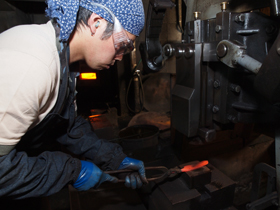
. Traditional products, such as a Japanese razor, the Ikenobo scissors, etc. which learned the method of making from an expert, are made from KANETAKA. In addition to them, idea goods, such as a herb clip, a pencil sharpener, and a knife that deletes the reed of a wind instrument, are also produced broadly.
<br class="clear-both" />
</div>
</div>
<p><strong>The notes on use Kiribashi [KANETAKA]</strong></p>
<p>* Please do not twist. <br />
* please do not drop<br />
* It rusts for a steel part. Please wipe after use well. <br />
* Pleasey a whetstone, if it becomes difficult to cut. <br />
* If edged tool oil is applied, it will last long more. </p> </p>]]></content:encoded>
                    <dc:subject>Ueki-Basami &amp; Kiribashi Shears (Aogami &amp; Shirogami)</dc:subject>
                    <dc:creator>TETSUFUKU</dc:creator>
                    <dc:format>17600</dc:format>
                    <dc:date>2026-07-08T18:01:50+09:00</dc:date>
                    <dc:type>shop</dc:type>
                </item>
                
                <item rdf:about="https://www.tetsufuku.com/product/254">
                    <title>[Kanetaka] Right-Handed Kyoto Style Ueki-Basami 215mm (8.5&quot;) Aogami No.2</title>
                    <link>https://www.tetsufuku.com/product/254</link>
                    <description>* There are many points to note. Please be sure to understand that the high hardness blade is easy t…</description>
                    <content:encoded><![CDATA[<p><a href="https://www.tetsufuku.com/product/254" target="_blank"><img src="https://www.tetsufuku.com/data/tetsufuku/product/20220217_e35009.JPG" width="250" border="0" alt="[Kanetaka] Right-Handed Kyoto Style Ueki-Basami 215mm (8.5") Aogami No.2" hspace="5" align="left"/></a>* There are many points to note. Please be sure to understand that the high hardness blade is easy to chip if you are not used to it, and that the Kyo style scissors have a loose fulcrum, and read the full text before purchasing. 
* Other names for Wabasami are Warabite, Uekibasami, Kibasami, and Nanban. These have almost the same shape.
* If it is out of stock, it will be made to order. Please feel free to contact us. In most cases, it can be delivered in about one month. 

It is a pair of scissors that you can experience Japanese tradition. The culture of the Japanese garden has developed along with the history of Kyoto. In other words, the scissors in Kyoto are the symbol that has supported the traditional Japanese gardening. The manufacturer of this scissors, Kanetaka, is a blacksmith with a history of over 350 years in Kyoto. If you want to equip the Japanese garden tradition, Kanetaka will be one of the leading options.

This Ueki-Basami 215mm (8.46 inch) is a pair of scissors actually used by professional NIWASHI (Japanese professional gardener). It is highly rigid and is manufactured optimized for cutting tree branches. Kyoto's tools have been developed through dialogue with customers. The spirit is inherited by this scissors, and various minor changes are repeated to reach the current shape.

Because it is a completely professional scissors, we prioritize high hardness that produces cutting ability. The harder the steel, the more brittle it becomes, so a blade with increased hardness is not suitable for gardener who make unnecessary movements their hands when cutting.
* If the blade is chipped while using this scissors, there is almost no possibility that the product is responsible. We always inspect before shipping. This scissors is so special that we have to write this notice. Japanese young gardeners will be able to use these scissors while making many mistakes (chipped, drop it, can't use it very well, etc).

These scissors are manufactured with particular attention to the sound of cutting. When the lower part of the handle fits when you cut through, the characteristic sound of hitting an iron rod will reverberate around you. People in the area understand that you are pruning. In traditional Japanese culture, there is a culture that uses the five senses to imagine who is doing what, even if they cannot be seen.

There are other products in Kanetaka's lineup of scissors. Ueki-Basami 180mm white paper steel is a normal specification. Ueki-Basami 215mm (8.46 inch) Blue paper steel has higher rigidity and cutting ability. Therefore, if you look closely, the hardness of the blade, the quenching and tempering methods, the cross-sectional shape of the blade and the finishing method by sharpening are completely different. In addition, the caulking design uses a traditional pattern called Kikuza that imitates a chrysanthemum flower.

*Shape
There are four styles of traditional Japanese gadening scissors. Ohkubo style, Tsushima style, Kyo style, Sasuke style. These scissors are Kyo style. "Kyo" means Kyoto. There are many products that imitate the shape, but this is one of the true Kyo styles. Manufacturer Kanetaka, who has a history of more than 350 years, belongs to the Kyoto Hamono Association and is working on the protection and tradition of this traditional scissors.

* Characteristics of these traditional Kyo style scissors
What surprises everyone is the looseness of fulcrum. However, this is the greatest feature of the Kyo style, which has a long history. When cutting, it is used by grasping it so that the gap between the blades does not open, but by that action, fulcrum changes its shape according to the habit of the person's hand. This is called "scissors grow". It will become a pair of scissors with your own habit.
* A normal product of this is one with wobbling in fulcrum. After purchase, please do not retighten by yourself.

*material
The blade is made of Yasuki blue paper steel. It is characterized by being hard and having a long. Hard iron is used for the handle. Therefore, even if you cut a hard tree, it will not bend easily.

*Production method
They use a belt hammer and a grinder, but they make it entirely by hand. In particular, forge welding, forging and sharpening have a high level of finish that is possible only because of human work.

<p><strong>The main use</strong><br />
Pruning of wood.</p>

<div class="makerwaku">
<p class="midashi">About a maker, KANETAKA (Kyoto pref) </p>
<div class="makerwaku02">
<img src="https://tetsufuku.ocnk.net/data/tetsufuku/image/_6045386.jpg" alt="KANETAKA (The scene where Yoshitaka Yamada is manufacturing Japanese razor )" width="280" height="210" />
A store and a factory are in front of the head family of the flower arrangement "Ikenobo" which is proud of the membership maximum by the oldest, and the birthplace. Also only by record remaining, it is a long-established store of seven generation at 200 years (History as a blacksmith is over 350 years). Mr. Kazuhiro Yamada of the eldest son inherited Master of sharpen, and Mr. Yoshitaka Yamada of the second son has acted as the blacksmith craftsman. <br />
. Traditional products, such as a Japanese razor, the Ikenobo scissors, etc. which learned the method of making from an expert, are made from KANETAKA. In addition to them, idea goods, such as a herb clip, a pencil sharpener, and a knife that deletes the reed of a wind instrument, are also produced broadly.
<br class="clear-both" />
</div>
</div>
<p><strong>The notes on use [Kanetaka] Right-Handed Kyoto Style Ueki-Basami 215mm (8.5") Aogami No.2</strong></p>
<p>* Please do not twist. <br />
* please do not drop<br />
* It rusts for a steel part. Please wipe after use well. <br />
* Pleasey a whetstone, if it becomes difficult to cut. <br />
* If edged tool oil is applied, it will last long more. </p> </p>]]></content:encoded>
                    <dc:subject>Ueki-Basami &amp; Kiribashi Shears (Aogami &amp; Shirogami)</dc:subject>
                    <dc:creator>TETSUFUKU</dc:creator>
                    <dc:format>46200</dc:format>
                    <dc:date>2026-07-08T18:00:20+09:00</dc:date>
                    <dc:type>shop</dc:type>
                </item>
                
                <item rdf:about="https://www.tetsufuku.com/product/257">
                    <title>[Kanetaka] Right-Handed Kyoto Style Kiribashi Shears 220mm (8.7&quot;) Shirogami No.2</title>
                    <link>https://www.tetsufuku.com/product/257</link>
                    <description>* Can&#039;t use this scissors suddenly. If you don&#039;t know how to hold it, don&#039;t buy it.
* If it is out …</description>
                    <content:encoded><![CDATA[<p><a href="https://www.tetsufuku.com/product/257" target="_blank"><img src="https://www.tetsufuku.com/data/tetsufuku/product/20220218_24ecc4.JPG" width="250" border="0" alt="[Kanetaka] Right-Handed Kyoto Style Kiribashi Shears 220mm (8.7") Shirogami No.2" hspace="5" align="left"/></a>* Can't use this scissors suddenly. If you don't know how to hold it, don't buy it.<br />
* If it is out of stock, it will be made to order. Please feel free to contact us. In most cases, it can be delivered in about one month. <br />
<br />
This scissors is completely special. Because of its unique shape in Kyoto, it can only be used by gardeners who have trained in Kyoto basically.<br />
<br />
・ If you don't know how to hold it, don't buy it.<br />
・ We will not accept returns, etc. at our expense except for obvious initial defects.<br />
・ It is really difficult to master. In fact, I can't use it cleanly either.<br />
<br />
It is a pair of scissors that you can experience Japanese tradition. The culture of the Japanese garden has developed along with the history of Kyoto. In other words, the scissors in Kyoto are the symbol that has supported the traditional Japanese gardening. The manufacturer of this scissors, Kanetaka, is a blacksmith with a history of over 350 years in Kyoto. If you want to equip the Japanese garden tradition, Kanetaka will be one of the leading options.<br />
<br />
This Kiribashi 220mm (8.66 inch) is a pair of scissors actually used by professional NIWASHI (Japanese professional gardener). It is highly rigid and is manufactured optimized for cutting tree branches. Kyoto's tools have been developed through dialogue with customers. The spirit is inherited by this scissors, and various minor changes are repeated to reach the current shape.<br />
<br />
The setting is exclusively for professionals and experienced people. It is a little soft than Kiribashi, a blue paper steel manufactured by Kanetaka, to make it easier to use. And because it is white paper steel, it is easy to sharpen. The fulcrum and looseness are also reduced. However, it is certainly difficult for beginners to use. Not suitable for gardeners who move their hands unnecessarily when cutting.<br />
* If the blade is chipped while using this scissors, there is almost no possibility that the product is responsible. We always inspect it before shipping. This scissors is so special that I have to write this notice. Young Japanese gardeners can use these scissors while making many mistakes (chips, drops, misuse, etc.).<br />
<br />
These scissors are manufactured with particular attention to the sound of cutting. When the lower part of the handle fits when you cut through, the characteristic sound of hitting an iron rod will reverberate around you. People in the area understand that you are pruning. In traditional Japanese culture, there is a culture that uses the five senses to imagine who is doing what, even if they cannot be seen.<br />
<br />
*Shape<br />
There are styles of traditional Japanese gadening of Kyoto scissors. Manufacturer Kanetaka, who has a history of more than 350 years, belongs to the Kyoto Hamono Association and is working on the protection and tradition of this traditional scissors.<br />
<br />
* Characteristics of these traditional Kyo style scissors<br />
What surprises everyone is the a little looseness of fulcrum. However, this is the greatest feature of the Kyo style and Kiribashi, which has a long history. When cutting, it is used by grasping it so that the gap between the blades does not open, but by that action, fulcrum changes its shape according to the habit of the person's hand. This is called "scissors grow". It will become a pair of scissors with your own habit.<br />
* A normal product of this is one with wobbling in fulcrum. After purchase, please do not retighten by yourself.<br />
<br />
*material<br />
The blade is made of Yasuki white paper steel. It is characterized by being little hard. Hard iron is used for the handle. Therefore, even if you cut a hard tree, it will not bend easily.<br />
<br />
*Production method<br />
They use a belt hammer and a grinder, but they make it entirely by hand. In particular, forge welding, forging and sharpening have a high level of finish that is possible only because of human work.<br />
<br />
<p><strong>The main use</strong><br /><br />
Pruning branches.</p><br />
<br />
<div class="makerwaku"><br />
<p class="midashi">About a maker, KANETAKA (Kyoto pref) </p><br />
<div class="makerwaku02"><br />
<img src="https://tetsufuku.ocnk.net/data/tetsufuku/image/_6045386.jpg" alt="KANETAKA (The scene where Yoshitaka Yamada is manufacturing Japanese razor )" width="280" height="210" /><br />
A store and a factory are in front of the head family of the flower arrangement "Ikenobo" which is proud of the membership maximum by the oldest, and the birthplace. Also only by record remaining, it is a long-established store of seven generation at 200 years (History as a blacksmith is over 350 years). Mr. Kazuhiro Yamada of the eldest son inherited Master of sharpen, and Mr. Yoshitaka Yamada of the second son has acted as the blacksmith craftsman. <br /><br />
. Traditional products, such as a Japanese razor, the Ikenobo scissors, etc. which learned the method of making from an expert, are made from KANETAKA. In addition to them, idea goods, such as a herb clip, a pencil sharpener, and a knife that deletes the reed of a wind instrument, are also produced broadly.<br />
<br class="clear-both" /><br />
</div><br />
</div><br />
<p><strong>The notes on use [Kanetaka] Right-Handed Kyoto Style Kiribashi Shears 220mm (8.7") Shirogami No.2</strong></p><br />
<p>* Please do not twist. <br /><br />
* please do not drop<br /><br />
* It rusts for a steel part. Please wipe after use well. <br /><br />
* Pleasey a whetstone, if it becomes difficult to cut. <br /><br />
* If edged tool oil is applied, it will last long more. </p> </p>]]></content:encoded>
                    <dc:subject>Ueki-Basami &amp; Kiribashi Shears (Aogami &amp; Shirogami)</dc:subject>
                    <dc:creator>TETSUFUKU</dc:creator>
                    <dc:format>38500</dc:format>
                    <dc:date>2026-07-08T17:58:51+09:00</dc:date>
                    <dc:type>shop</dc:type>
                </item>
                
                <item rdf:about="https://www.tetsufuku.com/product/256">
                    <title>[Kanetaka] Right-Handed Kyoto Style Kiribashi Shears 230mm (9.1&quot;) Aogami No.2</title>
                    <link>https://www.tetsufuku.com/product/256</link>
                    <description>* Can&#039;t use this scissors suddenly. If you don&#039;t know how to hold it, don&#039;t buy it.
* If it is out …</description>
                    <content:encoded><![CDATA[<p><a href="https://www.tetsufuku.com/product/256" target="_blank"><img src="https://www.tetsufuku.com/data/tetsufuku/product/20220218_24ecc4.JPG" width="250" border="0" alt="[Kanetaka] Right-Handed Kyoto Style Kiribashi Shears 230mm (9.1") Aogami No.2" hspace="5" align="left"/></a>* Can't use this scissors suddenly. If you don't know how to hold it, don't buy it.<br />
* If it is out of stock, it will be made to order. Please feel free to contact us. In most cases, it can be delivered in about one month. <br />
<br />
This scissors is completely special. Because of its unique shape in Kyoto, it can only be used by gardeners who have trained in Kyoto basically.<br />
<br />
・ If you don't know how to hold it, don't buy it.<br />
・ We will not accept returns, etc. at our expense except for obvious initial defects.<br />
・ It is really difficult to master. In fact, I can't use it cleanly either.<br />
<br />
It is a pair of scissors that you can experience Japanese tradition. The culture of the Japanese garden has developed along with the history of Kyoto. In other words, the scissors in Kyoto are the symbol that has supported the traditional Japanese gardening. The manufacturer of this scissors, Kanetaka, is a blacksmith with a history of over 350 years in Kyoto. If you want to equip the Japanese garden tradition, Kanetaka will be one of the leading options.<br />
<br />
This Kiribashi 230mm (9.06 inch) is a pair of scissors actually used by professional NIWASHI (Japanese professional gardener). It is highly rigid and is manufactured optimized for cutting tree branches. Kyoto's tools have been developed through dialogue with customers. The spirit is inherited by this scissors, and various minor changes are repeated to reach the current shape.<br />
<br />
Because it is a completely professional scissors, we prioritize high hardness that produces cutting ability. The harder the steel, the more brittle it becomes, so a blade with increased hardness is not suitable for gardener who make unnecessary movements their hands when cutting.<br />
* If the blade is chipped while using this scissors, there is almost no possibility that the product is responsible. We always inspect before shipping. This scissors is so special that we have to write this notice. Japanese young gardeners will be able to use these scissors while making many mistakes (chipped, drop it, can't use it very well, etc). <br />
<br />
These scissors are manufactured with particular attention to the sound of cutting. When the lower part of the handle fits when you cut through, the characteristic sound of hitting an iron rod will reverberate around you. People in the area understand that you are pruning. In traditional Japanese culture, there is a culture that uses the five senses to imagine who is doing what, even if they cannot be seen.<br />
<br />
*Shape<br />
There are styles of traditional Japanese gadening of Kyoto scissors. Manufacturer Kanetaka, who has a history of more than 350 years, belongs to the Kyoto Hamono Association and is working on the protection and tradition of this traditional scissors.<br />
<br />
* Characteristics of these traditional Kyo style scissors<br />
What surprises everyone is the a little looseness of fulcrum. However, this is the greatest feature of the Kyo style and Kiribashi, which has a long history. When cutting, it is used by grasping it so that the gap between the blades does not open, but by that action, fulcrum changes its shape according to the habit of the person's hand. This is called "scissors grow". It will become a pair of scissors with your own habit.<br />
* A normal product of this is one with wobbling in fulcrum. After purchase, please do not retighten by yourself.<br />
<br />
*material<br />
The blade is made of Yasuki blue paper steel. It is characterized by being hard and having a long. Hard iron is used for the handle. Therefore, even if you cut a hard tree, it will not bend easily.<br />
<br />
*Production method<br />
They use a belt hammer and a grinder, but they make it entirely by hand. In particular, forge welding, forging and sharpening have a high level of finish that is possible only because of human work.<br />
<br />
<p><strong>The main use</strong><br /><br />
Pruning branches.</p><br />
<br />
<div class="makerwaku"><br />
<p class="midashi">About a maker, KANETAKA (Kyoto pref) </p><br />
<div class="makerwaku02"><br />
<img src="https://tetsufuku.ocnk.net/data/tetsufuku/image/_6045386.jpg" alt="KANETAKA (The scene where Yoshitaka Yamada is manufacturing Japanese razor )" width="280" height="210" /><br />
A store and a factory are in front of the head family of the flower arrangement "Ikenobo" which is proud of the membership maximum by the oldest, and the birthplace. Also only by record remaining, it is a long-established store of seven generation at 200 years (History as a blacksmith is over 350 years). Mr. Kazuhiro Yamada of the eldest son inherited Master of sharpen, and Mr. Yoshitaka Yamada of the second son has acted as the blacksmith craftsman. <br /><br />
. Traditional products, such as a Japanese razor, the Ikenobo scissors, etc. which learned the method of making from an expert, are made from KANETAKA. In addition to them, idea goods, such as a herb clip, a pencil sharpener, and a knife that deletes the reed of a wind instrument, are also produced broadly.<br />
<br class="clear-both" /><br />
</div><br />
</div><br />
<p><strong>The notes on use [Kanetaka] Right-Handed Kyoto Style Kiribashi Shears 230mm (9.1") Aogami No.2</strong></p><br />
<p>* Please do not twist. <br /><br />
* please do not drop<br /><br />
* It rusts for a steel part. Please wipe after use well. <br /><br />
* Pleasey a whetstone, if it becomes difficult to cut. <br /><br />
* If edged tool oil is applied, it will last long more. </p> </p>]]></content:encoded>
                    <dc:subject>Ueki-Basami &amp; Kiribashi Shears (Aogami &amp; Shirogami)</dc:subject>
                    <dc:creator>TETSUFUKU</dc:creator>
                    <dc:format>46200</dc:format>
                    <dc:date>2026-07-08T17:58:27+09:00</dc:date>
                    <dc:type>shop</dc:type>
                </item>
                
                <item rdf:about="https://www.tetsufuku.com/product/317">
                    <title>[Sasaoka] Right-Handed Gourd-Shaped Kiribashi Shears 210mm (8.3&quot;) Aogami No.2</title>
                    <link>https://www.tetsufuku.com/product/317</link>
                    <description>Features of [Sasaoka] Right-Handed Gourd-Shaped Kiribashi Shears 210mm (8.3&quot;) Aogami No.2

This pr…</description>
                    <content:encoded><![CDATA[<p><a href="https://www.tetsufuku.com/product/317" target="_blank"><img src="https://www.tetsufuku.com/data/tetsufuku/product/20250303_ed5ab0.jpg" width="250" border="0" alt="[Sasaoka] Right-Handed Gourd-Shaped Kiribashi Shears 210mm (8.3") Aogami No.2" hspace="5" align="left"/></a><h2>Features of [Sasaoka] Right-Handed Gourd-Shaped Kiribashi Shears 210mm (8.3") Aogami No.2</h2>
<ul>
<li>This product is for right-handed people only.</li>
<li>These professional pruning shears are used by Japanese gardeners for thinning pruning.</li>
<li>Until you get used to using them, they are more difficult to use than regular pruning shears, but once you do, they are very easy to use.</li>
<li>The shape is gourd-shaped, devised by Mr. Yoshinobu Osumi (Yasuhiro) of Kyoto.</li>
<li>They are characterized by a bulge towards the tail so that it is easier to apply pressure with the little finger.</li>
<li>The blade is thicker than the Okubo-style, with a deeper back face indentation.</li>
<li>It uses Yasuki steel blue paper (Aogami) No. 2.</li>
<li>The shape is designed to emphasize the balance felt when holding it.</li>
<li>The feeling of cutting is transmitted directly to your hand.</li>
</ul>

<p><img src="https://www.tetsufuku.com/data/tetsufuku/product/_B081420.jpg" alt="kiribashi gourd-shaped"/></p>

<h3>About [Sasaoka] Right-Handed Gourd-Shaped Kiribashi Shears 210mm (8.3") Aogami No.2</h3>
<p>First of all, it is worth noting that it is very cost-effective. Although these pruning shears are made by hand through all the processes of forging, welding, and sharpening, they are very reasonably priced. The reason for this is simple: the cost of living in the Kochi area is lower than the standard price range in Japan.</p>

<p>This is a special order item among the pruning shears made by Sasaoka factory, which makes traditional Japanese pruning scissors. The gourd-shaped kiribashi was originally designed by Yoshinobu Osumi of Yasuhiro in Kyoto. With his permission, Sasaoka factory reproduced this shape.</p>

<p>The most notable feature of the gourd-shaped kiribashi is that it does not have a ring shape on the handle, and the tail of the grip swells once so that the little finger can put pressure on it. This makes it possible to cut through branches with less force overall. The blade is made of blue paper steel (Aogami) No. 2, which improves sharpness and durability.</p>

<p>For the Japanese, Kyoto is the root of Japanese culture. Therefore, traditions have been preserved and passed down for a long time, but as a side effect, it is difficult to create new things. Pruning shears are one example of this, and the traditional shape has been preserved for a long time. However, a new traditional shape has been presented. This gourd-shaped kiribashi was invented by Mr. Yoshinobu Osumi. While preserving the traditional shape of kiribashi, a new concept kiribashi was born.</p>

<p>Kiribashi made in Kyoto are characterized by their great looseness at the fulcrum. The gourd-shaped kiribashi made by Yoshinobu Osumi of the original also have a great deal of looseness. However, the Sasaoka kiribashi have almost no looseness, making them easy to use. Another feature of the Kyoto style is that the rivets at the fulcrum are handcrafted into a chrysanthemum pattern. This is also a style that has been completely adopted. In fact, professional gardeners all over Japan use these pruning shears.</br>
* The looseness of the fulcrum of the original Kyoto shears is intentional. It is based on the concept that the shape of the fulcrum is optimized based on the user's habits.</p>

<h3>Shipping and ordering information</h3>
<p style="color:#FF0000">If the item is in stock, it will be shipped within 3 business days. We usually ship the next day.<br />
Please contact us if the item is out of stock.</p>

<h3>About Sasaoka, the blacksmith who manufactured this product (Kochi pref)</h3>
<p><img src="https://www.tetsufuku.com/data/tetsufuku/product/20230602_952c7e.jpg" alt="Sasaoka (Working scene of current Tobisho's master blacksmith, Satoru Sasaoka.)" /></p>
<p>Eiji Sasaoka, the first generation, and Satoru Sasaoka, the second generation, are the only Hasami Blacksmiths in Tosa (Hasami means clippers, scissors, shears, pruners, secateurs, etc). According to Mr. Satoru, "The Mr. Eiji has a strong spirit of challenge and has great skills. And I think that my characteristic is to work carefully." In fact, the Hasami of Sasaoka that the two of them produce are a collaboration of skill and politeness. Looking at the mallet marks and sharpening marks, you can feel the warmth of handmade. On the other hand, when you actually use it, it cuts smoothly. The Hasami and knives in particular are carefully hand-sharpened, so the blades are very beautiful.
Another feature of Sasaoka Scissors Manufacturing is that they can produce a wide variety of cutlery and tools using scissors as their basic technology. At the age of 24, Mr. Eiji set up a blacksmith factory here in Ino City, Kochi Prefecture, but when he was making Hasami, neighbors asked him to make kitchen knives and farming tools. Mr. Eiji, who has a strong spirit of challenge, quickly expanded the product categories of Sasaoka.</p>

<h3>Signature</h3>
The character "英" used in the inscription is derived from Eiji's name.</p>

<h3>The notes on use about [Sasaoka] Right-Handed Gourd-Shaped Kiribashi Shears 210mm (8.3") Aogami No.2</h3>
<p>* Please do not twist. <br />
* please do not drop.<br />
* Please do not use it for any purpose other than wood branches.<br />
* It rusts for a steel part. Please wipe after use well.</p></p>]]></content:encoded>
                    <dc:subject>Ueki-Basami &amp; Kiribashi Shears (Aogami &amp; Shirogami)</dc:subject>
                    <dc:creator>TETSUFUKU</dc:creator>
                    <dc:format>33000</dc:format>
                    <dc:date>2026-07-08T17:57:47+09:00</dc:date>
                    <dc:type>shop</dc:type>
                </item>
                
                <item rdf:about="https://www.tetsufuku.com/product/316">
                    <title>[Sasaoka] Right-Handed Kyoto Style Ueki-Basami 218mm (8.6&quot;) Aogami No.2</title>
                    <link>https://www.tetsufuku.com/product/316</link>
                    <description>Features of [Sasaoka] Right-Handed Kyoto Style Ueki-Basami 218mm (8.6&quot;) Aogami No.2

This product …</description>
                    <content:encoded><![CDATA[<p><a href="https://www.tetsufuku.com/product/316" target="_blank"><img src="https://www.tetsufuku.com/data/tetsufuku/product/20250303_70bc8e.jpg" width="250" border="0" alt="[Sasaoka] Right-Handed Kyoto Style Ueki-Basami 218mm (8.6") Aogami No.2" hspace="5" align="left"/></a><h2>Features of [Sasaoka] Right-Handed Kyoto Style Ueki-Basami 218mm (8.6") Aogami No.2</h2>
<ul>
<li>This product is for right-handed people only.</li>
<li>These professional pruning shears are used by Japanese gardeners for thinning pruning.</li>
<li>The shape is Kyoto-style, a style of manufactured in Kyoto.</li>
<li>The blade is thicker than the Okubo-style, with a deeper  back face indentation. It uses Yasuki steel blue paper (Aogami) No. 2.</li>
<li>The handle wraps around under the shoulder.</li>
<li>It has a somewhat heavy feeling when you hold it.</li>
<li>As a result, the feeling of cutting is transmitted directly to your hand.</li>
</ul>

<p><img src="https://www.tetsufuku.com/data/tetsufuku/product/_U010627.jpg" alt="Sasaoka kyoto style traditional pruning shears" /></p>

<h3>About [Sasaoka] Right-Handed Kyoto Style Ueki-Basami 218mm (8.6") Aogami No.2</h3>
<p>First of all, it is worth noting that it is very cost-effective. Although these pruning shears are made by hand through all the processes of forging, welding, and sharpening, they are very reasonably priced. The reason for this is simple: the cost of living in the Kochi area is lower than the standard price range in Japan.</p>

<p>Among the pruning shears made by Sasaoka factory, which makes traditional Japanese pruning shears, this product is specialized in the shape that has been manufactured in Kyoto. The blade is made of blue paper steel No. 2, which enhances sharpness and durability.</p>

<p>Kyoto is a special place for traditional Japanese gardeners. There are many shrines and temples with long histories, and in some places, they have passed down culture that is over 1,000 years old to the present day. Many gardeners who have trained in Kyoto or visited the area have purchased Kyoto-style scissors and used them locally. This trend has become particularly noticeable in the last half century. This product is a product that closely follows the traditional Kyoto-style shape.</p>

<p>The original Kyoto-style pruning shears have a large amount of looseness at the fulcrum, but Sasaoka's Kyoto-style shears have almost no looseness. Therefore, they are easy to use. Another feature of the Kyoto-style is that the rivets at the fulcrum are handmade in a chrysanthemum pattern. This is also completely followed. In fact, professional gardeners all over Japan use these pruning shears.</br>
* The looseness of the fulcrum of the original Kyoto shears is intentional. It is based on the concept that the shape of the fulcrum is optimized based on the user's habits.</p>

<h3>Shipping and ordering information</h3>
<p style="color:#FF0000">If the item is in stock, it will be shipped within 3 business days. We usually ship the next day.<br />
Please contact us if the item is out of stock.</p>

<h3>About Sasaoka, the blacksmith who manufactured this product (Kochi pref)</h3>
<p><img src="https://www.tetsufuku.com/data/tetsufuku/product/20230602_952c7e.jpg" alt="Sasaoka (Working scene of current Tobisho's master blacksmith, Satoru Sasaoka.)" /></p>
<p>Eiji Sasaoka, the first generation, and Satoru Sasaoka, the second generation, are the only Hasami Blacksmiths in Tosa (Hasami means clippers, scissors, shears, pruners, secateurs, etc). According to Mr. Satoru, "The Mr. Eiji has a strong spirit of challenge and has great skills. And I think that my characteristic is to work carefully." In fact, the Hasami of Sasaoka that the two of them produce are a collaboration of skill and politeness. Looking at the mallet marks and sharpening marks, you can feel the warmth of handmade. On the other hand, when you actually use it, it cuts smoothly. The Hasami and knives in particular are carefully hand-sharpened, so the blades are very beautiful.
Another feature of Sasaoka Scissors Manufacturing is that they can produce a wide variety of cutlery and tools using scissors as their basic technology. At the age of 24, Mr. Eiji set up a blacksmith factory here in Ino City, Kochi Prefecture, but when he was making Hasami, neighbors asked him to make kitchen knives and farming tools. Mr. Eiji, who has a strong spirit of challenge, quickly expanded the product categories of Sasaoka.</p>

<h3>Signature</h3>
The character "英" used in the inscription is derived from Eiji's name.</p>

<h3>The notes on use about [Sasaoka] Right-Handed Kyoto Style Ueki-Basami 218mm (8.6") Aogami No.2</h3>
<p>* Please do not twist. <br />
* please do not drop.<br />
* Please do not use it for any purpose other than wood branches.<br />
* It rusts for a steel part. Please wipe after use well.</p></p>]]></content:encoded>
                    <dc:subject>Ueki-Basami &amp; Kiribashi Shears (Aogami &amp; Shirogami)</dc:subject>
                    <dc:creator>TETSUFUKU</dc:creator>
                    <dc:format>29700</dc:format>
                    <dc:date>2026-07-08T17:57:15+09:00</dc:date>
                    <dc:type>shop</dc:type>
                </item>
                
                <item rdf:about="https://www.tetsufuku.com/product/315">
                    <title>[Sasaoka] Left-Handed Okubo Style Ueki-Basami 200mm (7.9&quot;) Aogami No.2</title>
                    <link>https://www.tetsufuku.com/product/315</link>
                    <description>Features of [Sasaoka] Left-Handed Okubo Style Ueki-Basami 200mm (7.9&quot;) Aogami No.2

This product i…</description>
                    <content:encoded><![CDATA[<p><a href="https://www.tetsufuku.com/product/315" target="_blank"><img src="https://www.tetsufuku.com/data/tetsufuku/product/20250303_7c26c6.jpg" width="250" border="0" alt="[Sasaoka] Left-Handed Okubo Style Ueki-Basami 200mm (7.9") Aogami No.2" hspace="5" align="left"/></a><h2>Features of [Sasaoka] Left-Handed Okubo Style Ueki-Basami 200mm (7.9") Aogami No.2</h2>
<ul>
<li>This product is for left-handed people only.</li>
<li>These professional pruning shears are used by Japanese gardeners for thinning pruning.</li>
<li>The shape is called the Okubo style, and is considered to be the most standard specification.</li>
<li>The blade is thinner than the Kyoto type, and has a moderate back face indentation. Made from Yasuki steel blue paper (Aogami) No. 2.</li>
<li>The handle wraps around to the shoulder area.</li>
<li>The shape is designed to emphasize the balance felt when holding it.</li>
<li>Feeling of cutting is light.</li>
</ul>

<h3>About [Sasaoka] Left-Handed Okubo Style Ueki-Basami 200mm (7.9") Aogami No.2</h3>
<p>First of all, it is worth noting that it is very cost-effective. Although these pruning shears are made by hand through all the processes of forging, welding, and sharpening, they are very reasonably priced. The reason for this is simple: the cost of living in the Kochi area is lower than the standard price range in Japan.</p>

<p>Among the pruning shears made by Sasaoka factory, which makes traditional Japanese pruning shears, this is an Okubo-style product, which is considered to be the most standard type. The blade is made of blue paper steel (Aogami) No. 2, which improves sharpness and durability. The Okubo-style is recognized as a standard specification, but the origin of the name and where it was created are unclear. However, when you want traditional Japanese pruning shears, the first one you should consider is the Okubo-style.</p>

<p>This pruning shears is for left-handed people only. The blade and handle have the reverse three-dimensional structure as the right-handed ones, so all the normal manufacturing processes have to be reversed, and therefore the price is higher than the right-handed version. Thank you for your understanding.</p>

<h3>Shipping and ordering information</h3>
<p style="color:#FF0000">If the item is in stock, it will be shipped within 3 business days. We usually ship the next day.<br />
Please contact us if the item is out of stock.</p>

<h3>About Sasaoka, the blacksmith who manufactured this product (Kochi pref)</h3>
<p><img src="https://www.tetsufuku.com/data/tetsufuku/product/20230602_952c7e.jpg" alt="Sasaoka (Working scene of current Tobisho's master blacksmith, Satoru Sasaoka.)" /></p>
<p>Eiji Sasaoka, the first generation, and Satoru Sasaoka, the second generation, are the only Hasami Blacksmiths in Tosa (Hasami means clippers, scissors, shears, pruners, secateurs, etc). According to Mr. Satoru, "The Mr. Eiji has a strong spirit of challenge and has great skills. And I think that my characteristic is to work carefully." In fact, the Hasami of Sasaoka that the two of them produce are a collaboration of skill and politeness. Looking at the mallet marks and sharpening marks, you can feel the warmth of handmade. On the other hand, when you actually use it, it cuts smoothly. The Hasami and knives in particular are carefully hand-sharpened, so the blades are very beautiful.
Another feature of Sasaoka Scissors Manufacturing is that they can produce a wide variety of cutlery and tools using scissors as their basic technology. At the age of 24, Mr. Eiji set up a blacksmith factory here in Ino City, Kochi Prefecture, but when he was making Hasami, neighbors asked him to make kitchen knives and farming tools. Mr. Eiji, who has a strong spirit of challenge, quickly expanded the product categories of Sasaoka.</p>

<h3>Signature</h3>
The character "英" used in the inscription is derived from Eiji's name.</p>

<h3>The notes on use about [Sasaoka] Okubo traditional shears (Left-handed)</h3>
<p>* Please do not twist. <br />
* please do not drop.<br />
* Please do not use it for any purpose other than wood branches.<br />
* It rusts for a steel part. Please wipe after use well.</p></p>]]></content:encoded>
                    <dc:subject>Ueki-Basami &amp; Kiribashi Shears (Aogami &amp; Shirogami)</dc:subject>
                    <dc:creator>TETSUFUKU</dc:creator>
                    <dc:format>27500</dc:format>
                    <dc:date>2026-07-08T17:56:48+09:00</dc:date>
                    <dc:type>shop</dc:type>
                </item>
                
                <item rdf:about="https://www.tetsufuku.com/product/314">
                    <title>[Sasaoka] Right-Handed Okubo Style Ueki-Basami 200mm (7.9&quot;) Aogami No.2</title>
                    <link>https://www.tetsufuku.com/product/314</link>
                    <description>Why Choose [Sasaoka] Right-Handed Okubo Style Ueki-Basami 200mm (7.9&quot;) Aogami No.2?
Whether you&#039;re …</description>
                    <content:encoded><![CDATA[<p><a href="https://www.tetsufuku.com/product/314" target="_blank"><img src="https://www.tetsufuku.com/data/tetsufuku/product/20250303_d17841.jpg" width="250" border="0" alt="[Sasaoka] Right-Handed Okubo Style Ueki-Basami 200mm (7.9") Aogami No.2" hspace="5" align="left"/></a><h2>Why Choose [Sasaoka] Right-Handed Okubo Style Ueki-Basami 200mm (7.9") Aogami No.2?</h2>
<p>Whether you're a professional gardener or simply someone who takes pride in caring for your plants, the [Sasaoka] Okubo-Style Traditional Shears will become an indispensable tool in your collection. Designed with precision and balance in mind, these shears are one of a perfect example of Japanese craftsmanship at its finest.</p>

<ul>
    <li><strong>Crafted for Right-Handed Use:</strong> Exclusively for right-handed users, ensuring ergonomic comfort.</li>
    <li><strong>Trusted by Professionals:</strong> A favorite tool among Japanese gardeners, ideal for thinning and delicate pruning.</li>
    <li><strong>Iconic Okubo-Style Design:</strong> Known as the most standard specification in Japanese pruning shears.</li>
    <li><strong>Superior Blade Quality:</strong> Features a thinner blade than Kyoto-style shears with a moderate back-face indentation, crafted from premium Yasuki steel blue paper (Aogami) No. 2 for outstanding sharpness and durability.</li>
    <li><strong>Perfectly Balanced Handle:</strong> A wraparound handle design that ensures a natural balance and lightweight cutting experience.</li>
    <li><strong>Smooth Cutting Performance:</strong> Designed for a light and effortless pruning experience.</li>
</ul>

<h3>Why These Shears Offer Outstanding Value</h3>
<p>Handcrafted through every step of forging, welding, and sharpening, these shears deliver exceptional quality while remaining surprisingly affordable. Located in Ino City, Kochi Prefecture—an area with a lower cost of living—Sasaoka combines master craftsmanship with cost efficiency, ensuring you get premium tools without a premium price tag. If you're looking for a quintessentially Japanese pruning tool, the Okubo-Style should be your go-to choice.</p>

<h3>The Legacy of Sasaoka: Masters of Hasami (shears)</h3>
<p><img src="https://www.tetsufuku.com/data/tetsufuku/product/20230602_952c7e.jpg" alt="Sasaoka (Working scene of current Tobisho's master blacksmith, Satoru Sasaoka.)" /></p>
<p>Sasaoka is one of the most respected blacksmith workshops in Tosa, renowned for their skill and dedication to their craft. Founded by Eiji Sasaoka, the spirit of challenge and perfection lives on in his successor, Satoru Sasaoka. Together, they’ve built a reputation for creating scissors and tools that embody precision, durability, and warmth.</p>
<p>Beyond pruning shears, Sasaoka's innovations extend to kitchen knives, farming tools, and more, making them a versatile name in Japanese blacksmithing. Each piece carries the legacy of handmade excellence, with fine hammer and sharpening marks that tell a story of care and skill.</p>

<h3>Care Instructions for Your Shears</h3>
<p>To preserve the exceptional quality of your [Sasaoka] Okubo-Style Shears, follow these care tips:</p>
<ul>
    <li>Do not twist the shears to avoid damage.</li>
    <li>Handle with care—dropping the shears may affect their precision.</li>
    <li>Use only for pruning wood branches to maintain blade integrity.</li>
    <li>Wipe the steel parts dry after use to prevent rusting.</li>
</ul>

<h3>Shipping Information</h3>
<p style="color:#FF0000;">If the item is in stock, it will be shipped within 3 business days. Orders are typically shipped the next day. If the item is out of stock, please contact us for availability.</p>

<h3>Signature of Excellence</h3>
<p>The character "英" engraved on the blade is a tribute to Eiji Sasaoka, the founder of this remarkable lineage of blacksmiths. Owning a pair of Sasaoka shears means carrying a piece of this history into your daily life.</p></p>]]></content:encoded>
                    <dc:subject>Ueki-Basami &amp; Kiribashi Shears (Aogami &amp; Shirogami)</dc:subject>
                    <dc:creator>TETSUFUKU</dc:creator>
                    <dc:format>22000</dc:format>
                    <dc:date>2026-07-08T17:56:19+09:00</dc:date>
                    <dc:type>shop</dc:type>
                </item>
                
                <item rdf:about="https://www.tetsufuku.com/product/339">
                    <title>[Kondo] Hex-Point Carbide-Tipped Chipping Chisel (Brass-Wrapped) Body:32mm (1.26&quot;) Carbide Tip:10x12mm (0.39x0.47&quot;)</title>
                    <link>https://www.tetsufuku.com/product/339</link>
                    <description>Maximum mass for relentless impact. Wrapped in brass to cushion the blow. — Premium Japanese Hand-Fo…</description>
                    <content:encoded><![CDATA[<p><a href="https://www.tetsufuku.com/product/339" target="_blank"><img src="https://www.tetsufuku.com/data/tetsufuku/product/20120827_498e15.jpg" width="250" border="0" alt="[Kondo] Hex-Point Carbide-Tipped Chipping Chisel (Brass-Wrapped) Body:32mm (1.26") Carbide Tip:10x12mm (0.39x0.47")" hspace="5" align="left"/></a><h2>Maximum mass for relentless impact. Wrapped in brass to cushion the blow. — Premium Japanese Hand-Forged Stonemason Tools</h2>

<h3>About the Kondo Stonemason Tools Factory Hex-Point Series</h3>

<p>The Hex-Point Carbide-Tipped Chipping Chisel series is engineered for the critical phase of dressing and surface flattening in both traditional Japanese stone walling and international dry stone walling. Unlike a Koyasuke, which is designed to aggressively shear off major stone corners, the primary responsibility of the hexagonal chisel is to pinpoint and knock down stubborn bumps and raised irregularities on near-flat stone faces. By clearing these protrusions, craftsmen can precisely adjust the interfaces where adjacent stones meet, ensuring a structurally stable and seamless fit. Because repeatedly walking back to a distant toolbox is highly inefficient on a busy site, professional stonemasons typically evaluate the geology of the stone and select a single, optimal body diameter to carry as their primary tool for the day.</p>

<p>Mechanical straightness defines the structural integrity of this series. Kondo masterfully forges each instrument so that the centerline axis of the steel body and the centerline axis of the hexagonal tungsten carbide tip sit in a perfectly collinear alignment. When a hammer strike lands on the forged steel head, the kinetic energy moves through this undivided straight line without lateral deflection or rotational loss, driving the full mechanical force directly into the stone's protrusion. This alignment significantly enhances structural stability, ensuring the chisel head remains steady under heavy impact. While tungsten carbide delivers exceptional wear resistance compared to standard all-steel chisels, it is a physical reality that the carbide edge will still gradually lose its sharpness and round over through continuous friction against hard stone. Regularly refreshing the crispness of the edge on a Green Carbonite (GC) whetstone is an essential operational requirement to eliminate slipping and sustain a high-focus working rhythm.</p>

<h3>About Kondo Hex-Point Carbide-Tipped Chipping Chisel (Brass-Wrapped) Body:32mm (1.26") Carbide Tip:10x12mm (0.39x0.47")</h3>

<p>This is the 32mm (1.26") model featuring a premium Brass-Wrapped joint structure, delivering the maximum structural mass and impact energy within the entire Hex-Point lineup. It is engineered specifically for the most aggressive rough-chipping phases, where high material removal volumes are required to flatten heavy irregularities. The heavy 32mm round steel body acts as a massive kinetic reservoir, making it highly effective when squaring up tough, stubborn surfaces or matching heavily mismatched rock interfaces before final dressing. Within this series, the diameters graduate downward across six sizes to the highly agile 19mm version, which transitions the tool's focus from raw clearing power to meticulous fine-finishing and tight-quarter adjustments.</p>

<p>The defining feature of this specific model is its shock-absorbing architecture. A thick, protective jacket of brass is wrapped around the base of the ultra-hard tungsten carbide tip where it meets the forged steel shaft. This copper-alloy layer serves as a mechanical buffer, mitigating the punishing shock waves generated by violent metal-on-stone impacts and significantly reducing hand and arm fatigue during multi-hour operations. For professional stonemasons, the recommended standard companion for a 32mm chisel is a Setto hammer weighing between 1.0 and 1.3 kg to achieve the proper kinetic balance. However, this is not an absolute restriction; craftsmen frequently crossover and adjust their hammer weights based on personal preference, arm strength, or the specific resistance of the stone on site. A standard Embedded-style version of this identical 32mm size is also available for users prioritizing a more direct impact feedback.</p>

<h3>How to Maintain Your Kondo Carbide-Tipped Chisels</h3>

<p><strong>How do I re-sharpen the carbide edge when it rounds over?</strong><br>
To restore the crisp, biting geometry of a rounded hexagonal tip, use a Green Carbonite (GC) whetstone, such as the Aoto-equivalent GC 120H. For general stone labor, setting the edge to an initial baseline angle of approximately 60 degrees is highly recommended. As your technical experience grows, you can freely adjust this grinding angle to suit specific stone geologies: dressing soft, porous materials like Oya stone or Shirakawa stone allows for a clean 60-degree bevel, whereas processing highly resistant granites typically requires grinding to a more obtuse, durable angle to prevent edge deflection.</p>

<p><strong>How do I prevent the carbide tip from fracturing or detaching?</strong><br>
Tungsten carbide possesses immense compressive strength but is physically brittle when subjected to lateral stress or twisting forces. Never lever, twist, or pry the chisel while it is under the pressure of a strike. Because the Brass-Wrapped version relies on an exposed shock-absorbing layer, continuous dragging across raw stone can prematurely compromise the joint. To maximize the operational lifespan of the instrument, you must train your hand to lift the chisel slightly between every single hammer blow, preventing structural friction from cracking the brass buffer before the carbide wears down naturally.</p>

<p><strong>Does the steel body require rust prevention?</strong><br>
Yes. While the cutting point is tungsten carbide, the entire structural shaft is made of high-grade forged steel. Working in wet conditions or leaving moisture-laden stone dust caked on the handle will rapidly induce surface oxidation. After concluding daily labor, thoroughly wipe down the entire body with a dry cloth to clear away stone slurry and dust, and store the tool in a dry environment. Periodically applying a light film of low-viscosity machine oil to the steel shaft will preserve the forge-finish and prevent corrosion over long-term storage.</p>

<h3>About Kondo Stonemason Tools Factory: Three Generations of Integrated Hand-Forging</h3>

<figure>
<img src="https://www.tetsufuku.com/data/tetsufuku/image/_U016701.jpg" alt="Third-generation master Yoshiyuki Kondo hand-forging a steel stone chisel body at Kondo Stonemason Tools Factory in Okazaki, Japan" />
</figure>

<p>Kondo Stonemason Tools Factory has been forging professional stonemasonry equipment in Okazaki, Aichi Prefecture—a historic capital of Japanese stone craftsmanship—since 1936. Across three generations, this workshop has firmly rejected modern outsourcing, remaining one of the very few independent facilities capable of executing every single stage of production entirely under one roof. From the initial raw shaping of the steel bars and proprietary heat treatment to the high-precision brass brazing of specialized carbide tips, every process is conducted within their single Okazaki workshop, ensuring absolute metallurgical consistency.</p>

<p>The mechanical foundation of Kondo’s highly demanded modern carbide line was perfected by the late second-generation master, Yoji Kondo, who dedicated over 50 years of continuous labor to perfecting the integration of ultra-hard materials with hand-forged steel. Today, this rigorous engineering standard and uncompromised quality control are strictly maintained by his son, the third-generation master Yoshiyuki Kondo. This exceptional durability directly embodies the traditional Japanese philosophy of Mottainai—avoiding waste through extreme longevity—delivering an outstanding, multi-decade cost-effectiveness that mass-produced alternatives cannot replicate.</p>

<h3>Notes on use</h3>

<p><b>IMPORTANT: The body of this chisel is made of Forged Steel (Not Stainless Steel). It will rust if not cleaned and dried after use.</b><br>
Do not twist, pry, or lever the chisel during or after a strike.<br>
Avoid exposure to lateral impacts; never strike the side of the tool or use it as a crowbar.<br>
For Brass-Wrapped models, lift the tip slightly between strikes and avoid dragging the edge across stone.<br>
Match the chisel size with an appropriate hammer weight to avoid structural over-stressing.<br>
Always wear certified safety goggles, heavy-duty gloves, and protective footwear during operation.<br>
Do not use on concrete, metal rebar, wire, or any non-stone structural materials.<br>
Keep out of reach of children.</p>

<div class="series-options-box">
  <p class="series-options-title">🌿 Other options in this series</p>
  Looking for a direct impact response? ➔ <a href="https://www.tetsufuku.com/product/340">[Kondo] Hex-Point Carbide-Tipped Chipping Chisel (Embedded) Body:32mm (1.26") Carbide Tip:10x12mm (0.39x0.47") [KMF100209]</a><br>
  Looking for a slightly lighter body? ➔ <a href="https://www.tetsufuku.com/product/41">[Kondo] Hex-Point Carbide-Tipped Chipping Chisel (Brass-Wrapped) Body:30mm (1.18") Carbide Tip:10x12mm (0.39x0.47") [KMF100101]</a>
</div>

</p>]]></content:encoded>
                    <dc:subject>Hex-Point Carbide-Tipped Chipping Chisel</dc:subject>
                    <dc:creator>TETSUFUKU</dc:creator>
                    <dc:format>16500</dc:format>
                    <dc:date>2026-07-08T01:44:27+09:00</dc:date>
                    <dc:type>shop</dc:type>
                </item>
                
                <item rdf:about="https://www.tetsufuku.com/product/129">
                    <title>Blacksmith&#039;s tong (Flat) </title>
                    <link>https://www.tetsufuku.com/product/129</link>
                    <description>This is a Japanese blacksmith&#039;s tong. The shape of the tong has a flat. You can grip easily for flat…</description>
                    <content:encoded><![CDATA[<p><a href="https://www.tetsufuku.com/product/129" target="_blank"><img src="https://www.tetsufuku.com/data/tetsufuku/product/20130401_cf796c.jpg" width="250" border="0" alt="Blacksmith's tong (Flat) " hspace="5" align="left"/></a>This is a Japanese blacksmith's tong. The shape of the tong has a flat. You can grip easily for flat products.<br />
<br />
*Originally, the Japanese blacksmiths to manufacture tools for themselves.<br />
<br />
We called HIBASHI this product.<br />
"Hi" means fire.<br />
"BASHI (HASHI)" means chopstick.</p>]]></content:encoded>
                    <dc:subject>Blacksmith&#039;s tongs</dc:subject>
                    <dc:creator>TETSUFUKU</dc:creator>
                    <dc:format>15400</dc:format>
                    <dc:date>2026-07-07T17:35:41+09:00</dc:date>
                    <dc:type>shop</dc:type>
                </item>
                
                <item rdf:about="https://www.tetsufuku.com/product/128">
                    <title>Blacksmith&#039;s tong (The mouth of the Crow) </title>
                    <link>https://www.tetsufuku.com/product/128</link>
                    <description>This is a Japanese blacksmith&#039;s tong. The shape of the tong has a similar to the mouth of the crow.…</description>
                    <content:encoded><![CDATA[<p><a href="https://www.tetsufuku.com/product/128" target="_blank"><img src="https://www.tetsufuku.com/data/tetsufuku/product/20130401_b76e55.jpg" width="250" border="0" alt="Blacksmith's tong (The mouth of the Crow) " hspace="5" align="left"/></a>This is a Japanese blacksmith's tong. The shape of the tong has a similar to the mouth of the crow.<br />
<br />
*Originally, the Japanese blacksmiths to manufacture tools for themselves.<br />
<br />
We called HIBASHI this product.<br />
"Hi" means fire.<br />
"BASHI (HASHI)" means chopstick.</p>]]></content:encoded>
                    <dc:subject>Blacksmith&#039;s tongs</dc:subject>
                    <dc:creator>TETSUFUKU</dc:creator>
                    <dc:format>16500</dc:format>
                    <dc:date>2026-07-07T17:35:30+09:00</dc:date>
                    <dc:type>shop</dc:type>
                </item>
                
                <item rdf:about="https://www.tetsufuku.com/product/96">
                    <title>[KANETAKA] Fine Whetstone (artificial, #4000, for medium or large edges, with a table)</title>
                    <link>https://www.tetsufuku.com/product/96</link>
                    <description>Fine Whetstone (artificial, #4000, for medium or large edges, with a table)</description>
                    <content:encoded><![CDATA[<p><a href="https://www.tetsufuku.com/product/96" target="_blank"><img src="https://www.tetsufuku.com/data/tetsufuku/product/20120904_db2852.jpg" width="250" border="0" alt="[KANETAKA] Fine Whetstone (artificial, #4000, for medium or large edges, with a table)" hspace="5" align="left"/></a>Fine Whetstone (artificial, #4000, for medium or large edges, with a table)</p>]]></content:encoded>
                    <dc:subject>Whetstone</dc:subject>
                    <dc:creator>TETSUFUKU</dc:creator>
                    <dc:format>9900</dc:format>
                    <dc:date>2026-07-07T17:34:41+09:00</dc:date>
                    <dc:type>shop</dc:type>
                </item>
                
                <item rdf:about="https://www.tetsufuku.com/product/95">
                    <title>[KANETAKA] Fine Whetstone (artificial, #4000, for small or medium edges)</title>
                    <link>https://www.tetsufuku.com/product/95</link>
                    <description>Fine Whetstone (artificial, #4000, for small or medium edges)</description>
                    <content:encoded><![CDATA[<p><a href="https://www.tetsufuku.com/product/95" target="_blank"><img src="https://www.tetsufuku.com/data/tetsufuku/product/20120904_9b2425.jpg" width="250" border="0" alt="[KANETAKA] Fine Whetstone (artificial, #4000, for small or medium edges)" hspace="5" align="left"/></a>Fine Whetstone (artificial, #4000, for small or medium edges)</p>]]></content:encoded>
                    <dc:subject>Whetstone</dc:subject>
                    <dc:creator>TETSUFUKU</dc:creator>
                    <dc:format>5500</dc:format>
                    <dc:date>2026-07-07T17:34:25+09:00</dc:date>
                    <dc:type>shop</dc:type>
                </item>
                
                <item rdf:about="https://www.tetsufuku.com/product/94">
                    <title>[KANETAKA] Medium-rough Whetstone (artificial, #800, for medium or large edges)</title>
                    <link>https://www.tetsufuku.com/product/94</link>
                    <description>Medium-rough Whetstone (artificial, #800, for medium or large edges)</description>
                    <content:encoded><![CDATA[<p><a href="https://www.tetsufuku.com/product/94" target="_blank"><img src="https://www.tetsufuku.com/data/tetsufuku/product/20120904_aa1943.jpg" width="250" border="0" alt="[KANETAKA] Medium-rough Whetstone (artificial, #800, for medium or large edges)" hspace="5" align="left"/></a>Medium-rough Whetstone (artificial, #800, for medium or large edges)</p>]]></content:encoded>
                    <dc:subject>Whetstone</dc:subject>
                    <dc:creator>TETSUFUKU</dc:creator>
                    <dc:format>13200</dc:format>
                    <dc:date>2026-07-07T17:32:39+09:00</dc:date>
                    <dc:type>shop</dc:type>
                </item>
                
                <item rdf:about="https://www.tetsufuku.com/product/93">
                    <title>[KANETAKA] Medium-rough Whetstone (artificial, #800, for small or medium edges)</title>
                    <link>https://www.tetsufuku.com/product/93</link>
                    <description>Medium-rough Whetstone (artificial, #800, for small or medium edges)</description>
                    <content:encoded><![CDATA[<p><a href="https://www.tetsufuku.com/product/93" target="_blank"><img src="https://www.tetsufuku.com/data/tetsufuku/product/20120904_0e4e08.jpg" width="250" border="0" alt="[KANETAKA] Medium-rough Whetstone (artificial, #800, for small or medium edges)" hspace="5" align="left"/></a>Medium-rough Whetstone (artificial, #800, for small or medium edges)</p>]]></content:encoded>
                    <dc:subject>Whetstone</dc:subject>
                    <dc:creator>TETSUFUKU</dc:creator>
                    <dc:format>5500</dc:format>
                    <dc:date>2026-07-07T17:32:23+09:00</dc:date>
                    <dc:type>shop</dc:type>
                </item>
                
                <item rdf:about="https://www.tetsufuku.com/product/91">
                    <title>[KANETAKA] NAKURA</title>
                    <link>https://www.tetsufuku.com/product/91</link>
                    <description>NAKURA.
Please use with Honzan whetstone.</description>
                    <content:encoded><![CDATA[<p><a href="https://www.tetsufuku.com/product/91" target="_blank"><img src="https://www.tetsufuku.com/data/tetsufuku/product/20120904_5b06a2.jpg" width="250" border="0" alt="[KANETAKA] NAKURA" hspace="5" align="left"/></a>NAKURA.
Please use with Honzan whetstone.</p>]]></content:encoded>
                    <dc:subject>Whetstone</dc:subject>
                    <dc:creator>TETSUFUKU</dc:creator>
                    <dc:format>3300</dc:format>
                    <dc:date>2026-07-07T17:31:45+09:00</dc:date>
                    <dc:type>shop</dc:type>
                </item>
                
                <item rdf:about="https://www.tetsufuku.com/product/233">
                    <title>[NANIWA] Gouken Curved Water whetStone (#220)</title>
                    <link>https://www.tetsufuku.com/product/233</link>
                    <description>Fine Whetstone (artificial, #220), for pruning secateurs and all of curved edges. #220 is rough fini…</description>
                    <content:encoded><![CDATA[<p><a href="https://www.tetsufuku.com/product/233" target="_blank"><img src="https://www.tetsufuku.com/data/tetsufuku/product/20180708_1a4934.JPG" width="250" border="0" alt="[NANIWA] Gouken Curved Water whetStone (#220)" hspace="5" align="left"/></a>Fine Whetstone (artificial, #220), for pruning secateurs and all of curved edges. #220 is rough finished. This is the most necessary whetstone for repairing a small lacking blade and correcting the shape of the blade. All blacksmiths place importance on rough whetstones.</p>]]></content:encoded>
                    <dc:subject>Whetstone</dc:subject>
                    <dc:creator>TETSUFUKU</dc:creator>
                    <dc:format>1540</dc:format>
                    <dc:date>2026-07-07T17:30:42+09:00</dc:date>
                    <dc:type>shop</dc:type>
                </item>
                
                <item rdf:about="https://www.tetsufuku.com/product/67">
                    <title>[KANETAKA] Ikenobo Shears (Full length 180mm, long edges)</title>
                    <link>https://www.tetsufuku.com/product/67</link>
                    <description>Ikenobo Shears (Full length 180mm, long edges)</description>
                    <content:encoded><![CDATA[<p><a href="https://www.tetsufuku.com/product/67" target="_blank"><img src="https://www.tetsufuku.com/data/tetsufuku/product/20120828_927e19.jpg" width="250" border="0" alt="[KANETAKA] Ikenobo Shears (Full length 180mm, long edges)" hspace="5" align="left"/></a>Ikenobo Shears (Full length 180mm, long edges)</p>]]></content:encoded>
                    <dc:subject>Traditional Ikebana Scissors</dc:subject>
                    <dc:creator>TETSUFUKU</dc:creator>
                    <dc:format>44000</dc:format>
                    <dc:date>2026-07-07T17:26:29+09:00</dc:date>
                    <dc:type>shop</dc:type>
                </item>
                
                <item rdf:about="https://www.tetsufuku.com/product/68">
                    <title>[KANETAKA] Ikenobo Shears (Full length 165mm, long edges)</title>
                    <link>https://www.tetsufuku.com/product/68</link>
                    <description>Ikenobo Shears (Full length 165mm, long edges)</description>
                    <content:encoded><![CDATA[<p><a href="https://www.tetsufuku.com/product/68" target="_blank"><img src="https://www.tetsufuku.com/data/tetsufuku/product/20120828_696dfe.jpg" width="250" border="0" alt="[KANETAKA] Ikenobo Shears (Full length 165mm, long edges)" hspace="5" align="left"/></a>Ikenobo Shears (Full length 165mm, long edges)</p>]]></content:encoded>
                    <dc:subject>Traditional Ikebana Scissors</dc:subject>
                    <dc:creator>TETSUFUKU</dc:creator>
                    <dc:format>36000</dc:format>
                    <dc:date>2026-07-07T17:26:17+09:00</dc:date>
                    <dc:type>shop</dc:type>
                </item>
                
                <item rdf:about="https://www.tetsufuku.com/product/69">
                    <title>[KANETAKA] Ikenobo Pocket Shears (Full length 107mm)</title>
                    <link>https://www.tetsufuku.com/product/69</link>
                    <description>Ikenobo Pocket Shears (Full length 107mm)</description>
                    <content:encoded><![CDATA[<p><a href="https://www.tetsufuku.com/product/69" target="_blank"><img src="https://www.tetsufuku.com/data/tetsufuku/product/20120828_2464e3.jpg" width="250" border="0" alt="[KANETAKA] Ikenobo Pocket Shears (Full length 107mm)" hspace="5" align="left"/></a>Ikenobo Pocket Shears (Full length 107mm)</p>]]></content:encoded>
                    <dc:subject>Traditional Ikebana Scissors</dc:subject>
                    <dc:creator>TETSUFUKU</dc:creator>
                    <dc:format>9900</dc:format>
                    <dc:date>2026-07-07T17:26:02+09:00</dc:date>
                    <dc:type>shop</dc:type>
                </item>
                
                <item rdf:about="https://www.tetsufuku.com/product/24">
                    <title>[YSUHIRO] Ikenobo Shears (Full length 165mm)</title>
                    <link>https://www.tetsufuku.com/product/24</link>
                    <description>Mr. YOSHINOBU OSUMI follows the form of the father who got the expert&#039;s title, and how to build, and…</description>
                    <content:encoded><![CDATA[<p><a href="https://www.tetsufuku.com/product/24" target="_blank"><img src="https://www.tetsufuku.com/data/tetsufuku/product/20120826_dccde8.jpg" width="250" border="0" alt="[YSUHIRO] Ikenobo Shears (Full length 165mm)" hspace="5" align="left"/></a><p>Mr. YOSHINOBU OSUMI follows the form of the father who got the expert's title, and how to build, and this Ikenobo Shears is manufacturing. It is the proof of thing ability that Ikenobo Shears of "YASUHIRO" is put on products offered in the flower arrangement tool store and edged tools store in severe Kyoto above all. Since it is handmade, a lovely sound when it cuts and the form of the made edge has the feature. </p>
<p>These scissors do not choose a user. Also in Ikenobo, the scissors of this size are general size and are used regularly broadly. It grows up to the scissors suitable for a user's motion, so that you use. We are also looking forward to the day when these scissors serve as extension of your hand.</p>

<p><strong>The main use</strong><br />
Living Flowers (IKEBANA)" and "way of flowers (KADO)"<br />
Flower arrangement</p>
<p style="color:#FF0000">It will be necessity about three business day to send. </p>

<div class="makerwaku">
<p class="midashi">About a maker, YASUHIRO (Kyoto pref) </p>
<div class="makerwaku02">
<img src="https://tetsufuku.ocnk.net/data/tetsufuku/image/yasuhiro02.jpg" alt="YASUHIRO (The scene where Yoshinobu Osumi is manufacturing Ikenobo Shears )" width="280" height="210" />
In Japan, it is a blacksmith of the scissors speciality which has already decreased. Also in professional gardeners and flower arrangement lovers, YASUHIRO is a maker known only to insiders. <br />
The founder is famous as an expert of the production of HANABASAMI (Ikebana Shears) who received authorization from Kyoto. Present the second generation and Mr. Yoshinobu Osumi are chosen as the professional gardener as a scissors blacksmith of the production of garden shears.
<br class="clear-both" />
</div>
</div>
<p><strong>The notes on use about Ikenobo Shears (Full length 165mm) [YASUHIRO]</strong></p>
<p>* Please do not twist. <br />
* please do not drop.<br />
* Please do not use it except flower arrangement. <br />
* It rusts for a steel part. Please wipe after use well. <br />
* Pleasey a whetstone, if it becomes difficult to cut. <br />
* when frequency in use is low, please wrap in an oilpaper and keep it. </p> </p>]]></content:encoded>
                    <dc:subject>Traditional Ikebana Scissors</dc:subject>
                    <dc:creator>TETSUFUKU</dc:creator>
                    <dc:format>38500</dc:format>
                    <dc:date>2026-07-07T17:25:45+09:00</dc:date>
                    <dc:type>shop</dc:type>
                </item>
                </rdf:RDF>