
[Tobisho] A-type Aogami Damascus Pruning Shears 225mm (8.9") [TBS010301D]

⚠️ Important Notice for 🇺🇸 US, 🇪🇺 EU, and 🇬🇧 UK Customers (View details)
Related Items
-

[Tobisho] Natural Cowhide Sheath for 200mm (7.9") SR-1, A-Type & B-Type Pruning Shears [TBS019921]
2,750JPY (not include VAT & TAX)
Stock:5
A Sheath Made to Fit, Not Just to Hold About Natural Cowhide Sheath for 200mm (7.9") SR-1, A-Type…
-
[Tobisho] Replacement Spring (Size 8) for A-Type 225mm & 230mm Pine Needle Shears [TBS019904]
220JPY (not include VAT & TAX)
Stock:3
Built for the Larger Single-Handed Shears About Replacement Spring (Size 8) for A-Type 225mm & 23…
-
[NANIWA] Gouken Curved Water whetStone (#1000) [NNW010102]



1,650JPY (not include VAT & TAX)
Stock:94
Fine Whetstone (artificial, #1000), for pruning secateurs and all of curved edges. #1000 is medium f…
Item Description
Sixteen layers folded. More pattern to see. — Premium Japanese Hand-Forged Pruning Shears
About the Tobisho A-type Series
The A-type and B-type are the two oldest pruning shear forms still made in Yamagata, both predating Tobisho's founding as a pruning shear forge in 1930. Almost every manufacturer who once made an A-type has since switched to full-body forging, where blade and body are shaped from a single piece of steel in one process. Tobisho is, as far as Tetsufuku knows, the only manufacturer in the world still using the original method: a separately forged blade joined to a malleable cast iron body by brass brazing. Daiki Tobitsuka, the fourth-generation master, calls keeping this method alive a matter of pride. The A-type, made this way, carries the history of Japanese pruning shears within it.
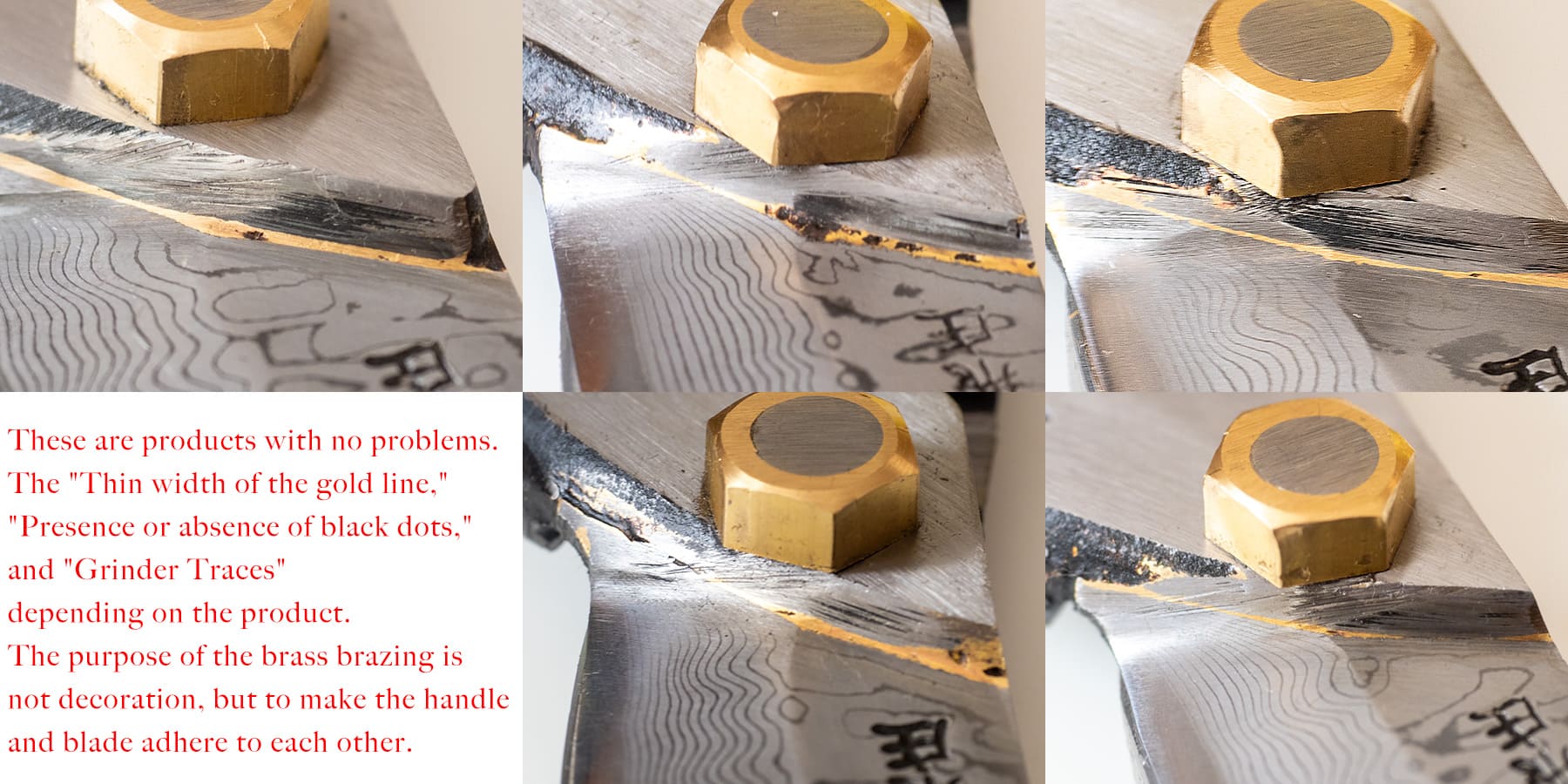
The brass-brazed seam where blade meets body may show slight variation from piece to piece: the width of the brass line, small dark specks, or faint grinding marks. These are not defects. Brazing exists to bond blade and handle securely, not for decorative uniformity, and Tobisho does not grind or polish the seam for cosmetic appearance. Each seam is unique because each is brazed and finished by hand.
Tradition here has never meant standing still. More than a quarter century ago, the third generation, Yasuhito Tobitsuka, redesigned the handle from the ground up: a new mold, a more ergonomic shape, easier to grip and less tiring over a long day's work. And because the blade is forged separately from the body, the blade material itself can be freely chosen, a structural freedom unique to the A-type. It was Yasuhito who first put this freedom to use by introducing an Aogami steel edge to the A-type; Daiki Tobitsuka, the fourth generation, took it further by applying a Damascus pattern to that same Aogami blade.
Tobisho sits in direct lineage with this method. Brazing a blade to a body takes more time and more skill than forging the two as one. Tobisho keeps doing it anyway, one shear at a time.
About Tobisho A-type Pruning Shears 225mm (8.9") Aogami Damascus
This is the A-type 225mm (8.9") with an Aogami Damascus blade, the largest and most visually striking shear in the A-type lineup, right-handed only. No left-hand version exists, as no mold for one has ever been made. Black finish only: the Damascus pattern is the main character here, and a taped handle would draw the eye away from it.
A note on terminology: what is called "Damascus" in the context of modern blades is more precisely a lamination pattern, produced by folding and welding layers of different steels together. True Damascus steel, as produced in ancient times, was a different material altogether. Tobisho's blade is made by folding Aogami steel No.2 and premium blade steel into 16 layers, with Aogami steel as the cutting edge. Tetsufuku uses "Damascus" in the widely understood sense of this layered pattern, while recognizing the distinction.
The pattern itself is formed in the forging process, as the folded layers of different steels deform and flow together under the hammer. Etching the blade surface afterwards brings that pattern into visibility, accentuating the contrast between the layers. Because the forging is done by hand, no two blades carry the same pattern. The pattern will gradually become less visible with use, particularly toward the cutting edge, as friction wears the etched surface. There is no change in cutting performance as the pattern fades.
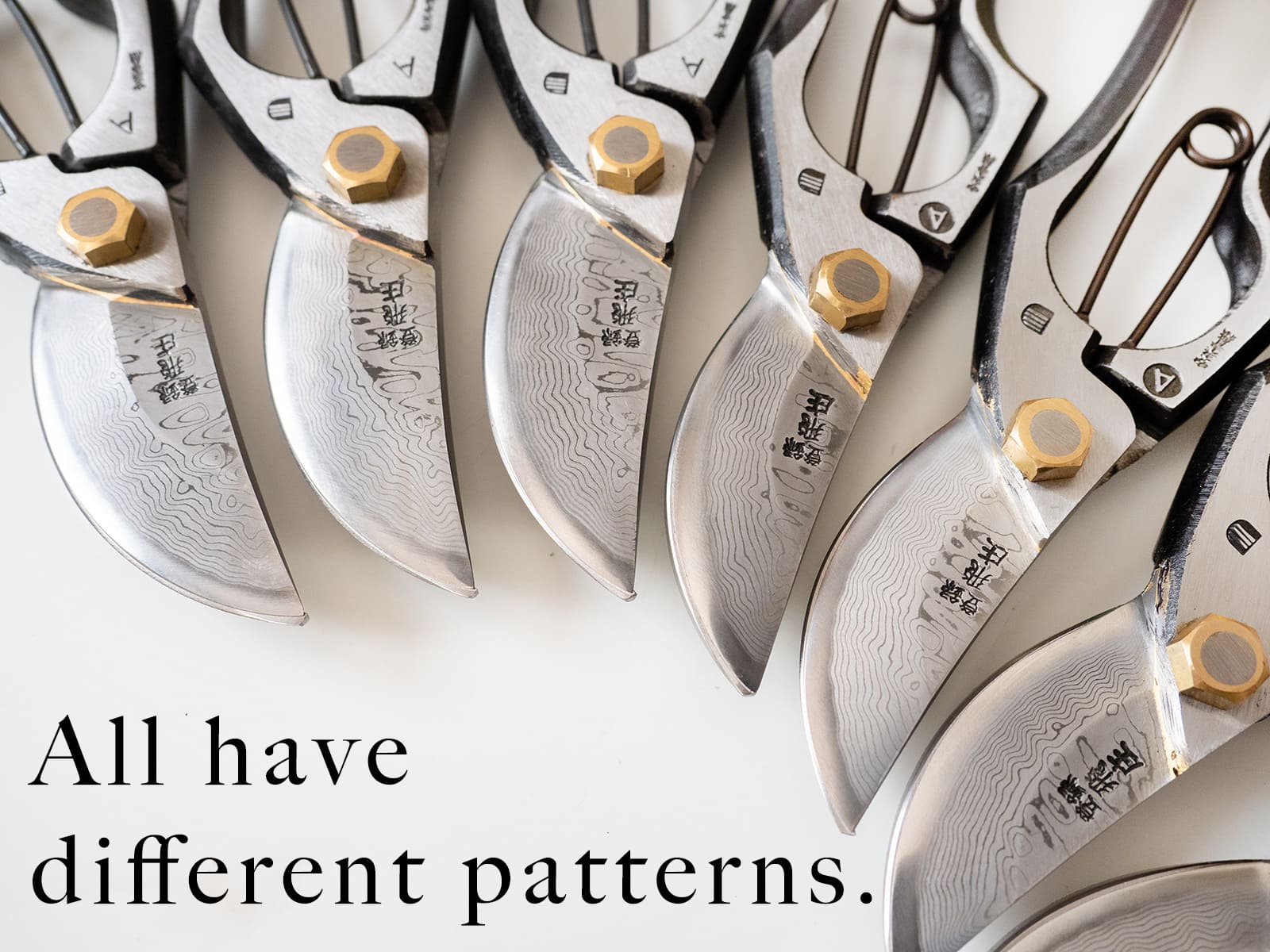
Because every shear has a unique pattern, returns based on pattern preference cannot be accepted. If you have strong preferences about the pattern, please contact us before ordering. We will photograph the current stock and send the images so you can choose.
The blade is quenched and tempered at temperatures suited to Aogami steel, giving it the hardness and toughness needed to cut through living wood. The edge holds its sharpness longer than YCS-3, and the Damascus pattern adds a visual presence that sets this shear apart in any collection. Among Tobisho's A-type lineup, the Aogami Damascus is particularly popular with those who care deeply about the tools they work with.
The Damascus version of the A-type is available in 200mm and 225mm only, and 225mm offers the largest surface area of any size to display the pattern. Other A-type models offer further size and finish options.
The A-type has roots in Yamagata's once-thriving sericulture industry and in the fruit farms that have expanded production in recent years. Its high rigidity makes it easy to cut through hard tree species, and its use has since spread among gardeners working with a wide variety of trees. Used by professional gardeners, orchardists, vineyard workers, and serious enthusiasts worldwide.
How to Maintain Your Tobisho Pruning Shears
How do I keep the blade in condition?
Wipe off resin after every use, ideally. Resin buildup gradually forces the blade trajectory outward, the two cutting edges stop meeting cleanly, and the pivot bolt begins to wear along that same outward path, compounding the problem. If wiping after every use isn't practical, clean the blades regularly. Carrying a small cloth and blade cleaner means you can do it on a break.
How do I lubricate the pivot?
Ideally, remove the bolt periodically and pack grease inside, grease holds longer than oil. That said, this requires skill and confidence to do correctly. A practical alternative: one drop of oil on the pivot once a month. It's not the full solution, but it keeps things running smoothly.
Can the shear get wet?
Avoid it where possible, and never leave the shear wet. After working in rain or morning dew, wipe it dry thoroughly. The pivot area retains moisture longest, use a blower or compressed air if you have one. Regular oiling helps here too: a well-oiled blade sheds water rather than holding it.
What if I drop it?
It depends on how and where it lands. A handle-first drop can bend the handle, affecting feel and the locking mechanism. A blade-first drop risks chipping. As a general rule: the sharper the blade, the harder and more brittle the steel, and the thinner the edge. Handle forged Japanese blades accordingly.
Can I sharpen it myself?
Yes, if you understand the blade geometry and have the skill. Sharpening scissors is significantly harder than sharpening knives: you are managing the contact between two blades, and as you sharpen, the blade face recedes, which can cause the edges to lose contact. If you are confident, sharpen only the face of each blade, never the inner flat side. When the blades stop meeting cleanly despite sharpening, that is the point to send it back to the maker. If you are not confident, leave it to a professional. A blade sharpened incorrectly is harder to recover than a dull one. That said: when you reach the point where you can sharpen your own tools, your relationship with them changes entirely.
What if I force it through a branch that's too thick?
Don't. Twisting or levering the shear to force a cut transfers lateral stress directly to the blade, chipping, blade separation, handle damage. Pruning shears, regardless of maker, are not designed for branches thicker than a little finger. That is what a saw is for. The boundary is the thickness of a little finger. Remember it.
About Tobisho: Four Generations of Pruning Shear Hand-Forging
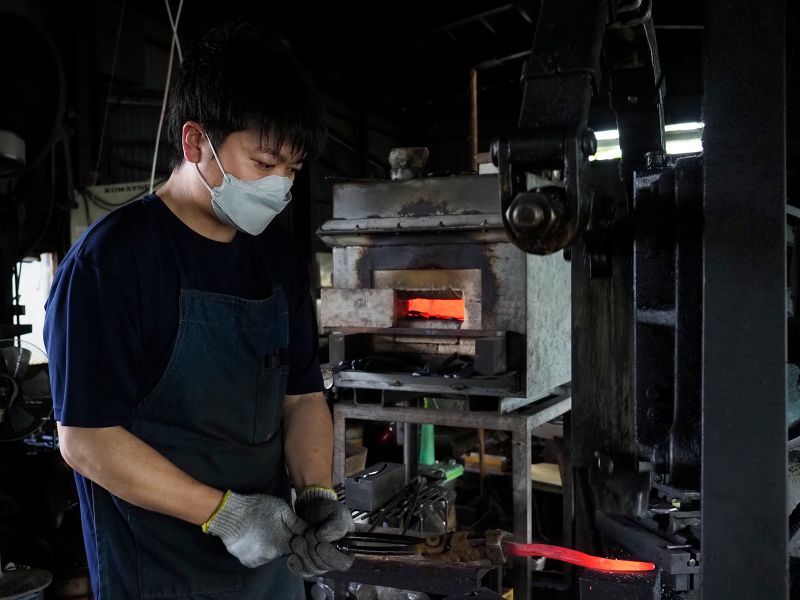
Tobisho has been forging blades in Yamagata since 1804, ten generations of blacksmiths, four of them dedicated to pruning shears. It was Syojiro Tobitsuka, the seventh-generation bladesmith in his family line, who founded Tobisho as a pruning shear forge in 1930, making him the first of four generations dedicated to shears.
Syojiro's shears served both the silkworm farmers already working the region and the orchardists who followed as Yamagata became one of Japan's great fruit-growing prefectures. The tools had to work. His name is still stamped on every Karikomi Shear Tobisho makes.
Generation by generation, the shears got better. What Tobisho is known for today, their heat treatment, their distinctive surface finish, is accumulated experience, made visible.
The late master Yasuhito Tobitsuka, third generation, developed the SR, the Hiryu, and the Asuka, and redesigned the A-type's handle. Daiki Tobitsuka, the fourth-generation master working at the forge today, has added the Hisui, the Hirei, and a Damascus steel A-type. His philosophy: "Cutting well is the baseline. Beyond that: simple and sturdy.", 質実剛健
Forging the Handle
Sharpening the Blade
Notes on use
IMPORTANT: This shear is made of Premium Blade Steel (Not Stainless Steel). It is exceptionally sharp but prone to rust if not maintained.
The Damascus pattern on the blade surface will gradually fade with use. This is expected and does not affect cutting performance.
Do not twist or lever the blade during a cut.
Handle with care, blade-first drops risk chipping.
For one-handed use only. Right hand.
Designed for branches up to the thickness of a little finger. Use a saw beyond that.
Oil and clean regularly to prevent rust and blade separation.
Do not use on wire, rope, or any non-plant material.
Keep out of reach of children.
💬 Story of This Model - By Shop Manager (Part 5 of 5)
Topic: The simple joy of more Damascus pattern to look at, and one word of caution.

Hiroshi Urata
Item Description
| Origin | Yamagata, Japan [TOBISHO] |
|---|---|
| Type | Gardening Tools > Scissors & Shears > Bypass Pruning Shears |
| Handedness | Right-Handed |
| Overall Length | 225 mm = 8.86 inch |
| Edge Length | 73 mm =2.87 inch (From the center of a bolt to the top of a blade) |
| Edge Material | Damascus 16 layer : Aogami No.2 (Blue Paper Steel) |
| Handle Material | White heart malleable cast iron |
| Item Weight | approx.390g |
| Shipping Weight | approx.460g (incl. box & packaging) |
Other Images
-
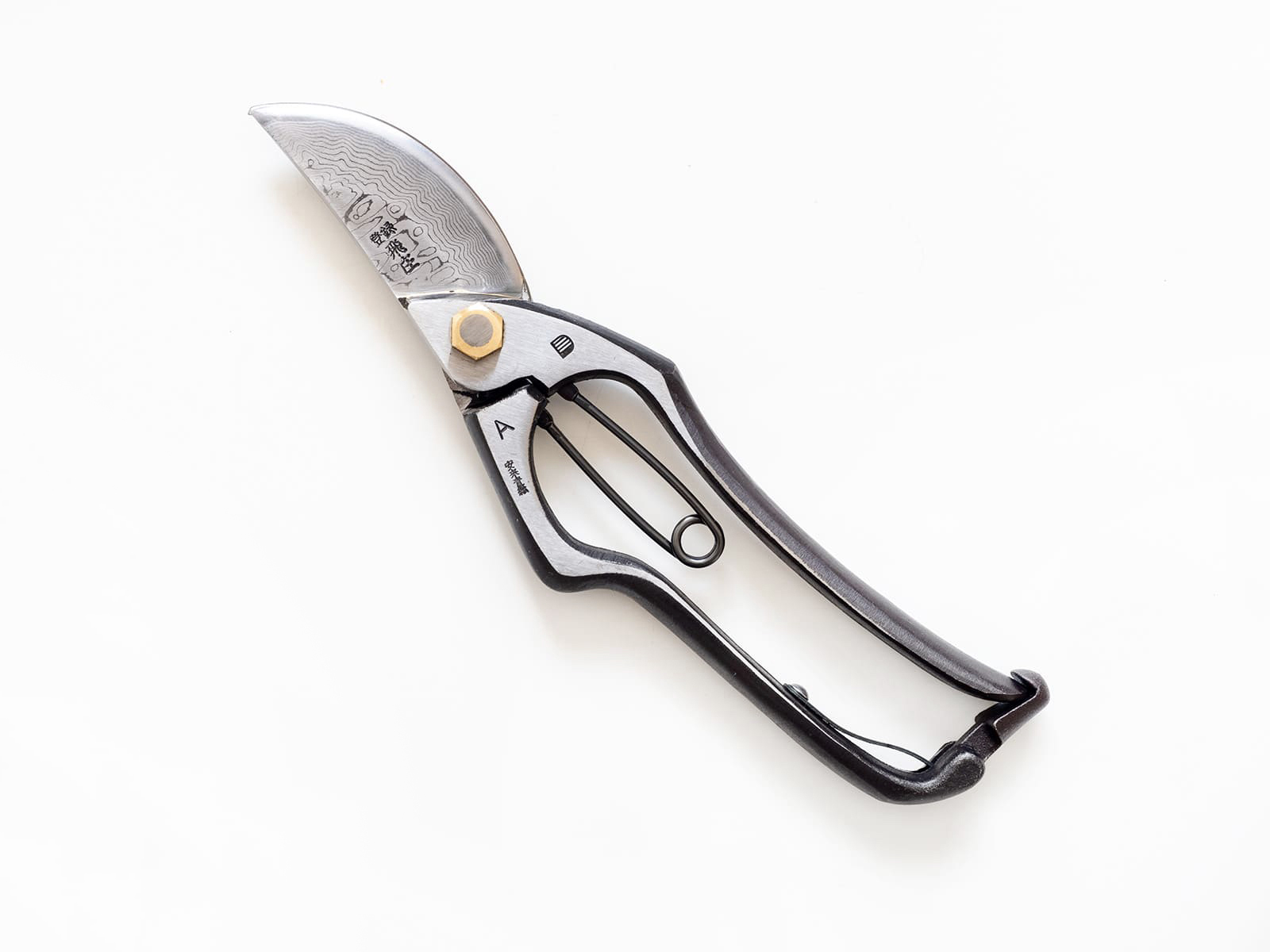
![Photo1: [Tobisho] A-type Aogami Damascus Pruning Shears 225mm (8.9")](https://www.tetsufuku.com/data/tetsufuku/_/70726f647563742f32303235303132385f6635356432322e6a7067003430300000740066.jpg) Fully open and shown in black. Against the dark iron of the body, the Damascus blade does the talking. Only the brass pivot breaks the restraint, a single warm note in an otherwise quiet composition.
Fully open and shown in black. Against the dark iron of the body, the Damascus blade does the talking. Only the brass pivot breaks the restraint, a single warm note in an otherwise quiet composition. -
![Photo2: [Tobisho] A-type Aogami Damascus Pruning Shears 225mm (8.9")](https://www.tetsufuku.com/data/tetsufuku/_/70726f647563742f32303235303132385f3836303231302e6a7067003430300000740066.jpg) One full blade face, seen straight on. The pattern travels the whole length of the steel, wrapping around the stamped Tobisho mark, then quietly disappears where the bevel has been ground clean toward the edge. That fade from pattern to polish is simply what a brazed Aogami blade looks like once it's finished.
One full blade face, seen straight on. The pattern travels the whole length of the steel, wrapping around the stamped Tobisho mark, then quietly disappears where the bevel has been ground clean toward the edge. That fade from pattern to polish is simply what a brazed Aogami blade looks like once it's finished. -
![Photo3: [Tobisho] A-type Aogami Damascus Pruning Shears 225mm (8.9")](https://www.tetsufuku.com/data/tetsufuku/_/70726f647563742f32303235303132385f6262623266612e6a7067003430300000740066.jpg) Pulled in tight enough to catch the hand-polishing marks hiding under the etched lines. These particular curves belong to this blade alone. No two Tobisho shears share the same map. Up in the corner, the pattern gives way to the bare, sharpened bevel of the cutting edge.
Pulled in tight enough to catch the hand-polishing marks hiding under the etched lines. These particular curves belong to this blade alone. No two Tobisho shears share the same map. Up in the corner, the pattern gives way to the bare, sharpened bevel of the cutting edge.
![Photo1: [Tobisho] A-type Aogami Damascus Pruning Shears 225mm (8.9")](https://www.tetsufuku.com/data/tetsufuku/product/20250128_f55d22.jpg)
![Photo2: [Tobisho] A-type Aogami Damascus Pruning Shears 225mm (8.9")](https://www.tetsufuku.com/data/tetsufuku/product/20250128_860210.jpg)
![Photo3: [Tobisho] A-type Aogami Damascus Pruning Shears 225mm (8.9")](https://www.tetsufuku.com/data/tetsufuku/product/20250128_bbb2fa.jpg)