
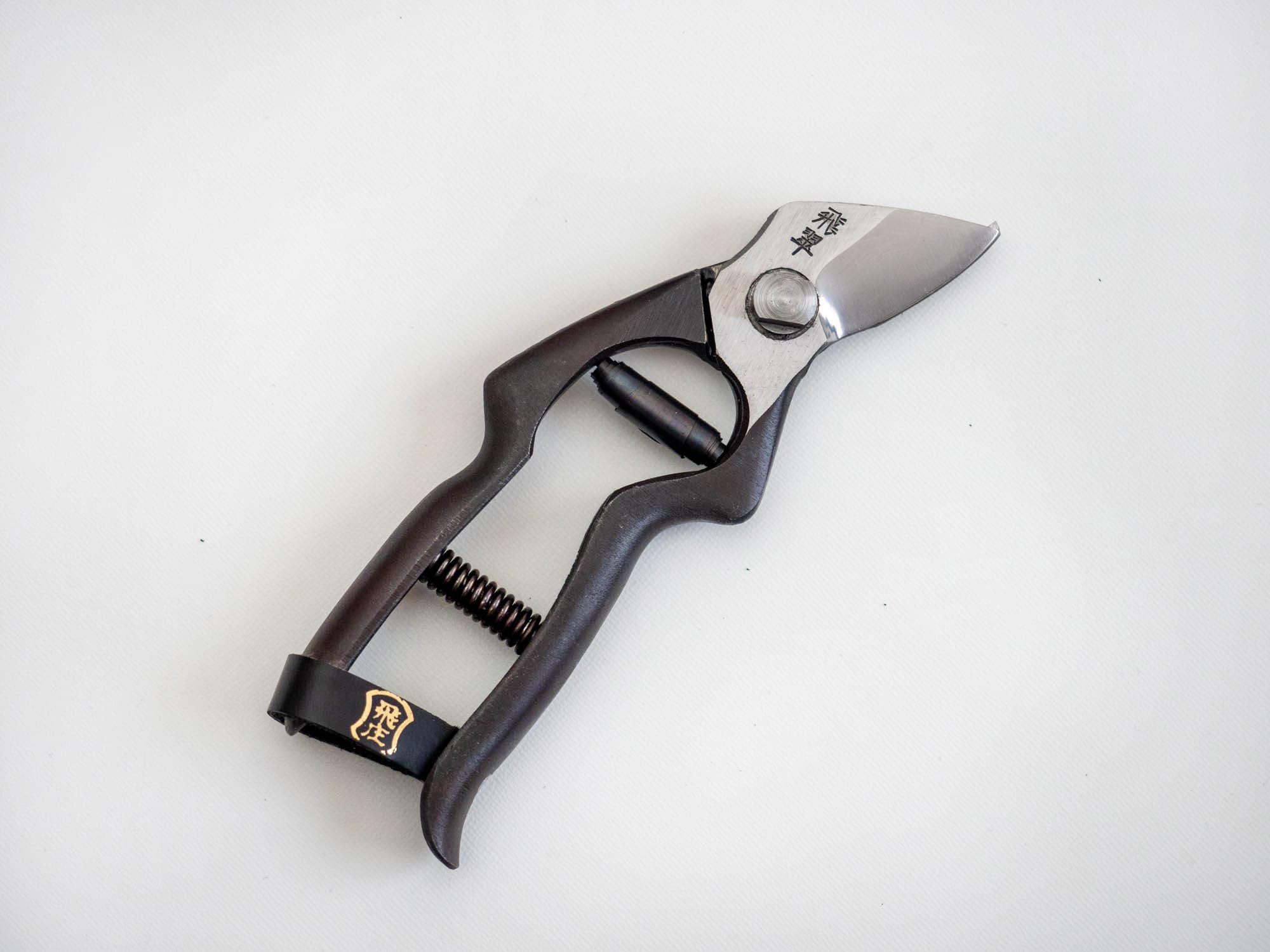
[Tobisho] Hisui Pruning Shears 165mm (6.5") [TBS011601]

⚠️ Important Notice for 🇺🇸 US, 🇪🇺 EU, and 🇬🇧 UK Customers (View details)
Related Items
-

[Tobisho] Replacement Coil Spring (Mushi-bane) for Hiryu & Asuka [TBS019906]
275JPY (not include VAT & TAX)
Stock:9
A Coiled Spring for a Different Kind of Blade About Replacement Coil Spring (Mushi-bane) for Hiry…
-
[NANIWA] Gouken Curved Water whetStone (#1000) [NNW010102]



1,650JPY (not include VAT & TAX)
Stock:96
Fine Whetstone (artificial, #1000), for pruning secateurs and all of curved edges. #1000 is medium f…
Item Description
So light, it barely feels like cutting at all. — Premium Japanese Hand-Forged Pruning Shears
About the Tobisho Hisui & Hirei Series
The Hisui and Hirei began with a request from a peach orchard farmer: a smaller hand pruner, one that could cut thin, hard branches with a real sense of drawing through the cut rather than simply pinching it shut. Daiki Tobitsuka, Tobisho's fourth-generation master, took the request as a starting point and reworked the handle from the ground up. The motif behind the shape is the "pistol-type" pruning shear developed in the Akita region; Hisui and Hirei are both built on that silhouette, carrying forward Tobisho's own accumulated experience.
Hirei shares its body with Hisui, forged full-body in Yamagata, but its blades are finished to meet and slide against each other, cutting the way an ordinary pair of shears does, the same logic as the Asuka. Hisui's blades incorporate the innovations behind the Hiryu, Tobisho's most refined model: shaped so the two edges never touch at all, cutting with a drawing motion instead of a direct pinch.
Both are forged full-body in Yamagata, Japan, the same construction as the rest of the Tobisho pruning shear lineup.
About Tobisho Hisui Pruning Shears 165mm (6.5")
The Hisui 165mm (6.5") is right-handed only. Steel: Premium Blade Steel (undisclosed grade), full-body forged in Yamagata, Japan.
Because the whole shear is built smaller, its blade runs thinner too, and that thinness is directly tied to how easily it bites into a cut. Combined with a hamaguri-style convex edge and a mirror finish, and blades that never touch at all, the same non-contact engineering behind the Hiryu, the Hisui cuts with remarkably little resistance. One customer described it simply: it's like cutting butter.
It sits close to the hand, light enough to prune with something close to the feeling of pinching with your fingers. Despite its small size, it suits a wide range of hand sizes, and for work that doesn't call for a saw, it can often handle the job on its own. The difference this makes on a single cut is small, but over a long day of pruning, that difference compounds, which is why the Hisui is especially recommended for professionals concerned about tendonitis.
How to Maintain Your Tobisho Pruning Shears
Why won't it cut rope or paper?
That's expected with the Hisui. It's built specifically for materials with the hardness and thickness of a branch. Because there's a gap between the blades, soft or thin materials won't cut, and that isn't a defect or a fault.
How do I keep the blade in condition?
Wipe off resin after every use, ideally. Resin buildup gradually forces the blade trajectory outward, the two cutting edges stop meeting cleanly, and the pivot bolt begins to wear along that same outward path, compounding the problem. If wiping after every use isn't practical, clean the blades regularly. Carrying a small cloth and blade cleaner means you can do it on a break.
How do I lubricate the pivot?
Ideally, remove the bolt periodically and pack grease inside, grease holds longer than oil. That said, this requires skill and confidence to do correctly. A practical alternative: one drop of oil on the pivot once a month. It's not the full solution, but it keeps things running smoothly.
Can the shear get wet?
Avoid it where possible, and never leave the shear wet. After working in rain or morning dew, wipe it dry thoroughly. The pivot area retains moisture longest, use a blower or compressed air if you have one. Regular oiling helps here too: a well-oiled blade sheds water rather than holding it.
What if I drop it?
It depends on how and where it lands. A handle-first drop can bend the handle, affecting feel and the locking mechanism. A blade-first drop risks chipping. As a general rule: the sharper the blade, the harder and more brittle the steel, and the thinner the edge. Handle forged Japanese blades accordingly.
Can I sharpen it myself?
The Hisui's blade is ground to a shape unlike a standard pruning shear, so we don't recommend sharpening it yourself. Because the blades are built never to touch, even a small sharpening error can throw off the cutting performance and balance significantly. If you notice the cutting performance declining, we'd recommend sending it to the maker instead.
What if I force it through a branch that's too thick?
Don't. Twisting or levering the shear to force a cut transfers lateral stress directly to the blade, chipping, blade separation, handle damage. Pruning shears, regardless of maker, are not designed for branches thicker than a little finger. That is what a saw is for. The boundary is the thickness of a little finger. Remember it.
About Tobisho: Four Generations of Pruning Shear Hand-Forging
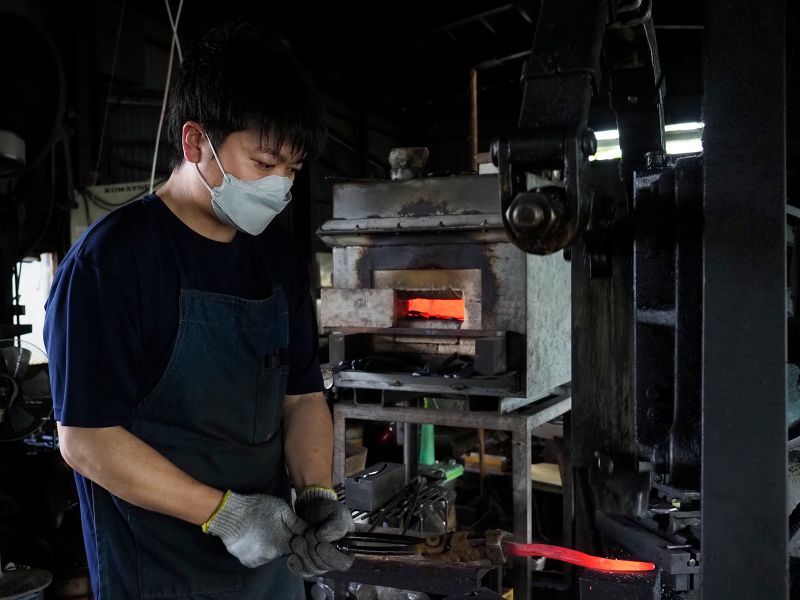
Tobisho has been forging blades in Yamagata since 1804, ten generations of blacksmiths, four of them dedicated to pruning shears. It was Syojiro Tobitsuka, the seventh-generation bladesmith in his family line, who founded Tobisho as a pruning shear forge in 1930, making him the first of four generations dedicated to shears.
Syojiro's shears served both the silkworm farmers already working the region and the orchardists who followed as Yamagata became one of Japan's great fruit-growing prefectures. The tools had to work. His name is still stamped on every Karikomi Shear Tobisho makes.
Generation by generation, the shears got better. What Tobisho is known for today, their heat treatment, their distinctive surface finish, is accumulated experience, made visible.
The late master Yasuhito Tobitsuka, third generation, developed the SR, the Hiryu, and the Asuka, and redesigned the A-type's handle. Daiki Tobitsuka, the fourth-generation master working at the forge today, has added the Hisui, the Hirei, and a Damascus steel A-type. His philosophy: "Cutting well is the baseline. Beyond that: simple and sturdy.", 質実剛健
Forging the Handle
Sharpening the Blade
Notes on use
IMPORTANT: This shear is made of High-Carbon Alloy Steel (Not Stainless Steel). It is exceptionally sharp but prone to rust if not maintained.
This shear will not cut thin or soft materials. Do not attempt to force it. Doing so leads directly to damage. For example, forcing it through rope won't cut the rope; instead, the rope becomes wedged between the receiving and cutting blades. That wedging pushes the blades apart and can visibly widen the gap between them.
Do not twist or lever the blade during a cut.
Handle with care, blade-first drops risk chipping.
For one-handed use only. Right hand.
Designed for branches up to the thickness of a little finger. Use a saw beyond that.
Oil and clean regularly to prevent rust and blade separation.
Keep out of reach of children.
💬 Story of This Model - By Shop Manager (Part 1 of 2)
Topic: What's in a name: Hisui.

Hiroshi Urata
Item Description
| Origin | Yamagata, Japan [TOBISHO] |
|---|---|
| Type | Gardening Tools > Scissors & Shears > Bypass Pruning Shears |
| Handedness | Right-Handed |
| Overall Length | 165 mm =6.50 inch |
| Edge Length | 47 mm =1.85 inch (From the center of a bolt to the top of a blade) |
| Construction | Integrally Forged |
| Edge Material | Premium Blade Steel (undisclosed grade) |
| Handle Material | Premium Blade Steel (undisclosed grade) |
| Item Weight | approx.200g |
| Shipping Weight | approx.about 260g (incl. box & packaging) |
![Photo1: [Tobisho] Hisui Pruning Shears 165mm (6.5")](https://www.tetsufuku.com/data/tetsufuku/product/20231128_7499de.jpg)
![Photo2: [Tobisho] Hisui Pruning Shears 165mm (6.5")](https://www.tetsufuku.com/data/tetsufuku/product/20231128_b0d119.jpg)
![Photo3: [Tobisho] Hisui Pruning Shears 165mm (6.5")](https://www.tetsufuku.com/data/tetsufuku/product/20231128_8c5426.jpg)