
[Kanetaka] Right-Handed Kyoto Style Kiribashi Shears 230mm (9.1") Aogami No.2 [KNT090301]
![[Kanetaka] Right-Handed Kyoto Style Kiribashi Shears 230mm (9.1") Aogami No.2 — full view of blade and handle](https://www.tetsufuku.com/data/tetsufuku/product/20220218_24ecc4.JPG)

⚠️ Important Notice for 🇺🇸 US, 🇪🇺 EU, and 🇬🇧 UK Customers (View details)

Item Description
Refined Toward Hardness
About the Kanetaka Kiribashi Series
Many people are surprised, the first time they hold this pair of shears, to find a slight looseness at the pivot. This is not a defect. It is the genuine specification shared by Kyoto's traditional wabasami and kiribashi shears, and a long-standing tradition.
When cutting, you hold the shears so that no gap opens between the blades, guiding them gently with your fingertips. Through repeated use, the pivot's core metal gradually shifts to match the habits of your hand. This is known as "the shears growing," and with continued use, the pair becomes uniquely shaped to you and no one else.
For this reason, please do not retighten the pivot yourself after purchase. The looseness itself is proof that the shears are working exactly as they should.
These shears are also crafted with particular attention to the sound they make when cutting. As the lower part of the handles meet, a clear tone rings out, like two iron rods striking together. Even without being seen, that sound tells those nearby that someone is pruning. In traditional Japanese culture, there is an aesthetic of sensing, through the senses, what is happening even when it cannot be directly observed.
Kanetaka's kiribashi come in two steel options: Aogami (Blue Paper Steel) and Shirogami (White Paper Steel). The Aogami version is harder, while the Shirogami version is set up to prioritize ease of handling and sharpening.
About [Kanetaka] Right-Handed Kyoto Style Kiribashi Shears 230mm (9.1") Aogami No.2
The blade is made of Aogami No.2 (Blue Paper Steel). Compared to the Shirogami No.2 version, it has greater hardness and holds its edge longer. As hardness increases, steel also becomes more brittle, so the pivot's looseness may feel slightly more pronounced than on the Shirogami version — this, too, falls within the same "shears growing" mechanism.
The handle is made of hard iron, so it resists bending even when cutting thick branches.
A belt hammer and grinder are used, but every step is finished entirely by hand. The forge welding and sharpening in particular reach a level of precision that only human hands can achieve.
It is used for pruning branches. This is a pair of shears actually used by professional Japanese gardeners in the field, built with high rigidity for the task. Kyoto's tools have been refined over generations of dialogue between makers and the gardeners who use them, and that accumulated history lives on in this pair of shears.
This 230mm Aogami version is the model within the Kiribashi series built with the greatest emphasis on hardness. Because the blade is harder, it calls for a more careful touch in use. If this is your first pair of Kanetaka shears, we recommend starting with the 220mm Shirogami No.2 version, then moving on to this one once the shears have had time to settle into your hand.
How to Maintain Your Kanetaka Kiribashi Shears
Does it rust easily?
As a high-carbon steel, it can rust if left unattended. Wipe it down thoroughly after each use.
What if the edge starts to dull?
Sharpen it with a whetstone.
Any tips for making it last?
Applying edged tool oil will help it last longer.
About Kanetaka: A Kyoto Blacksmith with 350 Years of History
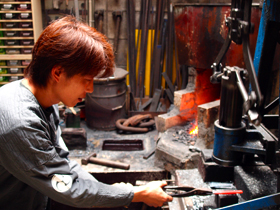
Kanetaka is a Kyoto blacksmith with a history spanning more than 350 years. By recorded lineage alone, it stands as a long-established house of seven generations, over 200 years.
The shop and workshop sit directly in front of the head family of Ikenobo, the founding school of Japanese flower arrangement. It is a blacksmith rooted in the same soil that has shaped Kyoto's tradition of flower arrangement.
Today, the eldest son, Kazuhiro Yamada, carries on the sharpening technique, while the second son, Yoshitaka Yamada, works as the blacksmith. Each brother handles a different stage of the process, and together they bring a single pair of shears to completion.
Alongside traditional items such as Japanese razors and Ikenobo scissors, made using techniques learned from specialists, Kanetaka also produces a range of idea goods, including herb clips, pencil sharpeners, and reed knives for wind instruments, building on traditional craftsmanship to create a broad range of tools.
Notes on use
Important: These shears are made of high-carbon steel, not stainless steel. They cut extremely well, but are prone to rust if not cared for.
Do not twist or lever the blades while cutting.
Dropping the shears can cause the blade to chip.
For right-handed, one-handed use.
If you are unsure how to hold it, please feel free to contact us before purchasing.
Do not use for cutting anything other than plant material, such as wire or rope.
Store out of the reach of children.
Item Description
| Origin | Kyoto, Japan [Kanetaka] |
|---|---|
| Type | Gardening Tools > Scissors & Shears > Kiribashi Shears |
| Handedness | Right-Handed |
| Overall Length | 230mm = 9.06 inch |
| Edge Length | 65mm = 2.56 inch (From the tip of the blade to the fulcrum ) |
| Edge Material | Aogami No.2 (Blue Paper Steel) |
| Handle Material | Iron |
| Item Weight | 255g |
| Shipping Weight | 355g |
![Photo1: [Kanetaka] Right-Handed Kyoto Style Kiribashi Shears 230mm (9.1") Aogami No.2](https://www.tetsufuku.com/data/tetsufuku/product/20220218_61aff3.JPG)
![Photo2: [Kanetaka] Right-Handed Kyoto Style Kiribashi Shears 230mm (9.1") Aogami No.2](https://www.tetsufuku.com/data/tetsufuku/product/20220218_d224d1.JPG)
![Photo3: [Kanetaka] Right-Handed Kyoto Style Kiribashi Shears 230mm (9.1") Aogami No.2](https://www.tetsufuku.com/data/tetsufuku/product/20220218_58e6fc.JPG)