
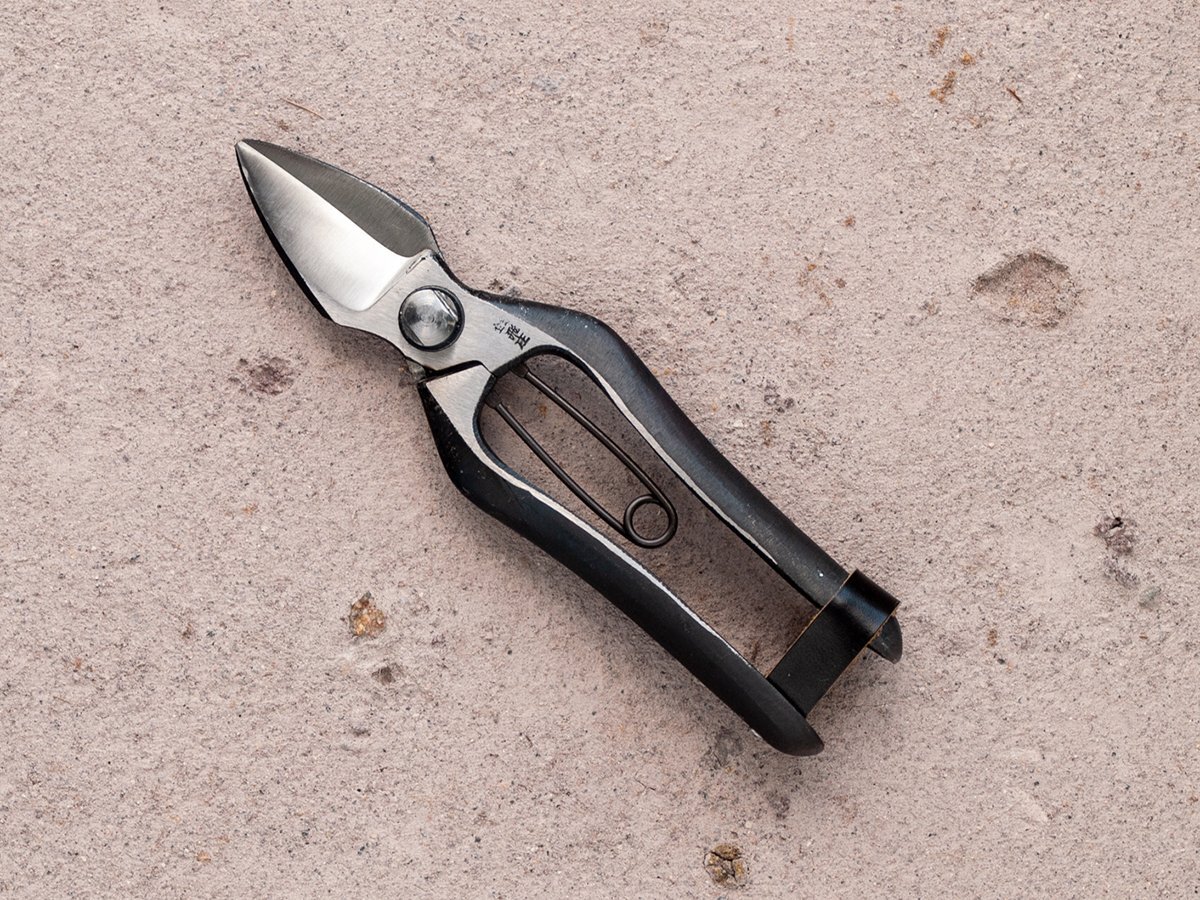
[Tobisho] Double-Bladed Pruning Shears (Curved Blade) 185mm (7.3") [TBS012102]

⚠️ Important Notice for 🇺🇸 US, 🇪🇺 EU, and 🇬🇧 UK Customers (View details)
Related Items
-

[Tobisho] Replacement Spring (Size 7) for Standard Pruning & Bud Shears [TBS019903]
220JPY (not include VAT & TAX)
Stock:22
One Spring, Eleven Shears About Replacement Spring (Size 7) for Standard Pruning & Bud Shears …
-
[NANIWA] Gouken Curved Water whetStone (#1000) [NNW010102]



1,650JPY (not include VAT & TAX)
Stock:96
Fine Whetstone (artificial, #1000), for pruning secateurs and all of curved edges. #1000 is medium f…
Item Description
Cut Deep, Leave Nothing Behind
About Double-Bladed Pruning Shears (Curved Blade) 185mm (7.3")
This is a double-bevel shear with a short, curved blade, ground thin for sharpness rather than for cutting through wood. Where the straight-blade version slides in flat, this curve lets the blade reach further into rounded material as it closes, cutting deeper into a garlic or onion root, or a pumpkin's stem, in a single stroke, rather than leaving a stub that needs a second cut. The thin edge isn't suited to branches; treat it as a shear for fibrous, soft-to-firm material, not wood.
In Japan, this is the model gardeners and farmers reach for specifically to cut garlic and onion roots close, and to sever a pumpkin's tough stem cleanly at harvest. It also sees steady use in Hokkaido, one of Japan's major livestock regions, where it's used for cattle hoof care.
How to Maintain Your Tobisho Pruning Shears
Can I use this on a branch?
No. This shear is ground thin for sharpness on soft, fibrous material, not for wood. Forcing it through a branch risks chipping the edge. For branches, use a bypass pruner or a single-bevel shear instead.
How do I keep the blade in condition?
Wipe off resin or plant residue after every use, ideally. Resin buildup gradually forces the blade trajectory outward, the two cutting edges stop meeting cleanly, and the pivot bolt begins to wear along that same outward path, compounding the problem. If wiping after every use isn't practical, clean the blades regularly.
How do I lubricate the pivot?
Ideally, remove the bolt periodically and pack grease inside, grease holds longer than oil. That said, this requires skill and confidence to do correctly. A practical alternative: one drop of oil on the pivot once a month.
Can the shear get wet?
Avoid it where possible, and never leave the shear wet. After use, especially around livestock or damp root vegetables, wipe it dry thoroughly, the pivot retains moisture longest.
What if I drop it?
It depends on how and where it lands. A handle-first drop can bend the handle. A blade-first drop risks chipping, this blade is ground thin, so treat it with more care than a heavier pruning shear.
Can I sharpen it myself?
Yes, if you understand the blade geometry and have the skill. Sharpen only the face of each blade, never the inner flat side. If you're not confident, leave it to a professional. A blade sharpened incorrectly is harder to recover than a dull one.
About Tobisho: Four Generations of Pruning Shear Hand-Forging
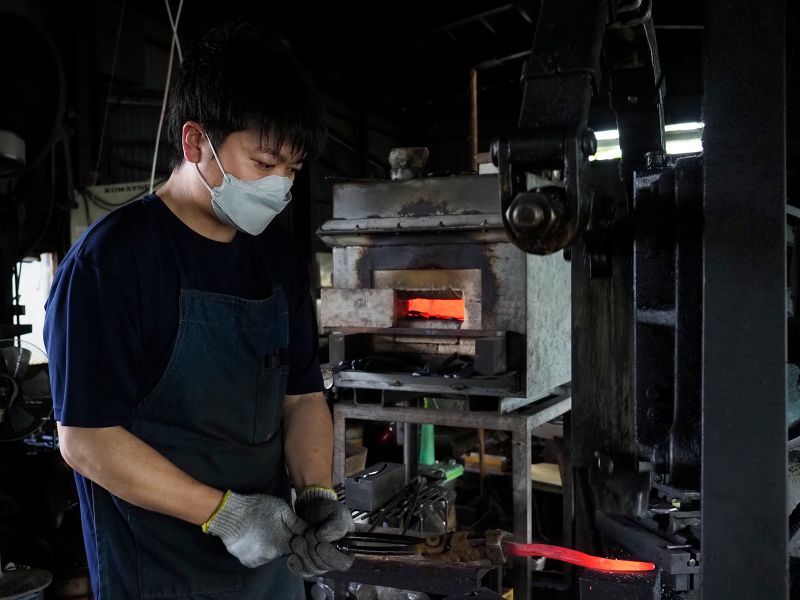
Tobisho has been forging blades in Yamagata since 1804, ten generations of blacksmiths, four of them dedicated to pruning shears. It was Syojiro Tobitsuka, the seventh-generation bladesmith in his family line, who founded Tobisho as a pruning shear forge in 1930, making him the first of four generations dedicated to shears.
Syojiro's shears served both the silkworm farmers already working the region and the orchardists who followed as Yamagata became one of Japan's great fruit-growing prefectures. The tools had to work. His name is still stamped on every Karikomi Shear Tobisho makes.
Generation by generation, the shears got better. What Tobisho is known for today, their heat treatment, their distinctive surface finish, is accumulated experience, made visible.
The late master Yasuhito Tobitsuka, third generation, developed the SR, the Hiryu, and the Asuka, and redesigned the A-type's handle. Daiki Tobitsuka, the fourth-generation master working at the forge today, has added the Hisui, the Hirei, and a Damascus steel A-type. His philosophy: "Cutting well is the baseline. Beyond that: simple and sturdy.", 質実剛健
Forging the Handle
Sharpening the Blade
Notes on use
IMPORTANT: This shear is made of High-Carbon Alloy Steel (Not Stainless Steel). It is exceptionally sharp but prone to rust if not maintained.
Ground thin for sharpness on soft, fibrous material such as garlic or onion roots and pumpkin stems. Not suited to cutting branches; use a bypass pruner or single-bevel shear instead.
Do not twist or lever the blade during a cut.
Handle with care, blade-first drops risk chipping.
Oil and clean regularly to prevent rust and blade separation.
Do not use on wire, rope, or any non-plant material.
Keep out of reach of children.
💬 Story of This Model - By Shop Manager (Part 2 of 2)
Topic: The uses we know, and the ones we don't.

Hiroshi Urata
Item Description
| Origin | Yamagata, Japan [TOBISHO] |
|---|---|
| Type | Gardening Tools > Scissors & Shears > Double-Bladed Pruning Shears |
| Handedness | Right-Handed |
| Overall Length | 185 mm =7.28 inch |
| Construction | Integrally Forged |
| Edge Material | Premium Blade Steel (undisclosed grade) |
| Handle Material | Premium Blade Steel (undisclosed grade) |
| Item Weight | approx.210g |
| Shipping Weight | approx.280g (incl. box & packaging) |
![Photo1: [Tobisho] Double-Bladed Pruning Shears (Curved Blade) 185mm (7.3")](https://www.tetsufuku.com/data/tetsufuku/product/20260803_27fee7.jpg)
![Photo2: [Tobisho] Double-Bladed Pruning Shears (Curved Blade) 185mm (7.3")](https://www.tetsufuku.com/data/tetsufuku/product/20260803_80a17f.jpg)
![Photo3: [Tobisho] Double-Bladed Pruning Shears (Curved Blade) 185mm (7.3")](https://www.tetsufuku.com/data/tetsufuku/product/20260803_6e5259.jpg)