


I have an axe to grind about straight blades and curved blades. Everyone, manufacturers, gardeners, all of them, says the same thing: the straight blade is for cutting flat lines, and you flip the curved blade over to shape curved surfaces. I don't buy it, and I'd genuinely like someone to prove me wrong.
Try cutting a flat, straight hedge face with a straight blade, and the hand holding the far side ends up bumping right into the surface you just cut. Lift your hand to avoid that, and the blade starts cutting inward, eating into the hedge instead of running along it. A curved blade solves both problems: it lets you cut a flat plane straight and clean without your hand ever touching what you just trimmed. And on a curved, convex surface, it's the straight blade that gives you control, because nothing ever touches down where you've already cut.
Here's the other half of the argument. Japan's traditional garden style was tama-zukuri, ball-shaped topiary, round and convex by definition. That's a curve. If curved surfaces really call for the straight blade, as I'm arguing, then it makes sense that the straight blade became the standard model here, a shaping style with roots going back to the tea gardens of the Muromachi and Momoyama periods, and one that stayed dominant until just thirty-odd years ago. Prove me wrong.
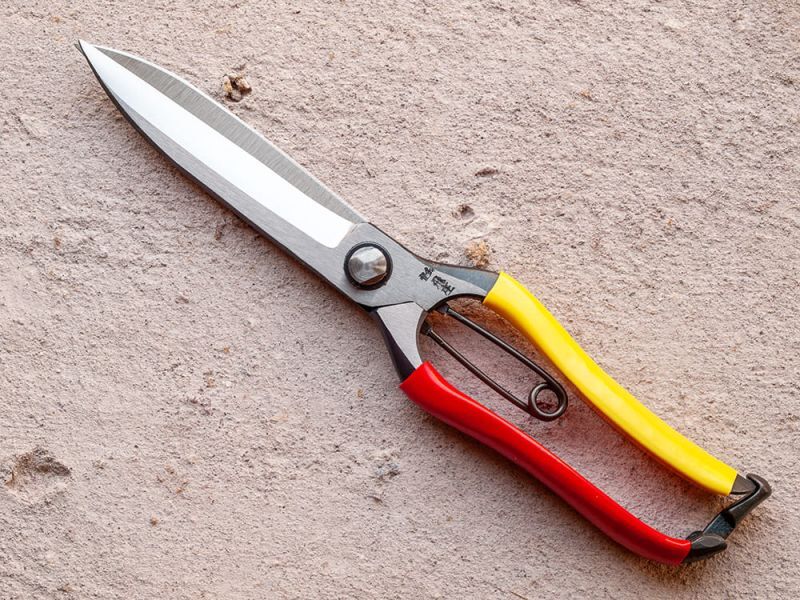
[Tobisho] Topiary Shears 270mm (10.6") Double Bevel, Curved Blade [TBS010201C]
⚠️ Important Notice for 🇺🇸 US, 🇪🇺 EU, and 🇬🇧 UK Customers (View details)
To Our US Customers: Due to U.S. Section 232 regulations, all traditional steel products—including kitchen knives and pruning shears—are currently subject to a 50% customs duty upon import, plus standard carrier clearance fees. Please note that these import charges are the sole responsibility of the recipient.
🇪🇺 To Our EU Customers: Due to the EU's General Product Safety Regulation (GPSR) and Packaging and Packaging Waste Regulation (PPWR), which require a locally established Authorised Representative for non-EU sellers, we are currently unable to ship to European Union member countries. We regret the inconvenience and are monitoring the situation for future options.
🇬🇧🇳🇴🇨🇭🇮🇸 Good News for UK, Norway, Switzerland & Iceland Customers: As these are not EU member states, we continue to ship to the United Kingdom, Norway, Switzerland, and Iceland as usual.
To Our UK Customers: Due to local tax compliance regulations, we require a minimum order value (excluding shipping) of £135 to process international shipments. Customs duties and carrier handling fees will apply according to your country's laws.
Other Destinations: Local VAT, import duties, and carrier processing commissions may apply depending on your country's regulations.
*Note regarding cancellations: Refunds for customer-requested cancellations will be processed minus the non-refundable PayPal transaction fees incurred at the time of purchase.
Related Items
-

[Tobisho] Natural Cowhide Sheath for 270mm (10.6") Topiary & Root Pruning Shears [TBS019923]
3,190JPY (not include VAT & TAX)
Stock:4
Built to the Shape of the 270mm Blade About Natural Cowhide Sheath for 270mm (10.6") Topiary & Ro…
-
[Tobisho] Replacement Spring (Size 8-3) for 270mm Topiary & Root Pruning Shears [TBS019905]
220JPY (not include VAT & TAX)
Not available
The Extra Turn for the 270mm Shears About Replacement Spring (Size 8-3) for 270mm Topiary & Root …
Item Description
Not Everything Is Meant to Be Straight
About the Topiary Shears Series
Single-handed Topiary Shears have long been used across Japan for trimming leaves on hedges and shaped shrubs, working alongside two-handed Karikomi shears for the broader hedge face. This style of fine, one-handed pruning has old roots in Japanese gardening, going back to the ball-shaped tama-zukuri topiary that took hold with the tea gardens of the Muromachi and Momoyama periods, and it remained a mainstay of the Japanese garden until as recently as the last thirty years or so.
There's nothing especially secretive about how Tobisho makes this shear, no unique heat treatment, no method Tobisho alone holds. What Tobisho brings is care taken in the ordinary steps: keeping the blade thin without losing carbon at the edge, and holding the two blades to a tolerance close enough that the shear needs little adjustment for years. It's not a shear that leans on a single trick; it's a shear made carefully, the same way, every time.
These shears suit trees and shrubs with small, dense leaves: needle evergreens such as pine (after candling and green-picking), Podocarpus macrophyllus (rakanmaki), and Chinese yew (inumaki); fine-leaved broadleaf evergreens such as boxwood (inutsuge), azalea (satsuki, tsutsuji), Ubame oak, and red-tip photinia; hedge species such as fragrant olive (hiiragi mokusei), privet, and Chinese privet; and bonsai and small garden work on shimpaku juniper, Japanese maple, and similar material. On a flat hedge, a two-handed Karikomi shear covers the broad face; a single-handed shear like this one follows, for the corners and for thinning gaps the larger blade can't reach cleanly.
About Topiary Shears 270mm (10.6") Double Bevel, Curved Blade
Where the standard model runs a straight edge, this one carries a gently curved blade. The common understanding, shared by gardeners and manufacturers alike, is that a curved blade suits curved and convex surfaces, the rounded, ball-shaped forms of tama-zukuri topiary in particular, where a straight blade doesn't sit flush against the curve of the work.
There's also a well-known technique among experienced gardeners: turning the shear over, so the curve faces outward, and using it that way tends to produce a cleaner, rounder result on ball-shaped work. As far as we know, neither Tobisho nor any other maker originally designed this blade with that reversed grip in mind, if they had, they would have forged the curve the other way and given it a separate model name of its own. This looks like a technique generations of gardeners worked out through use, not one any manufacturer set out to build. It's become common enough by now that makers, Tobisho included, describe it themselves when asked.
Beyond the blade curvature, this shear matches the standard model in every other respect: same 270mm length, same weight at approximately 300g, right-handed only. The standard handle uses red and yellow vinyl tape; a black finish is not offered for this model.
How to Maintain Your Tobisho Pruning Shears
Can I use this on a branch?
No. This shear is built for trimming leaves, not for cutting branches, of any thickness. It has no cutting margin for woody material, forcing a branch through it risks bending the blade or damaging the pivot. For branches, use a bypass pruner or a single-bevel shear instead.
How do I keep the blade in condition?
Wipe off resin after every use, ideally. Resin buildup gradually forces the blade trajectory outward, the two cutting edges stop meeting cleanly, and the pivot bolt begins to wear along that same outward path, compounding the problem. If wiping after every use isn't practical, clean the blades regularly. Carrying a small cloth and blade cleaner means you can do it on a break.
How do I lubricate the pivot?
Ideally, remove the bolt periodically and pack grease inside, grease holds longer than oil. That said, this requires skill and confidence to do correctly. A practical alternative: one drop of oil on the pivot once a month. It's not the full solution, but it keeps things running smoothly.
Can the shear get wet?
Avoid it where possible, and never leave the shear wet. After working in rain or morning dew, wipe it dry thoroughly. The pivot area retains moisture longest, use a blower or compressed air if you have one. Regular oiling helps here too: a well-oiled blade sheds water rather than holding it.
What if I drop it?
It depends on how and where it lands. A handle-first drop can bend the handle, affecting feel and the locking mechanism. A blade-first drop risks chipping. As a general rule: the sharper the blade, the harder and more brittle the steel, and the thinner the edge. Handle forged Japanese blades accordingly.
Can I sharpen it myself?
Yes, if you understand the blade geometry and have the skill. Sharpening scissors is significantly harder than sharpening knives: you are managing the contact between two blades, and as you sharpen, the blade face recedes, which can cause the edges to lose contact. If you are confident, sharpen only the face of each blade, never the inner flat side. When the blades stop meeting cleanly despite sharpening, that is the point to send it back to the maker. If you are not confident, leave it to a professional. A blade sharpened incorrectly is harder to recover than a dull one. That said: when you reach the point where you can sharpen your own tools, your relationship with them changes entirely.
About Tobisho: Four Generations of Pruning Shear Hand-Forging
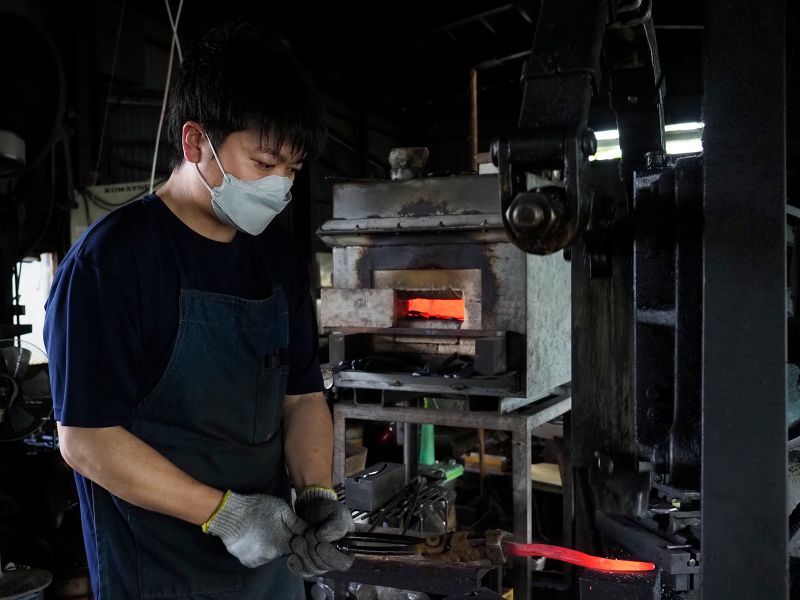
Tobisho has been forging blades in Yamagata since 1804, ten generations of blacksmiths, four of them dedicated to pruning shears. It was Syojiro Tobitsuka, the seventh-generation bladesmith in his family line, who founded Tobisho as a pruning shear forge in 1930, making him the first of four generations dedicated to shears.
Syojiro's shears served both the silkworm farmers already working the region and the orchardists who followed as Yamagata became one of Japan's great fruit-growing prefectures. The tools had to work. His name is still stamped on every Karikomi Shear Tobisho makes.
Generation by generation, the shears got better. What Tobisho is known for today, their heat treatment, their distinctive surface finish, is accumulated experience, made visible.
The late master Yasuhito Tobitsuka, third generation, developed the SR, the Hiryu, and the Asuka, and redesigned the A-type's handle. Daiki Tobitsuka, the fourth-generation master working at the forge today, has added the Hisui, the Hirei, and a Damascus steel A-type. His philosophy: "Cutting well is the baseline. Beyond that: simple and sturdy.", 質実剛健
Forging the Handle
Sharpening the Blade
Notes on use
IMPORTANT: This shear is made of High-Carbon Alloy Steel (Not Stainless Steel). It is exceptionally sharp but prone to rust if not maintained.
Designed for trimming leaves and light foliage on hedges and topiary. Not suited to cutting branches; use a bypass pruner or single-bevel shear instead.
Do not twist or lever the blade during a cut.
Handle with care, blade-first drops risk chipping.
For one-handed use only. Right hand.
Oil and clean regularly to prevent rust and blade separation.
Do not use on wire, rope, or any non-plant material.
Keep out of reach of children.
💬 Story of This Model - By Shop Manager (Part 4 of 4)
Topic: Straight vs. curved, an argument nobody's won.

Hiroshi Urata
Item Description
| Origin | Yamagata, Japan [TOBISHO] |
|---|---|
| Type | Gardening Tools > Scissors & Shears > Topiary Shears |
| Handedness | Right-Handed |
| Overall Length | 270 mm =10.63 inch |
| Edge Length | 125 mm =4.92 inch (From the center of a bolt to the top of a blade) |
| Construction | Integrally Forged |
| Edge Material | Premium Blade Steel (undisclosed grade) |
| Handle Material | Premium Blade Steel (undisclosed grade) |
| Item Weight | approx.300g |
| Shipping Weight | approx.370g (incl. box & packaging) |
Other Images
![Photo1: [Tobisho] Topiary Shears 270mm (10.6") Double Bevel, Curved Blade](https://www.tetsufuku.com/data/tetsufuku/product/20240124_cbbc9c.jpg)
![Photo2: [Tobisho] Topiary Shears 270mm (10.6") Double Bevel, Curved Blade](https://www.tetsufuku.com/data/tetsufuku/product/20240124_03bef1.jpg)
![Photo3: [Tobisho] Topiary Shears 270mm (10.6") Double Bevel, Curved Blade](https://www.tetsufuku.com/data/tetsufuku/product/20240124_fb7c39.jpg)
Reviews
0 reviews