
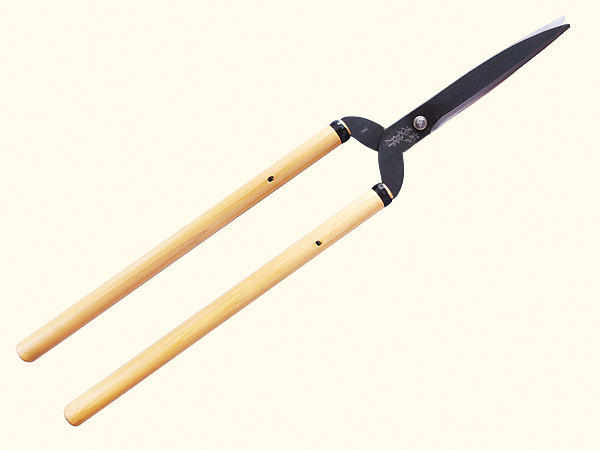
[Tobisho] Karikomi Shears Shojiro Kanto-type 210mm (8.3") Blade [TBS020201]

⚠️ Important Notice for 🇺🇸 US, 🇪🇺 EU, and 🇬🇧 UK Customers (View details)
Related Items
-

[Tobisho] Natural Cowhide Sheath for Karikomi Shears [TBS019930]
3,080JPY (not include VAT & TAX)
Not available
A Sheath for the Two-Handed Shear About Natural Cowhide Sheath for Karikomi Shears This sheath…
-
[NANIWA] Gouken Curved Water whetStone (#1000) [NNW010102]



1,650JPY (not include VAT & TAX)
Stock:94
Fine Whetstone (artificial, #1000), for pruning secateurs and all of curved edges. #1000 is medium f…
Item Description
The Sharper Choice for Practiced Hands
About the Karikomi Shears Series
Two-handed Karikomi shears sit apart from the rest of our pruning shear lineup. Where most pruning shears are made by specialist secateur blacksmiths, large hedge shears like these are traditionally the domain of ueki-basami (planting shears) blacksmiths, a different craft entirely. Tobisho makes both, each blade forged from Yasuki-produced Blue Paper steel (Aogami steel), the handle carved from magnolia obovata (honoki), a wood chosen for how well it takes and holds an oiled finish over years of use.
The two models here differ in how the blades meet. On the Yamagata-type, the blades don't fully cross when the shear closes, a built-in stopper limits the swing, so there's no risk of catching a finger between them. It's the gentler of the two to learn on, though plenty of professionals use it by choice, not just necessity. The Kanto-type has no such stopper; its blades cross fully and its handles run narrower and closer to parallel, trading that extra safety margin for more direct cutting power. Both blades carry a curve suited to shaping rounded and spherical forms, sliding through material cleanly enough that the bark isn't torn or bruised at the cut.
These shears are built for hedges and shaped shrubs generally, not tied to any one species. We've heard from customers overseas using them on hedges considerably older than the shop itself: a customer in the Netherlands wrote to us after using a Yamagata-type on two Buxus sempervirens (common boxwood) hedges, one planted in 1890, the other in 1920, describing the work as careful and slow, done over the better part of a week, and the shear as having handled it beautifully.
About Karikomi Shears Shojiro Kanto-type 210mm (8.3") Blade
The Kanto-type trades the Yamagata-type's built-in stopper for something else entirely: the two blades cross fully as the shear closes, and the handles sit narrower and nearer to parallel than on the Yamagata-type. That combination sharpens the leverage and the bite of the cut, this is the version many professional gardeners in Japan reach for once they're used to handling a two-handed Karikomi shear.
Because there's no stopper, the blades can close all the way, which calls for a slightly more deliberate hand than the Yamagata-type. It's not a shear we'd point a first-time user toward, it's the one experienced hands ask for once they know what they want from it.
This is by far the rarer of our two Karikomi models. Most people, even in Japan, have only ever seen or handled a Yamagata-type; the Kanto-type sees far more limited production.
If in stock, this shear ships within three business days. If not, allow up to three months, it's made to order.
How to Sharpen Karikomi Shears (Japanese Hedge Shears) on a Whetstone
This demonstration isn't Tobisho's own work. It's Shunsuke Manaka of Kisuke, a different Japanese blacksmith, sharpening one of his own Karikomi shears. We're including it here because the technique itself, how the two blades are brought back into contact, how the whetstone is worked along the edge, applies to two-handed Karikomi shears from any maker, Tobisho's included.
Note: The first half of the video covers repair work. If you're looking for everyday sharpening technique, use the chapter markers to skip to the second half.
*Subtitles available in 15 languages.
How to Maintain Your Tobisho Karikomi Shears
Can I use this on individual branches?
This shear is built for hedges and foliage, including the thin twigs that naturally get caught up in a hedge face, not for cutting a single thick branch cleanly. For that, use a bypass pruner.
How do I keep the blade in condition?
Wipe off resin and sap after use where you can. Oil and clean the blade regularly to prevent rust and blade separation, this is an Aogami (Blue Paper) high-carbon steel edge, not stainless, and it will rust if neglected.
Can I sharpen it myself?
Yes, on a whetstone, once cutting performance starts to decline. See the sharpening demonstration above for technique.
What if I drop it?
Handle with care. A blade-first drop risks chipping the edge.
Anything I shouldn't do?
Don't twist or lever the blade mid-cut, and don't use it on wire, rope, or anything that isn't plant material. Keep it out of reach of children.
About Tobisho: Four Generations of Pruning Shear Hand-Forging
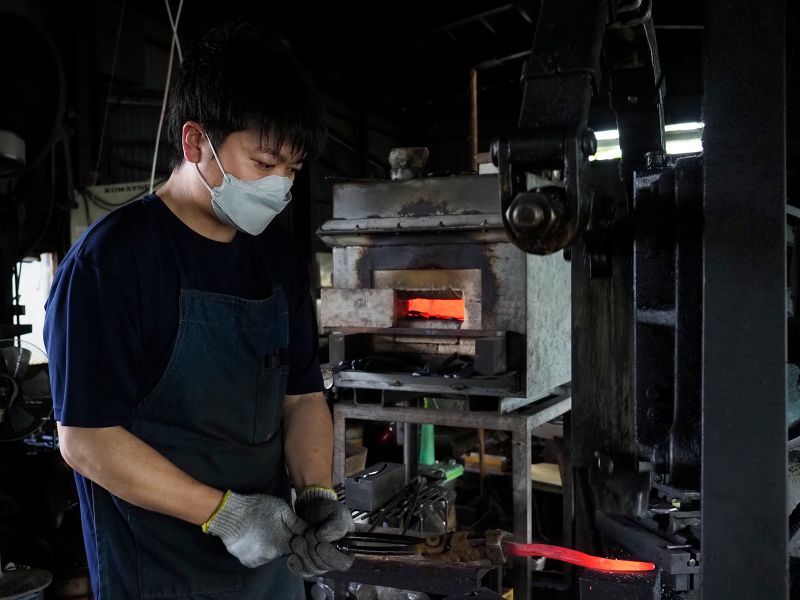
Tobisho has been forging blades in Yamagata since 1804, ten generations of blacksmiths, four of them dedicated to pruning shears. It was Syojiro Tobitsuka, the seventh-generation bladesmith in his family line, who founded Tobisho as a pruning shear forge in 1930, making him the first of four generations dedicated to shears.
Syojiro's shears served both the silkworm farmers already working the region and the orchardists who followed as Yamagata became one of Japan's great fruit-growing prefectures. The tools had to work. His name is still stamped on every Karikomi Shear Tobisho makes.
Generation by generation, the shears got better. What Tobisho is known for today, their heat treatment, their distinctive surface finish, is accumulated experience, made visible.
The late master Yasuhito Tobitsuka, third generation, developed the SR, the Hiryu, and the Asuka, and redesigned the A-type's handle. Daiki Tobitsuka, the fourth-generation master working at the forge today, has added the Hisui, the Hirei, and a Damascus steel A-type. His philosophy: "Cutting well is the baseline. Beyond that: simple and sturdy.", 質実剛健
Forging the Handle
Sharpening the Blade
Notes on use
IMPORTANT: This shear is made of Aogami Steel (High-Carbon Steel, Not Stainless Steel). It is exceptionally sharp but prone to rust if not maintained.
Do not twist or lever the blade during a cut.
Handle with care, blade-first drops risk chipping.
For two-handed use.
Designed for trimming hedges and foliage, including the thin twigs naturally caught up in a hedge, not for cutting individual thick branches.
Oil and clean regularly to prevent rust and blade separation.
Sharpen on a whetstone when cutting performance declines.
Do not use on wire, rope, or any non-plant material.
Keep out of reach of children.
💬 Story of This Model - By Shop Manager (Part 2 of 2)
Topic: Why Tobisho started making these at all.

Hiroshi Urata
Item Description
| Origin | Yamagata, Japan [TOBISHO] |
|---|---|
| Type | Gardening Tools > Scissors & Shears > Hedge Shears |
| Handedness | Right-Handed |
| Overall Length | 730 mm =28.74 inch |
| Edge Length | 165 mm =6.50 inch (From the center of a bolt to the top of edges) |
| Edge Material | Aogami steel No.2 (Blue Paper steel) |
| Handle Material | Magnolia obovata (Length : 445mm / 17.52") |
| Item Weight | approx.790g |
| Shipping Weight | approx.1250g (with leather sheath and shipping box, Including the difference in volume weight ) |
![Photo1: [Tobisho] Karikomi Shears Shojiro Kanto-type 210mm (8.3") Blade](https://www.tetsufuku.com/data/tetsufuku/product/20120826_bf25b0.jpg)
![Photo2: [Tobisho] Karikomi Shears Shojiro Kanto-type 210mm (8.3") Blade](https://www.tetsufuku.com/data/tetsufuku/product/20120826_a3477a.jpg)
![Photo3: [Tobisho] Karikomi Shears Shojiro Kanto-type 210mm (8.3") Blade](https://www.tetsufuku.com/data/tetsufuku/product/20120826_c12e4e.jpg)