
[Kanetaka] Right-Handed Kyoto Style Ueki-Basami 180mm (7.1") Shirogami No.2 [KNT090201]
![[Kanetaka] Right-Handed Kyoto Style Ueki-Basami 180mm (7.1") Shirogami No.2 — full view of blade and handle](https://www.tetsufuku.com/data/tetsufuku/product/20220218_6e48d6.JPG)



⚠️ Important Notice for 🇺🇸 US, 🇪🇺 EU, and 🇬🇧 UK Customers (View details)

Item Description
Your First Taste of a Kyoto Shears
About the Kanetaka Ueki-Basami Series
Traditional Japanese garden shears fall into four regional styles: Ohkubo, Tsushima, Kyo, and Sasuke. "Kyo" refers to Kyoto. Many products imitate the shape, but Kanetaka's shears here belong to the genuine Kyo style. Kanetaka, a Kyoto blacksmith with more than 350 years of history, is also a member of the Kyoto Hamono Association and works to protect and pass on this traditional style.
The pivot of Kyo-style shears carries a slight looseness. This is not a defect but a genuine feature, rooted in the Kyoto idea that with continued use, the pivot's core metal gradually shifts to match the habits of your hand — a process known as "the shears growing." Please do not retighten the pivot yourself.
These shears are also crafted with particular attention to the sound they make when cutting. As the lower part of the handles meet, a clear tone rings out, like two iron rods striking together. Even without being seen, that sound tells those nearby that someone is pruning. In traditional Japanese culture, there is an aesthetic of sensing, through the senses, what is happening even when it cannot be directly observed.
Ueki-Basami comes in two sizes: the 180mm Shirogami No.2, suited to general use, and the 215mm Aogami No.2, suited to professionals and experienced users.
About [Kanetaka] Right-Handed Kyoto Style Ueki-Basami 180mm (7.1") Shirogami No.2
This 180mm model is built for general use within the Ueki-Basami series. Professional gardeners use it too, but it suits soft branches, flowers, and grass better than thick, hard wood. Its shape is close to the Ohkubo style, with a slightly smaller build.
The blade is made of Shirogami No.2 (White Paper Steel), finished to a hardness that prioritizes ease of handling and sharpening. The handle is made of hard iron, giving it a sturdy build that lasts.
A belt hammer and grinder are used, but every step is finished entirely by hand. The forge welding and sharpening in particular reach a level of precision that only human hands can achieve.
Kyoto's tools have been refined over generations of dialogue between makers and the gardeners who use them, and this pair of shears carries on that accumulated history. Rather than a tool for heavy-duty professional work, this is a way to bring the tradition of the Japanese garden into everyday reach. If this is your first Kyoto shears, start here with this Shirogami No.2 version, and let it settle into your hand a little at a time.
How to Maintain Your Kanetaka Ueki-Basami Shears
Does it rust easily?
As a high-carbon steel, it can rust if left unattended. Wipe it down thoroughly after each use.
What if the edge starts to dull?
Sharpen it with a whetstone.
Any tips for making it last?
Applying edged tool oil will help it last longer.
About Kanetaka: A Kyoto Blacksmith with 350 Years of History
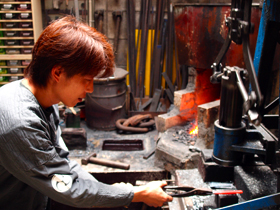
Kanetaka is a Kyoto blacksmith with a history spanning more than 350 years. By recorded lineage alone, it stands as a long-established house of seven generations, over 200 years.
The shop and workshop sit directly in front of the head family of Ikenobo, the founding school of Japanese flower arrangement. It is a blacksmith rooted in the same soil that has shaped Kyoto's tradition of flower arrangement.
Today, the eldest son, Kazuhiro Yamada, carries on the sharpening technique, while the second son, Yoshitaka Yamada, works as the blacksmith. Each brother handles a different stage of the process, and together they bring a single pair of shears to completion.
Alongside traditional items such as Japanese razors and Ikenobo scissors, made using techniques learned from specialists, Kanetaka also produces a range of idea goods, including herb clips, pencil sharpeners, and reed knives for wind instruments, building on traditional craftsmanship to create a broad range of tools.
Notes on use
Important: These shears are made of high-carbon steel, not stainless steel. They cut extremely well, but are prone to rust if not cared for.
Do not twist or lever the blades while cutting.
Dropping the shears can cause the blade to chip.
For right-handed, one-handed use.
If you are unsure how to hold it, please feel free to contact us before purchasing.
Do not use for cutting anything other than plant material, such as wire or rope.
Store out of the reach of children.
Item Description
| Origin | Kyoto, Japan [Kanetaka] |
|---|---|
| Type | Gardening Tools > Scissors & Shears > Traditional Japanese Garden Shears |
| Handedness | Right-Handed |
| Overall Length | 180mm = 7.09 inch |
| Edge Length | 58mm = 2.28 inch (From the tip of the blade to the fulcrum ) |
| Edge Material | Shirogami No.2 (White Paper Steel) |
| Handle Material | Iron (hard type) |
| Item Weight | 245g |
| Shipping Weight | 345g |
![Photo1: [Kanetaka] Right-Handed Kyoto Style Ueki-Basami 180mm (7.1") Shirogami No.2](https://www.tetsufuku.com/data/tetsufuku/product/20220218_b5c961.JPG)
![Photo2: [Kanetaka] Right-Handed Kyoto Style Ueki-Basami 180mm (7.1") Shirogami No.2](https://www.tetsufuku.com/data/tetsufuku/product/20220218_d940df.JPG)
![Photo3: [Kanetaka] Right-Handed Kyoto Style Ueki-Basami 180mm (7.1") Shirogami No.2](https://www.tetsufuku.com/data/tetsufuku/product/20220218_55a031.JPG)