
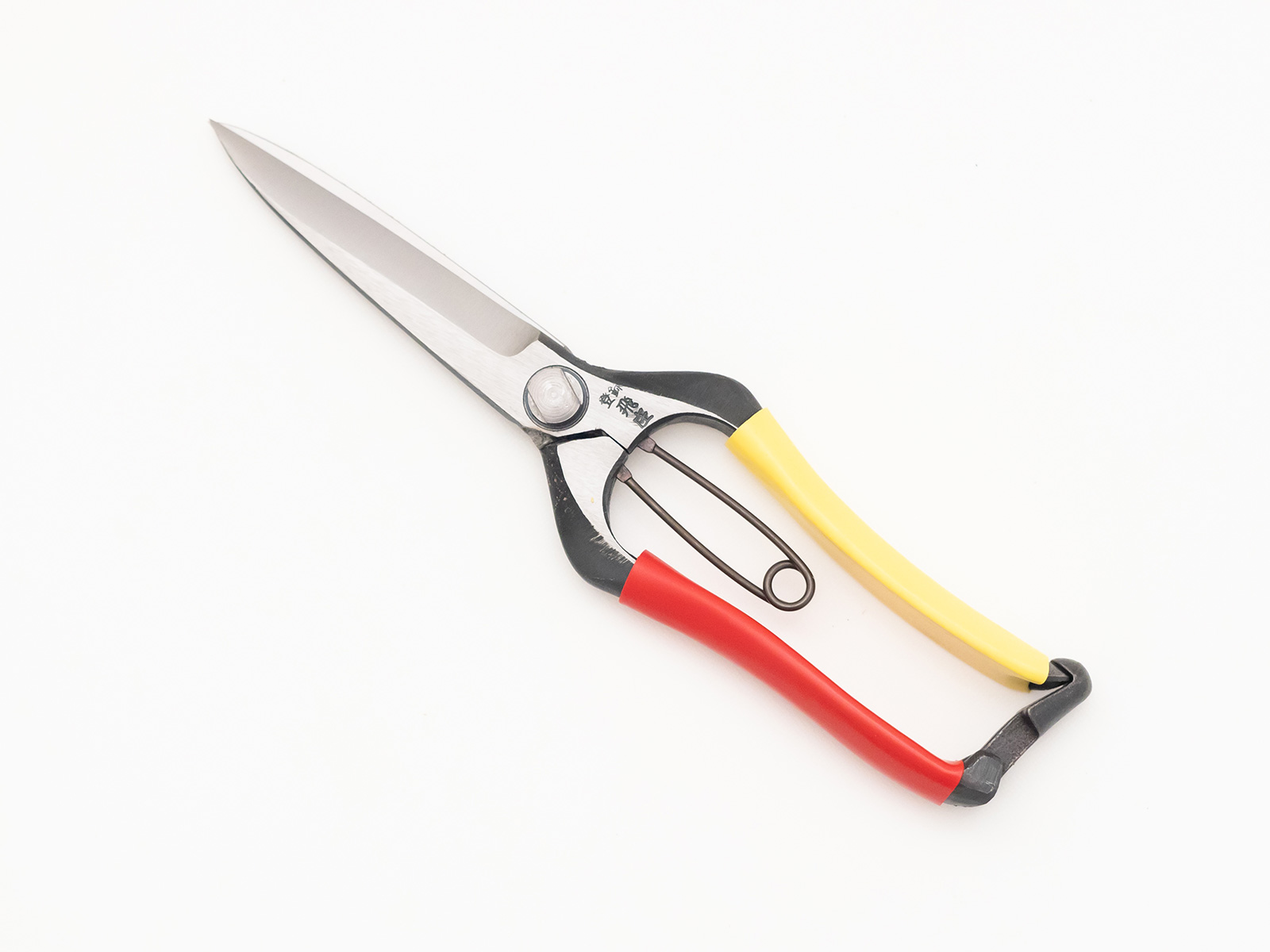
[Tobisho] Pine Needle Shears 230mm (9.1") Red & Yellow Taped Handle [TBS010701V]

⚠️ Important Notice for 🇺🇸 US, 🇪🇺 EU, and 🇬🇧 UK Customers (View details)
Related Items
-

[Tobisho] Natural Cowhide Sheath for 230mm (9.1") Pine Needle Shears [TBS019925]
3,080JPY (not include VAT & TAX)
Low stock
Sized for the Pine Needle Shears' Reach About Natural Cowhide Sheath for 230mm (9.1") Pine Needle…
-
[Tobisho] Replacement Spring (Size 7) for Standard Pruning & Bud Shears [TBS019903]
220JPY (not include VAT & TAX)
Stock:22
One Spring, Eleven Shears About Replacement Spring (Size 7) for Standard Pruning & Bud Shears …
-
[NANIWA] Gouken Curved Water whetStone (#1000) [NNW010102]



1,650JPY (not include VAT & TAX)
Stock:96
Fine Whetstone (artificial, #1000), for pruning secateurs and all of curved edges. #1000 is medium f…
Item Description
Precision That Holds Its Line
About the Pine Needle Shears Series
Despite the name, this isn't a tool for candling or needle-plucking, the hand techniques most often associated with pine care. This is a cutting shear, used for the short-leaf method (tanyoho), trimming elongated new needles back by roughly half to encourage denser, shorter growth, and for old-needle removal (furubatori), thinning out the previous year's needles from crowded interior branches to improve light and airflow.
Tobisho used to also make a dedicated 230mm single-handed Karikomi shear for general hedge work. That model has since been folded into this line: Pine Needle Shears now cover both roles, needle work on pines and other conifers, and general single-handed hedge and topiary trimming, in one shear.
The blade shape sets this apart from our double-bevel Topiary Shears, even though the two share nearly identical bodies and handles. Topiary Shears keep their width for roughly 80% of the blade's length before narrowing sharply near the tip, built for shearing across a broad leaf surface. This shear's widest point is at the base near the pivot, tapering gradually toward a narrower tip, built to slip into dense foliage rather than shear across it. That difference in profile is also what makes it useful well beyond pine: the pointed blade suits bonsai work broadly, and some gardeners use it for traditional pruning styles where the blade shape recalls older warabite-style shears such as the Okubo-gata.
About Pine Needle Shears 230mm (9.1") Red & Yellow Taped Handle
This is the same 230mm shear as our standard model, finished with our red and yellow vinyl taped handle in place of the black finish. Blade shape, weight, and cutting performance are identical, this version is a handle finish choice only.
Hold the shear with your index finger resting along the spine near the pivot, the rest of your fingers and palm wrapping around the handle. Rather than closing the blades in a single pinch, slide them forward slightly as you cut, a push-cut that lets the 230mm blade pass through even stiff pine needles with very little effort.
For old-needle removal, slip the blade in near the base of the needle and cut just above the hakama, the small sheath at the base, rather than pulling the needle out by hand, which can tear the bark. Left in place, the remaining stub dries and drops off naturally within a few months. Approach the needle from along the branch's own angle, not straight across it, cutting into it vertically or at a diagonal; a straight, sideways cut risks nicking the needles you mean to keep, leaving a browned cut edge.
Used as a single-handed hedge shear, this model favors keeping the lower blade steady, against the branch or braced in your grip, while the upper blade does the moving. Trying to move both blades evenly tends to wander off-line; letting one stay fixed keeps a straight or curved cut clean.
Tobisho designed this shear to hold up over long sessions: removing steel from areas that don't carry load, and controlling how far the handles open, so it doesn't tire the hand under repeated use. This model is available only at 230mm, and is right-handed only.
How to Maintain Your Tobisho Pruning Shears
Can I use this on a branch?
No. This shear is built for pine needles and thin, dense foliage, not for cutting branches, of any thickness. It has no cutting margin for woody material, forcing a branch through it risks bending the blade or damaging the pivot. For branches, use a bypass pruner or a single-bevel shear instead.
How do I keep the blade in condition?
Wipe off resin after every use, ideally. Resin buildup gradually forces the blade trajectory outward, the two cutting edges stop meeting cleanly, and the pivot bolt begins to wear along that same outward path, compounding the problem. If wiping after every use isn't practical, clean the blades regularly. Carrying a small cloth and blade cleaner means you can do it on a break.
How do I lubricate the pivot?
Ideally, remove the bolt periodically and pack grease inside, grease holds longer than oil. That said, this requires skill and confidence to do correctly. A practical alternative: one drop of oil on the pivot once a month. It's not the full solution, but it keeps things running smoothly.
Can the shear get wet?
Avoid it where possible, and never leave the shear wet. After working in rain or morning dew, wipe it dry thoroughly. The pivot area retains moisture longest, use a blower or compressed air if you have one. Regular oiling helps here too: a well-oiled blade sheds water rather than holding it.
What if I drop it?
It depends on how and where it lands. A handle-first drop can bend the handle, affecting feel and the locking mechanism. A blade-first drop risks chipping. As a general rule: the sharper the blade, the harder and more brittle the steel, and the thinner the edge. Handle forged Japanese blades accordingly.
Can I sharpen it myself?
Yes, if you understand the blade geometry and have the skill. Sharpening scissors is significantly harder than sharpening knives: you are managing the contact between two blades, and as you sharpen, the blade face recedes, which can cause the edges to lose contact. If you are confident, sharpen only the face of each blade, never the inner flat side. When the blades stop meeting cleanly despite sharpening, that is the point to send it back to the maker. If you are not confident, leave it to a professional. A blade sharpened incorrectly is harder to recover than a dull one.
About Tobisho: Four Generations of Pruning Shear Hand-Forging
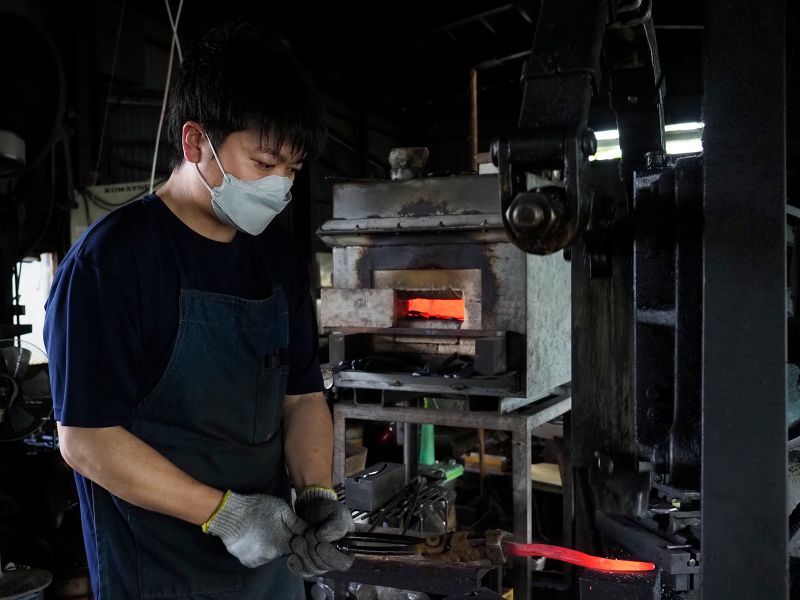
Tobisho has been forging blades in Yamagata since 1804, ten generations of blacksmiths, four of them dedicated to pruning shears. It was Syojiro Tobitsuka, the seventh-generation bladesmith in his family line, who founded Tobisho as a pruning shear forge in 1930, making him the first of four generations dedicated to shears.
Syojiro's shears served both the silkworm farmers already working the region and the orchardists who followed as Yamagata became one of Japan's great fruit-growing prefectures. The tools had to work. His name is still stamped on every Karikomi Shear Tobisho makes.
Generation by generation, the shears got better. What Tobisho is known for today, their heat treatment, their distinctive surface finish, is accumulated experience, made visible.
The late master Yasuhito Tobitsuka, third generation, developed the SR, the Hiryu, and the Asuka, and redesigned the A-type's handle. Daiki Tobitsuka, the fourth-generation master working at the forge today, has added the Hisui, the Hirei, and a Damascus steel A-type. His philosophy: "Cutting well is the baseline. Beyond that: simple and sturdy.", 質実剛健
Forging the Handle
Sharpening the Blade
Notes on use
IMPORTANT: This shear is made of High-Carbon Alloy Steel (Not Stainless Steel). It is exceptionally sharp but prone to rust if not maintained.
Designed for pine needles and thin, dense foliage. Not suited to cutting branches; use a bypass pruner or single-bevel shear instead.
Do not twist or lever the blade during a cut.
Handle with care, blade-first drops risk chipping.
For one-handed use only. Right hand.
Oil and clean regularly to prevent rust and blade separation.
Do not use on wire, rope, or any non-plant material.
Keep out of reach of children.
💬 Story of This Model - By Shop Manager (Part 2 of 3)
Topic: A pointed blade versus a broad one.

Hiroshi Urata
Item Description
| Origin | Yamagata, Japan [TOBISHO] |
|---|---|
| Type | Gardening Tools > Scissors & Shears > Pine Needle Shears |
| Handedness | Right-Handed |
| Overall Length | 230 mm = 9.06 inch |
| Edge Length | 103 mm =4.06 inch (From the center of a bolt to the top of a blade) |
| Construction | Integrally Forged |
| Edge Material | Premium Blade Steel (undisclosed grade) |
| Handle Material | Premium Blade Steel (undisclosed grade) |
| Item Weight | approx.240g |
| Shipping Weight | approx.310g (incl. box & packaging) |
![Photo1: [Tobisho] Pine Needle Shears 230mm (9.1") Red & Yellow Taped Handle](https://www.tetsufuku.com/data/tetsufuku/product/20221021_0176d3.jpg)
![Photo2: [Tobisho] Pine Needle Shears 230mm (9.1") Red & Yellow Taped Handle](https://www.tetsufuku.com/data/tetsufuku/product/20221021_b09837.jpg)
![Photo3: [Tobisho] Pine Needle Shears 230mm (9.1") Red & Yellow Taped Handle](https://www.tetsufuku.com/data/tetsufuku/product/20221021_5a8940.jpg)