
[MINAMOTO-IZUMIMASA] Yanagiba hocho 240mm For home use [MIM150102]
![Photo1: [MINAMOTO-IZUMIMASA] Yanagiba hocho 240mm For home use (1)](https://www.tetsufuku.com/data/tetsufuku/product/20130301_a414c2.jpg)

⚠️ Important Notice for 🇺🇸 US, 🇪🇺 EU, and 🇬🇧 UK Customers (View details)
Related Items
-

[MINAMOTO-IZUMIMASA] Yanagiba hocho 210mm For home use [MIM150101]

12,100JPY (not include VAT & TAX)
Stock:3
This item is not eligible for shipping to the UK. We can only ship knives with blades under 200mm. …
-
[KANETAKA] Medium-rough Whetstone (artificial, #800, for medium or large edges) [KNT060202]
13,200JPY (not include VAT & TAX)
Low stock
Medium-rough Whetstone (artificial, #800, for medium or large edges)
-
[KANETAKA] Fine Whetstone (artificial, #4000, for medium or large edges, with a table) [KNT060302]
9,900JPY (not include VAT & TAX)
Low stock
Fine Whetstone (artificial, #4000, for medium or large edges, with a table)
Item Description
This item is not eligible for shipping to the UK. We can only ship knives with blades under 200mm.
This kitchen knife is made by forge welding soft iron and White paper No.2 steel in traditional way. 240mm Yanagiba hocho is slightly smaller than the size which a professional Japanese cook uses. There is no problem in the case of cooking the general size. However, it is recommended 270mm or 300mm If you are cooking a large fish or cook in earnest. This is the best also for professional 2nd Yanagiba hocho.
This kitchen knife is making the body in a traditional way that is bonded to soft iron and steel. White paper No.2 steel is very hard, so you can cut well. Simply because it is a general manufacturing method, you will notice that the technical capabilities of MINAMOTO-IZUMIMASA is stand out.
It is edged many times in the manufacturing process, this knife is to remove the distortion many times. Blade straight, and even more attractive your food thoroughly.
What is "Haze Polish"? The haze is a border of soft iron and steel. It will appear by sharpen perfectly the body that has been forged in the forge welding and high technology. Haze Polish is a designation given to only the more technical and beautifully.
For example use a white steel material, these knives will have a performance very close to the kitchen knife for professional. However, finish is simplified sharpening and distortion removal compared with kitchen knife for professional. You can experience the performance of MINAMOTO-IZUMIMASA.
After receiving an order, in order to produce, it will be necessity about 15 days for longest to send.
How to sharpen your Yanagiba (Sashimi or sushi) chef knife on a whetstone.
| Product List of MINAMOTO-IZUMIMASA | ||||
|---|---|---|---|---|
| Product name | Edge material | Base material | Finish | Handle material |
| Mirror and cherry | White paper steel No.2 | Mirror Polish | Octagon / Ebony | |
| All blue paper with mirror | Blue paper steel No.2 | Mirror Polish | Octagon / Ebony | |
| All white paper | White paper steel No.2 | Hon-yaki Polish | Octagon / Magnolia | |
| Blue paper 16 or 32 layer | Blue paper steel No.2 | Soft iron & steel | Genuine Haze Polish | Octagon / Ebony |
| Blue paper foged | Blue paper steel No.2 | Soft iron | Genuine Haze Polish | Octagon / Magnolia |
| White paper foged | White paper steel No.2 | Soft iron | Genuine Haze Polish | Round / Magnolia |
| For home use (This product) |
White paper steel No.2 | Soft iron | Haze Polish | Round / Magnolia |
| SAVIN | V10 GOLD (Stainless) | SUS440 | Genuine Haze Polish | Octagon / Magnolia |
| Silver paper foged | Silver paper steel No.3 (Stainless) |
Stainless | Genuine Haze Polish | Octagon / Magnolia |
About a maker, MINAMOTO-IZUMIMASA = Matsuo edges factory ( SAKAI, OSAKA pref )
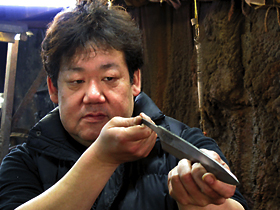 MINAMOTO-IZUMIMASA is a brand name of Matsuo edges factory that is in SAKAI, OSAKA pref. Sakai is a kitchen knife producing area famous in the world. Among the factory of the Sakai, technology MATSUO edges blacksmith is especially good. Prominent cutlery store in Japan is coming to purchase a large number. Therefore, It is a blacksmith and grinder that is selected to chef of Japanese cuisine.
The top of master name is Yoshiaki Matsuo (photo). His skills gained from long experience are used in high-grade products. Kyohei Matsuo and Tsubasa Matsuo are Yoshiaki's cousin. They are also masters of kitchen knife griding.
* MATSUO edges factory has still a repertoire of size and material. If you want another material or another size, please let me know your request.
How to Sharpen a Single-Bevel Knife
This video shows how Tsubasa Matsuo sharpens a deba knife. It serves as a practical reference for sharpening single-bevel knives of any style and from any maker. A Japanese knife cannot truly perform until it has been properly sharpened, please watch and give it a try.
This is everyday maintenance sharpening, not the more intensive process used when finishing a knife for sale.
* Subtitles available in 15 languages.
Key steps for sharpening a deba knife
Before sharpening, carefully inspect the condition of the blade.
Make sure the whetstone surface is flat.
Front: rough whetstone to restore blade geometry, then a medium whetstone to establish the edge. Matsuo Hamono adds one additional whetstone between the rough and medium grades.
Back: medium whetstone to remove the burr.
Finish: raise the front slightly and sharpen to create a micro-bevel, then wipe the blade two to three times with a cloth.
One step unique to Matsuo Hamono: at the very end, the edge is tested against the craftsman's own hair. It's also worth watching for the posture, body mechanics, and working habits of a professional sharpening workshop.
Demonstrated by Tsubasa Matsuo of Matsuo Hamono Co., Ltd. (Izumimasa), Sakai, Osaka.
How Izumimasa Makes a Knife
In Sakai, the crafts of forging, sharpening, and handle-fitting are each handled by separate specialists. Among them, the sharpener acts as the producer of the finished product, responsible for the final edge and accountable to the customer for everything. This video captures the process by which Izumimasa takes a forged knife blank and sharpens it into a finished product ready for use.
Matsuo Hamono, founded in the Meiji era (1906), operates under the registered trademark Izumimasa, supplying knives to professional kitchens, hotels, ryokan, restaurants, and kappo dining, both in Japan and abroad. Working across large rotating whetstones and changing grit as he goes, master sharpener Tsubasa Matsuo's most critical task is eliminating morā, microscopic irregularities in the flat of the blade that affect both sharpness and ease of future sharpening. Training the eye and fingertips to detect and correct these invisible imperfections alone takes years. Between passes on the whetstone, he repeatedly holds the blade up to check that the edge runs perfectly straight.
From machine grinding to hand finishing, the knife becomes something new at each stage. At the very end, Matsuo tests the finished edge against his own hair, a method unique to Matsuo Hamono, where the craftsman's own body becomes the final instrument of quality control.
Demonstrated by Tsubasa Matsuo of Matsuo Hamono Co., Ltd. (Izumimasa), Sakai, Osaka.
The notes on use about Yanagiba hocho 240mm For home use [MINANMOTO-IZUMIMASA]
* Please do not twist.
* This kitchen knife has been optimized to work to slice raw fish. (Can be meat that contains no bone)
* It rusts for a steel part. Please wipe after use well.
* Please grind with a whetstone, if it becomes difficult to cut.
* If edged tool oil is applied, it will last long more.
Item Description
| Origin | Sakai, Japan [MINAMOTO-IZUMIMASA = MATSUO edges factory] |
|---|---|
| Type | Kitchen & Dining > Japanese Kitchen Knives > Yanagiba (Sushi) Knives |
| Handedness | righthand |
| Overall Length | about 380mm = 14.96 inch |
| Edge Length | 240mm = 9.45 inch |
| Material | Soft iron |
| Edge Material | White paper steel No.2 |
| Handle Material | Magnolia |
| Item Weight | 135g |
| Shipping Weight | 250g |
![Photo1: [MINAMOTO-IZUMIMASA] Yanagiba hocho 240mm For home use](https://www.tetsufuku.com/data/tetsufuku/product/20130301_481563.jpg)
![Photo2: [MINAMOTO-IZUMIMASA] Yanagiba hocho 240mm For home use](https://www.tetsufuku.com/data/tetsufuku/product/20130410_3f7166.jpg)